Let me guess. You published a bunch of blog posts last quarter. You optimized every title tag, hit your keyword density, and even built a few backlinks. Then you ask ChatGPT a question your product perfectly answers… and your competitor shows up. You don’t.
I’ve been there. That feeling in your gut isn't you failing at SEO. It's a signal that the rules changed while we were all busy playing the old game.
This isn't another vague "AI is coming" post. I'm going to walk you through exactly what changed, what it means for a lean SaaS team like yours (and mine), and how to rebuild your content playbook so AI systems cite you as the source. Not the company that outspent you on content two years ago.
The core shift is this: traditional SEO for the rank-click-convert funnel is breaking. AI rewards content that’s ridiculously easy to extract, clearly structured, and tied to a credible source. The founders who win this next round won't be the ones who game the algorithm. They'll be the ones who make it effortless for the AI to trust and quote them.
The uncomfortable truth: your “rank → click → convert” funnel is breaking
The funnel we all built was logical: rank on page one, get the click, and convert that traffic into trials. It’s a model that assumes users actually browse a list of search results. But a growing number of them don't anymore. They just ask an AI and take the first confident answer they get.
What “zero-click” really means for SaaS discovery
Zero-click search isn’t some new boogeyman. We’ve been losing clicks to featured snippets for years. AI overviews and conversational search are just the next evolution. When someone asks "what's the best tool for X" inside ChatGPT, Perplexity, or Google's AI search, they often get a neat, synthesized answer and move on. No click. No visit to your site. No entry into your funnel.
For us founders, this is a discovery crisis. If your brand isn't in that synthesized answer, you're invisible at the exact moment a potential customer has their highest intent. These are impressions you can't even see, lost to a conversation you weren't invited to. It’s a painful blind spot.
The new goal isn’t ranking—it’s being the source the answer is built from
This reframe is everything. Your goal is no longer "rank #1 for this keyword." It's "be the authoritative source an AI reaches for when this topic comes up."
That requires a different kind of content. It’s less about keyword frequency and more about being structured, credible, and specific. You want a model to be so confident in your explanation that it lifts it wholesale and attaches your name to it.
Citations in AI answers are the new top-of-funnel. Brand mentions are the new backlinks. That's the game now.
SEO vs AEO vs LLM SEO: what changes, what stays, and what founders should prioritize
This is where most of the advice out there gets fuzzy. Everyone says "SEO still matters, but also optimize for AI," without telling you what to actually do on a Tuesday afternoon when you have a million other things on your plate.
Definitions that actually help in practice (SEO, AEO, GEO, LLMO)
Let’s cut through the jargon.
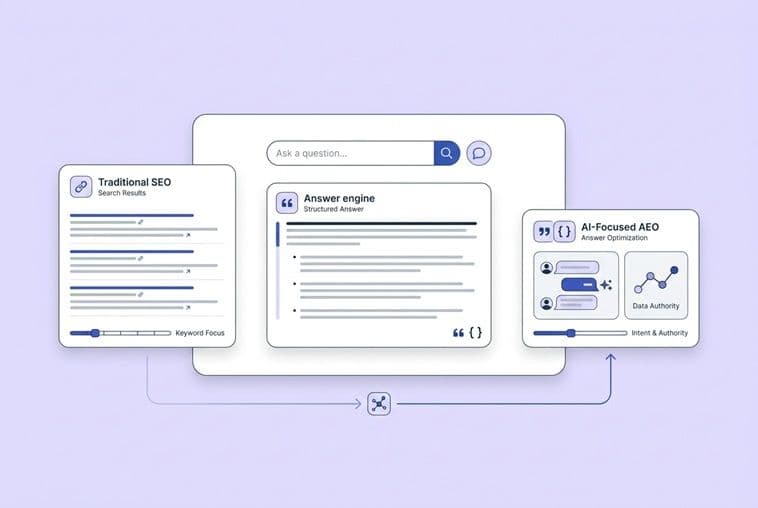
SEO (Search Engine Optimization): This is about getting your pages to rank in a traditional list of search results. It’s all about keywords, backlinks, and site health. SEO is still foundational because these signals feed the systems AI uses.
AEO (Answer Engine Optimization): This is about structuring your content so AI assistants can easily extract, quote, and cite it. The prize isn't a ranking; it’s getting included in a generated answer.
GEO (Generative Engine Optimization) / LLMO (Large Language Model Optimization): These are broader terms for getting your brand visible across all AI outputs. This is the long game of teaching models that your brand is an authority on certain topics.
For founders, it boils down to this: SEO is your infrastructure. AEO is how you package what sits on that infrastructure. GEO/LLMO is the long-term goal of becoming a trusted brand in the AI ecosystem. You need all three, but your most urgent job is AEO.
A founder-friendly comparison table: inputs, outputs, metrics, and effort
When I was trying to get my head around this, I found it helpful to map it out. Maybe this will help you too.
| Dimension | SEO | AEO | GEO/LLMO |
|---|---|---|---|
| Primary input | Keywords + backlinks | Structured answers + schema | Brand mentions + authority signals |
| Primary output | Rankings + organic clicks | Citations in AI answers | Model-level brand recognition |
| Key metric | Organic sessions, rankings | Citation frequency, referral traces | Brand mention volume, unlinked mentions |
| Time to results | Weeks to months | Weeks to months | Months to years |
| Founder effort | Medium (ongoing) | Medium (restructure + cadence) | Low-medium (systematic, not heroic) |
| What breaks without it | Traffic | AI discovery | Long-term model trust |
The key takeaway here is that AEO doesn't replace SEO. It just changes how you package the output of all that hard work.
The “keep / upgrade / stop” list for your old SEO playbook
Here’s a simple list to help you reprioritize without throwing everything out.
Keep:
- Technical site health (crawlability, site speed, clean indexing). This is non-negotiable.
- A solid internal linking structure.
- Publishing consistently on topics where you have real, genuine expertise.
- Writing long-form, in-depth content instead of thin, surface-level posts.
Upgrade:
- Keyword research → fan-out query mapping (I’ll explain this in a bit, it’s a game-changer).
- Generic intros → answer-first openings. Get to the point.
- Body copy for humans → body copy for both humans and extraction bots.
- Ignoring Bing → actively submitting to Bing Webmaster Tools. Seriously.
Stop (or seriously deprioritize):
- Publishing AI-generated content without a strong point of view or expert validation. We’ve all been tempted, but models are getting good at spotting their own hollow sludge.
- Chasing keywords you have no business trying to win.
- Writing "ultimate guides" that are a mile wide and an inch deep.
- Measuring success only by how many sessions you get.
This is an operational shift. It means tightening the loop from research to structured outlining to citation-ready formatting. You need to stop jumping between a bunch of tools where you lose context along the way.
How AI systems choose what to cite (in plain English)
To get cited, you need to understand the two ways an AI might know about your brand. Once you get this, your priorities become much clearer.
Pathway 1: long-term memory (training-data presence) and brand signals
Language models are trained on huge amounts of text from across the internet. If your brand, your perspective, and your content show up all over that training data (think blog posts, press mentions, community discussions), the model "knows" you. It's more likely to mention you without being prompted.
This is why unlinked brand mentions are so valuable. A Reddit thread where someone recommends your tool, a newsletter that references your framework, a podcast transcript where someone uses your term. All of these things build the pattern recognition that tells a model your brand is an authority. You can't control the training data, but you can definitely influence how often you show up on the web.
This is also where E-E-A-T (experience, expertise, authoritativeness, trustworthiness) comes in. Author bylines, detailed About pages, and your founder LinkedIn presence all feed into a model’s perception of your credibility.
Pathway 2: live retrieval (Bing-powered discovery) and crawlability
AI search tools like Perplexity and Microsoft Copilot use real-time retrieval. They actively crawl the web to find current, relevant sources for their answers. This is where your classic technical SEO is still critical.
If your pages aren’t indexed in Bing, AI tools that use its retrieval system will never find you. Full stop. If your content is buried in complex JavaScript that bots can't figure out, it might as well not exist. If your robots.txt file accidentally blocks AI crawlers, you’ve opted out of the game.
The practical takeaway here is huge: Bing Webmaster Tools is not optional anymore. Go submit your sitemap. Verify your site. It takes thirty minutes and it's probably the single highest-leverage technical task you haven't done yet.
What “structured, semantically rich” content means operationally
"Semantic depth" sounds like something from a PhD thesis. In practice, it just means writing content that fully answers a question, not just vaguely touches on the topic. Use clear headings that say what each section does. Define your terms. Use specific examples. Write each section so it makes sense on its own.
AI systems don't read pages; they pull passages. If every section of your article could stand alone and still be useful, then each section becomes a potential citation. That’s a fundamentally different structure from a flowing narrative that only makes sense from start to finish.
The AEO page formula: make your content easy to extract, quote, and trust
This is the tactical core of AEO. Most content is written to be read by a person. AEO-optimized content is also written to be sampled by a machine. It needs to make sense even when plucked out of context.
Write “answer-first” sections (definitions, direct responses, then nuance)
Every section should open with the answer, not the wind-up. If your H2 is "What is fan-out querying?" the first sentence should be a direct definition, not "That’s a great question. To understand it, we first have to look at the history of search..."
The pattern is simple: direct answer → one supporting sentence → then nuance, examples, or caveats. This mirrors how AI assistants like to present information. If your content is already in that shape, it's easy for them to grab it.
This doesn't mean dumbing things down. Your expertise shines in the nuance and specificity you provide after the direct answer.
Use citation-ready formatting (self-contained paragraphs, lists, tables)
Here's a practical checklist. Run your content against it to make it retrieval-friendly.
- Does each H2/H3 section answer a specific question?
- Does the first sentence of each section give the core claim or definition?
- Are you using lists for things that are actually lists (like steps, options, or criteria)?
- Do you have comparison tables for any "X vs Y" decisions?
- Are your paragraphs short and focused on one idea (3-5 sentences is a good rule of thumb)?
- Are you defining your terms explicitly? Don't assume everyone knows your jargon.
- Do your images have descriptive names and clear captions?
- Do you have takeaways or summaries at the end of complex sections?
When you build this into your drafting process, you're not trying to bolt on structure later. Your content is born retrieval-ready. This is the kind of stuff some content tools are starting to build in, which saves a ton of time.
Schema that matters most (and how not to overdo it)
Schema markup is just code that helps AI systems understand your content. It’s easy to get lost in all the options, but as a busy founder, you only need to focus on a few.
Start with these:
- Article schema for your blog posts.
- FAQPage schema for any page with a Q&A section (this is gold for getting into AI Overviews).
- HowTo schema for step-by-step guides.
- Organization schema on your homepage to establish your brand.
- Person schema on author pages to build those E-E-A-T signals.
Use the JSON-LD format and put it in the head of your HTML. You can check your work with Google's Rich Results Test. Just don't add schema for content that isn't actually on the page. It's a signal, not a magic trick.
Freshness signals without constant rewrites
AI retrieval favors current content, but that doesn't mean you have to rewrite every article each month. Just be smart about it. Keep your "last modified" dates accurate (update them when you actually update the content), refresh old examples, update stats, and add FAQ sections to existing posts.
Here’s a realistic cadence for a lean team: review your top 10 pages quarterly. Pick the three that are most outdated and give them a refresh. It’s less work than writing a new post and often delivers more value.
Fan-out queries: the hidden question map that determines whether you get included
This was a game-changer for me. When someone asks an AI "How do I reduce churn for my SaaS?" the model doesn't just search for that exact phrase. It breaks the question down into a bunch of sub-queries, which I call fan-out queries. It then finds sources for each of those. If your content answers several of them well, you have a much better shot at being included in the final synthesized answer.
What fan-out looks like for founders (a simple example tree)
Let's take the query "What is AEO?" The fan-out might look something like this:
- What is answer engine optimization?
- How is AEO different from SEO?
- What is an answer engine?
- Why do AI search results look different?
- How do I optimize content for AI?
- What schema helps with AEO?
Each of those is a target. A single page that covers several of these in a structured way is far more powerful than a page that only addresses the top-level question.
A practical workflow to discover fan-out queries
You don't need some crazy expensive tool for this. Here’s a quick-and-dirty manual workflow:
- Start with your core topic. Like "reducing SaaS churn" or "onboarding best practices."
- Ask the question in ChatGPT or Perplexity. Look at the sub-questions it brings up in its answer.
- Check "People Also Ask" on Google. Expand those boxes. The questions inside are a goldmine.
- Use Google autocomplete. Type your keyword and see what suggestions pop up.
- Cluster the questions. Group them by theme: definitions, comparisons, how-to's, etc.
- Map each cluster to a section in your article outline.
This process turns a vague topic into a concrete, structured plan for a piece of content that’s built for AI retrieval from the ground up.
Turning fan-out into an outline that AI can navigate
Once you have your question clusters, your outline is basically a map of your coverage. Each H2 can target a cluster, and each H3 can target a specific sub-query.
Here's the test for a good outline: if someone landed directly on an H3 section, would they get a complete, useful answer without having to read the rest of the article? If the answer is yes, that section is ready for extraction.
Technical essentials (especially if your site is JS-heavy)
You don't need to be an engineer to get this right, but you absolutely cannot ignore it. I've seen too many great content strategies fail because of a simple technical oversight.
Bing Webmaster Tools: the fastest “do this today” setup
Go to Bing Webmaster Tools. Add your site. Verify it. Submit your XML sitemap. Done. This takes 30 minutes and ensures Bing's crawler, which feeds Microsoft Copilot and many other AI tools, can actually find your content. Most founders I know have never done this. It's free value waiting to be claimed.
Once you’re set up, check your index status and crawl errors weekly for the first month. Don't assume that because you're good on Google, you're good on Bing.
Crawlability for AI: robots, rendering, and “can the bot see the text?”
AI crawlers like GPTBot and PerplexityBot listen to your robots.txt file. Check yours. It’s shockingly common to find an old Disallow: / rule from a staging site that accidentally made it to production, effectively locking out all bots.
A quick checklist:
- Open your
robots.txtfile (yourdomain.com/robots.txt) and look for overly broadDisallowrules. - Use Google's URL Inspection tool to see how Google renders your page.
- Try visiting your key pages with JavaScript disabled in your browser. If all the content disappears, you have a problem.
If your content is client-rendered: realistic options from quickest to best
If your marketing site is a React or Vue app where the content only appears after JavaScript runs, bots might just be seeing a blank page. Here are your options, from fastest to best.
- Quick mitigation: For your most important pages, just export them as static HTML files and serve them at the correct URLs. It’s not pretty, but it gets your content indexed now.
- Better: Implement static site generation (SSG) for your marketing content. The pages are pre-rendered into HTML. Most modern frameworks support this.
- Best: Use server-side rendering (SSR). This is more work but ensures that crawlers always see a fully rendered, up-to-date page.
Start with your ten most important pages. Don't wait for a full rebuild to start making progress.
Build authority when you’re small: brand mentions as an AEO growth lever
Getting mentioned across the web is how you build authority and visibility in the AI era. Models learn from patterns. If your brand name keeps showing up next to a specific topic across different credible sources, that connection gets baked into the model.
What kinds of mentions tend to matter (and why unlinked still counts)
We’re talking about mentions that show real, third-party validation. Things like:
- Community recommendations: A user on Reddit or in a niche Slack group suggests your product. This is pure gold because it’s organic and contextual.
- Expert citations: An expert in your field references your work or your company in their newsletter or on a podcast.
- Press and media coverage: Mentions in industry publications.
- Partner content: Co-marketing with other non-competing companies in your space.
Unlinked mentions matter because models parse the text, not just follow the links. The signal is the association between your brand name and a topic. The more times that association appears, the stronger it gets.
A lightweight “mention engine” founders can run monthly
You don't need a big PR agency. You just need a simple, repeatable system.
- Participate Helpfully: Spend 30 minutes a couple of times a week in relevant online communities. Don't just drop links. Answer questions. Be helpful. Mention your tool only when it's a direct, honest answer to someone's problem.
- Build a "Partner Cites" Program: Find 10 non-competing companies that serve a similar audience. Offer to trade citations. You reference their work, they reference yours. Make it easy for them by sending over a list of your best citable assets.
- Offer "Data for a Mention": Run a simple survey of your users. Publish the findings. Then, offer the unique data to journalists and newsletter writers. They get a fresh stat, you get a mention.
How to reuse one asset to earn multiple mentions
Don't let your content die after you hit publish. Take one strong "pillar answer" and atomize it.
- The Core Asset: The in-depth, AEO-structured article you wrote.
- The Diagram: Pull a key framework out of the article. Share it on LinkedIn and Twitter.
- The Data Point: Extract one compelling stat. Pitch it to newsletters.
- The Template: If the article describes a process, create a simple downloadable checklist.
One asset can easily become five opportunities for a mention, amplifying its reach and reinforcing your authority.
Measurement for the AI era: prove progress without relying on clicks
If you’re not just chasing clicks anymore, what should you measure? You need a new scoreboard that reflects your AEO goals. This means shifting from easy-to-track clicks to signals that are a bit fuzzier but much more valuable.
The new scoreboard: citations, mentions, referral traces, and query coverage
- Citation Frequency: How often does your brand or domain get cited in AI answers for your target queries? This is your new North Star metric. You can start by manually tracking this in a spreadsheet.
- Unlinked Brand Mention Volume: Use a tool like Google Alerts to track how often your brand is mentioned online. Is the volume growing? Is it in the right context?
- Referral Traffic from AI: Check your analytics for referrals from domains like
chat.openai.comorperplexity.ai. These are people who clicked a citation. - Query Coverage: Keep track of your target fan-out queries in a spreadsheet. Your goal is to turn that map green by creating high-quality, citation-ready answers for each one.
A simple monthly AEO review: what to check and what actions follow
Hold a one-hour meeting each month to review the new scoreboard and decide what to do next.
- Audit: Spot-check your top 10 queries in 2-3 different AI chat tools. Are you cited? Is a competitor?
- Refresh: Based on the audit, pick one high-value page that should be getting cited but isn't. Schedule it for an AEO refresh.
- Expand: Find one fan-out query cluster where you have no content and greenlight a new article.
- Mention Sprint: Review your mention goals. Did you hit them? Set a new goal for next month.
This creates a tight feedback loop between what AI is saying and what you're publishing.
Vendor/tool evaluation questions (so you don’t buy “AI SEO vaporware”)
As new AEO tools pop up, you need to be a skeptical buyer. Ask vendors these questions to cut through the buzzwords:
- How do you define and measure an "AI citation"? Show me the data.
- How does your tool help me find the fan-out queries AI systems are using?
- How does your workflow help my team create structurally better content for extraction?
- How do you track changes in AI answers over time for a given prompt?
- Do you differentiate between brand presence in training data versus live retrieval results?
A good tool gives you a better workflow and new data, not just a pretty dashboard.
A realistic 30-day shift plan for founders (minimum viable AEO)
This isn't about rewriting your entire content strategy overnight. It's about a targeted shift. Here’s how to get started in one month, even when you're swamped.
Week 1: Choose topics that can win answers (not just rankings)
Your goal is to find a topic where you have deep expertise and the current AI answers are generic or just plain wrong.
- Action: Identify 3-5 core customer questions your product helps solve. Ask them in ChatGPT, Perplexity, and Google's AI Overview.
- Analysis: Where are the answers weak? Where do they miss the nuance that you understand?
- Decision: Pick ONE question where the gap between the AI's answer and your expertise is biggest. That's your first pillar answer.
Week 2: Publish 1 “pillar answer” + 3–5 fan-out sections
Now, build one comprehensive, extraction-ready asset.
- Action: Use the fan-out query workflow to find 3-5 key sub-questions.
- Drafting: Write the article. Your core topic is the H2, and each fan-out query is an H3. Use the AEO page formula: answer-first sections, clean formatting, and clear definitions.
- Publish: Get it live. Don't chase perfection; just get the structure right.
Week 3: Add structure (schema/FAQ) + refresh pass + internal linking
Make the asset from Week 2 machine-readable.
- Action: Add
FAQPageandArticleschema to your new post. - Refresh: Add a short FAQ section at the end of the post answering a couple more related questions.
- Linking: Go to 2-3 older, related posts on your site and add a link pointing to your new pillar answer.
Week 4: Run a mention sprint + measurement loop
An asset is only finished when it's been cited.
- Action: Find one Reddit thread where your new article provides a genuinely useful answer and post it (helpfully!).
- Measurement: At the end of the week, re-run your pillar question in the AI interfaces. Note the baseline.
- Iterate: You now have a repeatable process. Pick your topic for Month 2 and do it again.