AI search visibility isn't a new discipline that replaces everything you know about search. It's how your expertise gets extracted, trusted, and cited by answer engines like ChatGPT, Perplexity, and Google AI Overviews - where half of all consumers now search. Most founders are confused about it because the advice out there is built on four myths that waste time and energy. This guide breaks each one down and ends with a 30-day execution plan for lean teams.
But I get why the confusion exists. You did everything right. You published consistently, watched your organic traffic climb, and then, somewhere between ChatGPT's launch and Google's AI Overviews, the playbook just stopped feeling solid. I've been there. It's a brutal feeling. Now competitors are popping up in AI answers, your board is asking about an "AI search strategy," and every piece of advice sounds like reheated SEO or meaningless buzzwords.
So let's cut through the noise. AI search visibility is a real thing, and yes, it requires new thinking. But most of the advice out there is either too abstract to be useful or written for giant companies with huge content teams. That's not you.
This article makes a simple argument: AI visibility isn't some dark art that replaces everything you know about search. It's a shift in how your expertise gets extracted, trusted, and cited by answer engines. The founders who win this next round won't be the ones who published the most content. They'll be the ones whose content is the most consistently cite-worthy, built with a structure and credibility that AI can lean on. And you can get there with a small, smart team. First, let's clear out four myths that are probably eating your time and energy.
Why AI search visibility feels confusing (and why founders are right to be skeptical)
The confusion is legitimate. "Rank for keywords" was a simple goal. We all got it. "Be cited by an AI" is way fuzzier. You can't just pull up a position-one result and feel the win. It's an uncomfortable shift.
The shift: from "ranking pages" to "being the cited answer"
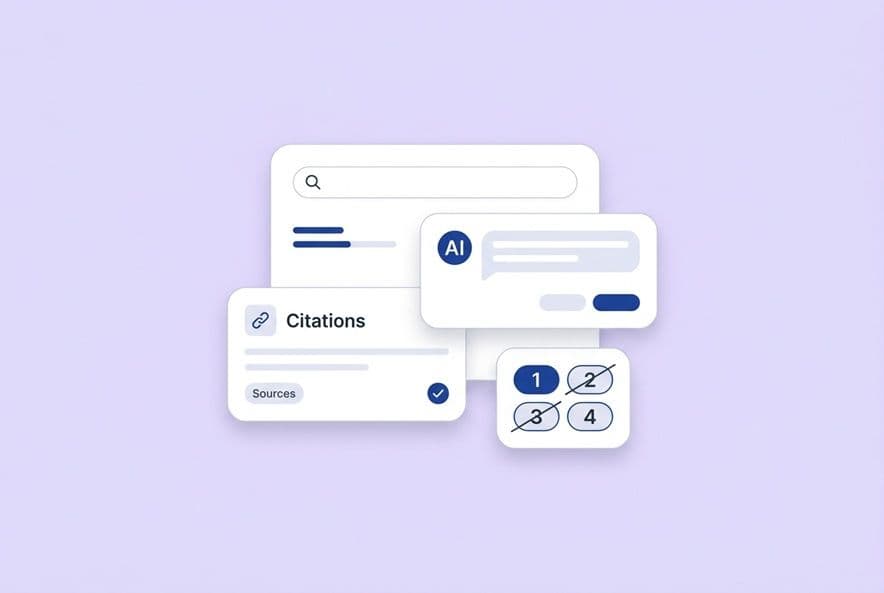
Traditional SEO was about earning a spot on a ranked list. AI search is different. A language model reads a bunch of sources, creates a new answer, and sometimes cites where it got the information. Your goal is no longer just "appearing in the results." It's "being the source the model trusts enough to cite." This is an extractability problem as much as it is a ranking problem.
What "visibility" can mean in practice (citations, mentions, snippets, assisted conversions)
In the AI world, "visibility" looks different. It might be a direct citation with your brand name, which is great. It could also be an uncited mention where your content clearly shaped the answer. Or a featured snippet pulled into an AI Overview. Sometimes it's an assisted conversion, where someone reads an AI answer that referenced you, then searches for your brand a few days later. None of these look like a classic blue-link click. That's not a bug. It's the new reality we're all optimizing for.
Myth #1: "AI search visibility is just SEO with a new name"
I see founders go one of two ways with this myth, and both are mistakes. Half of them dismiss Answer Engine Optimization (AEO) entirely and just keep doing old-school SEO. The other half panic and abandon their solid SEO foundation to chase shiny AI tactics.
What SEO still does (and why it's still the foundation)
Don't throw out the playbook. Indexability, domain authority, your backlink profile, and page speed still matter immensely. Most answer engines, including Google's, pull from indexed, crawlable content. Google's own helpful content guidelines still apply — if your technical SEO is a mess or your domain has no authority, no amount of AEO work is going to save you. Your existing SEO assets are the launchpad for creating cite-worthy content.
What AEO/GEO adds (extractability + citations + trust signals)
What's new is the intense focus on extractability. How easily can a machine pull a clean, confident answer from your content? This is where Generative Engine Optimization (GEO) adds a few new rules. It prioritizes an answer-first structure (the direct answer is in the first paragraph, not buried at the end), clear trust signals like expert author bylines, and structured data (like FAQ and HowTo schema) that helps machines understand what your content is about.
A practical "overlap map": what to keep, what to add, what to stop
Here's how I think about it:
- Keep: Keyword research, on-page fundamentals, internal linking, and building real authority with good backlinks.
- Add: Answer-first writing, framing your headings as questions, using one idea per paragraph (I call these atomic paragraphs), adding FAQ schema, showing off author credentials, citing your sources, and keeping content genuinely fresh.
- Stop spending time on: Mechanically stuffing long-tail keywords, targeting broad terms with no clear question, and writing content that only explains "what" but never "how" or "why."
The overlap is huge. You're not starting over. You're just upgrading your approach.
Myth #2: "To get cited by answer engines, you need to publish way more content"
This myth is expensive and a fast track to burnout. A volume-first strategy made some sense when SEO rewarded freshness and sheer breadth above all else. But answer engines don't care if you published 20 posts this month. They care if any of them contain a clear, credible, structured answer to a specific question.
The real goal: create fewer assets that are answer-ready
"Answer-ready" means a model can pull a complete, accurate response from your page without having to stitch it together from other sources. For a lean team, this is fantastic news. Five truly answer-ready pages will outperform fifty generic blog posts every time. The goal is depth and clarity on the questions your buyers are actually asking. It's about quality, not volume.
The cite-worthy content checklist (format + clarity + proof)
So what does answer-ready content actually look like? Here's our internal checklist:
- Answer-first structure: Lead with the direct answer. Don't make the reader (or the AI) wait for it.
- Q&A headings: Frame your H2s and H3s as questions. "How does X work?" is much better than "Overview of X."
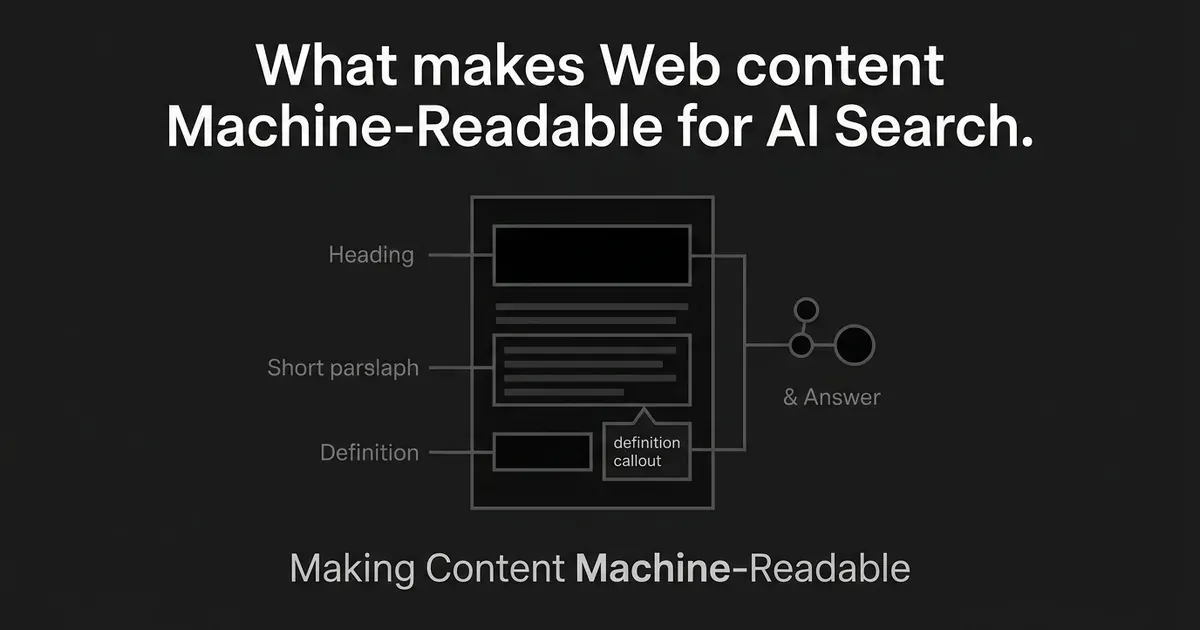
- Atomic paragraphs: Stick to one idea per paragraph, around three to five sentences. Models pull paragraphs, not entire pages.
- Definitions and comparisons: Clearly define your terms. We've found that simple comparison tables and "X vs. Y" sections get cited all the time.
- Grounded claims: Attribute your stats to a source. Vague claims get skipped, but sourced claims get cited. Research from Princeton University found that content with specific statistics and cited sources earns 30–40% more AI citations than purely qualitative content.
- Conversational language: Write like your buyer talks. Think about the questions they type into ChatGPT or Perplexity, not the weird keywords they used in Google back in 2018.
For a condensed, printable version of this framework, see our founder's AEO checklist.
Structured data without the rabbit hole (what's worth doing first)
You don't need to go crazy with schema. Just start with FAQ schema on your pages that answer a lot of questions and HowTo schema on your step-by-step guides. These two are gold because they directly signal extractability. After that, Q&A schema is a good next step. Everything else can wait.
Trust signals founders can implement fast (bylines, sources, freshness, provenance)
Answer engines want to cite sources they trust. For small teams, a few signals move the needle fast: a real author byline with a bio showing their credentials, citing your sources when you use data, an "updated on" date that reflects real updates, and a clear brand authority signal. On provenance (where your content comes from): if you use AI to help draft, you absolutely must have a human review process to verify every fact. Being cited for wrong information is so much worse than not being cited at all.
What to do instead of "more posts": refresh + consolidate + strengthen internal linking
Before you write a single new post, audit what you already have. Most early-stage companies have 10–30 articles. Figure out which ones target your most important customer questions and upgrade those to the answer-ready format first. Then, consolidate overlapping posts into a single, stronger asset. Finally, build internal links between related questions to show you have deep expertise on that topic. You'll get more lift from refreshing three old posts than from publishing five new thin ones.
Some teams (mine included) use a content production system to manage this. We build SEO and AEO checks right into our drafting process so we're not trying to bolt them on at the end. It's how you create cite-worthy content consistently without the founder becoming the bottleneck.
Myth #3: "If AI answers are zero-click, AEO can't generate pipeline"
This is the myth that almost convinces smart founders to just ignore AEO. If nobody clicks, what's the point? The point is that the citation is the impression. Those impressions compound into brand recognition, direct searches, and eventually, a paying customer. But you have to design for that path.
Accept the new funnel: impression/mention first, click later (or never)
Zero-click doesn't mean zero-conversion. It just means the attribution path got way messier. I've seen this happen a dozen times: a buyer asks Perplexity which tool is best for their problem, sees your name cited, and then searches your brand directly two days later. That shows up as "direct traffic" in your analytics, not AI-referred. Your content did all the work, but your analytics didn't catch it. Giving up on AEO because you can't see the click is like stopping podcast ads because you can't perfectly track listeners to a purchase.
Zero-click conversion tactics that still work
The goal is to make your brand so memorable that the journey from an AI answer to your website completes itself. Here are a few tactics that work:
- Develop a specific, memorable point of view. Brands that stand for something get mentioned by name. Bland brands get summarized and forgotten.
- Create comparison assets. Pages like "X vs. Y" or "best [category] for [use case]" get cited constantly and make your brand stick.
- Offer artifacts that require a click. An AI can't fully give someone a template, a calculator, or an interactive tool. These create a real reason to visit your site.
- Place your CTAs contextually. Don't just stick a "request a demo" button in the footer. Put it right after the answer to a key question or below a comparison table.
- Amplify your citations. When an AI cites you, treat it like a PR win. Share a screenshot on social media or in your newsletter. Reinforce your authority.
Build "conversion surfaces" that answer engines can't replace
The best hedge against a zero-click world is to build assets that are simply more valuable on your site than they are in a summarized snippet. Interactive tools, detailed guides with screenshots, and community resources all require a click to get the full value. These pages become your conversion surfaces. The AI mention is the referral, and the page itself closes the deal.
How to connect AI visibility to revenue without pretending attribution is perfect
You're not going to have a perfect attribution model. And that's okay. Instead, build a proxy measurement stack. Track direct and branded search traffic as a leading indicator. Monitor assisted conversions. Ask your sales team, "how did you hear about us?" and listen for mentions of AI tools. This isn't perfect attribution. It's honest attribution. Set that expectation with your board early.
Myth #4: "You should optimize for every answer engine at once (or you'll fall behind)"
Please don't do this to yourself. Trying to optimize for ChatGPT, Perplexity, Google, and Gemini all at once is how you burn out your team and end up with mediocre content everywhere. These platforms all work differently, and your buyers don't use them all equally.
Why different answer engines behave differently (and what that means for you)
Google AI Overviews lean heavily on content that already ranks well in traditional search. Perplexity seems to reward recency and directness more. ChatGPT often relies on slightly older training data, making well-established, evergreen content more impactful there. Same question, different logic. You need to pick your primary platform, not spread yourself thin.
A founder-friendly prioritization matrix (platform × query type × buying stage)
| Platform | Best for | Query type | Buying stage |
|---|---|---|---|
| Google AI Overviews | High-volume informational | "What is X," "How does X work" | Awareness |
| Perplexity | Comparison + evaluation | "Best X for Y," "X vs. Z" | Consideration |
| ChatGPT | Deep-context advice | "Help me decide between X and Y" | Decision |
| Gemini | Google ecosystem users | Local + integrated searches | Mixed |
Start with the platform your buyers actually use. If you're B2B SaaS, that's probably Perplexity and ChatGPT for product research. Pick one or two, build your cite-worthy assets for them, and only expand after you see results.
Start with "high-intent question clusters" that map to your product's wedge
Don't optimize for visibility on questions your product can't solve. That's just vanity. Instead, map out the 10–15 questions a buyer asks right before they'd be ready to look at your product. Those are your target question clusters. Build deep, answer-ready content for those, and you'll generate qualified interest.
Don't ignore PR/authority signals—just right-size them
Backlinks and brand mentions still signal authority, and answer engines use those signals to decide who to trust. But you don't need a massive link-building machine. For a lean team, a few high-quality mentions in industry publications, a guest post on a respected site, and a consistent presence in relevant communities is enough to compete. Focus on earning relevance, not manufacturing volume.
The execution plan: a lean-team AEO operating system (30 days to a repeatable loop)
Myth-busting is only useful if it leads to action. This isn't theory. Here's a 30-day plan you can actually run.
Week 1: pick targets + baseline visibility
Choose the two or three question clusters most tightly tied to what your product does best. Then, manually test a handful of prompts in Perplexity, ChatGPT, and Google. Do you show up? Do your competitors? Document what you find. This is your baseline.
Week 2: upgrade 2–3 existing pages into answer-ready assets
Pick your highest-potential existing posts and run them through the cite-worthy checklist. Add an answer-first intro, Q&A headings, atomic paragraphs, FAQ schema, and author bylines. Upgrading what you have is faster and lower-risk than starting from scratch.
Week 3: publish one new "anchor" asset + supporting FAQs
Create one definitive, deeply answer-ready piece on your most important question cluster. This is your citation hub. Then build two or three shorter posts that answer related questions and link back to it. This signals to answer engines that you're an authority on the topic.
Week 4: measure citations/mentions + iterate (and how to recover after shifts)
Re-run your baseline prompts. See what changed. If you appeared, figure out what's different about that content. If nothing changed, see which trust signals you might be missing. Build a simple monthly loop: run prompts, document results, update your weakest content. This is the process that builds resilience and helps you recover quickly when the models change their behavior.
If you want to operationalize this, you'll need a way to track prompts and citations over time. Manual spot-checking is fine to start, but it doesn't scale. Some platforms let you compare visibility before and after content updates so your iteration loop isn't just based on gut feel.
What "good" looks like: evaluation criteria, budget reality, and governance guardrails
Resourcing options for small teams (founder-led vs freelancer vs systemized)
Look, founder-led AEO works for about a month while you're learning the ropes. After that, it doesn't scale. A good freelance content strategist can speed things up, but you still have to manage them. The most efficient model I've found for lean teams is a systemized workflow, where research, drafting, and optimization all happen in one connected pipeline. The goal is to build a content engine, not become the hero editor for every single post. This is how you remove yourself as the bottleneck without sacrificing accuracy or quality.
Budget and ROI expectations: how to think in ranges and milestones (not promises)
Don't expect major citation lift in 30 days. In a month, you should have a few upgraded assets and a clear baseline. By 60–90 days, you should start seeing some citation appearances and a lift in branded searches. By six months, you should have a brand signal that contributes to the pipeline in a way your sales team can actually feel. Budget-wise, a systemized approach is a fraction of what a full-time hire would cost.
Governance: how to prevent being cited for the wrong thing
This is a huge and underappreciated risk. If an AI draft introduces a factual error that gets cited, your brand is now associated with bad information at scale. The guardrail is simple but requires discipline: every single piece needs a factual review from a human expert. Source every data point. Treat AI assistance as a first draft from a junior writer. It requires rigorous verification, not just a quick grammar check.