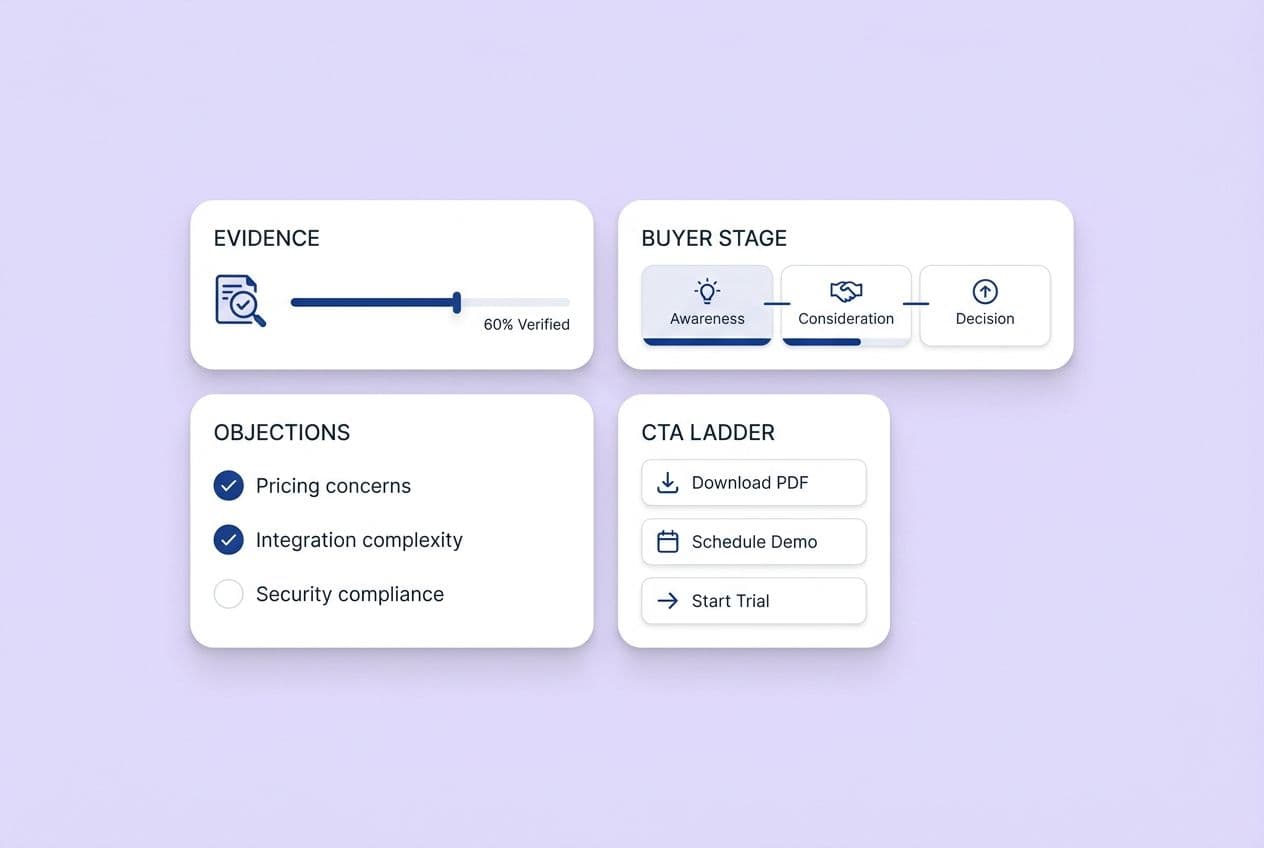
I’m going to give you my four-move playbook: teach first, lead with evidence, pre-answer objections, and match every call-to-action (CTA) to where the buyer actually is. If you do that consistently, your blog posts will stop feeling like thinly veiled brochures. They'll start doing what your sales team actually needs: building confidence, reducing risk, and moving buyers toward a decision.
Here’s what that looks like in the real world.
I know the situation because I’ve lived it. You're the content lead, trying to do good work. Sales comes knocking, asking for "more bottom-funnel content." We both know that’s code for product pitches dressed up as blog posts. And I’ve seen what happens when you go down that road. Bounce rates climb, nobody on the team shares the posts internally, and your best readers stop forwarding your work. It’s a disaster.
On top of all that, AI writing tools are flooding the internet with generic junk that sounds confident but says nothing. The pressure you’re feeling is real. The risk is real. And I know that hearing vague advice like "just be authentic" doesn't help you write a content brief.
So, this article is my operating system. It's the playbook I wish someone had given me years ago. Inside, you'll get a diagnostic for what makes content feel salesy, a framework for mapping posts to the buyer's journey, the six assets that get your content forwarded, my rules for using proof points, and so much more. Don't just read it once. Use it.
What Makes SaaS Content Sound "Salesy" (Even When You Don't Mention Your Product)?
Salesy content fails a trust test, and it happens in the first 30 seconds. I’ve learned to spot the signs. You know the symptoms because you’ve felt them as a reader: you skim, you bounce, you definitely don't share it with your team. If you're really annoyed, you might leave a comment that says, "this reads like an ad." That reaction isn't random. It’s a gut feeling, but it’s triggered by a few specific patterns.
From what I’ve seen, it usually boils down to three root causes that pop up all over SaaS blogs:
1. Intent mismatch. The reader showed up to learn something. Maybe they want to evaluate a new approach or figure out what questions to ask a vendor. But the article immediately pivots to talking about "our solution." That gap between what the reader wants and what the content wants from them feels like pressure, no matter how polite the copy is.
2. Evidence gap. This one drives me crazy. Big claims without any explanation. "10x faster." "Industry-leading accuracy." "The only platform that…" These phrases look like evidence, but they have zero substance. When your claims outrun your proof, readers will either dismiss your content or, worse, stop trusting you completely.
3. Self-centered framing. The post is all about the company: the product’s features, the roadmap, the mission statement. It's never about the reader's actual problem. A buyer at this stage is trying to figure out if an approach is right for them. If your content doesn't help them with that job, it’s useless.
Here’s a key distinction: being direct is not the same as being salesy. It's okay to mention your product. It’s okay to have a strong opinion. You can even say, "here's why we built it this way." None of that breaks trust. What buyers can't stand is pressure mixed with vagueness. Hype with no constraints. Confidence with no evidence.
Before you hit publish, run your post through this sniff test:
- Would a skeptical buyer forward this to their team, or would they be embarrassed?
- Does every big claim have a real example or a "how it works" explanation?
- Does the first screen actually answer the reader's question, or does it just push the company's message?
- Is the product introduced after you teach something, or instead of teaching?
- Is there any fake urgency or "limited time" nonsense?
- Could someone who never buys from you still get real value from this post?
- Do you admit to any trade-offs, or is everything presented as a magical upside?
If you're answering "I'm not sure" to more than two of these, that post needs another edit.
What "Authentic" Sounds Like in B2B SaaS (Specific Language Swaps)
Authenticity in B2B isn't some mysterious vibe. It’s about the words and structure you choose. The most important swap you can make is to replace hype adjectives with explanations and constraints.
| Salesy version | Authentic version |
|---|---|
| "Revolutionary AI-powered platform" | "The system works best when you have X in place. Here's what it does and doesn't handle." |
| "Game-changing for your pipeline" | "Teams usually see X outcome after Y weeks, but only when Z is true." |
| "Best-in-class security" | "Here's the compliance framework it supports. If yours is different, you'll need to ask these questions." |
| "Effortless implementation" | "Most teams are live in two weeks. The real sticking point is usually data migration, not the setup itself." |
Just replace the adjective with "how it works." Replace the superlative with "when it works." When you add the constraint, the if X, then Y part, your copy immediately sounds like an expert, not a salesperson.
How Do You Align Content to Buyer Stage and Sales Motion Without Turning It Into a Pitch?
This is the most important rule in the playbook: write for the decision the reader is trying to make right now, not the one you wish they were making.
At the consideration stage, buyers are almost never asking, "should I buy this specific product?" If you want a formal template for mapping content to stages and assets, see frameworks like the consideration stage approach that help you align content types to each buying decision.
Content that answers those questions builds trust and helps your sales team. Content that skips past them and shoves a "schedule a demo" button in their face loses them for good.
I’ve run both PLG and sales-led motions, and the content strategy diverges here:
- PLG content has to be all about end-user value. The "aha" moment. What it feels like to get activated. The path to "try it" should feel totally natural, because the product sells itself through use. Your content's job is just to get them to that first magical experience.
- Sales-led content has a tougher job. It needs to work for the end user, the internal champion who is sticking their neck out, and the economic buyer who holds the budget. That means your content needs to talk more about stakeholder alignment, risk, and ROI. Your champion needs to be able to forward your article to their CFO and have it make sense.
| Buyer Stage | Reader's Question | Content Promise | Proof Needed | CTA Strength |
|---|---|---|---|---|
| Awareness | "Is this even the right type of solution?" | Educate on category and approach | Conceptual — examples, case patterns | Soft (checklist, guide) |
| Consideration | "Which approach fits my situation, and how do I evaluate?" | Help them choose and build confidence | Specific — metrics with context, trade-offs | Mid (template, comparison, walkthrough) |
| Decision | "Can I trust this vendor and make the case internally?" | Reduce risk, support the buy decision | Detailed — references, security docs, ROI models | Strong (demo framed as fit assessment) |
If you know an article might hit different people (the user, the champion, the buyer), don't write a mushy post for everyone. Use subheadings to call out who you're talking to. Something like "If you're building the business case…" or "For the team that'll use this day-to-day…" works wonders. Trying to average it out makes your content perfect for no one.
The "Content Job" Lens (What This Article Is For, Not What It's About)
Before you write a word, name the job the article is doing for your reader. I don't mean the topic; I mean the job. Topics are easy to twist into a sales pitch. Jobs keep you honest.
Here are some examples of useful "content jobs":
- "Help me choose an approach" (comparison, decision criteria)
- "Help me build a business case" (ROI framing, risk reduction)
- "Help me avoid a bad migration" (implementation reality, what to ask vendors)
- "Help me evaluate vendors fast" (evaluation checklist, red flags)
- "Help me understand what I'll actually have to change" (team impact, change management)
When you’re clear on the job, the article basically writes itself. You'll also feel it instantly when a section starts drifting away from that job and into product promotion.
Here are some examples of useful content jobs:
What Should Sales-Supporting SaaS Content Include So Sales Can Reuse It Without Reading Like a Landing Page?
I spent years trying to figure out why Sales wouldn't use the content we were creating. The answer, it turned out, was simple. The content they actually use isn't the post that mentions the product the most. It's the post a champion can paste into Slack or forward in an email without feeling like they're a salesperson for your company.
If you write for forwardability, you solve the "Sales needs more content" problem for good.
The key is to embed what I call decision assets. These are just discrete, copy-pastable blocks that help a buyer make a better decision. Here are the six I always include:
1. Decision criteria list. What really matters when evaluating this space? This can't be your feature list in disguise. It has to be genuine criteria they can apply to any vendor.
2. Trade-off callout. "If you optimize for speed, you'll probably give up on customizability." Buyers aren't dumb; they know there are no perfect solutions. Naming the trade-offs shows you're honest and makes you instantly more credible.
3. Implementation reality. What actually breaks in the second week? What are the real challenges of adoption? What dependencies does nobody mention on a sales call? Your champion loves sharing this stuff because it makes them look smart.
4. Objection pre-buttal. Name the objection your reader is already thinking. Validate it. Then address it directly. "I know what you're thinking: this sounds like it will take six months to see any value. Here's what the timeline actually looks like..."
5. Proof block. A specific metric tied to a clear context. Not "customers see 40% improvement." Instead: "teams with more than three campaigns running at once typically cut their review cycle by a third, because..."
6. Next-step guidance. A CTA that matches where the reader is in their journey, not where you wish they were.
The trick is to keep these assets focused on the problem and the category, not your brand. The second a decision criteria list just happens to be a perfect match for your product, it stops being helpful and becomes a pitch.
Add a "Copy/Paste Box" Inside the Article (How to Format for Internal Sharing)
This sounds almost too simple, but trust me, it works. Include a literal copy/paste block in your article, formatted for Slack or email, and label it clearly for someone who hasn't read the whole post.
Template:
Evaluating [category]? Here's a quick reference:
- If your team cares most about [priority], prioritize vendors that offer [capability or approach].
- Watch out for [common failure mode or hidden cost].
- Ask every vendor: [specific question that reveals a meaningful difference].
- Best fit for: [segment or use case].
- Not the right fit if: [disqualifying condition].
Keep it tight. Short sentences. No jargon that requires the full article for context. When your champion can grab this block and drop it in Slack saying, "here's the framework I'm using," you've just done more for that deal than any pitchy blog post ever could.
How Do You Use Proof Points Without Breaking Brand Voice or Sounding Like You're Trying Too Hard?
Proof points stop feeling salesy when they include a mechanism. A number floating on its own, like "customers see 3x faster results," just sounds like a sales claim. But if you give that same number some context, a baseline, and a short explanation of why it happened, it becomes real evidence.
I tell my team the anatomy of a good proof point is: metric + narrative context + buyer segment + "why it worked."
- Where to put them: Right after a big claim or in a section handling objections. Don't sprinkle them in randomly like decoration.
- How to keep it in your voice: Be observational. "What we saw happen was..." is so much better than "This proves we're the best." Talk about what was true before and what conditions made the outcome possible.
- What breaks the voice: Superlatives ("the best," "the only"), percentages without a baseline, and outcomes presented as a guarantee.
Here are three templates we developed after getting this wrong for a long time:
Before/after: "[Team type] was spending [time/resource] on [activity]. After they [did this specific thing], that dropped to [outcome], mostly because [mechanism]."
Time-to-value: "Most [segment] teams get to [milestone] within [timeframe] as long as [condition is true]. The variable that usually speeds this up is [lever]."
Risk reduction: "The most common failure mode in this category is [risk scenario]. Our approach reduces that risk by [specific mechanism]. It doesn't eliminate it, but it contains the damage if [condition]."
Getting these stories is an operational challenge. Sales and CS are the ones who hear them on calls. We created a shared doc where they can drop raw notes after QBRs or renewals. Then, Marketing's job is to package them. If you don't have a process for this, you'll either skip proof points entirely or just pull stale quotes from a 2022 case study page.
Proof Point Quality Checklist (Publish Gate)
Before a proof point goes live, we run it through this checklist:
- Baseline included? Does the reader know what "before" looked like?
- Timeframe stated? Is it clear how long this took?
- Segment defined? Does the reader know if this applies to a company like theirs?
- Action identified? Is it clear what the customer did to get this result?
- Confounders noted? Are other factors mentioned that might have helped?
- Limits stated? Is there a "this works when X, but your mileage may vary if Y"?
A proof point that passes this checklist isn't just more credible. It's more useful for your sales team, because a buyer can't immediately poke a hole in it.
How Do You Handle Objections in Content Without Sounding Defensive or Negative?
This was a huge mental shift for me: objections aren't pushback, they're just poorly worded decision criteria. Every buyer has a list of reasons why this might not work for them. When your content ignores those reasons, you look either naive or dishonest. But when you name them and tackle them head-on, you build incredible trust.
The reframe is to think of objection handling as a form of buyer protection. You're helping them avoid a mistake, whether that's choosing the wrong category, the wrong vendor, or just bad timing. That's the mindset to have.
Here are the five most common objections I see, and how to handle them:
| Objection | What the buyer is really afraid of | What to include | What to avoid |
|---|---|---|---|
| "This won't work for our situation" | Wasting time on something that doesn't fit | Explicit fit criteria and segment descriptions | Claiming it works for everyone |
| "This will take too long to implement" | Disrupting the business before seeing any value | A phased approach, time-to-value levers, what actually takes the longest | Empty promises about speed |
| "It's too expensive" | Poor ROI, budget cuts, high switching costs | The cost of doing nothing, explaining your pricing model, what drives cost up or down | A vague "contact us for pricing" page |
| "We tried something like this before" | Repeating a past failure | Specific failure modes and what's different now | Dismissing their past experience as irrelevant |
| "Risk/security/compliance" | Data risk or getting in trouble with regulators | A due diligence checklist, questions to ask all vendors | Vague claims about "enterprise-grade security" |
The key to tone is to always validate first. "This is a legitimate concern, and here's what it actually looks like..." feels completely different than the dismissive "while some people worry about this..." Give them options, not just empty reassurance. And the most powerful move of all is to include a "when not to do this" section. It's the ultimate trust-builder.
The "Fit" Section You Should Include in Almost Every Sales-Supporting Post
A simple "best for / not for" block near the end of a post is a secret weapon. It does two things at once: it helps the right buyers feel seen and qualify themselves in, and it helps the wrong buyers leave early, which is a gift to your sales team.
Example format:
This approach works best if:
- You're managing more than [volume threshold] of [thing].
- Your team already has a [specific role or function].
- You're really trying to optimize for [outcome].
This probably isn't the right fit if:
- You're still early-stage and have [under X condition].
- You absolutely need [a capability this approach doesn't have].
- Your timeline is [faster than what's realistic].
Write this for the category, not as a product comparison. When a buyer reads "this isn't for you if you need X" and realizes that's them, they trust everything else you just told them. Helping people disqualify themselves is one of the most powerful things a content program can do. Almost nobody does it.
What CTAs Should You Use So Content Progresses to Sales Without Killing Trust?
The best CTAs at this stage are decision helpers, not conversion buttons. Think about it from the reader's side. They came to your post to learn something. Asking them to book a meeting before they've even finished the article is an interruption, not a call to action. It breaks the promise you made in the headline.
I think about CTAs as a ladder based on readiness:
Low-friction (early in the post or for less-ready readers):
- "Steal this evaluation checklist"
- "Download the vendor comparison template"
- "Get the implementation planning guide"
Mid-friction (after a comparison or a list of decision criteria):
- "See examples from [your use case]"
- "Watch the 3-minute walkthrough"
- "Compare the two main approaches side by side"
High-friction (only after you've handled objections or at the end of a true decision-stage post):
- "Book a fit assessment. It's 20 minutes, and we'll tell you honestly if this is right for you."
- "See it for your use case. Bring your requirements, and we'll show you what changes."
- "Get a second opinion on your current approach."
Put your CTAs where they make sense: after decision assets, comparisons, or objection sections. Don't just sprinkle them randomly between paragraphs because some marketing guru told you to.
The copy should be dead simple: one clear action, one clear benefit, no fake urgency. "Book before Friday" for a software demo doesn't create scarcity; it just drains your credibility.
6 CTA copy examples that don't set off the "salesy" alarm:
- "Use this checklist to run your own evaluation"
- "See how other [job title]s structured their shortlist"
- "Get the questions to ask every vendor in this category"
- "Compare your current approach against this framework"
- "Book 20 minutes and we'll map this to your specific use case"
- "Download the business case template your CFO will actually read"
CTA Anti-Patterns That Trigger "Salesy" Fast
Some CTA patterns are so bad they actually hurt you, even if the content is good. Nothing makes me close a tab faster than these:
- Fake scarcity: "Only a few spots left this week" for a software demo. Please.
- Premature ask: "Ready to get started?" in the intro. No, I just got here!
- Vague everything: A "Learn more" button that links to a generic product page.
- Interruptive modals: A giant popup on an article about being trustworthy. The irony.
- Irrelevant demo ask: Asking someone reading a top-of-funnel post to book a sales call.
Each of these signals that your content exists for your conversion rate, not for the reader. That’s the exact mismatch that makes content feel salesy in the first place.
How Do You Structure the Article for SEO + AEO So Your Helpful Answers Get Extracted (and Cited)?
I'll be honest, I was late to this idea. But once you see it, you can't unsee it: answer engines don't read your articles, they extract statements. That one mental shift changes how you should structure everything. The rules for getting your answers extracted are simple:
Answer first. Every H2 section should open with the direct answer in one or two sentences. The context and evidence come after.
2. Question-based headers. Write your headers the way people ask questions. "What's the difference between…?", "When does X make sense?" Generic headers like "Implementation Considerations" are invisible to AI.
Structured comparisons. Use tables. Use side-by-side lists. AI engines love structured formats because they are easy to pull from.
4. Short paragraphs, selective bolding. Stick to two to four sentences per paragraph. Bold the single most important sentence, not a bunch of random phrases.
5. Citation-ready specifics. Use named frameworks, defined terms, and stated constraints. "It depends" is honest but useless for an AI. "It depends on X, Y, and Z, and here's how to evaluate each" is gold.
Here's a quick before/after:
Generic section opening:
Content strategy is an important part of any SaaS marketing program. There are many factors to consider when thinking about how your content supports the sales team...
Answer-first rewrite:
Sales-supporting content gets reused when it contains decision assets: specific criteria, trade-offs, and proof formatted so a champion can paste them into Slack. The six assets that matter most are decision criteria, trade-off callouts, implementation reality checks, objection pre-buttals, proof blocks, and readiness-matched CTAs.
The rewrite is extractable. An AI answering, "what should sales-supporting content include?" can lift that opening directly. The original gives a machine (and a human skimming the page) nothing to grab onto.
Minimal "AEO Retrofit" Checklist for Existing Posts
You don't have to rewrite your whole library. I've found this five-step pass gets most posts 80% of the way there.
- Rewrite the first two sentences of each H2 section to lead with the direct answer.
- Add one structured table (a comparison, a list of options, etc.).
- Add a "best for / not for" fit block near the end.
- Add an FAQ section with 5–8 standalone Q&As using question-phrased headings.
- Tighten vague claims. Replace any statement that couldn't be easily verified with a specific, constrained version.
Posts that go through this process usually see better featured snippet performance pretty quickly. The bigger AEO benefits take longer, but the work you do here will compound over time.