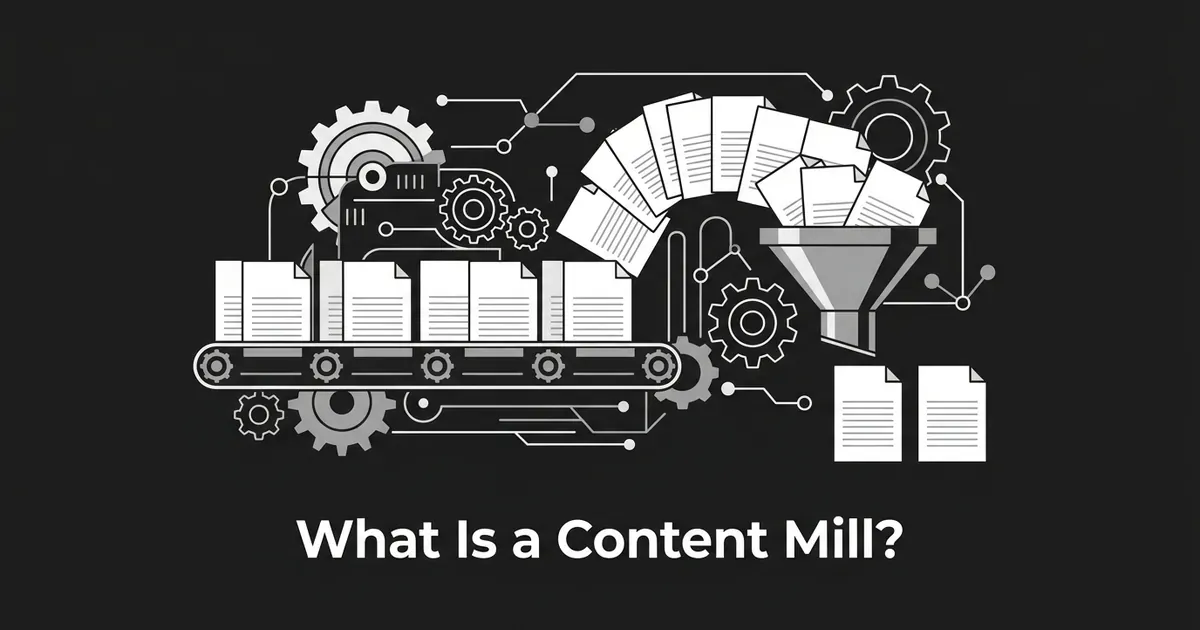
A content mill is a volume first content operation. It turns standardized topics or briefs into a large quantity of articles or copy, usually by spreading the assignments across a pool of writers who are paid per piece. That is the whole definition. It says nothing about whether the writing is good, whether the writer knows your product, or whether anyone checks the claims before you publish. Those are separate questions, and this piece is about answering them for your own content, not about scaring you off outsourcing altogether.
If you're a founder who just fired a freelancer whose draft needed a full rewrite, or you're eyeing a cheap high volume offer because your content calendar is a mess, you need a way to tell a mill from a real editorial process before you sign anything.
What Is a Content Mill, Really?
The word gets used loosely, and that looseness is part of the problem. It covers at least four different things, and confusing them leads to bad decisions in both directions.
The historical version is the content farm, a publisher that builds a large number of search oriented pages on its own site, chasing traffic and ad revenue. Topics get picked from search demand data, then handed to freelance contributors who write to a formula. This is the model Wired described at Demand Media, and it is genuinely a different business than what most founders are shopping for today.
The version you're more likely to run into is the client facing content mill: you pay a company, that company assigns or posts your brief to a pool of writers, and it delivers the finished copy back to you. This is what most people mean when they ask what is a content mill in a buying context, and it's the one worth understanding before you hand over a brief.
An agency can look similar from the outside, since it may also use freelancers and produce at real volume. The difference isn't the org chart, it's whether someone takes responsibility for your topic strategy, matches a writer with relevant expertise to your brief, gets access to your product or subject matter experts, edits with real judgment, and stays accountable for the result. Calling something an agency doesn't guarantee any of that on its own.
A freelance marketplace is narrower still. It connects you to individual writers and stops there, it doesn't supply a unified editorial process just by making the introduction. And AI assisted writing is a production method, not a label for a mill. A human writer can turn out formulaic, low value pages, and an AI assisted draft can be carefully researched and reviewed by someone who knows the product. Judge the process and the output, not the tool or the title on the contract.
The boundary test that actually matters comes down to five questions: who picks the topics, who can talk to someone who knows the product, who checks the claims against something real, who makes substantive edits, and who is on the hook when the page is wrong. If an offer is built around throughput and the answers to those questions stay vague, you're looking at the tradeoffs this piece is about, whatever the vendor calls itself.
How a Content Mill Actually Works
The mechanics are simple, which is exactly why the model scales. You supply topics, keywords, or a brief. The company either assigns the work directly or posts it to a job board where writers pick it up. Writers produce pieces against the brief, often jumping between unrelated subjects from one assignment to the next, and the company may do a pass of editing before it lands in your inbox.
The appeal for a founder is obvious, since you get a lot of assignments filled without having to recruit and manage a writer for every single piece yourself. But the structural risk sits right there in the mechanics. A thin brief plus a writer with no access to anyone who actually knows the product leaves that writer reconstructing the topic from whatever is already public online, and publishing more pages built that way doesn't create the product knowledge, first hand experience, or distinct point of view that was missing in the first place. It just multiplies the gap.
One HubSpot contributor described writing car parts product listings without owning a car, and being told at one mill to stuff a keyword in five times per article. That's one person's account of one bad experience, not proof that every mill works this way. But it's a useful illustration of what happens when the brief and the access are both thin.
Where Content Mill Quality Breaks Down for a SaaS Product
For a founder, the real failure mode isn't clumsy sentences. It's a fluent, confident looking page that misstates how your product actually works, recommends a use case it can't support, or answers a buyer's real question with a generic summary that could belong to any company in your category. A writer who has nothing but a keyword and your competitors' public pages can't reliably supply your private product facts, your customers' actual experience, or an informed opinion about your category. That's the predictable risk of an under briefed process, not a guaranteed outcome for every provider.
A few specific ways content mill quality breaks down are worth watching for on your own drafts. The page can substitute for original knowledge, paraphrasing what's already ranking without adding a tested observation, an expert explanation, or anything from your own documentation. Claims can go unverified, with features, integrations, comparisons, and numbers showing up with nothing a reviewer could check them against. Expertise gets misassigned when a fluent generalist writes with authority about a product or a specialist subject they've never used and never discussed with anyone who has, and nobody ends up owning the accuracy check, since no named person is responsible for confirming the facts, the relevance, and the fit for your actual reader before it goes live.
There's also a subtler failure in how topics get picked in the first place. When they're chosen for search volume instead of a real reader need, you end up with several pages that all answer slightly different phrasings of the same question, none of them distinctly. And the review burden often just gets hidden rather than removed. You end up reconstructing the brief, correcting the claims, and rewriting the page anyway, which erases whatever time the mill was supposed to save you.
These failures matter most on the pages that carry the most weight: product explanations, security or compliance claims, implementation advice, competitive comparisons, customer stories, and anything meant to move a buyer from considering to deciding. Those pages need someone with real access to evidence behind them, whatever production model produced the draft.
What the SEO Risk Really Is
A lot of founders get the wrong idea here, in both directions. Google's scaled content abuse policy is about pages generated mainly to manipulate rankings, with little or no value for the person reading them, regardless of how those pages were produced. Its examples include mass generating pages without adding anything and stitching together material from other pages without adding anything. Using an outsourced writer, an AI tool, or publishing at high frequency isn't automatically a violation. A human byline doesn't rescue a page that's unoriginal and search first either, so the risk sits with the output, not the arrangement that produced it.
Google's own self assessment for helpful content asks whether a page supplies original information or analysis, adds real value instead of just rewriting other sources, shows clear sourcing and real expertise, avoids easily checked errors, and got enough care and attention before it published. It explicitly asks whether content was mass produced or spread across so many different creators that individual pages got less attention. Treat these as questions to ask about your own drafts, not as a rule that outsourcing itself is banned or a checklist that guarantees a ranking if you tick every box.
There's a separate, narrower policy called site reputation abuse, and it's easy to conflate with the mill question. It targets third party content hosted mainly to exploit another site's established ranking signals, and Google clarified in November 2024 that third party involvement by itself isn't the offense. Hiring outside writers, or publishing a freelancer's article, doesn't automatically trigger this policy on its own.
For historical context, in 2011 Google described the Panda update as an effort to reduce rankings for lower quality material, and it warned that low quality pages in one part of a site could drag down the rest. That's background on how the search engine has thought about volume and quality over time, not evidence that a specific outsourced article published today will get penalized.
And separate from any of Google's policies, there's a reputational risk that's really a business judgment. If a page under your company's name gives wrong product advice or makes a claim you can't back up, a reader can lose trust in you even when no search policy was ever broken.
Content Mill vs Agency: What the Label Doesn't Tell You
The content mill vs agency question comes up constantly, and the honest answer is that the label on the contract tells you less than you'd think. An agency that takes real ownership of your strategy, gets your product team on a call, and edits with judgment is doing something genuinely different from a mill. But an agency that just relabels the same assign and deliver process, with no more access or accountability, is a mill with a nicer invoice.
The questions from the boundary test earlier are the ones to actually ask before you sign: who picks the topics, who gets access to your product knowledge, who checks the claims, who edits with real judgment, and who is answerable when a page is wrong. Ask a prospective agency or mill to answer those five questions concretely, with names and a process, not with a page of marketing language about their "expert writers." A vague answer is itself useful information.
When the Tradeoff Might Still Be Worth It
None of this means outsourced, high volume production is off the table for you. It's worth it, possibly, under fairly narrow conditions: you have a bounded backlog of straightforward material, a complete and accurate set of facts to hand the writer, a clearly specified audience and format, and someone with the authority to check and approve every single piece before it goes out. Think descriptions written from approved product specs, routine reformatting of existing material, or internal first pass drafts nobody outside the team will see. The lower the factual and reputational stakes, and the less original insight the piece is supposed to deliver, the more this arrangement makes sense.
Even in that narrow case, your brief needs to say plainly what the writer may state as fact, what they must not guess at, which sources they're allowed to pull from, and where they need to flag something they're unsure of. Keeping the material internal removes the search indexing question, but it doesn't excuse getting the facts wrong. And if you can't actually supply the facts or review the output yourself, a mill doesn't remove your bottleneck, it just moves the bottleneck to the moment you're about to publish.
The poor fit is anything meant to build category authority, explain a nuanced part of how your product behaves, guide someone through a consequential implementation decision, back up a security or compliance claim, or compare you to a competitor from real experience. Those assignments need accountable research and real access to evidence, no matter which production model makes the draft.
How to Test One Before You Scale
If you're going to try a provider, test with a representative assignment, not the easiest topic you can find. Hand over your actual product documentation, the real audience and angle you want, anything you don't want claimed, and a way for the writer to ask you a question. Ask for the draft with source notes and visible edits included, not just a clean final file.
Then have someone who actually knows your product check every material claim in that draft, note anything missing, judge whether it's actually useful to the reader it's for, and track how much correction it needed. Ask who wrote it, who edited it, what access to your product or subject matter that writer had, and whether the same people would be available for your next batch.
A workable result answers the question accurately, adds something beyond a rewrite of what's already ranking, stays inside the claims you're comfortable making, and can go out after a normal review pass. A bad one reads fluently but is unsupported, needs you to supply the analysis it was supposed to deliver, or just repeats a competitor's structure with your name on it. Scale the arrangement only if that real sample's review burden and factual risk are something you can live with at volume. There's no sourced, universal number for how many revisions or how much turnaround time is normal, so don't let a vendor hand you one as if it were a benchmark.
The point of all of this isn't to avoid content mills on principle. It's to know what you're actually buying, so the choice to use one, or to avoid content mills entirely for the pages that matter most, is one you're making on purpose instead of one you backed into because a keyword list showed up fast and cheap. If keeping every draft grounded in your own product facts and reviewed before it publishes is the part you don't have time for, that's the exact problem DeepSmith's Deep IQ and Writer are built to solve, by drafting from your stored brand and product context instead of a generic brief. You can try it free for 7 days at deepsmith.ai.