Agile marketing is a way of organizing marketing work around customer value, frequent delivery, experimentation, and quick response to change, instead of activity volume, perfection, or a fixed annual plan. For a content team, that means keeping an ordered backlog of content ideas, committing to a small amount of work for a short cycle, publishing something useful or learning something useful quickly, reviewing the evidence with the people who need to see it, and improving the next cycle through a short retrospective. None of that requires copying a software team's ceremony wholesale.
If you run content for a portfolio of clients, or for a marketing team that keeps getting new requests mid-quarter, this matters more than it sounds like it should. A fixed twelve-month content calendar assumes you already know what will matter in month nine. Agile content planning assumes you don't, and builds the system to find out as you go.
What is agile marketing?
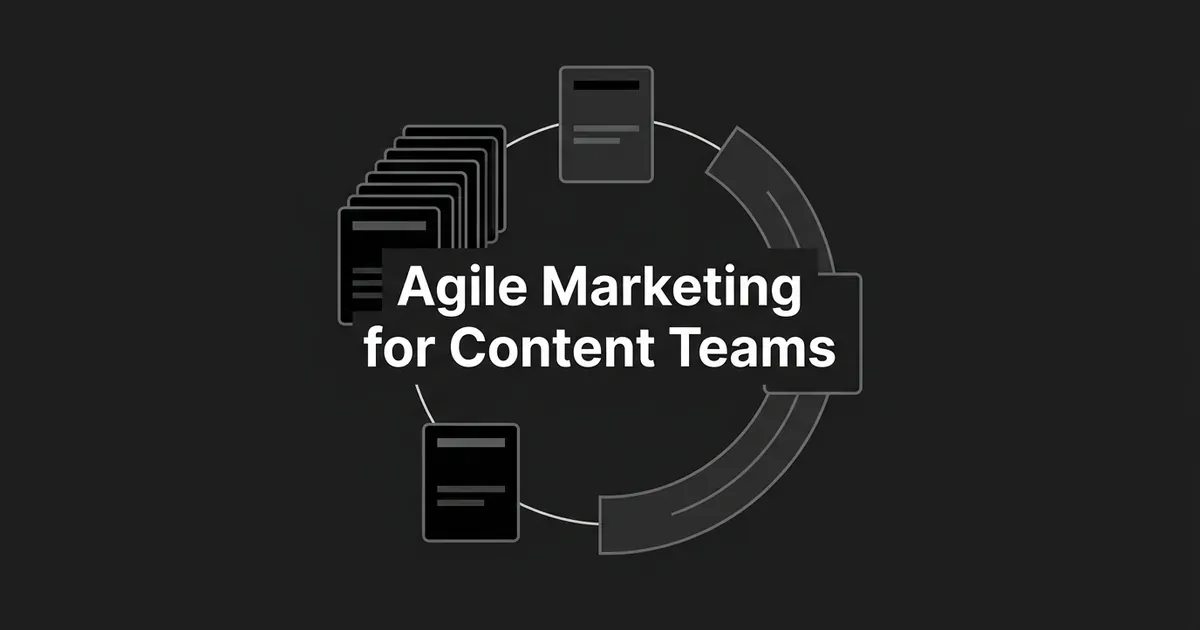
Agile marketing applies the same operating principles that reshaped software teams to marketing work. Its defining behavior isn't speed for its own sake. It's a repeated loop: sense what the audience or the market actually needs, make a decision, do the work, look at the evidence, and adjust. Repeat.
The Agile Marketing Manifesto lays out five values that hold this together. Focusing on customer value and business outcomes over activity and outputs. Delivering value early and often over waiting for perfection. Learning through experiments and data over opinions and conventions. Cross-functional collaboration over silos and hierarchies. Responding to change over following a static plan. Notice the word "over" in each one. Agile doesn't say outputs, plans, or opinions are worthless. It says they shouldn't outrank customer value, learning, and the ability to change course.
That manifesto traces back to a 2012 gathering in San Francisco where 35 marketers wrote a first draft, borrowing directly from the software industry's own Agile Manifesto from a decade earlier. The wording has been revised since, but the core idea hasn't moved: marketing work should be organized so a team can learn something real before committing to a large amount of effort.
It helps to be clear about what agile marketing is not. It's not a content calendar with shorter columns, and it's not a promise to publish more, faster. It's also not the same thing as Scrum. Scrum, Kanban, and Scrumban are frameworks a team can use to put agile principles into practice, while agile marketing is the philosophy underneath them. You can run an agile content operation without ever touching a Scrum board, and you can run a Scrum board every week without being agile, if the backlog never gets reordered and nobody changes a decision based on what happened last cycle.
The manifesto's own principles rule out a few common misreadings. Agile doesn't mean skipping planning: one principle calls for planning "only to a level sufficient to ensure effective prioritization and execution," which is a case for planning less far in advance, not less carefully. It doesn't mean constant emergency response either, since another principle calls for a sustainable pace. And it doesn't excuse weak marketing fundamentals. Positioning, audience understanding, and editorial quality still have to hold up, agile or not.
How does agile marketing work?
Strip away the vocabulary and agile work runs through a small number of repeatable moves.
Start with an ordered backlog. A backlog is a visible, living list of work, arranged by what matters most right now, not a dumping ground for every idea anyone has floated. For a content team, each backlog item can carry the audience problem it addresses, the format it's likely to take, the evidence behind it, and a rough sense of effort. The backlog stays open to new information: an idea can start as a single sentence and sharpen as the team learns more about it.
Prioritize for the next decision, not a perfect ranking. The team needs a transparent reason one item sits ahead of another. That reason usually blends relevance to a real customer question, evidence that the topic matters now, expected learning value, and whether the team can actually ship something useful this cycle. A backlog item also needs to be specific enough to act on. "Write more blog posts" isn't a work item. "Test whether answering this recurring client question increases qualified engagement" is, because it names the audience, the work, and what the team is trying to learn.
Set a short cycle with one clear goal. In Scrum, a sprint is a fixed-length event of one month or less, and a new one starts the moment the last one ends. Marketing and content teams adapt that cadence rather than copying it exactly: some run two- to four-week content sprints, and at least one agency experience report describes starting with one-week sprints and moving to two weeks once clients understood how to plan work requests. There's no single correct length. It depends on how fast the team can produce something meaningful, how often priorities shift, and how much stakeholder coordination the work needs. Whatever the length, the cycle should point at one goal, not a wish list of every task the team hopes to touch.
Plan just enough to execute well. A useful planning session for a content team answers three questions: why is this cycle worth doing, what can the team realistically finish, and how will it get done. That can live in a short cycle brief: the goal, the selected items, who owns what, what has to be approved, and what counts as done. None of that is a promise that nothing will change mid-cycle. It's a way to protect the goal while staying honest about what might shift.
Keep work visible and limit how much is in flight at once. Too many half-finished drafts create context switching, hidden queues, and slow reviews. A simple content workflow, something like backlog, planned, drafting, editing, stakeholder review, ready to publish, published, learning captured, makes bottlenecks visible instead of letting them hide inside someone's inbox. A team might agree not to start another big draft while three others wait on subject-matter review. That limit isn't a productivity target aimed at individuals. It's a prompt to unblock or finish something before starting the next thing.
Review the work and what's changed around it. In Scrum, the sprint review looks at what got done and what's shifted in the surrounding environment, and it's meant to be a working session, not a status readout. For content, that review can cover what published, whether it met its definition of done, what early signals are showing up, and what changed in the market or the client's business since the cycle started. This is a different conversation from an editorial approval meeting. Approval asks whether a piece can go live. A review asks what the finished work and the evidence around it should change about the plan.
Run a retrospective that actually changes something. A retrospective looks at how the team worked, not what it produced. Four simple prompts cover most of it: what's working, what have we learned, what needs more attention, and what should we try next. Scrum allows up to three hours for a one-month sprint's retrospective; one content practice example uses thirty minutes, which is a reasonable starting point for a small team rather than a rule anyone has to follow. The only requirement that matters is that the retrospective produces a small number of changes the team actually tries next cycle, not a meeting that restates the same complaints every time.
What does agile content planning look like?
Put those moves together and you get an operating loop a content team can run without adopting every Scrum role or ceremony:
- Collect. Add content ideas, customer questions, performance observations, and stakeholder requests to one visible backlog.
- Clarify. Note the audience, goal, format, evidence, and rough effort for each item.
- Order. Sequence the backlog using the team's own editorial and business judgment.
- Commit. Pick a small group of items for the next cycle and set one cycle goal.
- Deliver. Research, write, review, publish, and distribute the selected work, keeping the amount in progress under control.
- Inspect. Look at what published, the early signals, and what's changed in the environment.
- Learn. Write down what the team learned about the audience, the format, the message, and the workflow itself.
- Adapt. Change the backlog, the next cycle, or the production process based on what was learned.
This is what "sprint-based content marketing" actually means: content planned and delivered in repeated, bounded cycles. The sprint itself isn't the point. The point is shortening the distance between deciding, delivering, learning, and changing course.
Not every piece needs to be treated as a formal experiment, but when there's real uncertainty worth resolving, a simple hypothesis helps: what will the team do differently, for whom, what effect do they expect, and what signal will they check, and when. "Adding expert commentary to a buyer-facing article may increase qualified engagement because the expert shares or references the piece" is a hypothesis you can actually check. "Let's just try it and see" isn't.
Early signals are worth watching but worth holding loosely. Time on page against your usual benchmark, links earned, social shares, and email click-through can all tell you something before slower channels like search visibility catch up. None of them proves a business outcome on its own, and a high share count in particular is easy to mistake for reach that never actually landed with the right audience. Treat these as clues that tell you whether to keep going, not as the finish line.
What should content teams borrow from Scrum, and what should they leave behind?
Keep the principles: a visible, ordered backlog, a clear near-term goal, small batches of work, cross-functional collaboration, evidence-based learning, and a retrospective that changes how the team works next time. Those hold regardless of format or team size.
Adapt the mechanics to fit content rather than software. Sprint length should match how fast content can produce something meaningful and how much client coordination it needs, not a fixed convention. A daily standup earns its place only if it actually resolves a dependency or a blocker; for a small or distributed team, an async written update often does the same job with less overhead. Formal Scrum titles like Scrum Master and Product Owner aren't required: assign accountability for backlog order, editorial quality, delivery, and facilitation to real people on the team, under whatever names already make sense there. Definition of done should reflect what actually matters for a piece of content: accuracy, compliance, SEO and AEO requirements, accessibility, and distribution, not a checklist copied from a software backlog.
The strongest warning here is not to confuse visible agile artifacts with actual agility. A kanban board can make work transparent while decisions stay hierarchical, the backlog goes stale, and the team keeps shipping large, unreviewed batches without learning anything from them. The board is not the point. The behavior underneath it is.
When should a content team use Kanban or Scrumban instead of fixed sprints?
Kanban is a strategy for optimizing the flow of work through a process: visualize the workflow, actively manage what's in it, and improve it continuously. It fits content operations especially well when work doesn't arrive in clean batches, which describes most agency and in-house teams most of the time. An editorial calendar, an urgent client request, three pieces waiting on review, and a repurposing job can all be live at once, and Kanban's job is to keep that flow visible and moving rather than forcing it into a sprint-shaped box.
A workable Kanban content system needs a board that reflects the team's actual stages of work, clear rules for moving something from one stage to the next, work-in-progress limits sized to real capacity, and a way to handle urgent work without quietly displacing everything else. Scrumban blends Scrum's planning and review rhythm with Kanban's flow control, which suits a team that wants a regular cadence for deciding what's next but can't commit every request to a fixed sprint the way a software team would.
As a rough guide: reach for Kanban or Scrumban when client requests regularly interrupt planned work, content moves through several approval stages, and the real problem is a flow bottleneck rather than a lack of planning cadence. Reach for a sprint-oriented approach when the team can form a genuine short-term goal, protect a set of work for a cycle, and get stakeholders to review outcomes on a predictable schedule. Neither is the universally correct answer. The question is which one helps this team learn and deliver with less waste.
Running this across an agency's client roster
An agency carries an extra layer of difficulty here, because the team is juggling several client contexts, several approval chains, and deadlines that don't line up. A small cross-functional pod, a strategist or account lead, a content lead, a writer, a search specialist where relevant, and whoever holds the client context, works better than routing every piece through a full department chain, because the people who need to weigh in are already in the room early instead of finding problems at the last stage.
Client backlogs need to stay separate even when the team managing them doesn't. Each item benefits from carrying the client and workspace, the audience, the objective, the format, any relevant positioning or product facts, the evidence behind the idea, and what counts as done for that specific piece. Keeping that context attached to the item, rather than in someone's head, is what lets an agency stay agile without letting one client's voice or facts bleed into another's draft.
A practical client cadence usually includes a rolling backlog review, a short planning session for the next cycle, brief coordination during execution, a client-facing review of completed work, an internal retrospective, and a periodic strategic check that protects the longer-term direction underneath all the short cycles. One agency experience report describes monthly planning paired with weekly sprint planning, and it's honest about the hard part: clients keep asking for new work mid-month, and pulling a team off something already in progress has a real cost. The fix isn't refusing new requests. It's agreeing in advance where new requests enter the backlog, what counts as urgent enough to jump the queue, and what gets displaced when something does. Without that agreement, a sprint quietly turns into a pile of half-started work.
What are the limits of agile marketing?
Agile is a genuine improvement in how work gets prioritized and reviewed, but it has real limits worth naming plainly.
A label doesn't create agility. Calling a meeting a standup or a list a backlog changes nothing if the team's actual decisions don't change. Fast delivery can also tip into shallow work: shipping early and often means delivering a useful, quality-checked increment sooner, not skipping the quality check to hit the date. Content feedback loops are also uneven by nature. An email click shows up in a day; search visibility and authority can take months. Treating an early signal as proof of a mature outcome leads a team to declare victory, or failure, too soon.
Brand consistency gets harder as the pace picks up, and that risk compounds for an agency managing several distinct client voices at once. Cross-functional teams are also genuinely difficult to design well, so it's worth starting from the actual decision or workflow problem, rather than redrawing an org chart and hoping the collaboration follows. And a team can wear itself out by taking on too much change at once, spreading across too many tasks, and losing the consistency that made clients trust it in the first place.
Not every marketing activity fits constant re-prioritization, either. Some work needs stable long-range planning, a regulatory review cycle, or a fixed launch window that shouldn't be reopened every two weeks just because a process says so. And agile planning doesn't replace strategy. The team still needs a durable sense of direction; agile principles ask for planning only as far ahead as useful for near-term execution, not for abandoning the plan. A retrospective that never produces a change is just another meeting, and a team should watch for that like any other failure mode on this list.
Content planning becomes agile when a team makes smaller commitments, learns from the work it actually ships, and lets that evidence change the next decision, without losing its strategy or its standards along the way. That's a shift in how decisions get made, not a new set of meetings to sit through.