You typed a question your buyers actually ask into ChatGPT, and a competitor came back as the source. You did not. That stings. It is also the most useful signal you will get all quarter.
Here is the good news. You do not need a bigger strategy. You need a repeatable way to turn AI visibility gaps into a queue of work a writer can pick up.
This guide is for a marketing lead who already has answer data and has to decide the next production move. By the end you will have an evidence record per gap, a scored backlog, and a test that tells you whether the work landed.
What you need: your answer observations, a page inventory, your competitor list, business priorities, and a content calendar. Take it one row at a time. Momentum matters more than a perfect system.
Step 1: Capture the exact AI-answer gap
Start with the AI visibility gaps you have already seen, and write down what happened before you write down what to do about it.
Create one evidence record per meaningful gap. Not one row called "improve AEO." One row per specific thing an engine got wrong or left out. Each record holds:
- The buyer question or tracked prompt, in its exact wording.
- The engine, and the date you observed it.
- Whether your brand was absent, mentioned, recommended, or described inaccurately.
- Whether one of your pages was cited.
- The competitor names and the exact page titles the answer leaned on.
- The claim or subquestion the answer was doing work for.
- The funnel stage, and the product or offer behind the question.
- Your closest existing page, if you have one.
- Your suspected reason for the gap, labelled as a hypothesis.
That last word matters. "Competitor X was cited" is evidence. "Write a comparison post" is a decision, and it has not earned its place yet.
How to tell it is done: a writer who was not in the room can read one record and answer four questions. What did the engine say? What did it leave out? Which source did it use? Which of your pages should have supported that answer? If they have to go searching, the record is not ready.
Where people go wrong: treating a mention as a citation. Your brand can be named in an answer without a single link back to you. A page can be cited for one narrow fact and still be a poor fit for the buyer's whole question. Keep those two states separate, because the difference decides the fix.
Step 2: Classify what the gap is asking you to fix
Give every record one primary gap type, plus a secondary cause if you need one. This is the step that stops a backlog turning into a pile of vague topics.
| What the answer did | Gap type | Likely content response |
|---|---|---|
| Your brand is absent for a valuable buyer question | Presence gap | Create a focused page, or strengthen a relevant one |
| Your brand is named, but none of your pages is cited | Mention-to-citation gap | Create or refresh the page that should substantiate the claim |
| A competitor is cited for the same buyer job | Competitive citation gap | Fill the information job with original, better-supported content |
| A competitor covers a topic you do not touch | Untapped topic gap | Create a new page, but only if the topic is commercially relevant |
| You cover the topic, but depth or a funnel stage is missing | Depth or funnel gap | Add a supporting page, decision page, or useful section |
| You have a page, but the answer cites a weaker one | Page-fit gap | Rework scope, headings, evidence, and links, or consolidate |
| The AI describes your brand or category inaccurately | Entity or positioning gap | Publish a clarification where content can supply the proof |
| The page was useful once and is now stale | Freshness gap | Refresh, consolidate, redirect, or retire, based on its role |
| The answer needs information you cannot substantiate | Evidence-readiness gap | Raise an SME or review task, and hold the content idea |
Notice what the middle column does. It names a problem, not a title.
A citation gap to content is not automatically a new-page request. It is a request to work out which page should be the source of truth, then make the smallest defensible change that turns it into one.
This is where tracking earns its keep. DeepSmith's AI Visibility area hands you the raw material: per-prompt mention and citation status, which of your pages AI actually cites, which competitor pages win instead, and the full answer history behind each one. Read those outputs as inputs to a decision, not as a scoreboard to admire.
How to tell it is done: every row has one primary gap type, one intended outcome, and a reason the gap is content-addressable at all. Rows that are really technical, product-data, or legal problems get routed to that dependency instead of shoved into the writing queue.
Where people go wrong: copying the competitor's headline and calling it a brief. Their citation tells you an information job exists and who owns it today. It is not permission to reproduce their page.
Step 3: Map the gap to the pages you already have
Before you approve a new page, go look at the page you already own. Teams skip this and pay for it later in cannibalized clusters.
Run each record through this decision tree:
- A relevant page owns the same job but misses a subquestion? Refresh or expand it.
- Several pages split the same job? Consolidate, or name one source-of-truth page, before adding another.
- The missing piece belongs to a different buyer stage? Create a supporting page and connect the cluster.
- No relevant page, and the question is commercially relevant and evidence-ready? Create a new page.
- No relevant page, and the topic is not really yours? Hold it, or reject it.
- The problem is a wrong description, or a stale page? Decide whether content can supply the proof, then pick refresh, consolidation, redirect, or retirement. Do not refresh every old page by reflex.
Sort gaps into two levels. A topic-level gap means your site lacks meaningful coverage of a subject or a funnel stage. A page-level gap means the coverage exists, but one page needs a section, stronger evidence, or a tighter scope. The first buys a new page. The second usually does not.
Classic content gap analysis gives you the mechanics: compare yourself against one to three relevant competitors, strip out branded and irrelevant opportunities, check whether an existing page can be improved first, then turn each accepted opportunity into a task with an owner. That workflow travels well. Its filters do not. Thresholds like two competitors in the top ten are SEO filters. Borrow the mechanics, leave the numbers.
Rank is not a clean proxy for citation opportunity either. In one 2025 study of generative search, more than 40 percent of the URLs retrieved by Google AI Overviews were not in the top 100 organic results. Your best-ranking page is not automatically your best citation candidate.
DeepSmith's Content Map is built for this comparison. It maps your site and your competitors' sites onto one shared topic taxonomy and funnel stage, surfaces coverage gaps where a competitor publishes more, flags untapped topics where you have nothing, and shows per-topic depth. Sitemaps are re-checked every 24 hours, so new pages fold in without a re-import. It answers one question here: new page, or change an existing page?
How to tell it is done: each record names a target page, or explicitly says new page, supporting page, consolidate, or dependency first. It also states the topic, the funnel stage, and why another page would or would not be redundant.
Where people go wrong: one page per prompt wording. Google warns against creating separate content for every query variation mainly to influence search or generative answers. Split pages only when the information job, audience, funnel stage, or evidence is genuinely different.
Step 4: Turn the gap into a produce-ready backlog item
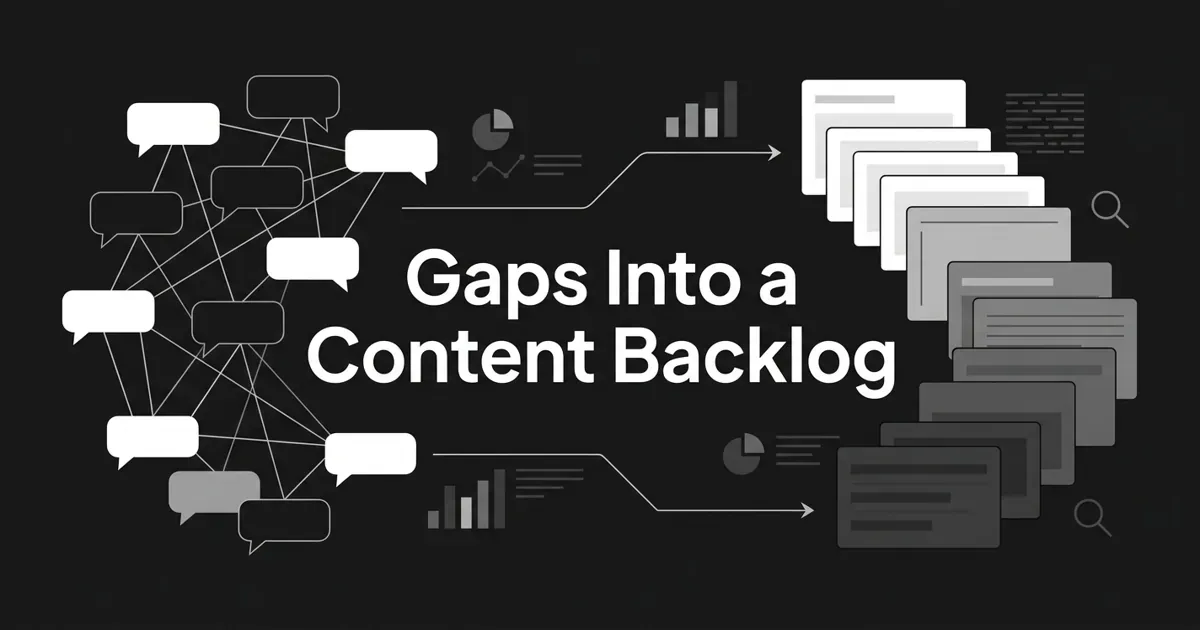
Now convert the validated gap into one card a writer can execute without another strategy meeting. The path from citation gap to content runs through this card, and this is where a content backlog from AI gaps becomes real work instead of a spreadsheet of wishes.
| Backlog field | What to capture |
|---|---|
| Evidence statement | The exact answer observation, and why it is a gap |
| Primary buyer question | The one question this page will answer |
| Audience and funnel stage | Who needs it, and whether the job is Awareness, Consideration, or Decision |
| Gap type and action | The type from Step 2, then create, refresh, support, consolidate, or hold |
| Working angle | Your useful point of view, not a rewritten competitor title |
| Answer target | The one or two sentence answer the page must make easy to find |
| Required coverage | The subquestions, definitions, comparisons, and objections the gap implies |
| Unique evidence | First-party data, product docs, SME experience, original analysis |
| Internal content role | Hub, spoke, decision page, comparison, or consolidation target |
| Guardrails | Claims to make, claims to avoid, required reviews |
| Owner, effort, and completion test | Who is accountable, how big the job is, and what closes it |
A produce-ready card is never "write an article about topic X." It says who the piece is for, which answer it must own, what evidence makes it credible, and how you will judge the result.
If building those cards by hand sounds heavy, that is because it is. DeepSmith's Opportunity Agents read your AI Visibility and Content Map data and return ideas with the justifying data point attached: get cited for a tracked prompt, turn mentions into citations, take a competitor's citations, fix how AI describes you, grow a funnel stage. Every idea travels with its evidence, so you can defend the backlog instead of guessing. They land in New Ideas, the single backlog in Content Studio.
Pro tip: keep the evidence statement attached to the idea all the way through planning and production. The moment an idea gets separated from the answer that justified it, your data-driven content pipeline turns back into a brainstorm list.
How to tell it is done: someone who missed the analysis can open the card and know what to make, why it matters, what evidence is allowed, who approves it, and what done means.
Where people go wrong: stuffing a whole topic cluster into one card. One card owns one information job. Create linked cards for the foundation page and each supporting job, and state the dependencies out loud.
Step 5: Score the opportunity and choose what content to produce next
You now have more cards than capacity. That is what a real backlog looks like.
Score each accepted card on five factors, subtract effort, and rank. Here is a starting rubric:
Priority = (2B + 2G + C + E + R) - F
| Factor | Scores 0 | Scores 3 | Scores 5 |
|---|---|---|---|
| B: Business impact | No real audience or offer connection | A qualified use case or awareness play | Directly supports a strategic offer or a decision |
| G: Gap severity | You already own a relevant citation | Mentioned without a source, losing intermittently | Repeated absence, repeated competitor citation, damaging inaccuracy |
| C: Strategic coverage | Isolated topic, no cluster role | Strengthens an existing topic or stage | Fills an untapped core topic or missing decision stage |
| E: Evidence readiness | No defensible evidence or owner | Some internal material, SME work remains | Strong first-party evidence and an accountable expert |
| R: Reuse | One low-value observation | Applies to several related questions | Repeats across prompts and engines, reusable in a cluster |
| F: Effort | A focused refresh or section change | A new article with research and SME review | Original research, heavy dependencies, or a new cluster |
Score every factor 0 to 5, and effort 1 to 5. Then read the result in bands. Roughly 24 to 34 is Now, approved for the next production window if evidence and dependencies are ready. Roughly 16 to 23 is Next, scheduled behind a top item or a prerequisite. Fifteen or below is Hold, so improve the evidence, revisit the business case, or merge it with another card. Recalibrate the bands after a few cycles. They are starting numbers, not laws.
When two cards tie, break in this order:
- A high-intent buyer job beats a broad, low-intent topic.
- Defensible first-party proof beats repeating generic competitor language.
- A missing foundation page comes before its dependent spokes, unless a small refresh unlocks a quick win.
- A repeated competitor citation beats a one-off, unstable answer.
- A problem content can solve beats one blocked by product or legal work.
One caution while you score business impact. A citation is not a click. Pew Research tracked 68,879 Google searches in March 2025 and found people who met an AI summary clicked a traditional result in 8 percent of visits, against 15 percent for people who did not. Score the value of owning the answer, not the traffic you imagine follows it.
How to tell it is done: every accepted card has a score, you can explain that score in plain language, and you can name the tradeoff behind the order. Your first batch is valuable and feasible, not just the loudest gaps.
Where people go wrong: rewarding a gap for being big. A huge gap sometimes means the topic is irrelevant or not solvable with content. Run the evidence gate before you rank anything.
Step 6: Sequence the backlog into a calendar
A ranked list is still not a plan. Dependencies decide the order as much as scores do.
A sequence that works:
- Clear the evidence, SME, product, or legal blockers under valuable items.
- Refresh high-relevance pages that already sit close to the answer.
- Create the missing foundation page for an uncovered topic or stage.
- Add supporting pages for distinct subquestions, objections, and decision jobs.
- Attack competitive citation gaps with original evidence and a clear point of view.
- Consolidate or retire redundant pages where another page owns the job.
- Add distribution tasks after the source article is accepted, not before.
Each calendar entry carries the backlog ID, the page action, the owner, the due date, the dependencies, and the next review point. The original evidence rides along. Give cards explicit statuses so nothing hides: Evidence captured, Triage, Brief ready, Approved, Planned, In production, Published, Recheck. A gap is not closed because an idea reached a spreadsheet.
How to tell it is done: anyone can see what is next, why it is next, who owns it, what must happen first, and what is blocked. You have a finite next batch, not an infinite wish list.
Where people go wrong: filling a quarter with only awareness topics, or only competitor reactions. Balance the cluster so it answers the buyer at the stage the gap came from. And never schedule two pages that will fight each other without deciding which one owns the job.
Step 7: Set the completion test and feed the result back
Every card gets an observable test before it is scheduled. Otherwise "done" means "published," which tells you nothing.
A good test checks that:
- The page or page change exists, and answers the target question near the top.
- It covers the required subquestions and entities without padding.
- It carries original, supportable evidence and a named reviewer.
- It has a clear role in your topic and funnel structure.
- It is crawlable, internally linked, and its important information is available as text.
- Any structured data matches what is visible on the page.
- The next answer observation and its owner are recorded.
Google is direct about this part: normal SEO best practices still apply for AI features, there is no special AI file or markup, no ideal page length, and no requirement that guarantees crawling, indexing, or serving. Write acceptance criteria around usefulness and evidence, not a secret format.
After the next observation, classify what happened instead of instantly commissioning another page:
- Closed: your page is now the cited source, or the description is accurate.
- Partial: the page is relevant, but a subquestion or evidence requirement remains.
- Unchanged: the hypothesis may be wrong, or the answer may simply be volatile.
- Wrong action: the real problem was technical, product-data, or evidence-related.
- Engine-specific: one engine moved and the broader pattern did not.
If it comes back unchanged, return to the gap record before you return to the calendar. Check page fit, crawlability, internal links, freshness, and whether the competitor holds proprietary information you cannot reproduce.
How to tell it is done: the backlog holds the original hypothesis and the outcome. Six months later you can tell "we never tried" apart from "we tried the wrong content action" and "content cannot fix this."
Where people go wrong: promising a time to citation. Optimization studies are directional laboratory results, and answers shift. Use your next scheduled observation, update the record, and move on.
What to do next
Pick your top three evidence-ready cards. Schedule them for the next production window. Record the evidence and the outcome in the same place, then run the loop again.
That is the whole trick. A content backlog from AI gaps turns deciding what content to produce next from a monthly argument into a data-driven content pipeline: observe, classify, map, score, sequence, produce, recheck. You do not need a bigger team for this. You need the loop to run without you holding it together.
If you want tracking and production in one place, so the gap you spot on Monday becomes a scheduled piece on Tuesday, start a free DeepSmith trial and build your first evidence-backed backlog.