If you have sat through a leadership meeting where someone says marketing is the top AI use case in the company, you have probably felt a small flash of pride followed by a nagging doubt. Is that actually true, or is it just the thing everyone repeats because marketing produces the most visible AI output? The honest answer sits in the middle. Marketing is one of the functions where generative AI gets used the most often, and it is one of the functions credited with the biggest revenue impact. But when you look at where companies place their most advanced, most deeply scaled AI systems, marketing is not first. It is not even second. The evidence on this AI use case ranking is mixed, because different studies are measuring different things, and marketing looks strong on some of them and weaker on others.
What "top AI use case" actually means
Before you can settle whether marketing deserves the top spot, you need to agree on what you are ranking. There is no single, industry-standard list of gen AI business use cases sorted from most important to least important. The major research groups that study enterprise AI adoption ask different questions and get different answers, and the six most common measures are worth knowing by name.
Regular use asks a simple question: does your organization use generative AI in this function at all, even occasionally. Most advanced scaled initiative asks something much narrower: where does your single most mature, most deployed AI system live. Agent scaling looks specifically at where autonomous AI agents are being rolled out across the business. Revenue impact asks which functions people credit with growing the top line. Cost impact asks which functions people credit with cutting expenses. Investment priority asks where leadership plans to spend money next.
A function can score high on one of these and low on another, and that is not a contradiction. Marketing can have a lot of people using AI for drafting, research and campaign ideas without hosting the company's single most advanced, most deeply integrated AI system. Both things can be true at once. So when someone tells you marketing is the top AI use case, the first useful question is: top by what measure.
The case for marketing as a leading AI use case
The strongest evidence for marketing sits in two places: how often people report using generative AI in the function, and how often people credit it with revenue gains.
McKinsey's State of AI survey from March 2025, based on 1,491 respondents across 101 countries, found that marketing and sales were among the functions most often reported for regular generative AI use. The range across functions ran from 42% in marketing and sales down to 5% in manufacturing. Seventy one percent of respondents said their organization regularly used generative AI in at least one business function, up from 65% earlier that year. That is a real signal: marketing and sales show up near the top of the list when the question is simply whether people are using the tools.
It is worth being precise about what that number does and does not tell you. Respondents in that survey reported use across an average of three business functions, so the percentages were never meant to add up to 100%, and 42% is not marketing's share of anything, it is the share of organizations that report regular use inside that function. It tells you gen AI business use cases are widespread in marketing. It does not tell you how deep those use cases go.
The newer McKinsey survey, fielded from May through June 2026 with 1,719 respondents across 97 countries, adds a second piece of evidence in marketing's favor. When organizations were asked which functions they credit with revenue gains from AI, marketing and sales came out on top, ahead of product and service development and software engineering. That is a genuinely strong result. If your leadership team is asking where AI is actually moving the revenue needle, marketing and sales are the answer more often than any other function in this survey.
So the evidence for marketing as a leading AI use case is real. It shows up in two separate, credible surveys, on two separate measures: breadth of regular use and reported revenue impact. Anyone building the case for marketing's AI budget can stand on that ground without overstating it.
The case against marketing being number one
Here is where the marketing AI priority story gets more complicated, and where most internal conversations stop short.
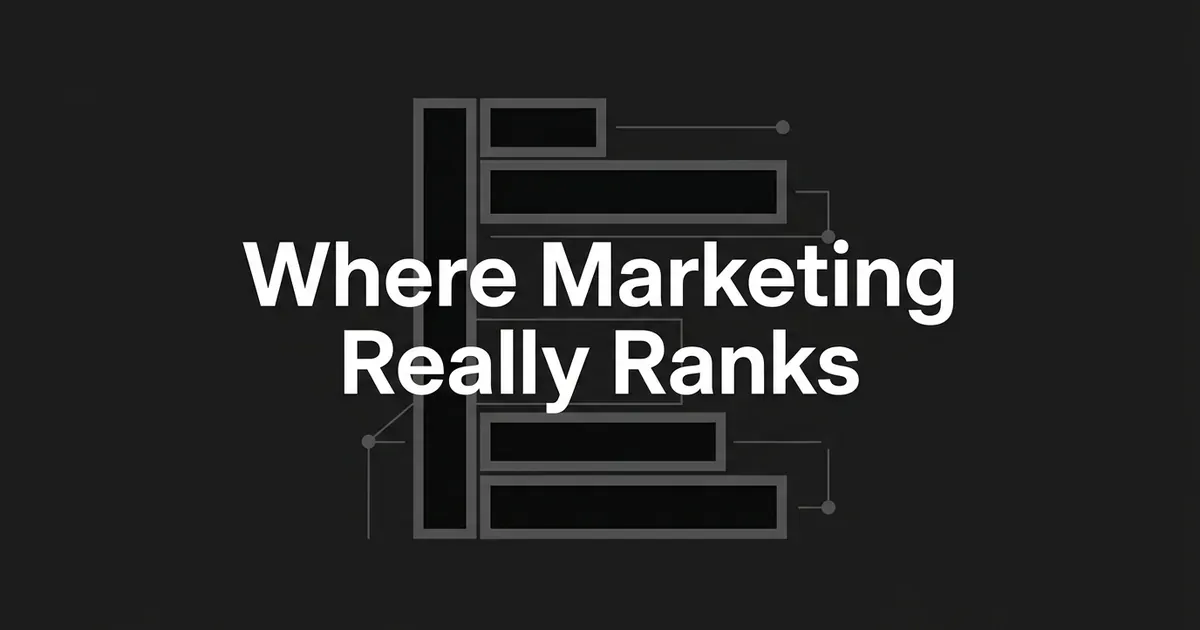
Deloitte's State of Generative AI in the Enterprise report, published in January 2025 from fieldwork conducted in July and September 2024 with 2,773 respondents, asked a much more specific question than McKinsey did. Instead of asking whether a function uses generative AI at all, it asked leaders to think about their organization's most advanced, scaled generative AI initiative and say which function it lives in. The answers were:
| Rank | Function | Share of most advanced scaled GenAI initiatives |
|---|---|---|
| 1 | IT | 28% |
| 2 | Operations | 11% |
| 3 | Marketing | 10% |
| 4 | Customer service | 8% |
| 4 | Cybersecurity | 8% |
| 6 | R&D | 7% |
| 7 | Product development | 6% |
| 8 | Sales | 5% |
| 8 | Supply chain | 5% |
Marketing lands third. It is well ahead of most of the list, but it is a long way behind IT, and a step behind operations. On this specific measure, the one that asks where a company's most mature, most deeply built AI system actually sits, marketing is not the leader. IT is, by a wide margin.
Accenture's October 2024 research points the same direction. Among organizations it classified as having a fully AI-led digital core, developed generative AI use cases showed up in IT at 75%, marketing at 64%, customer service at 59%, and finance at 58%. Marketing is strong here too, second on the list, but IT is still ahead of it even inside the group of companies furthest along on AI.
IBM's Global AI Adoption Index, fielded in November 2023 among 2,342 enterprise IT professionals, adds context rather than a direct function ranking. It found that IT process automation and security and threat detection were the most popular enterprise AI applications, and that 42% of enterprise IT professionals said their organization was actively deploying AI, with another 40% actively exploring it. This study blends general AI with generative AI and only surveyed IT professionals, so it should not be read as a clean marketing versus IT comparison. What it does show is that a lot of enterprise AI attention goes toward infrastructure, security and data work, the kind of investment that does not always show up in a marketing team's dashboard.
What primary sources actually say, separated from interpretation
It helps to keep the direct findings and the explanations for those findings in two separate buckets, because the research does not prove a single cause for the gap.
The direct findings: Deloitte places IT first and marketing third on the most-advanced-initiative measure. Accenture places IT first and marketing second among AI-led organizations. McKinsey places marketing and sales first on regular use and on reported revenue impact. McKinsey's 2026 data also shows AI agents most often being scaled in IT, knowledge management and software engineering, not in marketing, and shows cost reductions most often reported in supply chain, service operations and manufacturing, again not in marketing.
The interpretation, which none of these studies proves directly, is that marketing tends to adopt AI through many smaller, easier-to-launch tasks, drafting, summarizing, research support, personalization, while IT and operations more often host the single large system that changes how data, security or core processes work across the whole company. Deloitte's 2026 transformation framework backs this reading up loosely: it found 34% of organizations were using AI to deeply transform the business, 30% were redesigning key processes, and 37% were using AI at a more surface level with little process change. A marketing team producing more content faster can be a real productivity win while still sitting closer to the surface-level end of that spectrum than a system that has been built into core operations.
BCG's January 2025 research adds one more piece of context: three-quarters of executives named AI a top-three strategic priority, and the quarter of companies that reported creating significant value from AI did so by concentrating on a small set of initiatives and changing core processes around them, not by spreading effort evenly across every function. That pattern, concentrated investment in a few deep initiatives, tends to favor functions like IT and operations, where a single system can touch the whole enterprise.
None of these sources establishes a causal reason for the gap. What they establish, together, is a consistent pattern across four independent research groups: marketing shows up near the top on breadth of use and revenue credit, and consistently behind IT, and often behind operations, on the measure of where the most advanced and deeply scaled system lives.
The verdict, and what to do with it
Grade the evidence as mixed, not weak and not confirmed, because the studies genuinely measure different things and none of them contradicts another once you read the fine print. This AI use case ranking changes depending on which question you ask, and that is the whole point. Is marketing a top generative AI use case in business? Yes, if you mean breadth of regular use or reported revenue impact. No, if you mean the function most likely to host the company's most advanced, most deeply scaled AI initiative, where IT leads by a wide margin and operations comes second.
The practical move for a marketing leader is to stop defending AI investment with adoption numbers alone. Saying "everyone on the team is using it" answers a different question than the one your CFO or CEO is actually asking. Instead, separate experimentation and regular use from production-grade systems that touch revenue, retention or customer experience in a measurable way. Track whether a given use case is changing a workflow, not just whether it is producing content faster. Tie marketing's AI initiatives to a specific business outcome, pipeline quality, conversion, retention, and be ready to say which measure you are winning on and which one you are not.
It also helps to compare marketing against the right function for the question being asked. If the conversation is about revenue growth, marketing and sales have the strongest recent evidence behind them. If the conversation is about enterprise-wide scale, workflow redesign or cost reduction, IT, operations and supply chain currently have the stronger case. A single scorecard with columns for adoption, production scale, business impact and investment required will get you further in that conversation than a single adoption percentage will.
This is also, at its core, a measurement problem. A lot of marketing teams can tell you how many AI-drafted pieces they published this quarter. Far fewer can tell you which of those pieces actually get surfaced when a customer asks an AI engine a real question. DeepSmith exists for that gap. It tracks how AI engines like ChatGPT and Perplexity answer the questions your buyers actually ask, and it shows which of your pages are earning citations. It also flags which competitor pages are winning instead, then turns those specific gaps into content your team can produce without starting from a blank page. That will not change where marketing sits in a Deloitte survey. It does give you a way to show, with your own data, exactly what your AI investment in marketing is producing.

What would change this verdict
A future survey that directly compared marketing and IT on the same measure, using the same definition of "advanced" and the same time period, would settle the marketing AI priority question more cleanly than the current patchwork of studies does. Until then, the fairest summary is that marketing earns its reputation as a heavily used, revenue-credited AI function, while a different measure entirely, the location of the most advanced scaled initiative, currently favors IT and operations. Both statements can be true, and the studies that back them are not arguing with each other so much as counting different things.