Your buyers are asking AI a question about your category right now. The answer they get names a handful of brands. If yours is not one of them, you never find out, and you never get the chance to compete.
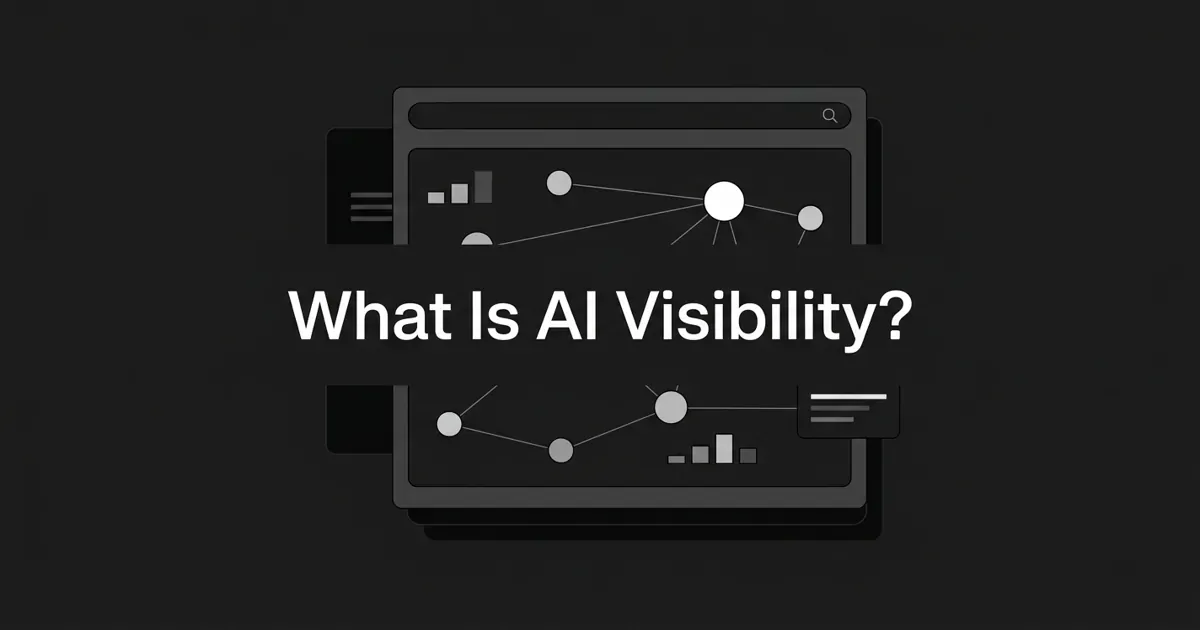
That is the problem AI visibility names. So what is AI visibility, in one plain sentence? It is how often, how accurately, and how favorably your brand shows up in the answers that AI engines like ChatGPT, Gemini, and Perplexity give when someone asks about your space.
If that feels like a whole new thing to worry about on top of SEO, take a breath. It is not as strange as it sounds, and you do not have to master all of it this week. In the next few minutes you will get a clear definition, the handful of metrics that actually measure it, and a plain look at how that measurement works under the hood. By the end you will know exactly what to look at first.
Let's start with the definition.
What AI visibility means: presence, attribution, and standing
Here is the clean version. The AI visibility definition most of the industry now uses is the measure of how often, how accurately, and how prominently your brand appears in responses from AI-powered search and assistant engines.
Three smaller ideas live inside that sentence, and pulling them apart is the fastest way to make the AI visibility meaning stick. Get these three straight and the rest of the AI visibility meaning falls into place on its own.
Presence is whether your brand name shows up in the answer at all, with or without a link. When someone asks an assistant "what are the best options for X," presence is simply whether you made the list.
Attribution is whether the engine actually points to your own site as the source behind a claim. This is the citation, the little link or named source. Attribution is harder to earn than presence, because the model has to trust your page enough to stand behind it.
Standing is your slice of the whole conversation. Out of all the brands named in your category across these engines, how much of that space is yours versus your competitors'? That is your share of the answer.
You will see a few different labels for the same idea. Some people say AI search visibility, some say generative engine visibility, some say answer-engine visibility. Treat them as the same thing. They all point at one question: when AI answers for your category, do you show up, and how well?
One more distinction worth keeping. Being mentioned is not the same as being framed well. A model can name you often and still cast you as "the budget option" while it calls a rival "the leader." Presence without the right framing is a shaky win. We will come back to that when we talk about sentiment.
Why AI visibility suddenly matters
If this was not on your radar a year ago, you are not behind. It moved from niche SEO jargon to a board-level question fast, and three shifts pushed it there.
The first is that search increasingly ends without a click. More than 60% of Google searches now finish on the results page itself, with no visit to any outside site, and that share has climbed steadily over the last several years, up from around half a decade ago. When AI answers sit at the top, they pull clicks away from the leading organic result too. There is a twist worth noticing: the clicks that do survive tend to convert better, because the person who still clicks through after reading an AI summary is further along and more serious. The traffic shrinks, but the intent behind it sharpens. Either way, the volume you used to count on is quietly getting absorbed into the answer itself.
The second shift is bigger, and it changes who decides. When a buyer asks ChatGPT "what is the best tool for a small team," the model hands back three to five names. That short list is the buyer's shortlist. The choice about which brands make the cut has moved from the search results page to the model itself. If you are not in the answer, you are not in the running, and no amount of ranking on page one fixes that.
The third shift is why this feels so slippery. AI engines do not publish rankings, crawl logs, or a tidy checklist the way Google search does. Brands kept discovering they were invisible or described wrong, with no dashboard to explain why. That gap is exactly what AI visibility measurement grew up to fill.
Put those together and the stakes are simple. A growing share of buying journeys now starts inside an AI answer, and for the first time you cannot see your position in it without deliberately measuring. That is the whole reason this metric exists.
How is AI visibility measured? The core metrics
Good news: the vocabulary here is small. Once you know a handful of metrics, most tools and reports will make sense. So how is AI visibility measured in practice? With six metrics, taken one at a time.
Mention rate is your headline "are we even here" number. It is the share of AI answers to your tracked questions that include your brand name at all. Simple, and the first thing to check.
Citation rate is the share of answers that link to or attribute a claim to your own domain. This is the trust signal. It is harder to win than a mention, because the engine has to point at a specific page of yours as the source. A telling pattern from the research: models mention brands far more often than they cite them, and only around a quarter of brands manage to earn both mentions and citations at a healthy rate. Most get one or the other.
Share of voice is your standing, expressed as a percentage. It is your slice of all the mentions (or all the citations) in your category across the engines you track. As a rough gut check, sitting under about 15% share of voice usually signals a real gap to the leaders in your space. You will sometimes see a close cousin called share of citation, which measures the same idea but counts only the cited sources rather than every brand name. It is a stricter, higher bar, because it tracks who the engines actually trust as a source, not just who they happen to name.
Sentiment is how you are described: positive, neutral, or negative. This is the framing question from earlier. Are you "a leading platform" or "a cheaper alternative"? Sentiment scoring is directional rather than exact, so read it as a tone reading, not a precise grade.
Position is where you land in the answer. First name mentioned, top three, buried near the end, or absent. Being the first brand an AI names is the closest thing to ranking number one on Google, and it carries outsized weight.
Visibility trend is the change in any of these over time. This one matters more than any single reading, and here is why. AI answers wobble. Ask the same engine the same question twice and you can get different brand lists. So a one-day snapshot lies. The trend line, measured over weeks, is the number you can actually trust.
You do not need all six from day one. Pick the two or three that match your goal. Chasing pure awareness? Watch mention rate and share of voice. Trying to be cited as a source? Citation rate and position are your pair. If you want a fuller walkthrough of which of these to track and where each one misleads, that is a topic worth going deep on separately.
How the measurement actually works
So where do these numbers come from? Almost every AI visibility platform runs the same basic pipeline. Understanding it demystifies the whole thing, and this is AI search visibility explained in five plain steps. Follow the pipeline once and you have AI search visibility explained well enough to read any tool's dashboard with confidence.
Step one: build a prompt set. You start with the real questions a buyer would type. Most tools group them three ways: category questions ("best tool for startups"), comparison questions ("Brand A vs Brand B"), and branded questions that include your name (to confirm the model even knows you exist). A working set usually runs from a few dozen to a few hundred questions per topic. A good shortcut is to start from the keywords you already track for SEO, then add the language your sales and support teams hear from real buyers, and map each question to a buyer stage so you know what part of the funnel it covers.
Step two: send those prompts to the engines. The platform asks each question across the AI engines it covers. Five engines is a common baseline, with ChatGPT almost always in the mix because it holds roughly three-quarters of the AI chatbot market. Broader plans add more, because tracking a single engine gives you a misleadingly narrow view.
Step three: sample, repeat, and aggregate. Because answers vary run to run, each prompt gets asked many times across the reporting window, usually daily or weekly. The tool then rolls all those individual answers up into your brand-level metrics and slices them by engine, question type, or buyer stage.
Step four: parse each answer. Software reads every response for your brand name (a mention), for any link to your domain (a citation), for where you land in an ordered list (position), and for tone (sentiment). Sentiment is typically judged by a smaller model acting as a scorer.
Step five: report on a cadence. Daily for active optimization, weekly or monthly for the leadership update. The output is a dashboard of trends rather than a single grade.
There is a sixth thread running alongside all of this that is easy to miss but very useful: source analysis. Tools also track which outside sites the engines lean on when they answer questions in your category. This is the bridge from "are we visible" to "why or why not." The mix is often surprising. Wikipedia drives a huge share of what ChatGPT cites, while Reddit drives a huge share of what Perplexity cites, and the same source rarely shows up across both. In fact, only about one in ten cited sources overlaps between engines. Each engine is almost its own ecosystem.
Two honest caveats before you trust any number. First, these answers are non-deterministic by design. Independent studies, including a widely shared one in early 2026, keep confirming that the same prompt returns different recommendations on different runs, so a single score is noisy and trend is the real signal. Second, AI engines are not always accurate. One well-known study of AI search tools found they failed to retrieve correct source information in more than 60% of tests. Measuring visibility is partly about catching where an engine gets you wrong, not just whether it names you.
AEO, GEO, and LLMO: the words for fixing it
Once you start measuring, you will bump into three acronyms for the work of improving your visibility. They sound like competing camps. For most teams, they are close enough to treat as the same job.
AEO (Answer Engine Optimization) focuses on being the direct answer inside an AI response, which means clear, snippet-friendly content that a model can lift.
GEO (Generative Engine Optimization) focuses on getting cited inside generative answers. It is a slightly broader framing, and the term traces back to a 2023 academic paper.
LLMO (Large Language Model Optimization) aims further upstream at the model itself. It shows up least often in day-to-day marketing talk.
The tactics behind all three overlap heavily: structure your content to answer questions directly, earn presence on the third-party sites engines trust (review platforms, communities, industry press), mark up your entities and pages with clean schema, and make sure AI crawlers can actually reach and read your site. If you want the full progression, our walkthrough of the shift from SEO to AEO lays out how the old playbook changes. And if you are starting cold, there is a first-90-days framework built to move you from zero to a working track-then-write loop.
One sign this discipline is maturing: in May 2026 the industry body AMEC published its GEO Principles, the first shared framework for measuring AI-led discovery. It is early, but it marks the moment AI visibility started shifting from scattered vendor metrics toward something like a professional standard.
Where to start measuring your own AI visibility
Feeling ready to actually look at your numbers? Here is the smallest first step that still counts.
Pick ten to twenty questions your buyers genuinely ask. Run them through the main engines yourself, by hand, and note whether you are mentioned, whether you are cited, and where a competitor beats you. That rough baseline, done once, will teach you more than any amount of reading. From there, a repeatable audit turns that one-time check into an ongoing habit. And benchmarking against your competitors turns raw numbers into a plan.
The manual version breaks down fast, though. A serious prompt set, run across several engines, sampled many times a week, is more than a person can keep up with in a spreadsheet. That is where a measurement platform earns its keep. DeepSmith is built for exactly this: it tracks your mention rate, citation rate, share of voice, and visibility trend across ChatGPT, Gemini, Perplexity, Claude, and Google AI Mode, shows which of your pages get cited, and lays out a competitor leaderboard so you can see who is winning your prompts and where. You define the questions once, and it checks them on a schedule and reports back.
The deeper point is that measurement is only half the loop. Once you can see where you are invisible, the next move is producing the content that closes the gap, because the pages that get cited are the ones written to be citable in the first place. Building the topical authority that engines recognize takes consistent, well-structured content over time, not a single push. Seeing the gap and filling it are two halves of the same job, and the teams that pull ahead do both on a rhythm.
None of this has to happen at once. The whole point of an AI visibility definition this clean is that it hands you a starting line: know what presence, attribution, and standing mean, pick the two metrics that match your goal, run one baseline, and let the trend teach you the rest. That is how AI visibility is measured in practice, one honest reading at a time.
Not sure where to start? Start with the baseline. You only need ten questions and an afternoon to know exactly where you stand. Want the whole loop, measurement plus the on-brand content to close the gaps, handled in one place? You can start a free DeepSmith trial and see your real numbers before you commit to anything.