Writesonic and Conductor both let you start without a credit card, but only Writesonic tells you what comes next, with a published Starter price of $99 a month. Conductor gives you a longer trial and no public prices, so a small team has to book a sales conversation to learn its budget. DeepSmith is the alternative that pairs a 7-day trial with published prices from $99 a month, no long-term contracts, and publish-ready articles on every plan.
If you run a small team and want to start self-serve on a budget, the choice between Writesonic and Conductor comes down to what happens after the trial ends. Both offer one with no card. Writesonic shows its prices, and Conductor sells through its sales team, which matters when you are planning a budget ahead of time. DeepSmith sits next to both with published prices of its own. This page covers Writesonic vs Conductor for small teams only, and the full Writesonic vs Conductor comparison is on its own page.
Writesonic vs Conductor for small teams: the short answer
- Choose DeepSmith if you want to track AI answers and publish the articles that close the gaps on one plan, with a 7-day trial, prices from $99 a month, and no long-term contracts.
- Choose Writesonic if you want the lower-risk start between the two, since the Starter plan is $99 a month ($79 billed annually) and the limits for each tier are on the pricing page.
- Choose Conductor if you are buying SEO, AI search tracking and site monitoring together, you are comfortable with a sales process, and you want a 3-week trial before you ask for a quote.
Comparison table
| Criterion | DeepSmith | Writesonic | Conductor |
|---|---|---|---|
| Entry price (monthly) | $99/mo (Pro) | $99/mo (Starter) | Not published |
| Entry price (billed annually) | $80/mo | $79/mo | Not published |
| Free trial | 7 days | 7 days, no card | 3 weeks, no card |
| Prompts at entry tier | 50 | 50 | Not published |
| Engines at entry tier | ChatGPT | ChatGPT, Gemini, Google AI Overviews | Not published per plan |
| Seats at entry tier | 5 | 1 user | Not published |
| Articles at entry tier | 20 per month | 15 per month | 60 drafts per year |
| Publishes directly to a CMS | Yes | Yes, WordPress on every plan | No |
| Contract terms | No long-term contracts | Not listed | Order form, auto-renews unless 90 days' notice |
| Review rating | 4.8/5 on G2 | 4.7/5 on G2 | 4.5/5 on G2 |
Pricing and features as of September 2026, from each vendor's site and public reviews.
Writesonic
Writesonic began as an AI writing tool in 2021 and now sells itself as an AI search growth engine. It tracks prompts daily across AI engines, reports mentions, citations, share of voice and sentiment, and adds an Article Writer and agents for the content work.

For a small team, the useful part is how much is written down. The pricing page lists prompts, daily answers, articles, site audits, users and projects for each plan. Starter covers 50 prompts, one user, one project and 15 articles a month. Basic is $199 a month billed annually and Growth is $399, and the monthly prices for those two are not shown on the pricing page. The self-serve plans track three engines, ChatGPT, Gemini and Google AI Overviews, and the full ten-engine list sits on custom Enterprise plans, along with most of the action features. Growth gets a limited Action Center, and Starter and Basic get none.
Writesonic is rated 4.7/5 on G2 from 2,133 reviews, checked in September 2026. Most of those reviews describe the older writing product, and the reviews of the visibility product are fewer. The recurring complaints are about pricing, credit limits and plan allowances that change. If engine coverage on the self-serve plans is your main question, AthenaHQ vs Writesonic looks at that in detail, and the list of Writesonic alternatives covers other options.
Conductor
Conductor was founded in 2006 and is an enterprise SEO and AEO platform. It has four connected products, Intelligence for AI search and keyword reporting, Creator for writing, Monitoring for always-on site checks, and AgentStack for apps, an MCP server and data access. It tracks eight engines, including ChatGPT, Google AI Overviews, Gemini, Perplexity, Claude, Copilot and Grok.

The plans are Essentials, Growth and Enterprise. Essentials is described as being for smaller teams, and it lists 3 tracked websites, 5 tracked competitors, 500 tracked keywords and 60 drafts a year. No plan has a dollar price on the page, and seats, prompt limits and which engines each plan can track are not published either. Reviewers on G2, where Conductor is rated 4.5/5 from 788 reviews, praise the support and the way AI visibility sits next to traditional SEO reporting. They also say the price and scope can be hard to justify for smaller teams. Otterly.AI vs Conductor covers the same published tiers or usage contract question for another tracker.
DeepSmith: the alternative that publishes its prices and its articles
For a small team that wants to start self-serve, the gap in this pair is about terms. Writesonic publishes its prices, but the full engine list and most action features sit on custom Enterprise plans, and Conductor offers a longer trial but keeps its prices behind a sales call. Neither one gives you a plan where the price, the trial and the cancellation terms are all stated up front and where the tracking and the finished articles come together.
DeepSmith does that. It tracks how AI engines answer questions about your brand and produces the on-brand content that closes the gaps, from the same data. You start with a 7-day trial, and the plans are published at $99 a month for Pro ($80 billed annually), $199 for Grow ($160) and $399 for Scale ($299). There are no long-term contracts and no cancellation fees. Pro includes 20 articles a month, 50 tracked prompts and 5 seats, and Pro tracks ChatGPT while Grow adds Perplexity and Scale adds Gemini.

The tracking side is the AEO module. It reports mention rate, citation rate and share of voice, a per-platform breakdown, and a competitor leaderboard, and it shows which of your pages AI actually cites.

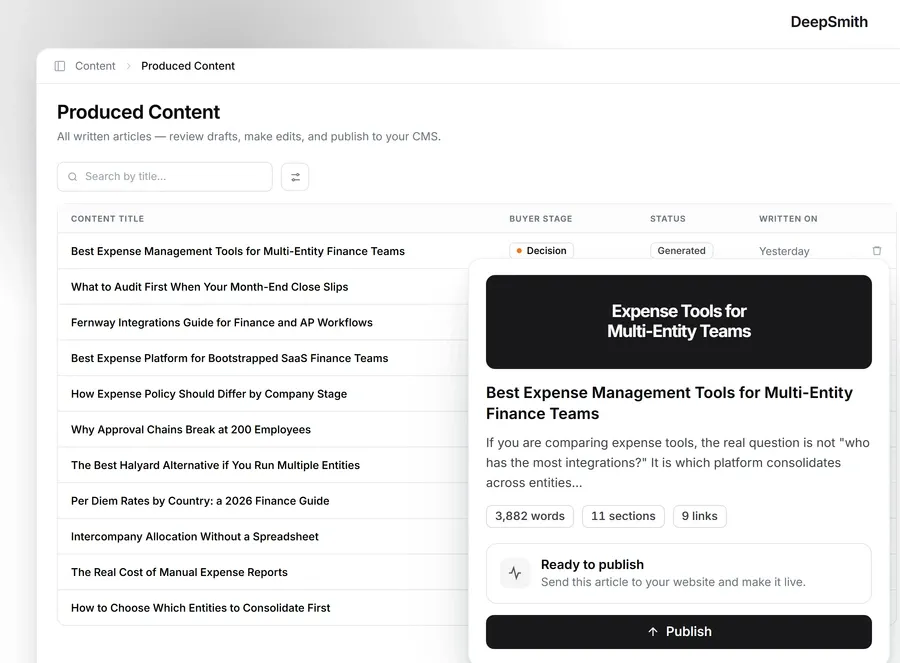
The production side starts from the gaps that tracking finds. Opportunity Agents turn them into ideas with the evidence attached, and the Writer turns a planned idea into a researched, linked article with a cover image and metadata, grounded in your brand context in Deep IQ. Finished articles land in Produced Content, where you review them and publish to WordPress, Webflow, Strapi, Sanity or Contentful, or to your own webhooks.
DeepSmith is rated 4.8/5 on G2. For a small team, this means one plan to budget for, and the articles are included in it. DeepSmith vs Writesonic goes further into how the two compare on tracking and writing, and the minimum content ops stack for a lean team shows where this fits in a small team's workflow.
Trial terms
Conductor has the longer trial, and Writesonic has the one that leads to a price you can already see. Conductor advertises 3 weeks free with no card, for Creator, Intelligence or Monitoring. Writesonic offers 7 days with no card on Starter, Basic and Growth.
A longer trial helps less than it sounds when the entitlements are unclear. Conductor does not say whether its trial includes AI Search credits or which engines you can track, so you may end three weeks having tested the writing tool and only part of the tracking. A shorter trial works better when you already know the plan you would be paying for, because you can judge each limit as you use it. In most cases that gives Writesonic the edge in a Writesonic vs Conductor small teams decision, although the evidence here comes from each vendor's own pages, not from trial reports.
Price visibility and budgeting
Writesonic is the clear winner on this axis. You can read the price of Starter before you sign up, and you can compare the prompts, articles and seats of each tier against your own plan. The one gap is that monthly prices for Basic and Growth are not shown, only the annual ones.
Conductor publishes allowances such as 2,500 AI Search credits a year on Essentials and Growth, but no dollar amounts, so a quote is the only way to get a number. The credits are also harder to plan around than a prompt count. Third-party research reports per-response costs that run from 0.1 credits for Google AI Overviews to 2 for ChatGPT Search, so how many answers you can track depends on which engines you pick. Our reading is that this suits a team with a procurement process and is harder to fit into a small budget. It is also part of the wider shift to usage-based pricing in AI tools.
What DeepSmith does: it publishes every plan, from Pro at $99 a month to Scale at $399, with fixed tracked prompts, seats and monthly articles, so the number you see is the number you plan around.
Contract commitment
Conductor's published US terms (dated 2024-05-03) say that fees are set in an order form, invoiced in advance, noncancellable and nonrefundable by default. Subscriptions renew automatically unless you give at least 90 days' written notice. The terms do not establish a month-to-month option, so a small team should read the order form before it signs. Writesonic's cancellation and refund terms were not captured in the pages checked, so confirm them before you pay.
On this axis Conductor's terms favor longer commitments, and Writesonic's are unconfirmed, so Writesonic is the safer starting point of the two by default.
What DeepSmith does: it sells monthly or annual plans with no long-term contracts and no cancellation fees, so a team can start on Pro and move up or down as its publishing volume changes.
From insight to action
Both tools do more than track. Conductor's Recommendations panel prioritizes actions and links into Writing Assistant, which produces outlines and drafts, and it states that final publishing remains in your CMS. Writesonic's Article Writer claims publish-ready long-form articles and exports to WordPress on every plan, plus Sanity, Contentful, Webflow and Ghost. For a small team that wants to publish, Writesonic has the shorter path, and it fits a team that is mostly looking for writing help.
What DeepSmith does: it takes the tracking data straight into production. Opportunity Agents return ideas with the data point that justifies each one, Autowrite can write planned articles on their scheduled dates, and every finished article arrives with social posts already written. Every plan includes this, not only the tracking.
Which should you choose
When the question is Writesonic or Conductor for small teams, the answer depends on how much of the buying process you want to take on.
- DeepSmith fits a small team that wants to start self-serve, see the whole price list before the trial, and get both AI visibility tracking and publish-ready articles on one plan with no contract. It is also the broadest option if you are still deciding how much of the work you want to do in-house.
- Writesonic fits a small team that has narrowed the choice to this pair and wants a visible price, a quick trial, and tracking of three engines on a self-serve plan.
- Conductor fits a team that already buys enterprise SEO software, wants AI search tracking and site monitoring in one system, and is ready to start with a quote and an order form.
If you want a wider view of the options, the list of AI visibility tools with a free trial and the guide to AI visibility tools for startups cover more of the field.
Start a DeepSmith free trial and see the tracking and the first articles before you pay.