Right now, someone in your market is asking ChatGPT which tool they should buy. You are not in that room. You cannot see the answer, and you have no idea whether your name came up.
That is unsettling the first time you sit with it. Take a breath, because this is more fixable than it feels.
Here is the shift underneath it. LLM-driven referral traffic has grown roughly 800 percent year over year, and the curve is still steepening. Your buyers are forming first impressions inside AI answers, often without ever clicking through to your site.
You do not need an enterprise budget to see what those answers say. The best AI visibility tools for startups now start at 29 dollars a month, and some useful checkers cost nothing at all. You need one affordable AI visibility tracker, a short list of questions worth tracking, and a rhythm you can keep.
This guide compares the options that a lean team can actually afford and actually run.
What an AI visibility tool actually tracks
Let's define the thing before we shop for it. An AI visibility tool watches three signals.
Mentions. Does an AI answer name your brand when someone asks about your category?
Citations. Does it link to your pages as a source it drew from?
Prompt coverage. Do you show up on the specific buyer-stage questions your real prospects ask, not just the flattering ones you'd think to type yourself?
Two facts make this harder than it sounds, and both argue for a tool rather than a spreadsheet.
First, engines disagree with each other. About 91 percent of URLs cited inside AI answers show up in only one large language model. Your ChatGPT visibility tells you almost nothing about your Perplexity, Gemini, or Claude visibility. Winning one engine is not winning AI search.
Second, the answers move. Identical brand recommendations appear in identical positions less than about 1 percent of the time. Ask the same question twice and you may get two different lists.
So a single lucky result means nothing. Neither does a single bad one. The signal lives in an aggregate of many prompts, checked on a schedule, which is exactly the work a tool exists to do.
That is also why founders struggle here specifically. You are wearing the marketing hat between two other jobs. You cannot justify a 400 dollar a month enterprise platform, and you need a usable answer in under 30 minutes of setup, not a six-week onboarding. Any tool worth calling startup AI search visibility software has to respect both of those limits.
How we picked these tools
A roundup is only as trustworthy as its criteria, so here are ours before the list. We scored every option against eight things that matter to a founder rather than to a Fortune 500 marketing department.
- Entry cost. The real monthly price at the lowest paid tier, and whether a genuine free tier or no-credit-card trial exists.
- Time to first insight. How many setup steps stand between you and a real result.
- Engine coverage. How many distinct LLMs and AI surfaces the tool watches.
- Prompt volume. The hard cap on tracked prompts at the entry tier, because that cap decides what you can actually monitor.
- Brand-context signals. Sentiment, position, share of voice, citation URLs, competitor deltas.
- Action layer. Does the tool only show you the gap, or does it help you close it?
- Reporting and export. CSV, API, Looker Studio, scheduled reports.
- Honesty floor. Real published pricing or a clearly documented free tier. No sales call required to learn the number.
We deliberately left out enterprise governance suites and agency multi-client platforms. If a tool needs procurement and a five-figure contract to get moving, it is not a startup AI search visibility tool, whatever its marketing says.
One honest caveat before the table. "Best" depends on your goal. The cheapest credible option is not the same as the broadest engine coverage, and neither is the same as the tool that also writes your content. We will name which tool wins which dimension so you can choose for your situation.
Quick comparison table
| Tool | Starting price | Engines tracked | Prompts (entry tier) | Free option | Best for |
|---|---|---|---|---|---|
| DeepSmith | 99/mo (80/mo annual) | ChatGPT on Pro; +Perplexity on Grow; +Gemini on Scale; all 10 on Enterprise | 50 on Pro | 7-day trial | Tracking plus publish-ready content in one platform |
| Otterly.AI | 29/mo (25/mo annual) | ChatGPT, Google AI Overviews, Perplexity, Copilot; Claude, Google AI Mode, Gemini as 59/mo add-ons | 15 on Lite | Free trial | The cheapest credible entry point |
| LLMrefs | 79/mo (launch price) | 10 engines including ChatGPT, Gemini, Claude, Perplexity, Grok, Copilot, Meta AI, DeepSeek | 500 | 7-day trial, no card | The broadest engine coverage per dollar |
| Semrush Checker | Free | ChatGPT, Gemini, Google AI Overviews, SearchGPT, Perplexity | One-shot snapshot | Free, no signup | A zero-cost sanity check with a gap list |
| Ahrefs Checker | Free | ChatGPT, Gemini, Perplexity, Copilot, Google AI Overviews, AI Mode | One-shot snapshot | Free, no signup | A fast read across the biggest surfaces |
| Frase Checker | Free | ChatGPT, Perplexity, Claude, Gemini, Google AI | One-shot snapshot | Free | Teams already evaluating Frase |
| Writesonic Tracker | Free tier | ChatGPT, Gemini, Perplexity, Claude, Google AI Overviews | Limited on free tier | Free tier | Existing Writesonic customers |
Prices and caps come from each vendor's public pricing page. This category changes pricing often, so confirm before you buy.
1. DeepSmith
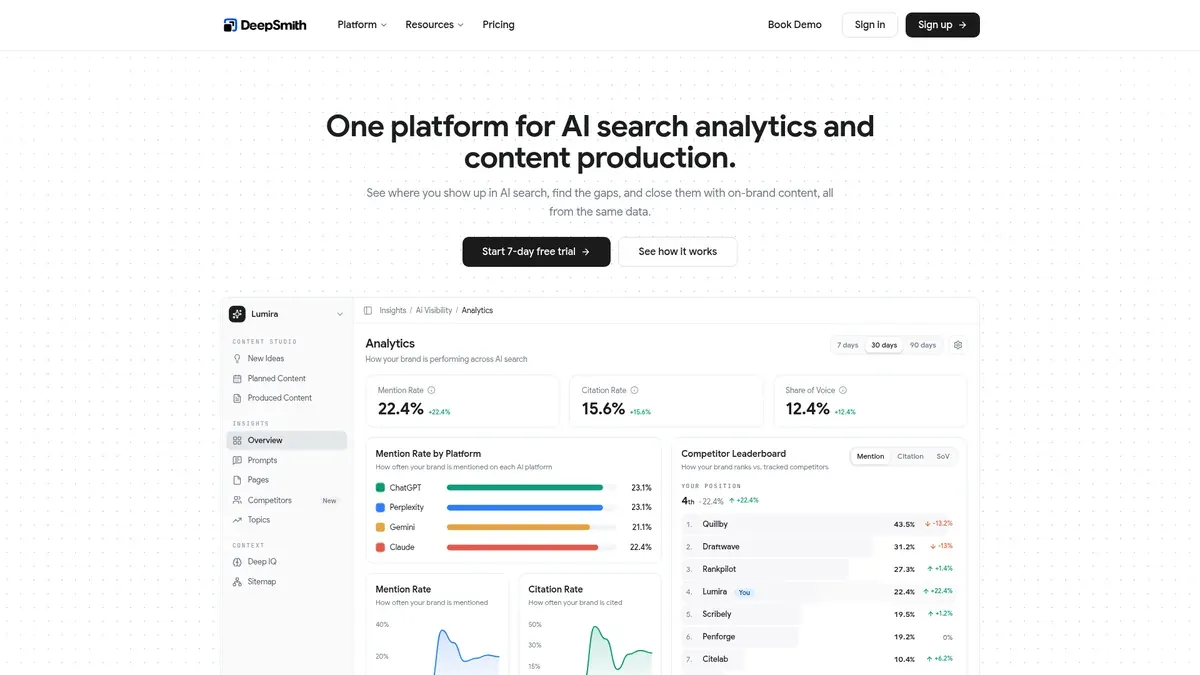
Best for: a founder who wants to see where they are invisible in AI answers and ship the content that fixes it, without stitching two subscriptions together.
Every other tool on this list hands you a diagnosis. DeepSmith is an AI search analytics and content production platform in one, so the same data that finds the gap also drives the on-brand article that closes it.
Here is why that matters when you are the whole marketing team. When your tracker and your writer are separate products, you become the glue between them. You export the gap, you brief the writer, you paste it back. That connective work is unpaid, invisible, and it is usually the first thing to slip in a busy week. Closing the loop inside one platform is what keeps the gap you found on Monday from still being open in six weeks.
Key features:
- Mention rate, citation rate, share of voice, sentiment, and visibility trend, with a per-platform breakdown and a competitor leaderboard.
- A Prompts view with per-prompt mention and citation rates plus full answer history, so you can debug a specific question rather than guess.
- Discover Prompts, which generates a starter prompt set from your product, persona, and buyer-stage context. Useful when you do not yet know what to track.
- A Pages view showing which of your URLs actually earn citations and which prompts drive them.
- Competitor citations: who wins your prompts, on which exact pages, on which platforms.
- The Writer turns one planned idea into a finished, brand-grounded article with research, internal and external links, a cover image, and publish-ready metadata.
- Autowrite runs configured articles on their scheduled dates with nobody in the app, landing them in Produced Content.
- Publishing straight to WordPress, Webflow, Strapi, Sanity, or Contentful, or to your own webhooks, with Markdown and HTML export as a fallback.
- Every finished article arrives with social posts already drafted, plus an Apps Library for LinkedIn, X, Medium, Substack, newsletter, Reddit, and more.
- Deep IQ stores your positioning, personas, brand voice, and product facts once, so output sounds like you instead of like a generic model.

Pricing: Pro is 99 dollars a month, or 80 dollars a month billed annually, with 20 articles, 50 tracked prompts, 5 competitors, 5 seats, and ChatGPT tracking. Grow is 199 dollars a month, or 160 annually, and adds Perplexity, 40 articles, and 100 prompts. Scale is 399 dollars a month, or 299 annually, and adds Gemini, 90 articles, and 200 prompts. Enterprise is custom and covers all ten tracked engines, including Claude, Google AI Overviews, Google AI Mode, Grok, Meta AI, Copilot, and DeepSeek. There is a 7-day free trial with real data and real drafts before you pay, no long-term contracts, and no cancellation fees.

The honest limitation: engine coverage climbs with price. Pro tracks ChatGPT only, and the full ten-engine view sits on custom-priced Enterprise. So the honest boundary here is a tier boundary rather than a coverage gap: if your one requirement is watching ten engines on a startup budget, LLMrefs gets you there for less. Worth knowing what that breadth actually buys, though. LLMrefs reports scores without full answer history and adds no content layer, so it shows you where you are invisible without helping you fix it. And most startup buyers live on ChatGPT and Perplexity first, which is Pro and Grow, so the engines that matter most arrive well before you ever reach for Enterprise. The 7-day trial is also short, so know which prompts you want to track before you start it, or you will spend the window setting up instead of learning something. Analytics here are AI-search focused too, so this does not replace your web analytics or a classic rank tracker.
2. Otterly.AI

Best for: solo marketers and very small teams who want the lowest credible entry price and do not yet need multi-engine coverage.
Otterly.AI is an AI search monitoring tool built around brand visibility, sentiment, and share of voice. At 29 dollars a month it is the easiest yes on this list, and it is the friendliest on-ramp if you have never done this before.
The standout is the Brand Visibility Index, an at-a-glance share of AI voice showing the percentage of citations you own versus competitors. Sentiment analysis sits alongside it, and among the paid options here only DeepSmith also tracks sentiment. Knowing that AI mentions you is one thing. Knowing whether it frames you as the budget option or the serious one is a different and useful thing.
Key features:
- Brand Visibility Index (share of AI voice) with sentiment analysis on mentions.
- Domain Ranking, showing which domains get cited for your prompts.
- Link Citations Analysis, showing the exact source URLs the LLMs pull from.
- GEO Audit for page-level generative-engine readiness.
- A prompt and keyword research tool to help you build the prompt library.
- Brand reports, exports, and support across 50-plus countries.
- Google Looker Studio connector on Standard and above.
Pricing: Lite is 29 dollars a month, or 25 annually, with 15 prompts, 1,000 GEO URL audits, one workspace, and unlimited brand reports and team members. Standard is 189 a month, or 160 annually, with 100 prompts and API access. Premium is 489 a month, or 422 annually, with 400 prompts. Annual billing saves 15 percent, and a free trial is available.
The honest limitation: the bundled engines are ChatGPT, Google AI Overviews, Perplexity, and Copilot. Claude, Google AI Mode, and Gemini are add-ons at 59 dollars each per month. Want all three? Your 29 dollar tracker is now a 206 dollar tracker. The 15-prompt cap on Lite is tight too, and a modest set of buyer-stage questions will eat it quickly. There is no content layer, so closing a gap means bringing your own writer.
3. LLMrefs

Best for: SEO-led teams who want the widest engine list in one subscription and who think in keywords rather than conversational prompts.
LLMrefs is a keyword-style LLM rank tracker. If you have lived in classic rank trackers, the model will feel immediately familiar: you track terms, you watch scores, you benchmark competitors, you get a weekly refresh.
The pitch is coverage. Ten engines are bundled at one price: ChatGPT including GPT-5, Google AI Overviews, Google AI Mode, Gemini, Perplexity, Claude, Grok, Copilot, Meta AI, and DeepSeek. Remember that 91 percent figure from earlier, where most cited URLs surface in only one model? Breadth is how you find out which engines actually know you exist.
Key features:
- Ten tracked engines in a single subscription, with 500 prompts included.
- The LLMrefs Score and share of voice benchmarking against competitors.
- Citation source URL tracking and filtering.
- Fan-out queries generated from your keywords to simulate real user behavior.
- Geo-targeting across 50-plus countries and 20-plus languages.
- Unlimited team members and projects, so one subscription covers all your domains.
- Bundled extras: an AI crawlability checker, a Reddit threads finder, and an LLMs.txt generator.
- CSV export and API access.
Pricing: one All-in-One plan at 79 dollars a month, advertised as a limited-time launch price, with a 7-day free trial and no credit card required. You can also create a free account.
The honest limitation: there is no sentiment analysis, so you learn that you appeared without learning how you were framed. LLMrefs also aggregates outputs into scores rather than keeping full verbatim answer history, which makes prompt-level debugging harder when you want to know why an answer went the way it did. It launched in 2025, so historical depth is thin, and there is no published enterprise compliance posture such as SOC 2. There is no content production layer either.
4. Free AI visibility checkers: Semrush, Ahrefs, Frase, and Writesonic

Best for: founders who want to know whether they show up at all before spending a dollar.
Not ready to buy? Good instinct. Run a free checker first. These are one-shot snapshots rather than platforms, but they answer the only question that matters on day one: do we even appear in AI answers yet?
Semrush Free AI Search Visibility Checker takes a brand or domain, no signup, and reports across ChatGPT, Gemini, Google AI Overviews, SearchGPT, and Perplexity. You get a visibility score out of 100, mention counts, a per-platform breakdown, cited sources, top industry competitors, and the high-volume prompts where your brand is absent. That last one is effectively a free gap list, and it is the most actionable output of any checker here.
Ahrefs Free AI Visibility Checker takes a brand or competitor name, no signup, and covers ChatGPT, Gemini, Perplexity, Copilot, Google AI Overviews, and Google AI Mode. It returns total mentions, mentions by platform, the top 5 topics associated with your brand, and the top 5 cited domains and pages. Run it on a competitor too. Seeing which topics AI associates with them is a quiet strategy lesson.
Frase Free AI Visibility Checker reports presence across ChatGPT, Perplexity, Claude, Gemini, and Google AI, plus prompt coverage. It is a sample of Frase's paid product, which pairs monitoring with a content workflow.
Writesonic AI Visibility Tracker has a genuine free tier covering ChatGPT, Gemini, Perplexity, Claude, and Google AI Overviews, returning a visibility score, a per-engine breakdown, and a competitor comparison.
The honest limitation: every one of these is a snapshot. Given how much AI answers swing run to run, a single snapshot is a photograph of a moving target. There is no scheduling, no trend line, no alerting, and no prompt-level history. Ahrefs gates ongoing tracking behind paid Brand Radar, and Writesonic gates scheduled monitoring behind its paid plan. Use them to decide whether this channel deserves budget, not to run the channel.
Here is a practical way to use them. Run two or three checkers this week and write the numbers down. That single page of notes is your baseline, and it turns the choice between free checkers and cheap AI visibility software into a concrete decision instead of a theoretical one.
How to choose the right tool for your startup
Stuck between options? Let's make it simple. Match the tool to your actual situation, not to the longest feature list.
Pick Otterly.AI if you need a cheap monitor and nothing else. It is the lowest entry price here, and sentiment at 29 dollars is a real edge over LLMrefs if you care how AI frames you. Just do the add-on math honestly before you commit.
Pick LLMrefs if engine breadth is the priority and you think in keywords. Ten engines and 500 prompts for 79 dollars a month is the widest coverage per dollar in this roundup. Take it if you are comfortable running monitoring without sentiment or a content layer.
Pick a free checker if you genuinely just want to know whether AI search deserves your attention this quarter. There is no shame in starting here. It is the right call more often than vendors admit.
Pick DeepSmith if your time is the bottleneck and you want the platform that found the gap to also draft the article that closes it. For a lean team, one affordable AI visibility tracker that also produces content beats juggling a tracker, a writer, and a publisher. If you only need monitoring and want the cheapest possible line item, Otterly is the more honest fit.
Notice what is not on this list: an enterprise governance suite. You do not need one yet, and cheap AI visibility software will teach you more this quarter than a platform you never finish onboarding.
Your next step this week
You do not have to solve AI visibility all at once. You need a baseline, a short prompt list, and one tool you will actually open.
Start here. Write down the 10 questions a real buyer asks before choosing your category. Run two free checkers against your brand. Note where you are absent. That is 30 minutes, and it turns a vague worry into a list.
Then pick your tool from that list, not from a feature grid.
If you want your tracking and your content engine in one place, start a DeepSmith free trial and see real data and real drafts before you pay. One small step this week beats a perfect plan you never begin.