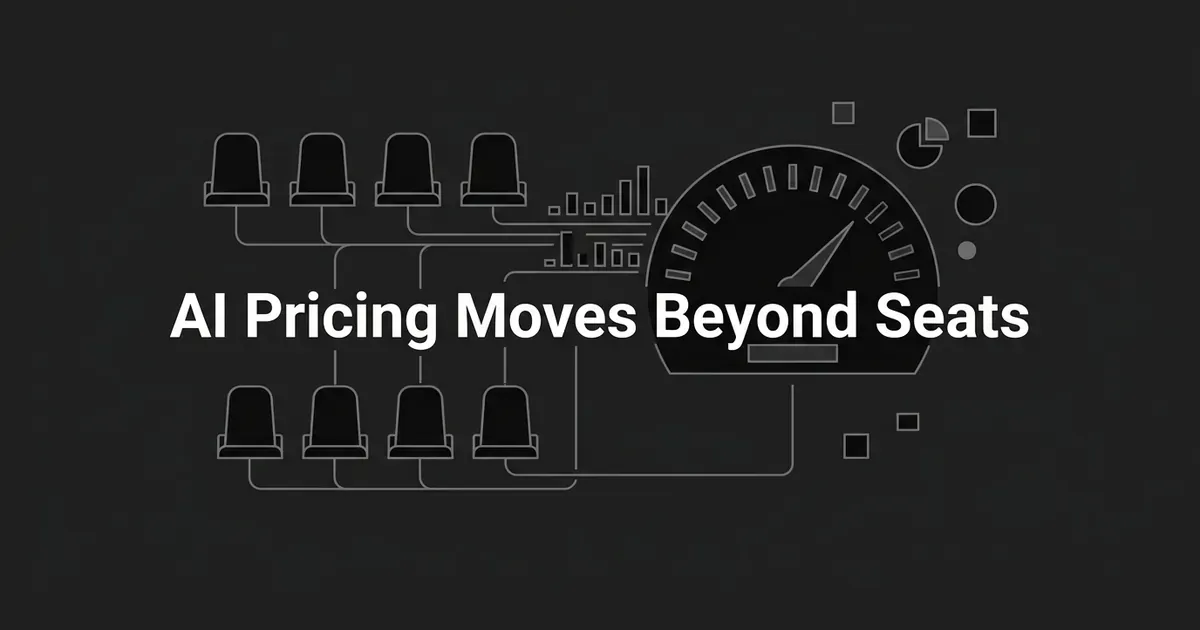
If your AI tool bill has started moving around from month to month, you are not imagining it. AI usage based pricing is spreading because AI features cost the vendor something real every time a model does work, and that cost does not track neatly with how many people are logged in. A vendor that only charges by seat can end up subsidizing the customers who ask the most of the product. So vendors are adding a second meter, usage, credits, or a capacity allowance, on top of the seat or the platform fee, and that second meter is what makes your invoice harder to predict.
This is not the seat going away. Most vendors are layering something new on top of it. Understanding why that layering is happening, and where in your workflow it shows up, is the point of this piece. How to actually plan around it is a separate question for another day.
What usage-based pricing actually means for an AI tool
"Usage-based" gets used loosely, so it helps to separate the AI tool pricing models a vendor might actually be running.
Seat-based pricing charges for a number of human logins. It is easy to forecast and works well when the product's value comes from giving people access to a shared workspace. Its weakness is that a person is not always the thing generating AI work. A background agent can run without anyone actively watching, and one person can trigger far more model activity than another.
Consumption pricing charges for what the system actually processes: input tokens, output tokens, API calls, or compute time. It tracks the vendor's real infrastructure cost closely, which is also why it creates the most uncertainty for a buyer. The bill follows activity, not a plan you picked in advance.
Credit-based pricing wraps usage in a simpler currency. The vendor defines what one credit buys, gives you a monthly allocation, and lets you top up. Credits are friendlier to look at than raw token counts, but a credit is not a standard unit. Two products can both sell "credits" while charging entirely different amounts of underlying work for them, which is why AI credit pricing marketing on a features page rarely tells you the full story on its own.
Capacity pricing commits you to a fixed allowance for a period, whether you use all of it or not. This is often marketed as usage-based, but it is not the same as paying only for what you consume. You are paying for a ceiling, and unused capacity usually does not roll over.
Workflow and outcome pricing charge for a finished unit of work, like a completed draft, or for a defined business result. A completed workflow is easier for a buyer to reason about than a token count, though different tasks can still cost the vendor very different amounts to produce. Outcome pricing is the closest to paying for value, but it only works where the result is easy to observe and attribute, which is rare in marketing.
Hybrid pricing keeps a seat or platform fee and adds usage, credits, or an allowance on top. This is the model doing most of the real work in the market right now, and it is worth understanding on its own.
Why AI vendors are changing the meter
Traditional software has a low marginal cost. Once it is built, serving one more user rarely costs much. AI products do not work that way. Every request calls a model, retrieves context, and sometimes runs several internal steps before returning an answer, and each of those steps costs the vendor money.
Bessemer Venture Partners frames this as a margin problem: AI companies often run at roughly 50% to 60% gross margins, against the 80% to 90% margins that traditional SaaS companies are used to. That is a directional figure from an investor's own analysis rather than a rule every AI product follows, but it points at something real. A vendor charging a flat seat price for a feature with a real, variable cost behind it is exposed every time a customer pushes the feature hard.
The cost of a single AI request is not fixed either. It moves with the model chosen, how much text goes in and comes out, whether an agent makes several internal calls to answer one visible request, and whether the work involves images, video, or audio instead of plain text. OpenAI's own API pricing shows this directly: it prices input tokens, cached input, and output tokens separately, and prices some video generation by the second instead of by the token. None of that maps to a headcount number.
At the same time, the value an AI feature creates is coming loose from the number of seats buying it. An agent can work in the background after one person sets it up. One person's request can produce output that many people use. Bain's research on AI pricing makes the same point: a growing share of AI value is not tied to how many people are logged in, which weakens the logic that made per-seat pricing work so well for the SaaS era before it.
Put those two things together and you can see why vendors are reaching for a second meter. They need a unit that tracks either their own cost or the customer's value, because seats alone no longer do either job reliably. That is the whole reason AI usage based pricing exists as a category, not because vendors decided seats were a bad idea, but because seats stopped covering the cost and the value at the same time.
Why your bill feels harder to predict than it used to
A few mechanics explain most of the unpredictability marketing teams are running into.
One click can trigger many machine actions. When you ask an AI tool to research a topic and draft a report, the system might pull documents, call a model more than once, run a few tool actions, and revise its own output before you see anything. You experience one request. The vendor's meter can see a dozen.
The same request does not always cost the same. A longer conversation, more attached context, or a more detailed answer changes the token count behind the scenes, so a fixed number of people does not add up to a fixed amount of AI work month over month.
Model choice moves the price too. Some products route harder tasks to a more capable, more expensive model automatically. Others let you pick the model yourself. A team can see its bill climb because it started using a stronger model, with the exact same headcount and the exact same number of projects.
Marketing work is also bursty by nature. Content production happens in campaigns and launch pushes, not at a steady daily rate. Stripe's own writing on usage-based billing points out that a single batch job can generate more usage in a few hours than the two weeks before it did, and a flat seat fee simply hides that pattern. A consumption meter does not.
Credit systems add one more layer of fog. Because a credit is a vendor-defined unit, the honest questions to ask are basic ones: what action actually uses a credit, does a stronger model use more of them, are credits shared across the workspace or tied to one person, do unused credits expire, and are overages automatic or something an admin has to turn on. Without answers to those, the AI credit pricing marketing teams see on a landing page tells you very little about what your month will actually cost. Two vendors can both advertise "credits included" and mean two very different monthly bills for the same workload.
Even capacity plans, the ones sold as predictable, carry their own version of this problem. You are committing to an allowance rather than paying only for what you use, so the risk shifts from "an open-ended bill" to "capacity you paid for and did not touch," or a scramble to upgrade mid-campaign when you run out.
Why hybrid pricing is winning the argument
If you look at what vendors are actually doing rather than what the marketing copy says, hybrid pricing is where most of the market is landing. Bain's research covering more than 30 SaaS vendors that added generative AI found that roughly 35% simply raised per-seat prices to bundle AI in, while about 65% added a separate AI meter, usage or feature based, on top of the seat price they already had. None of the vendors in that group had moved to pure usage or outcome pricing with no seat component left at all.
A later Bain analysis, covering close to 200 B2B SaaS companies, found that about one in five AI-native companies were still relying mostly on per-seat licensing. Among the companies adding a hybrid AI meter, close to four out of five chose a capacity model rather than direct, open-ended consumption pricing. Only around one in ten used an outcome-based meter, with the rest split between charging for effort (roughly 35%) and charging for a completed output (roughly 55%).
 Bain, June 2026 analysis of roughly 200 B2B SaaS companies.
Read together, those two data points say something specific: seats are not disappearing, and pure pay-per-use is rarer than the phrase "usage-based" suggests. Vendors are keeping the predictable base that procurement teams like, then layering a second meter on top that lets revenue expand as a customer's actual AI use grows. It is a compromise between a bill customers can approve in a budget meeting and a bill that reflects what the product actually costs the vendor to run.
A capacity-style model is one way vendors try to hold that line. DeepSmith's own plans work this way: a monthly platform fee attached to a set number of articles, tracked prompts, and seats per tier, rather than a raw per-token or per-credit rate card. That kind of structure does not remove the tradeoff entirely, a customer can still outgrow an allowance mid-cycle, but it keeps the monthly number closer to something you can actually plan against.
What this changes for your marketing budget
Under a pure seat model, the main thing you were forecasting was headcount. Under a hybrid or usage model, you are also forecasting behavior: how much research, drafting, revision, and automated output your team is going to generate in a given month.
That means a small team can produce a genuinely large bill if it runs heavy research, long drafting sessions, lots of revisions, or an automated workflow that fires on its own schedule. It also means a bigger team can end up paying less than you would expect if its actual AI usage stays light. Headcount stops being the whole story, in either direction.
It also means the sticker price on a pricing page tells you less than it used to. The number that matters is the relationship between the base fee, what capacity that fee includes, what your team's real workflow is likely to consume, what an overage costs if you go past the allowance, and whether unused capacity expires or rolls over. A low advertised starting price and a much higher real monthly cost at your actual volume can both be true of the same product.
There is a labor angle worth naming too. Bain uses the example of a $40,000 AI agent meant to replace an $80,000 sales development role, and note that for a stretch of time a company often pays for both the new tool and the person it is meant to eventually replace, before any labor saving shows up. The same pattern plays out in marketing. Your AI tool bill can rise for a while even as a founder or a marketing hire keeps reviewing drafts, checking facts, and managing where the content actually goes, because the labor and the tool spend overlap before either one fully replaces the other.
None of this proves usage-based pricing is bad for you specifically. McKinsey's own estimate puts the potential productivity value of generative AI in marketing at somewhere between 5% and 15% of total marketing spend, which is a statement about potential upside, not a guarantee that any particular tool will deliver it or that its pricing is fair. The economic case for AI and the fairness of a specific vendor's meter are two separate questions, and it is worth keeping them separate when you are staring at an invoice that moved.
What this shift does not mean
A few things worth ruling out plainly, because the "usage-based" framing around AI tool pricing models invites some sloppy conclusions.
It does not mean seats are dead. Bain's own research treats that claim as an overstatement, and roughly one in five AI-native companies are still mostly seat-licensed today. Most of the rest layered a meter on top of seats rather than getting rid of them.
It does not mean every "usage" plan charges only for what you use. A large share of what gets marketed as usage-based is actually a fixed capacity allowance, paid for whether or not you touch all of it.
It does not mean credits are comparable across products. A credit only means something inside the rate card of the vendor that defined it, so a number of credits on one pricing page cannot be measured against a number on another.
And it does not mean a bigger bill equals a worse deal, or a smaller one equals a better one. A usage model can lower the entry cost for a light user and raise it for a heavy one, and the honest question is always whether the value you got matches what you paid, not just which direction the number moved.
If you are trying to make sense of a bill that used to be one flat number and is not anymore, the shift itself is the thing to understand first. AI tool pricing models are changing because AI work has a real, variable cost attached to it and creates value that does not track cleanly with headcount, and every credit, allowance, or overage line on your invoice traces back to that basic fact. DeepSmith works from a capacity model for exactly this reason, a monthly plan tied to a defined amount of production and tracking rather than a meter you have to watch in real time, and you can see how that fits your own volume with a free trial.