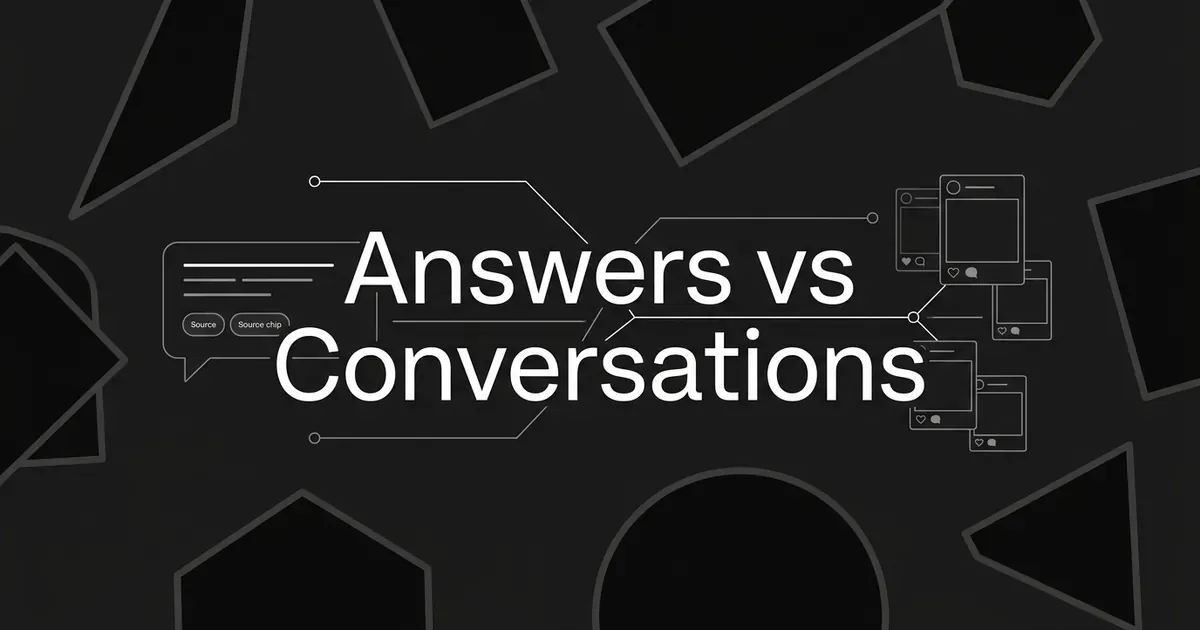
If someone on your team has asked whether the social listening tool you already pay for can also tell you what ChatGPT says about your brand, the short answer is no, not by itself. AI brand monitoring vs social listening comes down to what each one looks at. AI brand monitoring checks the answers that AI platforms generate for questions your buyers ask. Social listening analyzes conversations that a tool has collected from social networks and, depending on the provider, some web sources. They share a few goals, like understanding visibility, competitors and sentiment, but they watch different things and answer different questions.
This guide assumes you already know the basics of AI monitoring. If you want that background first, the explainer on what AI brand monitoring is covers it. Here we compare the two side by side, look at where they overlap, and work out when a team needs both.
The two approaches at a glance
The table below is the quick version. The sections after it go through each row in more detail.
| Dimension | AI brand monitoring | Social listening |
|---|---|---|
| What is observed | Answers generated by AI platforms for tracked prompts, including whether your brand is named, which sources are cited and which competitors appear | Posts, comments and other conversations that match a query, topic, keyword or hashtag, plus web, news, blog or forum content for some services |
| Unit of analysis | An answer to a prompt on a platform at a point in time, with its citations | A post, mention, comment, reply, hashtag or topic |
| Typical question | "When a buyer asks this in an AI platform, do we appear, what does the answer say and whose pages does it cite?" | "What are people saying about our brand, products, competitors or campaign in the conversations this tool can see?" |
| Typical goal | Measure presence in AI answers, citations and competitor visibility, then find the gaps | Understand public reaction, topics and sentiment, and spot campaign or market signals |
| Useful measures | Mention rate, citation rate, share of voice, sentiment, visibility trend, competitor citations | Mention volume, sentiment, social share of voice, engagement, topic patterns |
| What it cannot tell you alone | What every user sees, every possible prompt, or whether a citation caused a sale | Private conversations, every post on every network, or whether an AI answer names you |
One thing to notice before moving on is that both columns mention sentiment and share of voice. The words match, but the numbers underneath do not, and we will come back to that.
What AI brand monitoring covers
Brand monitoring for AI answers works from a list of questions you choose. The tool asks those questions on the AI platforms you pick, on a schedule, and records what comes back. A good report shows whether your brand is named, whether your site is linked as a source, how the answer describes you, which competitors show up, and which exact pages get cited.
The difference between a mention and a citation matters more than it first seems. An AI answer can name your brand without linking to you. It can also link to one of your pages without making your brand the focus of the answer. Those are two separate outcomes and they call for different follow-up, so it helps to keep them apart in your reporting.
A practical setup records a few things for every check:
- The question you asked.
- The AI platform, and the date, country and language where the tool captures them.
- Whether your brand is mentioned and how it is described.
- Whether a page you own is cited, and which one.
- Which competitors are named and which of their pages are cited.
It also helps to be modest about what one result means. OpenAI's help documentation says ChatGPT Search can rewrite a question into one or more targeted queries, may use your location to return local results, and can return citations that may be incomplete, outdated or incorrect. So a monitoring result is what the tool observed under its collection conditions. It is a useful sample, and it is not a promise that every person sees the same answer. If a result matters, open the cited source and keep a note of the question and settings you used.
What social listening covers
Social listening collects conversations from public sources, accounts you have connected, and other permitted data sources, then helps you make sense of them. Teams use it to learn what people say about a brand and its products, how a category or a competitor is being discussed, how an audience reacted to a campaign, and which topics keep coming up. The results often feed messaging, community management, customer care and communications.
The phrase is used loosely. Some products focus on social network posts, and others also watch selected news sites, blogs and forums. So the vendor's list of data sources tells you more than the label does. You will also see "monitoring" and "listening" used for different things: monitoring often means catching and replying to specific mentions as they happen, while listening is more about studying the patterns and meaning across many conversations. That split is a handy way to think about it, and it is not a fixed industry definition.
Two cautions apply to the outputs. Social sentiment is a reading of the content the tool captured, and it is not a survey of all your customers. Social share of voice only covers the sources and the formula that vendor uses. Neither one automatically measures the same thing as an AI answer mentioning you or citing your site.
Social data depends on what the tool can reach
It is worth looking at one vendor's documentation to see how much the source rules matter. Sprout Social publishes a detailed data availability and limitations page for its Listening product. These details belong to Sprout and should not be read as a description of every social listening tool, but they show the kinds of questions worth asking any provider:
- Public sources include Bluesky, public Facebook, public Instagram Business content, Reddit, TikTok brand hashtags, Tumblr, web sources, X and YouTube. Connected sources are the Facebook, Instagram Business, LinkedIn and TikTok profiles your organization manages and links.
- Most sources have an automatic historical backfill of 30 days. Some have none, with public Instagram Business content and Tumblr named as examples.
- Refresh timing differs by source. Some update in real time, public Facebook and public Instagram Business update every four hours, and others update every 24 hours.
- X data in Sprout Listening is sampled, and YouTube and Tumblr content is limited by rate and API restrictions.
- Queries have a 2,037-character limit, and a CSV export is limited to 10,000 messages.
- Reviews and paywalled content are generally not included, and age, gender and location are not supplied with message-level data.
None of this makes social listening a weak option. It means the tool shows you the conversation it can see, and the edges of that view depend on the networks, the plan and the vendor. When you shop for one, read the source documentation and not just the feature page.
Where the two overlap and where they do not
Both approaches can help with questions about brand visibility, competitor presence, topics and reputation. Both may report sentiment or some form of share of voice. Both can point a marketer toward something worth investigating, and both can feed content or communications decisions.
That overlap is in the business question, and it does not carry down into the data. Social listening watches conversations captured from social and related sources. AI monitoring watches generated answers for the prompts you track. Social sentiment is about the tone of what people wrote. AI sentiment is about how an answer describes your brand, which has its own quirks, and the piece on how AI sentiment analysis works and where it breaks goes through them.
Share of voice is where people most often get tripped up. A social tool may work it out from mentions or engagement compared with competitors. An AI visibility tool may work it out from answers or citations across your tracked prompts. The prompt set, the channels, the collection frequency and the denominator all change the number. So before you put a social percentage next to an AI percentage, find out what each one counts. We have not seen one universal formula for either category, so treat each number as belonging to its tool.
Some platforms bring both into one workflow
The two categories are not always sold separately. CisionOne, a communications platform, describes an AI Visibility capability that sits alongside its media monitoring, social listening and journalist outreach. Its dashboards report tracked audience questions and answers, AI visibility and share of voice, competitor comparisons, and the journalists, outlets and domains that get cited. The page describes coverage across nine AI platforms without naming them, and it does not publish a price.
That is a useful example because it shows the two data streams can live in one place and still be different streams. It does not mean every social listening product includes AI answer monitoring, and putting them in one platform does not make the signals interchangeable.
What each one costs to run
Price is not the main way to choose between these, but it helps to see how differently they are packaged. Sprout is a good illustration of one social listening setup. Its pricing page lists Standard at $199, Professional at $299 and Advanced at $399 per seat per month on annual billing, with Essentials at $79 per seat per month billed annually, or $99 billed monthly. Listening is sold as an add-on on Standard and above, and the add-on price is not published, since the page asks you to book a demo. These are Sprout's displayed prices and they are not a market benchmark.
DeepSmith plans are priced per workspace and not per seat. Pro is $99 a month ($80 on annual billing) with 50 tracked prompts and ChatGPT. Grow is $199 a month ($160 annual) with 100 prompts, adding Perplexity. Scale is $399 a month ($299 annual) with 200 prompts, adding Gemini. Enterprise is custom and covers all ten engines: ChatGPT, Gemini, Perplexity, Claude, Google AI Overviews, Google AI Mode, Grok, Meta AI, Microsoft Copilot and DeepSeek. There is a 7-day free trial and no long-term contract.
Because one is billed by seat and the other by workspace, a single seat is not comparable to a single workspace. If you are weighing the cost, count how many people need access in each case and what the add-ons add up to. For the monitoring side, the guide on AI brand monitoring tools for marketers is a good place to compare options.
Where DeepSmith fits
DeepSmith sits on the AI monitoring side of this comparison, and we want to be clear about that. It does not collect or analyze social posts, comments or listening topics, so it is not a replacement for a social listening service. What it does is take the AI answer data and connect it to content work.

You define the buyer questions to track, and AI Visibility reports mention rate, citation rate, share of voice and sentiment across your prompts and engines, with a competitor leaderboard and the sources AI cites most. From there the Content Map compares your site with your competitors' sites on a shared set of topics and buyer stages, so you can see where they publish and you do not. Opportunity Agents turn a visibility gap or a content gap into ideas, each with the data point that justifies it. Content Studio then takes an idea through planning and writing, with your brand context from Deep IQ shaping the draft, and you can publish to your CMS from there.

That path is useful when your problem is "competitors keep showing up in AI answers and we do not, so what do we write next?" It does not help with "what are customers saying about our launch on social?" For that you want listening.
If you want to see how this fits a team's routine, the guide on AI brand monitoring tools for content teams looks at tools by whether they connect mentions and citations to the pages that earn them.
When you need one, the other, or both
You do not have to decide this in the abstract. It usually comes down to what decision you are trying to make this quarter.
Social listening should come first when
- A decision depends on public reaction to a campaign, product, competitor or brand issue.
- You need to understand conversation topics and audience attitudes across the networks your vendor covers.
- Community, customer care or communications teams need a running view of matched mentions and available comments.
- The tool's coverage, history, refresh timing and export limits fit your region and reporting needs.
AI brand monitoring should come first when
- Leadership wants to know whether AI answers bring up your brand for buyer questions.
- You need to see whether an answer names you, cites your site, or cites a competitor instead.
- You want results by prompt and by platform and not by post volume.
- The plan is to find answer gaps, improve your content or sources, and check again later.
Use both when
- Your reputation work covers what people say in public and what AI systems say in answers.
- A campaign gets conversation on social while AI answers still leave you out or cite competitors.
- Communications wants to compare public conversation with how AI describes you and which sources it cites.
- Marketing and communications have different owners, decisions and reports.
A simple way to run both is to keep separate source definitions and separate dashboards, then bring the findings together when you decide what to do. Use listening to learn about conversation and reaction. Use AI monitoring to learn about answers and citations. If you want to see how that second stream feeds a larger program, the pages on AI reputation management and on monitoring category-level narratives in AI answers show where it can lead.
One more caution. If a social spike is followed by a change in AI answers, that is interesting, but it does not show one caused the other. You would need a separate, planned analysis to say that.
Which should you choose
If you are a marketing lead trying to answer "what is our AI search strategy?", start with AI brand monitoring. You get a clear picture of where you show up and where competitors win, and the Content Map and Opportunity Agents turn that into a content plan. DeepSmith is built for that job, and the 7-day free trial gives you real prompts and answers before you pay.
If you run communications or community and your questions are about sentiment, reactions and campaigns, a social listening tool is the right fit, and DeepSmith does not claim to replace it. If you have both kinds of questions, run both, keep the numbers separate, and compare them in the same planning meeting. If you are confused about the word "LLM monitoring," the page on brand tracking vs usage monitoring separates the two meanings, and social listening vs LLM monitoring then becomes a question about conversations versus answers.
To go deeper on the monitoring side, the roundup of the best AI brand monitoring tools compares the tools, and the guide to the best AI visibility tools covers the wider category. If sentiment is your main interest, see the best AI brand sentiment tools.
Related guides
- How to Set Up AI Brand Monitoring in One Afternoon: Get a working monitoring setup in a few hours with a starter prompt list and a first review.
- How to Track Competitor Mentions in AI Answers: Track when rivals appear in AI answers, in what context, and how that compares with your mentions.
- What a Good AI Brand Monitoring Dashboard Shows and Who Should Read It: Decide what a monitoring dashboard should show, such as mention rate, sentiment, sources and competitor share, and who each view is for, from executives to analysts.
- How to Monitor LLM Brand Mentions Without Buying Software: Monitor brand mentions across LLMs using a spreadsheet and a fixed routine.
- What Your CMS Needs to Support for AEO: Evaluate whether your CMS supports AEO by checking structured data and schema control, clean semantic markup, fast updates, redirect and metadata handling, and what to ask vendors before.