You have probably already checked whether ChatGPT knows your brand exists. Good. That is the first question. Here is the harder one: when the answer names you, does it call you the leader, the budget pick, the enterprise option, or the afterthought?
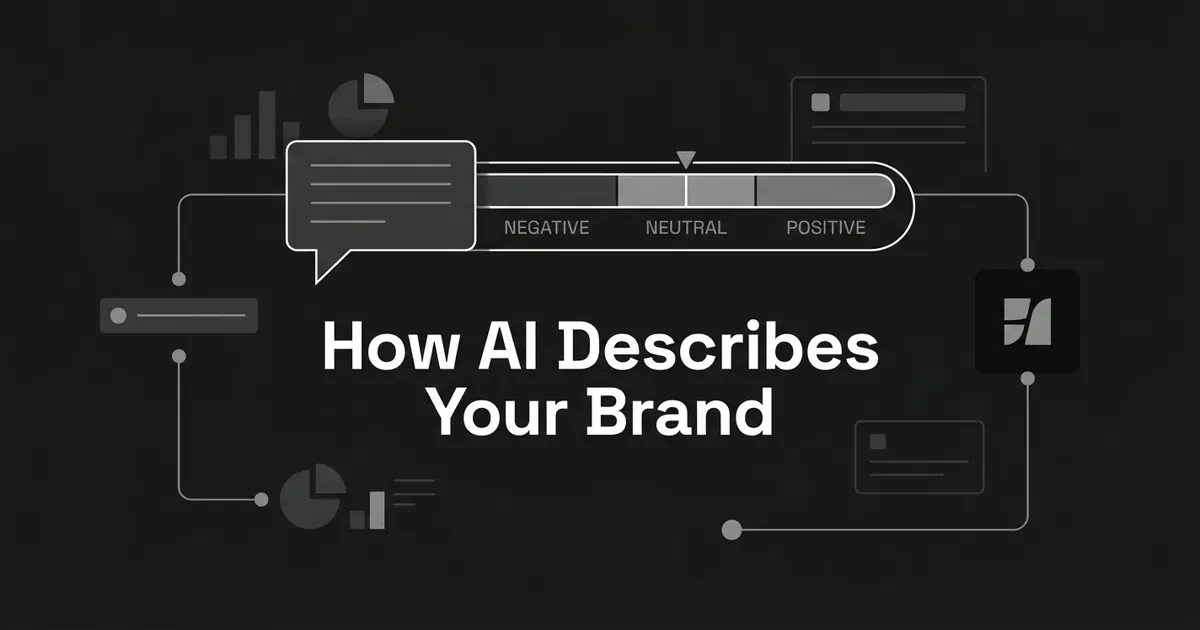
That gap, between being mentioned and being described well, is your ai brand perception in AI answers, and it is why AI brand sentiment tools exist. Presence tells you the machine sees you. Sentiment tells you what it thinks of you. And when roughly 60 to 65 percent of Google searches now end without a single click, the answer itself is the impression a buyer walks away with. You do not get a second visit to fix it.
If you have ever typed your company name into an assistant and thought, this is not how AI describes my brand at all, you already understand the problem. This guide compares the tools built to measure it: the tone, the recurring themes, the positive-versus-negative mix, and how all of that moves over time.
One boundary first, so you know what you are reading. This is a sentiment list, not a mention-counting list. If you mainly want to know how often and where you show up, that is a different job for a different roundup. Here we focus on the tools that read the language AI uses about you and turn it into something you can act on.
What an AI brand sentiment tool actually does
An AI brand sentiment tool runs the questions your buyers ask across engines like ChatGPT, Perplexity, Gemini, Claude, Google AI Mode, and Copilot, then reads the tone of every answer that names you. Positive, neutral, or negative. Some tools give you a single score. Others give you named themes, so you can see that "easy to use" is pulling your sentiment up while "missing integrations" is dragging it down.
Here is the part that trips people up. This is not social listening. Social listening reads what humans post. AI brand sentiment reads what machines say when no human is in the room. That is a genuinely different problem, because a language model is not quoting a customer. It is synthesizing from training data and whatever it retrieves in the moment, then speaking with confidence either way.
So the value is not just a number. It is understanding your ai brand perception well enough to change it. Which theme is hurting you? Which engine is harshest? What would you publish to shift the story? Good tools connect the reading to the reason, and that is what turns a raw ai reputation sentiment score into something you can act on.
How we picked these tools
Fair criteria make a roundup worth trusting, so here are ours. A tool earned a spot only if it met all four.
- It produces a real sentiment signal, either a labeled positive, neutral, or negative reading or a numeric score, for how AI engines describe your brand. Mention-only trackers did not qualify.
- It covers at least one major AI answer engine.
- Its pricing is public, was published in the last year, or is clearly flagged as quote-only.
- Sentiment is either the core product or a first-class feature, not a buried sub-tab.
Two honest notes before you scan the list. Tools that track AI answers but treat sentiment as an afterthought are included with a clear callout, because you deserve to know. And "sentiment" is not standardized across vendors: one reports positive-versus-negative percentages, another uses a 0 to 100 scale, another surfaces qualitative associations. Read the scores as directional, not identical. Comparing them one to one will only frustrate you.
The tools at a glance
| # | Tool | AI engines tracked | Sentiment signal | Pricing (entry to top) | Best for |
|---|---|---|---|---|---|
| 1 | DeepSmith | 10 engines including ChatGPT, Gemini, Perplexity, Claude, AI Overviews, AI Mode, Copilot, Grok, Meta AI, DeepSeek (all 10 on Enterprise; Pro is ChatGPT only) | Sentiment tracked alongside mention rate, citation rate, share of voice, and visibility trend, plus the content engine to move them | $99/mo ($80 annual) to $399/mo ($299 annual) to Enterprise custom | Teams that want AI sentiment and visibility tracking plus on-brand content production in one workflow |
| 2 | Profound | ChatGPT, Perplexity, Google AI Overviews | Sentiment dashboard with positive/negative percentages and named themes | $99/mo to $399/mo (annual) to Enterprise custom | Teams needing explainable sentiment with passage-level evidence |
| 3 | Peec AI | ChatGPT, Google AI Mode, AI Overviews, Copilot, Perplexity, Gemini | 0 to 100 sentiment score with positive/neutral/negative indicators | Starter self-serve; higher tiers quote-based | Teams wanting one sentiment number per engine with a published method |
| 4 | Otterly AI | ChatGPT, Google AI Overviews, Perplexity, Copilot (others as add-ons) | Positive/neutral/negative mix per prompt (not a labeled primary metric) | $29/mo ($25 annual) to $489/mo ($422 annual) | Solo marketers and small teams wanting affordable, transparent pricing |
| 5 | Goodie AI | ChatGPT, Claude, Perplexity, Gemini, Copilot, Grok, Meta AI, Google AI Mode | Brand sentiment tracking named as a product pillar | Explorer $399/mo (annual); higher tiers quote-based | Mid-market and enterprise teams wanting sentiment named as a core pillar across eight models |
| 6 | Evertune | ChatGPT, Perplexity, Gemini and 10+ models | Brand Index using Word Association (implicit sentiment) | Custom / demo only | Brands focused on AI-driven commerce discovery |
| 7 | LLMrefs | ChatGPT, Claude, Google AI Mode, Grok, Copilot, Meta AI, Gemini, Perplexity | Brand sentiment listed alongside visibility and citations | $79/mo (annual, limited-time), 500 prompts | Teams wanting broad coverage at a low entry price |
| 8 | AthenaHQ | ChatGPT, Perplexity, Gemini and others | Visibility, prompts, sources, competitor benchmarking (sentiment via visibility) | Self-serve tier; pricing not public | Mid-market and agency teams wanting action-led AEO playbooks |
| 9 | Brand24 | Social, web, news, reviews, forums | AI positive/negative/neutral per mention, plus theme insights | $249/mo ($199 annual) to Enterprise custom | Teams wanting sentiment across the whole web, not only AI answers |
| 10 | Awario | Social, news, blogs, forums, reviews | Real-time sentiment per mention with Boolean search | $49/mo ($39 annual) to $399/mo | Small teams wanting affordable social-listening sentiment |
| 11 | Talkwalker | Social, web, news, broadcast, print | AI sentiment with published ~90% accuracy and theme detection | $249/mo ($199 annual) to quote-based | Enterprises combining AI sentiment with broad media monitoring |
| 12 | Brandwatch | Social, news, blogs, forums | AI sentiment with sarcasm handling on a deep historical archive | Quote-based; typically $800+/mo | Enterprise consumer intelligence with deep historical data |
| 13 | Meltwater | Media, social, consumer, AI-search surfaces | AI sentiment across owned, earned, and AI channels | Quote-based; suite-level | Enterprise PR and comms teams needing integrated surfaces |
The AI brand sentiment tools, ranked
1. DeepSmith

Best for: marketing teams that want to track how AI describes their brand and then act on it, without switching tools.
Most tools on this list hand you a sentiment score and stop. DeepSmith takes a deliberately different stance: it reports sentiment beside the structural signals that decide what AI says about you, then gives you the engine to change them.
Here is the logic. How an assistant describes you is downstream of which sources it pulls from, which of your pages earn the mention, and which competitor pages sit next to you in the answer. DeepSmith tracks all of that: sentiment, mention rate, citation rate, share of voice, visibility trend, and the exact sources AI cites most. Then, in the same platform, it produces the on-brand content that shifts those inputs over time. You spot a prompt where the answer describes you weakly, and you turn it into a scheduled, publish-ready article without leaving the app.

Key features:
- Sentiment and visibility tracking across ten engines: ChatGPT, Gemini, Perplexity, Claude, Google AI Overviews, Google AI Mode, Grok, Meta AI, Microsoft Copilot, and DeepSeek, with all ten available at the Enterprise tier.
- A per-prompt and per-page view of where you win, lose, and get described unfavorably, plus a competitor leaderboard.
- A content pipeline that outputs publish-ready articles, with SEO structure, internal linking, metadata, and a cover image built in, not first drafts you have to rescue.
- Autowrite, which writes and schedules articles on set dates so the pipeline keeps moving during busy weeks.

One honest limitation: engine coverage scales with tier, so the full ten-engine read sits on Enterprise. Pro tracks ChatGPT only, Grow adds Perplexity, and Scale adds Gemini, which means a small team on an entry plan sees sentiment on fewer surfaces than the headline count suggests. DeepSmith also reads AI answers rather than the open social web, so it pairs mention and citation patterns with tone instead of scraping forums and reviews. If your reputation problem is mostly human chatter, add a listening tool alongside it.
Pricing: Pro $99/mo ($80 billed annually), Grow $199/mo ($160 annually), Scale $399/mo ($299 annually), Enterprise custom. There is a 7-day free trial with real data and real drafts, and no long-term contracts. Engine coverage scales with tier: Pro tracks ChatGPT, Grow adds Perplexity, Scale adds Gemini, and Enterprise covers all ten.
If you already know that counting mentions does not change how AI talks about you, this is the tool that closes the loop.
2. Profound

Best for: larger brands and agencies that need explainable sentiment they can defend in a review.
Profound runs a first-class sentiment module inside its answer-engine insights product. You get positive and negative percentages broken down by prompt, with named themes driving the tone, and each reading links back to the exact passage the model produced. That last part matters: you can read the sentence that scored you and understand why.
Key features: positive and negative sentiment percentages, named themes with root-cause drill-down, and passage-level evidence. Daily updates surface the impact of a campaign or PR moment fast.
One honest limitation: engine coverage is narrower than the broadest tools here (Gemini, Claude, and Copilot are not first-class), and pricing is annual-only above the entry tier.
Pricing: Starter $99/mo and Growth $399/mo, both annual billing only, with custom Enterprise.
3. Peec AI

Best for: marketing teams that want one clean sentiment number per engine, with a method they can show leadership.
Peec AI publishes its sentiment methodology openly and reports on a 0 to 100 scale, with positive, neutral, and negative indicators beside each prompt. Most tracked brands land between 65 and 85, which gives you a real reference point for what "good" looks like instead of a number floating in space.
Key features: a documented 0 to 100 sentiment score, coverage across six engines, and clean pairing with position and share of voice so you can see whether more mentions also mean kinder ones.
One honest limitation: pricing above the Starter tier is quote-only, and theme-level drill-down is lighter than Profound's.
Pricing: Starter is self-serve; Pro, Advanced, and Enterprise are quote-based.
4. Otterly AI

Best for: solo marketers and small teams who want transparent pricing and a low-friction trial.
Otterly AI centers on a visibility index, brand mentions, and link citations across ChatGPT, Google AI Overviews, Perplexity, and Copilot, with Claude, Google AI Mode, and Gemini available as paid add-ons. Sentiment shows up as a positive-neutral-negative mix per prompt rather than a single score.
Key features: publicly published pricing across three tiers (rare here), a 14-day trial with no credit card, and an add-on model that lets you expand engine coverage as budget allows.
One honest limitation: sentiment is not a labeled primary metric on the public site, so its depth is less documented than Profound's or Peec AI's.
Pricing: Lite $29/mo ($25 annual), Standard $189/mo ($160 annual), Premium $489/mo ($422 annual).
5. Goodie AI

Best for: mid-market and enterprise teams that want sentiment treated as a named pillar across broad model coverage.
Goodie AI lists brand sentiment tracking as a named product pillar and monitors mentions, sentiment, and competitive positioning across eight models. The workflow is closed-loop: research, monitor, optimize, measure.
Key features: eight-engine coverage, sentiment as a first-class pillar, and a built-in AEO content writer alongside the dashboard.
One honest limitation: only the Explorer tier is listed publicly, so Pro and Enterprise require a sales conversation, and the platform is younger than some rivals.
Pricing: Explorer $399/mo (annual billing); Pro and Enterprise quote-based.
6. Evertune

Best for: brands whose main goal is being chosen inside AI shopping answers.
Evertune runs a Brand Index using a Word Association method: it repeatedly prompts models to generate reviews and associations for your brand, then aggregates how they characterize you. The output reads as implicit sentiment, the qualitative associations models attach to you, across 10 or more models.
Key features: qualitative brand associations rather than raw counts, coverage across 10+ models, and an AI ad agent that can place paid placements inside ChatGPT conversations.
One honest limitation: pricing is not public and skews enterprise, and sentiment is implied through associations rather than reported as a labeled score.
Pricing: quote-based; a sales conversation is required.
7. LLMrefs

Best for: teams that want broad engine coverage at a low entry price and will validate depth in a trial.
LLMrefs lists brand sentiment as a tracked metric alongside visibility, citations, prompts, and competitors, with coverage across eight models. It frames sentiment as one signal in an LLM SEO dashboard rather than a standalone module.
Key features: eight-engine coverage at the lowest published single-tier price here, 500 tracked prompts, and unlimited projects and team members in the listed plan.
One honest limitation: a third-party review has stated that LLMrefs tracks visibility and citations but does not analyze sentiment in depth, so test that claim in a trial before you rely on it.
Pricing: $79/mo limited-time, annual billing, for 500 tracked prompts.
8. AthenaHQ

Best for: mid-market and agency teams that want a visibility dashboard paired with concrete next steps.
AthenaHQ focuses on visibility, prompts, sources, and competitor benchmarking across ChatGPT, Perplexity, Gemini, and other major engines. Sentiment is read through which sources engines cite and how you show up, rather than as a labeled score.
Key features: an action-led approach with recommended actions and content briefs tied to visibility gaps, Y Combinator backing, and named customer logos.
One honest limitation: pricing is not publicly listed, and sentiment is not surfaced as a first-class labeled metric.
Pricing: a self-serve tier exists, but pricing is not public.
9. Brand24

Best for: teams that need sentiment across the whole online conversation, not only AI answers.
Brand24 applies AI-driven positive, negative, and neutral classification to mentions from millions of online sources: social, news, blogs, podcasts, reviews, and forums. Its AI Insights layer adds themes and summaries on top.
Key features: publicly published pricing across five tiers, theme detection useful for crisis spotting, and a 14-day trial.
One honest limitation: the core product is broad web listening, so AI answer-engine coverage is not the primary surface.
Pricing: Individual $249/mo ($199 annual), Team $349/mo ($299 annual), Pro $599/mo ($499 annual), with custom Business and Enterprise.
10. Awario

Best for: small teams that want affordable per-mention sentiment across the open web.
Awario applies sentiment to every mention it collects across social, news, blogs, forums, and reviews, with Boolean search for precise topic control. AI answer-engine coverage is not native.
Key features: a low entry price, public pricing across three tiers, and flexible Boolean rules without an enterprise contract.
One honest limitation: no first-class tracking of ChatGPT, Perplexity, or Gemini, and a smaller historical archive than the enterprise suites.
Pricing: Starter $49/mo ($39 annual), Pro $149/mo, Enterprise $399/mo.
11. Talkwalker (Hootsuite)

Best for: enterprises that want mature sentiment layered into a broad consumer intelligence suite.
Talkwalker has long published AI-driven sentiment with reported accuracy around 90 percent, including sarcasm detection, and now sits inside the Hootsuite suite. It covers social, news, blogs, forums, and reviews, and is extending into AI-search surfaces.
Key features: a mature sentiment engine with published accuracy claims, coverage across 30+ languages, and integration with Hootsuite's social workflows.
One honest limitation: pricing is quote-based, and AI-answer coverage is newer and not the product's primary surface.
Pricing: Individual $249/mo ($199 annual) up to custom Business and Enterprise tiers.
12. Brandwatch
Best for: enterprise consumer intelligence teams with deep historical needs.
Brandwatch applies AI sentiment with sarcasm handling across one of the largest historical archives in the category. Its strength is depth and audience segmentation rather than first-class AI answer-engine coverage.
Key features: a very large historical archive, sentiment with nuance handling, and a deep enterprise feature set.
One honest limitation: pricing is quote-only, and third-party estimates put small-team plans well into four figures a month.
Pricing: quote-based; published estimates start around $800/mo for small teams and $2,000 to $5,000+/mo for mid-market and enterprise.
13. Meltwater

Best for: enterprise PR and comms teams that want AI sentiment alongside earned-media monitoring.
Meltwater applies AI sentiment across media, social, consumer, and emerging AI-search surfaces, all in one suite. Its recent research analyzed millions of AI citations across six major platforms, so the AI-search interest is real, even if it is one module in a bigger product.
Key features: suite-level integration across PR, comms, social, and AI search, broad global data coverage, and public research on AI citation patterns.
One honest limitation: pricing is suite-level, so AEO is one part of a larger contract, and AI-answer coverage is newer.
Pricing: quote-based; suite pricing varies by module bundle.
How to choose the right tool for you
Feeling like every option looks similar? That is normal at this stage. The trick is to match the tool to the job you actually have, not to the longest feature list. Here is how the choice usually breaks down.
You want one platform that tracks how AI describes you and ships the content to change it. Pick DeepSmith. It is the only tool here that pairs sentiment and AI visibility tracking across ten engines with a built-in content engine that feeds off the same data. If your real goal is not just to read your sentiment but to move it, having the tracker and the production line under one roof saves you the handoff, and the full ten-engine read sits on Enterprise.
You need explainable sentiment with named themes and passage-level proof. Pick Profound. When you have to walk a leadership team through why the number moved, its passage-level evidence is the most defensible in the category.
You want a single 0 to 100 score per engine with a published method. Pick Peec AI. The documented scale and the 65 to 85 benchmark make it easy to set a target and report against it.
You are a solo marketer or small team watching your budget. Start with Otterly AI or, for social-web sentiment, Awario. Transparent pricing and low-friction trials let you learn what sentiment analysis ai answers can tell you before you commit real money.
You need sentiment across the whole conversation, not just AI answers. Look at Brand24, Talkwalker, Brandwatch, or Meltwater. These read what people say as well as what machines say, which matters when your ai reputation sentiment problem is really a broader reputation problem that spans the open web and the answer box alike.
You do not need the most powerful platform on the list. You need the one that fits the next step you are actually going to take. Pick that, run the trial, and let real data settle the rest.
Ready to see how AI is describing your brand right now, and turn a weak answer into a published fix in the same place? Start a free DeepSmith trial and watch it work on your real prompts.