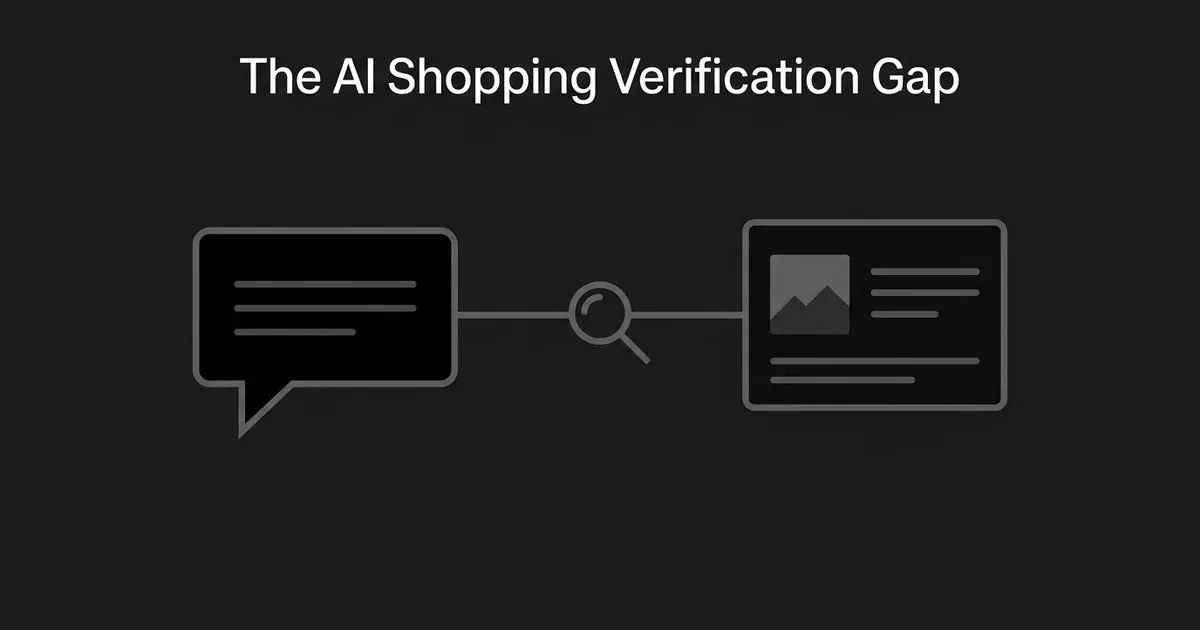
94% of AI-assisted shoppers check the recommendation before they buy. That comes from L.E.K. Consulting's survey of 2,650 U.S. consumers, fielded in April 2026 and published July 13, 2026, cross-referenced against traffic data from more than 100 brands and retailers. Consumers are not treating AI shopping trust as a switch they flip once and forget. They use AI to narrow a decision, then they go check it somewhere else before money changes hands. That gap between the recommendation and the purchase is where product-page content does its actual work.
This piece walks through the AI assisted shopping behavior the recent survey and traffic data actually show: how much of the shopping journey AI touches, how often consumers verify AI shopping recommendations before buying, where they go to check, and what that means for how you prioritize your own site.
AI is narrowing the shortlist, not making the purchase
Start with what AI is being used for, because that shapes everything after it. In L.E.K.'s April 2026 survey, comparing options and narrowing a shortlist accounted for 53% of primary AI shopping use, well ahead of product discovery at 19% and final decision making at 21%. Most people are not asking an AI tool to just pick something for them. They are asking it to cut a big pile of options down to a short one.
NIQ's early 2026 tracking, based on roughly 500 U.S. consumers surveyed monthly, backs this up. In that data, 42% of consumers had used at least one AI tool to shop in the previous month, but only 10% had used an AI shopping assistant and just 5% had used a fully autonomous AI agent to place an order. The gap between those numbers matters. Plenty of people are letting AI help them think. Very few are letting it act on their behalf.
That distinction is worth holding onto for the rest of this piece. When a survey says a third of consumers "use AI to shop," it usually means AI shaped their research, not that AI closed the sale. The shopper still drives.
The verification habit shows up in every major survey
Ask whether consumers trust AI enough to skip checking it, and the honest answer from the data is no, not usually. Product.ai's 2026 Trust in AI Commerce Report surveyed 1,463 U.S. online shoppers in April 2026, including 623 who had used AI for product research in the prior 90 days. Among that group, 86% verified an AI recommendation through another source before acting on it: 45% said they always verify, 41% said they sometimes do. Only 14% said they trusted the recommendation without checking anything else.
L.E.K.'s figure is even higher: 94% of AI users validated AI output before completing a purchase. The two numbers come from different survey designs and different populations, so they should not be averaged together, but they point the same direction. Consumers verify AI shopping recommendations as a matter of habit, not exception.
None of this means people distrust AI. In the same L.E.K. survey, 66% of AI users said the tool produced accurate results and 85% said AI had improved their shopping experience. Akeneo and Dynata's April 2025 survey of 1,000 U.S. consumers found that 32% had already completed a purchase based on an AI recommendation, and 84% of that group were happy with what they bought. The pattern across these surveys is what you'd call functional trust: shoppers use AI, like the results, and check anyway. That's not skepticism about AI. It's just how people shop for anything that costs real money.
Where shoppers actually go to check
If verification is the norm, the next question is where it happens, because that decides how much control a retailer's own site has over the outcome. L.E.K.'s survey gives the clearest breakdown: search engines were used by 48% of AI users to cross-check a recommendation, customer reviews by 47%, and retailer websites by 41%. The retailer's own page is a major stop on that path, but it is not the only one, and it is not automatically the first one.

Rithum and Retail Dive's April 2026 survey of 1,046 shoppers across the U.S. and U.K. tells a different story on the surface. Among people who verified an AI recommendation, only 5% went to a retailer or brand site, while search took 28%, reviews took 19%, and friends and family took 17%. That's a big gap from L.E.K.'s 41%, and it is worth naming rather than smoothing over. The two surveys ask different questions to different populations with different structures, so they are not contradicting each other so much as measuring different slices of the same behavior. What both agree on is this: the retailer's own website is one verification stop among several, not the default destination every AI-assisted shopper reaches for.
One more detail from Rithum is worth flagging on its own: 64% of shoppers aged 18 to 27 said they were likely to buy on an AI recommendation without checking anywhere else, and higher-income shoppers were about twice as likely to skip verification entirely. That's a subgroup finding, not a claim about AI assisted shopping behavior broadly, but it suggests the verification habit is not evenly distributed. Some segments already trust AI closer to the way L.E.K.'s 8% (below) describes.
Why the retailer's page still matters
One number here should reset how you think about this. Only 8% of L.E.K.'s respondents said they completed a purchase entirely through an AI agent without ever visiting a brand or retailer site. For roughly nine out of ten AI-assisted shoppers, the retailer's own page is still part of the path to a sale, whether that visit is for verification, price checking, or just finishing the transaction.
Adobe's traffic analysis, drawn from more than a trillion visits to U.S. retail sites, shows that path getting busier and more productive. AI-referred traffic to retail sites was up 393% year over year in the first three months of 2026, and in that same window, AI-referred visitors had a 12% higher engagement rate, spent 48% longer on site, viewed 13% more pages, and converted 42% better than non-AI traffic. Adobe's earlier reports from 2025 actually showed the opposite: AI-referred visits converted worse than other traffic while the gap slowly narrowed. Read together, that's not a contradiction, it's a trend line. AI-referred visitors used to arrive early in their research and browse without buying. More recently, they're arriving further along and converting at a higher rate once they land.
That shift raises the stakes for what a shopper finds when they get there. Adobe's own audit of retail product pages found they scored 66% on a machine-readability measure, compared with 75% for homepages and 74% for category pages. That's not a trust score and it doesn't prove anything about conversion by itself, but it's a signal that the pages carrying the heaviest verification load, individual product pages, are often the least finished part of a retail site.
What a mismatch actually costs you
This is where the stakes of the verification gap become concrete. Salsify's January 2025 report, based on 1,910 completed surveys of online shoppers in the U.S. and U.K., found that 54% had abandoned a purchase because product content was inconsistent from one channel to another, and 71% had returned an item because it did not match what was shown online. Those numbers predate the current wave of AI shopping tools, which makes them a baseline, not a special case: shoppers have always punished a mismatch between what they were told and what they got, and AI recommendations just add one more channel that has to agree with the retailer's own page.
Akeneo's April 2025 survey found that 28% of consumers pointed to better product information and descriptions as one of the improvements AI had brought to their shopping experience. Read next to Salsify's numbers, the implication holds together: accurate, complete, consistent product content is not a nice-to-have layered on top of AI visibility, it's the thing that confirms or breaks the recommendation once a shopper goes to check it.
A separate study published in ScienceDirect in September 2025, based on 327 responses from online shoppers in the United Arab Emirates, found that website quality, product assortment, and customer reviews were all positively linked to purchase intention, largely through their effect on trust. That study wasn't about AI shopping specifically, and its sample was small and regional, so treat it as supporting context rather than proof. It backs up the same general point: a page that looks complete and trustworthy converts better, with or without an AI recommendation pointing someone toward it.
How to prioritize with limited time
Put these findings together and a practical rule for AI shopping trust falls out. If your site gets little or no AI-referred traffic, the bottleneck is upstream: your product isn't making it into the shortlist AI hands shoppers, and no amount of product-page polish fixes that on its own. If AI-referred visitors are already arriving, the bottleneck has moved downstream to the page itself, where 94% of them are checking the recommendation against what you actually show.
A simple way to apply that:
- No real AI exposure yet: work on getting into AI-assisted shortlists before anything else.
- AI traffic exists but conversion is weak: fix product-page accuracy, consistency, and completeness first.
- AI-referred visitors are browsing multiple pages: treat the site as a confirmation and purchase environment, not just a landing spot.
- High return rates or complaints about mismatched descriptions: those are content trust failures, and they need fixing before more visibility spend makes sense.
None of the surveys here prove that a specific technical fix, a schema change, a particular structured-data format, causes more AI citations or more sales. What they show is a behavior pattern: AI compresses research, shoppers verify anyway, and the retailer's own page carries the weight of that verification far more often than it gets credit for. Tools like DeepSmith exist for exactly this two-sided problem: tracking where your brand actually shows up in AI answers so you know whether the upstream gap is real, while producing the on-site content that gives a verifying shopper something accurate to check against.
The numbers won't tell you which end of that problem you have. Your own traffic and return data will.