You ask ChatGPT for the best product in your category, and a competitor comes back with a tidy summary of what their customers love. You have more reviews than they do. You are just not in the answer.
That stings. It is also fixable.
This guide walks you through eight steps to turn Trustpilot, Amazon, and your own product reviews into evidence AI systems can reach, read, and cite. The product reviews AI search gap is rarely about your star average. It is about which evidence exists, where it lives, and whether an engine can get to it.
Take a breath. You probably already have most of the raw material.
Reviews are evidence. Citations are pages.
Two things get mixed up constantly, and the confusion burns quarters.
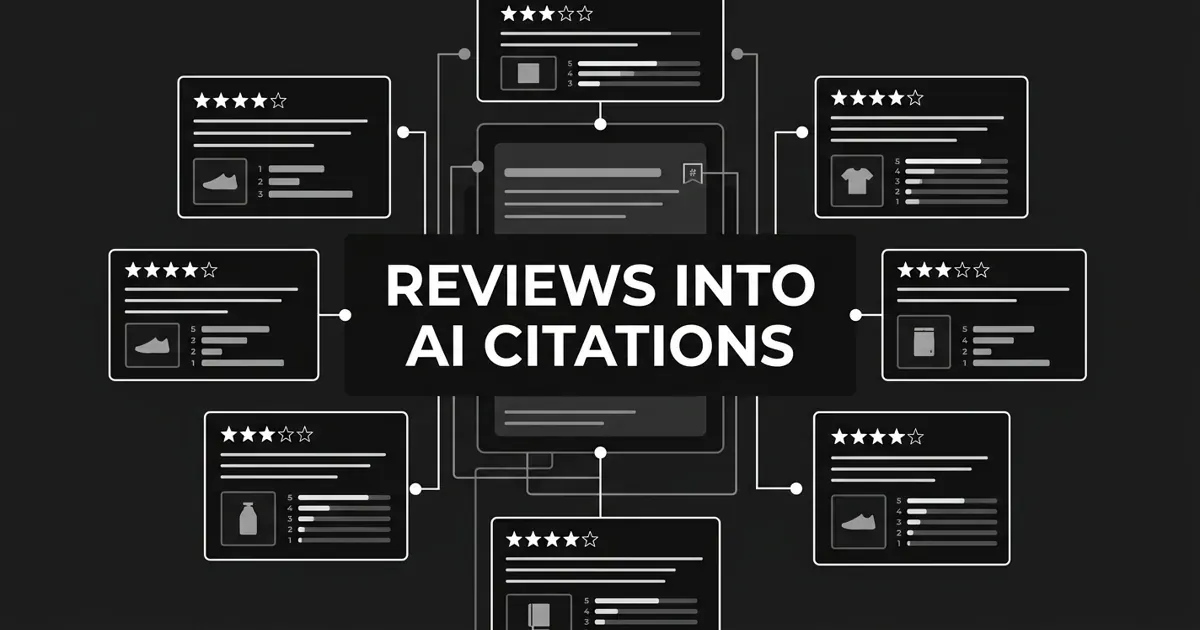
Recommendation evidence is what a system uses to judge fit and quality. Star rating, rating spread, review count, recency, recurring themes, verified-purchase status, pros and cons, customer photos.
A citation is the page shown as a source beside the answer. Your product page, an Amazon listing, a Trustpilot profile, a retailer.
An engine can lean hard on your review evidence and still cite someone else. That is normal.
Here is what the platforms say. Amazon says its generative shopping assistant, Rufus, renamed Alexa for Shopping in May 2026, is trained on Amazon's product catalog, customer reviews, Community Q&As, and information from across the web. OpenAI's Shopping Research, introduced in November 2025, looks across the internet for current price, availability, reviews, specifications, and images, then cites reliable sources. Perplexity documents indexing and rich product detail rather than any review formula. Google's AI Mode announcement names no review factor at all.
Review platforms surface as sources too. Trustpilot and SEER Interactive studied more than 800,000 AI responses across ChatGPT, Gemini, Perplexity, and Google AI Mode, and found review and trust sites were the second most-cited source category behind the general web. Brands with no Trustpilot profile were cited in 1% of responses. Brands with a claimed profile and a median of 13 reviews reached 54%. Brands with active profiles and a median of 81 reviews reached 75%. That is a partner study, not a controlled experiment, so treat Trustpilot AI citations as a reason to test rather than a promised rate.
So there is no universal review-ranking rule waiting to be cracked. When AI recommends products from reviews, the mechanics differ by engine, and they change. Your job is to make honest, detailed, current review evidence available on legitimate surfaces, keep product identity consistent, and measure which pages get cited.
Step 1: Map the shopping prompts your reviews need to answer
Start with the questions, not the platforms.
Write out the prompts a real buyer types before purchase. Cover five families:
- Category discovery: "best [product] for [use case]."
- Attribute fit: sizing, durability, ingredients, compatibility, battery life, noise, ease of setup.
- Comparison: "A versus B," "best alternative to X," "which is better for someone who."
- Trust and risk: returns, delivery, quality consistency, legitimacy, whether it is worth the price.
- Experience: what customers like, what they complain about, who should skip it.
For each prompt, log the platform, country and language, date, product and variant, and the result: brands named, pages cited, review platforms cited, and any rating claim the answer repeats.
Done when: you have a fixed prompt set you can re-run word for word, and you can tell a mention apart from a citation.
Where people go wrong: tracking only "best product" prompts. Attribute and risk prompts are where review evidence does its real work.
Step 2: Baseline where you stand and which pages get cited
Now run the set. Every engine your buyers use, one pass, everything recorded. That is your product reviews AI search baseline.
Then audit the sources you own or influence:
- Is the product page publicly accessible and indexable?
- Does the page actually display the reviews it claims to have?
- Do product name, brand, variant, and identifiers match across your site, the marketplace listing, and your feeds?
- Is the Trustpilot profile claimed, complete, and current?
- Does the Amazon listing point at the right variant, not a parent or a discontinued one?
Google is explicit that a page must be indexed and eligible to appear in Search with a snippet before it can support an AI Overview or AI Mode answer, and that meeting the requirements guarantees nothing. Boring technical checks come first.
This is where a tracking system earns its keep. Running the matrix by hand once is educational. Running it monthly by hand is how the program quietly dies. DeepSmith's AI Search Visibility module is built for this loop: define the prompts you care about, and it checks them on a schedule and reports mention rate, citation rate, share of voice, the exact pages cited, and which competitor pages win. It does not touch your reviews. It tells you whether the review work is changing what the engines say.
Done when: every baseline prompt has an answer record and a source record, and you have a written list of gaps: missing, stale, or competitor-owned pages.
Where people go wrong: calling a brand mention a citation. They are different numbers, and only one tells you which page to fix.
Step 3: Line up product identity across every review surface
Reviews are worthless to a machine that cannot tell which product they describe.
Build one evidence map per product and variant. Align the identifiers used by your catalog, Amazon listing, Google product feed, product-review feed, Trustpilot product reviews, and retailer pages. Keep GTIN, MPN, SKU, brand, ASIN, and canonical product name consistent. Google highly recommends GTIN and requires that identifiers match between the product feed and the review feed.
Do not merge variants to inflate a review count. A blue medium with 200 reviews and a red XL with four are different evidence stories.
Then capture the attributes that answer buyer questions:
- Rating and rating distribution, not just the average
- Review ID and product ID
- Review date, and how many reviews landed recently
- Title and full text
- Verified-purchase status where the platform supplies it
- Pros, cons, feature tags, language, country, images
- Themes: fit, durability, setup, delivery, packaging, returns, support, value
When AI recommends products from reviews, it is reading that text, not just counting stars. A review saying "runs small after washing" is worth ten that say "great."
Done when: you can trace a sample review from its source platform to the right product and variant with no guesswork, and report rating, volume, recency, and theme coverage separately.
Where people go wrong: reporting only the star average. Amazon's review highlights summarize shared feature opinions, and Trustpilot reports that AI summaries cover themes like shipping, quality, and refunds. The score is the headline. The reasons are the content.
Step 4: Build a collection loop that stays compliant
Good news: the compliant version of review collection also produces better evidence. You do not have to choose.
The rule is simple. Ask every eligible customer, the same way, for an honest review. Do not pick the ones you expect to be nice.
On Trustpilot, invite through a profile link, trigger the Automatic Feedback Service from a transactional email like an order receipt, use an integration with Shopify, WooCommerce, Magento, BigCommerce, or Salesforce, or fire API Invitations at the right moment. Product reviews work differently: a customer needs an invitation from you, then uses the Rate Now action inside it. Reply publicly to positive and negative reviews, stay professional, and leave personal information out.
On Amazon, use the Request a Review option in Seller Central. It is available once per eligible order, between 5 and 30 days after delivery, and sends a standardized request for both a product review and seller feedback. You cannot follow up through it, and you should not swap it for buyer-seller messaging.
Everywhere, the hard lines are identical. Never buy, write, edit, suppress, or selectively solicit reviews. Never make an incentive conditional on sentiment or a rating, and never ask someone to remove a negative review. Never post AI-written testimonials as customer voices. Trustpilot also bars owners, employees, family, shareholders, and competitors from reviewing the business, and warns that flagging reviews merely for being negative can cost you the feature.
The FTC announced its final rule banning fake reviews and testimonials on August 14, 2024. If you run any incentive or disclosure program, have someone qualified look at it.
Common mistake: offering a giveaway only to customers who leave five stars. It breaks platform rules, it is legally risky, and it builds a rating profile that looks suspicious to humans and machines alike.
Done when: you have a written invitation rule, a compliant trigger, a no-gating policy, and a response process.
Step 5: Grow volume, recency, and detail on the products that matter
Review collection is not a campaign. It is a post-purchase habit.
Track velocity per product, not just the company total. Then prioritize by thin evidence, stale reviews, high traffic, or frequent attribute questions.
Volume does move the needle, especially early. The Medill Spiegel Research Center reports that a product with five reviews carried purchase likelihood 270% greater than a product with none, and that the marginal benefit drops off quickly after those first five. PowerReviews reports that 99% of shoppers weigh review volume at least to some extent, and that 45% say a product needs between 1 and 25 reviews before they are comfortable buying.
Detail matters as much as count. PowerReviews reports that 91% of consumers are more likely to buy when reviews include photos and videos, up from 85% in 2021. Amazon generates its review highlights from verified-purchase text reviews, and only when multiple customers share the same opinion about a feature. Generic praise gives it nothing to highlight.
For Amazon reviews AI recommendations, then, the levers you control are legitimate volume, recency, accurate listing facts, and how concretely customers describe features.
Make specificity easy instead. A neutral prompt can ask how they used the product, what worked, what did not, and how delivery went.
Measure: total reviews, new reviews in your window, days since the last review, rating distribution, attribute coverage, image coverage, and the share tied to the current variant.
Pro tip: do not chase a perfect five. Spiegel reports that purchase likelihood typically peaks between 4.0 and 4.7 stars and then falls as the rating approaches 5.0. Authentic and mixed beats flawless and hollow.
Done when: every priority product has a current evidence profile, and you can tell whether the next review adds understanding or just adds a number.
Where people go wrong: a burst of collection at launch, then silence. Freshness decays, and an unnatural spike creates its own compliance risk.
Step 6: Switch on the approved review surfaces
Evidence only counts where a system can legitimately use it. Each surface has its own gate.
Google Product Ratings. A Product Ratings feed requires at least 50 reviews and compliance with the program policies. You must collect and own the reviews you share, delivered directly or through an approved aggregator, because Google does not accept reviews syndicated from other sources. Identifiers have to match between the product feed and the review feed. Product URLs must lead to your site, must not all be identical, and the live pages should display the reviews. A review ID has been required for every submitted review since July 8, 2024.
Trustpilot. Keep the profile complete, accurate, and current, and keep the product-review invitation flow switched on. Trustpilot says businesses that automate review collection have 105% more reviews than those that do not, which is a claim about collection volume, not about citations. Trustpilot AI citations follow from a profile that stays active, not from a one-time setup.
Amazon. Keep listing details accurate and legitimate review activity steady. Mind the scope: Amazon documents how Amazon reviews AI recommendations work inside Amazon's own shopping experience. That does not establish that every external engine can reach every Amazon review or will show it as a citation.
ChatGPT and Perplexity merchant programs. Treat these as discoverability controls, separate from review evidence. OpenAI describes an allowlisting process for merchants who want to appear in Shopping Research. Perplexity's free Merchant Program offers index inclusion, API access, and a trends dashboard, and Perplexity says richer product detail helps it judge quality and relevance. A catalog feed does not upload your reviews. Run both workstreams.
Done when: each eligibility checklist passes, your review feed maps to the right products, and you can point at the public page where the evidence is visible.
Where people go wrong: copying reviews across surfaces without permission or feed support. Google draws a clear line between reviews you own or collect through an approved aggregator and those syndicated from elsewhere.
Step 7: Publish product evidence pages AI can quote
Now use what the reviews told you.
Your review corpus is a research asset. It shows which questions buyers ask, which objections repeat, and which use cases people test.
A strong product evidence page makes these easy to verify:
- What the product is for, and who it is not for
- The attributes and tradeoffs that matter in your category
- What customers consistently praise
- What customers repeatedly criticize or find fiddly
- Rating, volume, recency, and distribution, shown accurately
- Which variant the reviews describe
- Returns, delivery, warranty, and support facts
Put the direct answer near the top of each section, then the supporting detail under clear headings. Google says no special AI markup or machine-readable file is required for AI Overviews or AI Mode. Ordinary fundamentals still apply: crawlable, discoverable through internal links, important content available as text, structured data matching what is visible, current merchant information.
Be honest about small samples and mixed sentiment. Do not manufacture a consensus from nine reviews, or rewrite mixed feedback into uniform praise.
This step usually stalls, because it is writing work and your team is already behind. DeepSmith's Content Studio exists for that bottleneck. Deep IQ holds your product facts, personas, brand voice, and the claims you will and will not make, and the Writer turns one planned idea into a finished article with heading structure, keyword coverage, internal links, metadata, and a cover image in place. You review for editorial judgment, not structure. It verifies no reviews and promises no citations. It removes the reason the page never got written.
Done when: the page answers the target prompt in its first screen, carries accurate evidence-backed detail, links to the relevant product and review sources, and is indexable.
Where people go wrong: burying the answer under a long review carousel. If the key point sits below a widget, it may as well not be there.
Step 8: Re-run the prompts and close the highest-value gap
Same prompts. Same wording. Same denominator.
Compare mention rate and citation rate per prompt, which exact pages were cited, what rating claims the answer repeated, which competitors replaced you, and any factual error worth correcting.
Then pick the next action by evidence, in roughly this order:
- A prompt where you are mentioned but the wrong page, or no page, is cited.
- A prompt where a competitor's product page is cited and you have no equivalent evidence page.
- A product that sells well but has thin or stale reviews.
- A product with plenty of reviews and almost no attribute detail.
- An answer that repeats an incorrect rating, price, identity, or use case.
Use Search Console for the technical baseline. Bing's AI Performance reporting can show total citations, unique cited pages, and grounding queries, and Bing is careful to say aggregated citation counts do not indicate ranking, authority, placement, or a page's role in any single answer.
This is where the program compounds. DeepSmith reports mention rate, citation rate, share of voice, sentiment, and trend across ten engines, with coverage rising by plan. Its Opportunity Agents read that data and return content ideas with the justifying data point attached, so the next brief writes itself from what the engines are actually doing. Measure, decide, produce, measure again. That loop is what ecommerce review optimization AEO looks like in practice.
Done when: each cycle has a before-and-after record and one next action tied to a specific prompt, page, review gap, or correction.
Where people go wrong: treating a single answer from a single chatbot as a verdict. Outputs shift with model updates, wording, location, personalization, and stock levels. One academic audit of shopping agents found preferences can shift sharply after model updates, and that sensitivity to price, ratings, and reviews varies widely by model. Look for repeated patterns, not one bad afternoon.
What to do next
Do not start with all eight steps. Start with one product and one prompt.
Pick the product where a citation would move revenue. Run one buyer prompt across two engines. Write down what got cited. Then fix the single biggest gap you find, whether that is a stale profile, a mismatched identifier, or a page that does not exist yet.
Re-run the same prompt in thirty days. That is the whole product reviews AI search loop. Everything else is scale.
Ecommerce review optimization AEO rewards patience, because reviews accumulate and pages get re-crawled on their own schedule. You are building an asset, not running a campaign.
If measurement is the half that keeps stalling, hand that off first. DeepSmith tracks your prompts on a schedule and produces the evidence pages you find missing, in one platform. Start a free trial and see which pages the engines cite for your category this week.
You are closer than you think.