You already rank on Google. The pages are there, the backlinks are earned, the clusters are built. And yet, when a buyer asks ChatGPT or Perplexity the exact question your best page answers, a competitor gets named instead of you. That gap is the whole reason to transition SEO to AEO, and here is the good news: you do not start over.
This is a reuse plan, not a rebuild. Your SEO to AEO migration keeps the technical foundation, the authority, and the content you already own, then adds a thin answer-engine layer on top. Think of it as three new habits stacked onto a system that already works: track the questions buyers ask AI, format your best pages so AI can quote them, and measure whether the citations show up. That is how you adapt SEO for AI answers without tearing down what earns your traffic today.
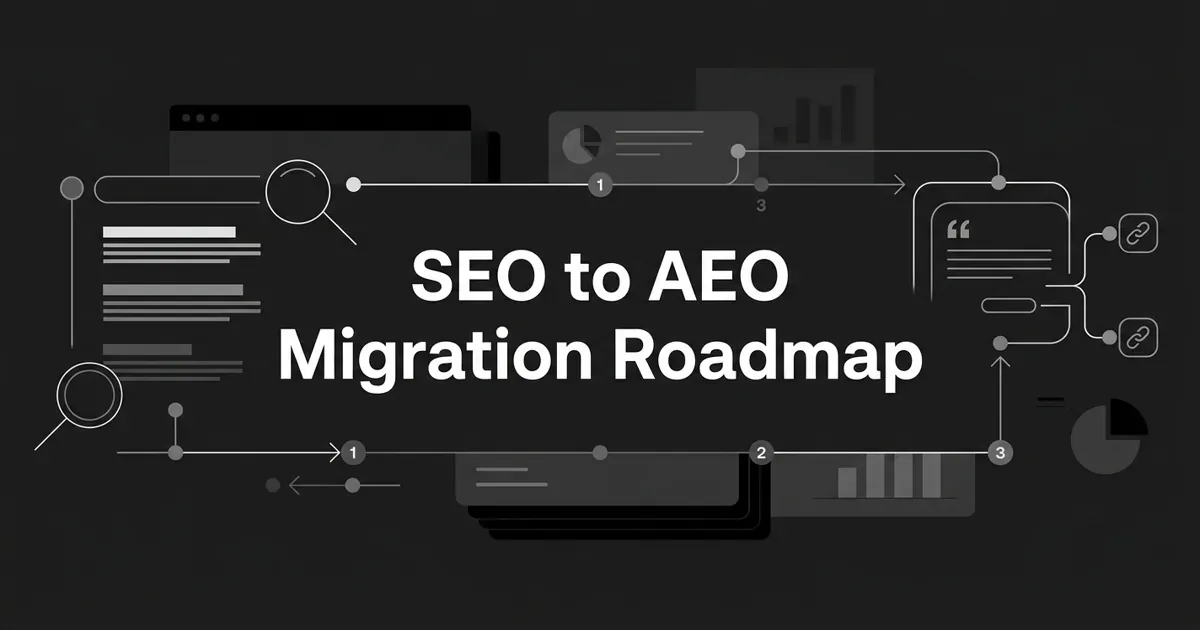
If that still feels like a lot, take a breath. The aeo migration roadmap below is seven steps, in order, and each step feeds the next. You can run it with the team you have.
What carries over, and what you are adding
Most of your SEO program stays exactly where it is. Crawlability, canonicals, sitemaps, and Core Web Vitals still matter, because AI engines retrieve from the same crawlable web that search engines index. Your backlinks and E-E-A-T signals still matter more than anything: roughly 96 percent of AI citations come from pages that already carry strong trust signals. Your writers, briefs, and review cycles stay too.
What you add is small and specific. A tracking layer for the AI engines. Answer-first formatting on your top pages. A little schema. Some off-site presence. A measurement rhythm. That is the entire shift. A good SEO to AEO migration leans on the foundation you already paid for, so you evolve SEO strategy for AI search rather than replacing it, and the pages that already rank are your unfair advantage.
Step 1: Inventory the SEO assets worth reusing
Start by listing what you already have. Pull a full sitemap of live pages, then tag each one by topic cluster, buyer stage, and current Google ranking. Flag the top 20 percent of pages by monthly organic traffic. Those high-value pages are where your migration earns the fastest return.
For each flagged page, note the target keyword, the metadata title, the last-updated date, and the internal links running into and out of it. Add two columns for whether FAQ schema and Article schema already exist. You are building one view of your reusable inventory before you touch a single word.
How do you know this step is done? You have a single spreadsheet or tool view with every high-value URL, its cluster, its buyer stage, its organic sessions, its top internal links, and its current schema status. Nothing more.
Where do people go wrong? They skip the map and start writing. Migration without an inventory produces duplicate pages and cannibalization. The second trap is subtler: teams only look at pages that already earn AI citations and miss the long tail of pages with strong SEO authority and zero AEO presence. Those quiet pages are the sweet spot, because the authority is already banked and only the formatting is missing.
If your library is large, this is one place the manual work adds up fast. DeepSmith's Sitemap module classifies every published page at onboarding by topic, type, angle, buyer stage, and key phrases, so the inventory builds itself instead of costing you a weekend.
Step 2: Map the prompts your buyers actually ask
Now shift from keywords to questions. A prompt is a full question a buyer types into ChatGPT, Perplexity, or Google AI Mode, not a two-word search term. Build a starter set of 30 to 60 real prompts. Pull them from customer interviews, sales call notes, support tickets, the People Also Ask boxes on your top SERPs, and your competitors' FAQs.
Bucket each prompt three ways: by buying stage, by the engine most likely to surface it, and by the page on your site that already owns the answer (or "none" if nothing does). Then flag your 5 to 10 must-win prompts, the ones where you have a real product but currently do not appear at all.
You will know the step is done when you have a tracked prompt set spanning every funnel stage, with the must-win gaps clearly marked. That set becomes the spine for every step after this one.
Where do people go wrong? They track only branded prompts like "what is [brand]," when AI engines answer unbranded and comparison prompts far more often. They skip "[your category] vs [competitor]" questions entirely. Or they overreach and track 300 prompts at launch, which scatters attention and burns budget for no added signal.
This is where DeepSmith earns its keep for a lean team. AI Visibility is built for exactly this workflow: define your questions in Prompts, schedule checks across ChatGPT, Perplexity, Gemini, Claude, or Google AI Mode, and get per-prompt mention and citation rates plus full answer history. Discover Prompts surfaces questions your team never thought of, generated from the product, persona, and buyer-stage context stored in your brand profile. You skip the blank page.
Step 3: Audit the AI answers and build a refresh queue
Run each prompt through the engines that matter to you. Start with ChatGPT and Perplexity for breadth, add Gemini for research-heavy B2B queries, add Google AI Mode for commercial ones. For each prompt, record which brand is named first, which URLs are cited, whether your domain appears at all, and the exact snippet the engine pulled.
Then sort every prompt into three lists. Wins are prompts where you are already cited; note the page and treat it as your benchmark. Losses with a winner are prompts where a competitor is cited and you are not; note their URL. No-citation prompts are ones where nobody is cited but the topic is core to your business; those are net-new opportunities.
The lists convert cleanly into a queue. Losses become refresh candidates, since a page on the topic likely already exists. No-citation prompts become net-new articles. Wins get reinforced with internal links from any new pages you publish. You now have a work queue built from real answer data, not from keyword volume alone.
Here is why the reuse framing matters so much at this step. Pages that already rank in the top 10 are disproportionately pulled into AI answers, so a page that ranks but does not get cited is usually one restructure away from a win, not a rewrite. That is a formatting job, and it is fast.
Where do people go wrong? They audit their "top 10 keywords" and stop, when AI prompts paraphrase rather than match a keyword verbatim. They run the audit once and walk away, even though engines refresh their source selections weekly. Log the answer history so you can tell later whether a refresh actually moved you.
Step 4: Restructure your best pages so AI can extract them
This is the core of the migration, and it is where you adapt SEO for AI answers in practice. It is more editing than writing. AI engines quote extractable answer units, so you are reshaping pages, not replacing them. Work through the refresh queue and apply the same rewrite pass to each high-value page.
1. Put the answer first
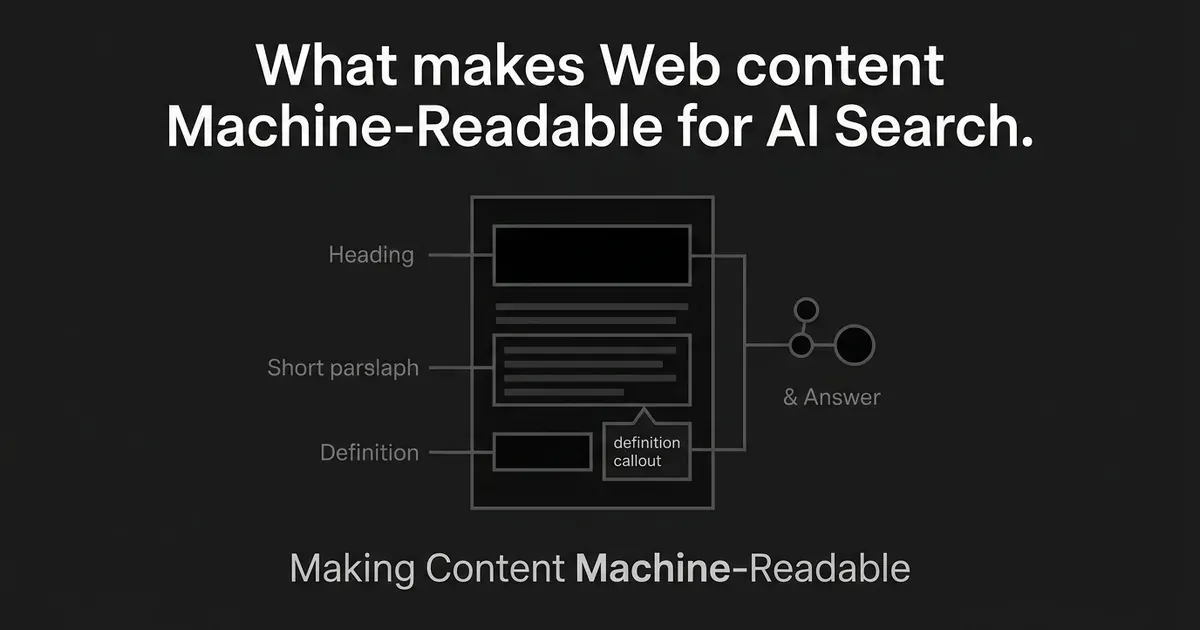
Open every section with a direct answer in the first 40 to 60 words. No throat-clearing, no scene-setting. This single change, front-loading the answer instead of burying it in paragraph three, is the highest-yield edit you can make for AI citation.
2. Structure for extraction
Convert buried answers into question-and-answer blocks, because engines lift Q&A pairs cleanly. Add a FAQ block of three to six questions near the top where it fits. Put a comparison table at the top of any comparison-style page. Pull statistics out of the prose into a callout with an inline source. Adding statistics has been shown to lift AI visibility by roughly 22 percent, and quotations by roughly 37 percent.
3. Name your entities
Each paragraph that mentions a product, framework, or named approach should name it explicitly. Pages with 15 or more recognized entities show a much higher selection probability for AI citation. You are not padding; you are naming the things you were already implying.
4. Add the schema that helps
Add Article schema with author, datePublished, and a dateModified set to today. Add FAQPage schema wherever you added an FAQ block, since it is the single highest-impact schema type across citation studies. Add HowTo schema on tutorials and Product schema on product pages.
Pro tip: think BLUF, not keyword density. BLUF means bottom line up front. Give every section its answer in the first 40 to 60 words and you win most of the citation battle before the reader (or the engine) reads sentence two. Keyword density is not a useful target for AI search anymore.
How do you know a page is done? First 60 words carry a direct answer, at least three Q&A items appear, Article schema is present with today's dateModified, the page has at least five internal links in and three out with descriptive anchors, and the body names at least 15 entities for its core topic.
Where do people go wrong? They restructure but forget to update dateModified, so engines keep aging the page. They treat schema as a magic citation trigger, when schema carries only around 10 percent of the weight in citation evaluation and cannot rescue weak authority. And they stuff the JSON-LD with keywords, which backfires, because models read it as raw text and irrelevant entries hurt.
This is the step that eats the most hours by hand, and it is where DeepSmith's Writer does the heavy lifting. The Writer produces publish-ready articles with the answer-first structure, FAQ blocks, schema, and internal links inserted automatically against your enriched sitemap, plus metadata and a cover image. Every output is grounded in your stored brand context, so the rewrite sounds like you and stays inside your real product claims instead of drifting into generic AI copy. For a queue you cannot staff, Autowrite schedules articles to generate on set dates and land ready for review, turning the backlog into a calendar.
Step 5: Build a citation corpus beyond your own site
AI engines cite from a much wider set than your domain. The pages you do not directly control often carry the most weight, so plan them into the migration instead of treating them as a separate PR project.
Earned media leads here. Third-party mentions in reputable publications drive the large majority of AI citations, so pitch the outlets and roundups that cover your category and ask to be named, not just linked. YouTube is the surprise heavyweight: in a study across 75,000 brands, YouTube mentions showed the strongest correlation with AI visibility of any factor measured. One well-titled video that names your product moves the needle at the brand level.
Reddit matters too, but only when you show up authentically. Pick two to five subreddits where your buyers actually ask questions, answer with real substance including specific figures, and mention your product in a helpful reply rather than a promotional post. If your brand has a Wikipedia or Wikidata record, improve it with proper references. And make sure the "best of" and comparison listicles in your space include you, since comparison content is one of the most-cited formats AI engines use.
Common mistake: spamming Reddit or spinning Wikipedia. Both platforms and the engines that read them detect pattern-style promotion and drop you from the citation set. Build genuine presence over months. Cheap listicle networks hurt for the same reason: they lower the authority signal instead of raising it.
You will know the step is working when, within about 90 days, you can point to one to three third-party mentions, at least one indexable YouTube video that names your product, steady presence in a couple of relevant subreddits, and inclusion in a handful of category comparison posts.
To aim your outreach, DeepSmith's Competitor citations view shows which exact competitor pages are winning your tracked prompts, so your pitch list writes itself, and Remix turns a winning competitor page into fresh idea titles that drop straight into your backlog.
Step 6: Turn the migration into a repeating cadence
The single biggest mistake teams make in a SEO to AEO migration is treating AEO as a one-quarter project. AEO drifts back toward zero within a quarter if you stop, because every competitor in your space is refreshing too. So set a cadence once and let it run.
A workable rhythm looks like this. Quarterly, refresh the tracked prompt set: add 5 to 10 new prompts, drop the dead ones. Monthly, refresh product and pricing pages, since AI engines favor fresh content and a large share of top-cited pages were updated within the last 30 days. Every four to eight weeks, re-check your must-win prompts, because measurable citation lift first appears in that window after a refresh. Every three to six months, do a deep refresh of high-value pages. Annually, run a full schema and content audit.
Standardize the brief so every article moves the same way: target prompt at the top, direct answer in the first 40 to 60 words, a schema checklist attached, an internal link plan attached, and distribution queued at publish time. You will know it is a system when your team can say in one sentence what gets refreshed, when, by whom, and against which prompt.
Where do people go wrong? They build a parallel AEO pipeline separate from SEO, which doubles the overhead and splits the team. Do not. It is one pipeline. The AEO layer sits on top of the SEO workflow; it is not a second team and not a bolt-on after publishing.
DeepSmith is built to run exactly this loop. The Idea Bank auto-replenishes from your topics, tracked prompts, and competitor Remix. Planned Content is a real calendar. Autowrite keeps production moving during busy weeks, and the Apps Library turns each finished article into channel-native posts for LinkedIn, X, newsletters, and more, so distribution stops falling off the list. Your brand context persists across every cycle, which is what keeps the volume from flattening into generic output.
Step 7: Measure citations and decide what to change next
You cannot manage what you do not measure, so define four numbers and report them every cycle. Mention Rate is the share of tracked prompts where the engine names your brand. Citation Rate is the share where it links one of your pages as a source. Share of Voice is your mentions divided by your mentions plus your competitors' across the same prompt set. Visibility Trend is the period-over-period change in any of them.
Then drill down. By prompt, so you can diagnose a weak page. By engine, so you can tell a content gap (ChatGPT cites you, Gemini does not) from a retrieval gap. By competitor, so when someone closes a gap you can see which page they refreshed and how. The report should come with one paragraph of interpretation: what improved, what regressed, which two pages to fix next.
Where do people go wrong? They report vanity totals like "total citations," which hide regressions on the prompts that matter. They snapshot once instead of tracking the delta, even though the trend is the actual signal. And they compare AI share of voice directly to revenue. Share of voice is a visibility metric. The bridge to pipeline is choosing the prompts most likely to drive sessions and demos, then watching whether those specific prompts improve.
Keep this measurement inside the same system that produces the content, so the close-the-gap loop stays short. DeepSmith's AI Visibility Overview shows mention rate, citation rate, and share of voice with trends, a per-platform breakdown, a competitor leaderboard, and the sources AI cites most, all driven by the prompt set you built back in Step 2. There is no separate tracker to keep alive.
What to do next
You do not have to transition SEO to AEO all at once. Pick your top 20 pages, map the prompts they should own, and restructure the first five for answer-first extraction. That is a real start, and it compounds. This aeo migration roadmap works because each step feeds the next, so you evolve SEO strategy for AI search a little more with every cycle. Momentum matters more here than perfection, because the engines reward the teams that keep refreshing.
Want to see where you show up in AI answers before you commit a single hour of rewrites? Start a free trial and let the data show you the gaps, then close them with content grounded in your own brand context.