It is Thursday night. Tomorrow's post is due, the doc is empty, and you have a demo at nine. If that is your week, most weeks, the problem isn't your discipline. It's the shape of the work.
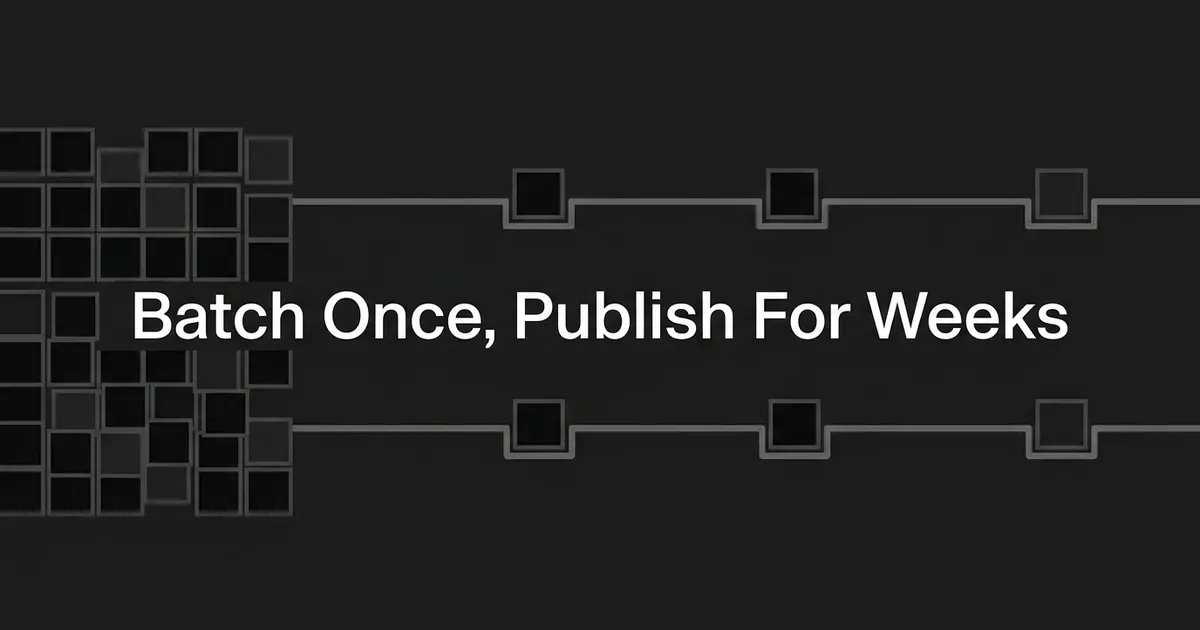
This guide shows you how to batch content production as a solo founder, so writing happens on your schedule instead of the calendar's. You'll set up theme days, a research block, a draft block, and a publish queue that holds finished pieces in front of you. By the end you'll know how to produce content in batches deep enough that a bad week costs you nothing.
What you need: one protected block on your calendar, somewhere to hold a queue, and a willingness to start smaller than you want to.
Step 1: Pick your themed days and protect one of them
A themed day assigns one kind of work to one day. Monday is marketing. Tuesday is delivery. Friday is admin and money. You stop asking "what should I do now" twenty times a day, because the day already answered.
Here's why that matters more than it sounds. Every switch between kinds of work costs you attention, and getting back into deep focus after an interruption takes a while. Grouping similar work into one sitting is how you stop paying that toll over and over.
Start by writing down the buckets you actually have. Most founders land on something like content, product or client delivery, meetings, money and admin, and thinking time. Then give each bucket a home day.
Pick your content day where your energy is highest. For a lot of founders that's Monday morning, before the week fills up. Guard that one hard. Everything else can flex.
How you know it's working: when something new lands, you don't do it now. The bookkeeper's request goes to Friday. The partner call goes to Thursday. Your writing block stays whole.
Where people go wrong: treating themed days like walls. They're buckets, not walls. Your week will bleed across days, and that's fine. The system only needs a default home for each kind of work, not perfect obedience.
Step 2: Set your publish cadence and map the topics first
Before you write a word, decide two things: how often you publish, and what goes in each slot.
Start with one article a week. That's it. You can move to two a week in month two if your buffer held, and to a heavier rhythm after that. Do not skip the gradient. Almost every founder who tries to jump straight to a month of content on the first attempt quits by week three.
Solo founder content batching lives or dies on this choice. Pick a cadence you can hit in a bad month, not a good one. A quiet, boring weekly rhythm you actually keep will beat an ambitious one you abandon in March.
Now build the topic map. Give the month one theme so every piece speaks to the same conversation. Then pick four or five topics inside that theme and pin one to each publish date. Sixty minutes is usually enough.
Some founders take a rougher swing at this and list seven to ten working titles in a single doc, enough to cover roughly the next three months. Either version works. What matters is that no publish date is a blank slot when draft day arrives.
How you know it's working: you can point at your next four publish dates and say what's going in each one.
Where people go wrong: planning topics one at a time, right before writing them. That puts a decision on every single publish day, which is exactly the deadline pressure you're trying to delete.
Step 3: Run one research batch and brief every planned piece
Research is the most expensive thing to do piecemeal. Every article pulls you into a new context, and rebuilding that context is where the hours vanish.
So do it once, for all of them, in one sitting.
Group the research by cluster. If three of your four pieces are related, they'll share most of the same sources, and one deep session powers all three. That's the compounding part of a content batching workflow: the cost of research spreads across the pieces instead of landing on each one.
What you're producing here isn't a draft. It's a one-page brief per piece:
- The working title
- Who exactly it's for
- Three to five sources you'll lean on
- The one angle this piece owns and the others don't
- One sentence on what the reader can do afterward
That's the whole deliverable. If your brief has that, draft day becomes typing instead of thinking.
Here's where a platform can carry weight. DeepSmith's Opportunity Agents read your own AI visibility data and your Content Map, then return ideas with the evidence attached, so every idea in New Ideas arrives carrying the data point that justifies it. You walk into brief writing with a reason for each topic, not a hunch.
How you know it's working: every planned date has a brief, and you haven't written a paragraph of article prose yet.
Where people go wrong: starting drafts during research. You'll feel productive. You'll also finish the block with one half-written post and three untouched briefs.
Common mistake: trying to batch a whole month on your very first attempt. Start with one week. One brief, one draft, one queued post. Prove the loop works before you scale it.
Step 4: Run a draft batch and finish ugly
Draft day has one job: turn briefs into complete drafts. Not good drafts. Complete ones.
This is the block that decides everything. When you produce content in batches, the leverage isn't in writing faster, it's in staying in one mode long enough that you stop reloading the whole project in your head between pieces.
Block ninety minutes per piece and write it start to finish. A ten minute timer per section keeps you moving when a paragraph gets sticky. Some founders prefer one long two to three hour block and produce rough first drafts of several posts back to back. Both work. The rule is the same either way.
Do not edit. Not the piece you're on, and definitely not yesterday's. The moment you start polishing, you're back on a per-article loop, and the whole point of batching is gone.
Say it out loud if you need to: finished, not perfect.
This is the step where AI changes the math for a solo founder. Doing all of it by hand, the research, the structure, the voice, the linking, the images, the metadata, means each piece still costs you most of a day, and the batch never closes. An AI-assisted pipeline moves that work off your plate and leaves you the brief, the angle, and the review.
DeepSmith's Writer takes one planned idea and runs research, planning, writing, internal and external linking, the cover image, and publishing metadata in a single pass. Autowrite goes further: configure the article when you plan it, and it writes itself on its scheduled date into Produced Content with nobody in the app. Publish-ready is the goal of that output, not a promise that you skip reading it. You still review. You just review instead of write.

How you know it's working: every planned piece has a complete draft, rough edges and all.
Where people go wrong: ending the block with four half-drafts. Half a draft is worth nothing to your queue. One finished rough post beats three polished openings.
Step 5: Polish only the piece that ships next
You now have a pile of rough drafts. Do not sit down and edit all of them.
Polish one piece: the one going out next. Do it in the week it publishes, in a fifteen to thirty minute pass. Check the facts, tighten the opening, fix the things that make it sound like a machine, and ship it.
Why so late? Because editing ahead of the queue is how the buffer never forms. Editing is comfortable work. It expands to fill whatever time you give it, and it feels like progress while your unwritten pieces sit there.
There's a quality point here too, and it's the one most people skip. Batching raises your output. It does not lower the bar. A draft that came out of an AI pipeline needs the same editorial pass as a draft that came out of your head. What batching buys you is that the pass is short, because the structure and the sourcing are already done.
Keeping voice consistent across a batch is the other risk, and it's a real one. This is what DeepSmith's Deep IQ layer is for: your positioning, personas, product facts, brand voice, and content types are stored once and every article is written against them, so you're not re-briefing tone on piece number four.
How you know it's working: your polish pass takes under thirty minutes and doesn't turn into a rewrite.
Where people go wrong: polishing the whole batch before anything has published. You spend the saved time immediately, and you're back where you started.
Step 6: Load the publish queue and leave it alone
This is the step people skip, and it's the one that actually delivers the promise.
A queue is a set of finished pieces sitting in dated publish slots ahead of today. Note the word finished. Dates in a calendar with nothing attached to them are not a buffer. A buffer is articles in the done state, waiting.
Load all four drafts into the queue on the last day of your sprint. Dates, slugs, metadata, links, cover images, all of it. Then close the tab.
If shipping still needs a decision from you on the day, launch stress comes right back, and a good batch collapses into deadline mode anyway. The queue is what removes the decision.
Publishing straight from where you produce keeps this cheap. DeepSmith pushes finished articles to WordPress, Webflow, Strapi, Sanity, or Contentful, or to your own webhook, with Markdown and HTML export as a fallback. Whatever you use, the goal is the same: the piece leaves your hands once and lands on the site without you.
One more thing about the queue. It's the only part of this system anyone else can see. Your themed days, your briefs, your rough drafts, none of that shows up on the site. The queue does. So when you're deciding where to spend a tired hour, spend it here, on getting one more finished piece into a dated slot.
How you know it's working: you can name today's date and the next four publish dates, and each one already has a finished piece behind it.
Where people go wrong: confusing "scheduled" with "ready". Ask the honest question of each slot: if I disappeared for a month, would this still publish?
Step 7: Audit monthly and replenish before the queue runs dry
Once a month, look at what shipped and how deep the queue still is. This is a fifteen minute review, not a project.
Three things to check:
- How many finished pieces are left in the queue? Set a floor and hold it. Two weeks of queued articles is the minimum. Four weeks is comfortable. Six to eight weeks makes sense before a known heavy stretch like a fundraise or a launch, as long as you accept that some pieces will go stale sitting there.
- Which themes drained fastest? That tells you what to plan next month, and it beats waiting for inspiration.
- Did you drop into deadline mode at any point? If you did, the cadence is wrong, not your effort.
That last one has a specific fix, and it's the opposite of what most founders do. The answer to a broken month is not a heroic catch-up sprint. It's smaller batches more often. Two pieces every two weeks beats four pieces once a month if once a month keeps failing.
When the queue drops under your floor, run a top-up batch. Even a small one. Maintaining a buffer of four costs far less than rebuilding one from zero after a bad month.
Pro tip: one monthly batching afternoon of five or six hours costs you less than four weeks of Thursday night panic. Put it on the calendar as a recurring block, not as a thing you'll get to.
Your first month, mapped out
Here's the whole system as one sample month. Treat it as a working model, not a law. Your numbers will move.
The setup: one theme for the month, one article a week, four articles in the queue at all times.
The sprint, spread across one working week or two half weeks, six to eight hours total:
- Day 1, 60 minutes. Pick four topics under the month's theme and pin them to your next four publish dates. Free-write five minutes per topic to find the angle. Write the four briefs.
- Day 2, 90 minutes. Draft post one, start to finish, ten minute timer per section. Make the cover image while the file is open.
- Day 3, 90 minutes. Draft post two. Do not touch post one.
- Day 4, 90 minutes. Draft post three.
- Day 5, 90 minutes. Draft post four, then load all four into the queue with their dates, slugs, and metadata.
The other three weeks: no writing. Each week you spend fifteen to thirty minutes reviewing the piece that ships that week. That's the only content work on your calendar. The rest of the month goes to product, hiring, and the fires.
That's the content sprint founder model in one paragraph: one week on, three weeks off, and the queue absorbs whatever the three weeks throw at you.
Batch content production isn't about writing faster. It's about moving the writing off the day it's due. Do that once and the panic has nowhere to live.

What to do next
Pick your Day 1 and put it in the calendar right now, before you close this tab. Give it sixty minutes and a month theme. That single block is the difference between a system and an intention.
Then start small. One theme, four topics, four briefs. Solo founder content batching gets easier every cycle, because the second month starts with a queue behind you instead of an empty page. If month one holds, you'll never write on a deadline again.
If you want the research, drafting, linking, images, and publishing handled inside the batch instead of on your plate, start a free trial of DeepSmith and produce your first queued pieces before you pay. It's a 7-day trial, with real data and real drafts, no long contract, and Pro starts at $99 a month.