Content operations maturity is how consistently your team can take a content priority all the way through to accurate, published, distributed, maintained, and measured content, without rebuilding the process around every single piece. It has nothing to do with how many people you have or how much software you're paying for. It has everything to do with whether the same basic steps happen on an ordinary Tuesday, not just on the piece you showcase in a deck.
A lot of teams confuse content strategy with content operations, and it's worth separating them before you try to place yourself on a maturity model. Strategy decides who you're writing for, what you're trying to achieve, and what matters most right now. Operations is the repeatable system that actually executes that strategy: the intake, the brief, the writing, the review, the publish, the distribution, and the upkeep after it goes live. You can have a sharp strategy sitting on top of operations that fall apart the moment someone goes on vacation. You can also have a smooth, well-oiled publishing machine that cranks out the wrong content because nobody connected it back to what your audience actually needs.
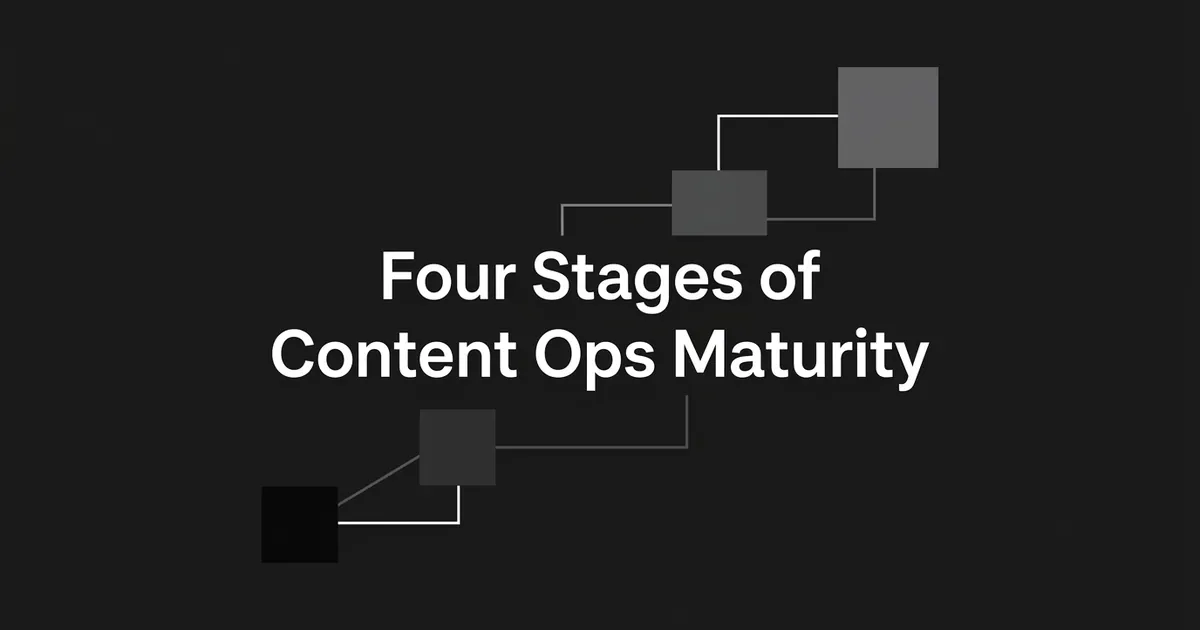
This piece walks through four content ops maturity stages: ad hoc, repeatable, integrated, and adaptive. These aren't an industry-certified scale, and you'll find other frameworks that count three, four, or five levels depending on who wrote them. Think of this content maturity model as a diagnostic vocabulary, a way to talk honestly about where your operation actually stands, so you can see what's really happening across the whole lifecycle instead of judging maturity by whether a calendar exists.
What content operations maturity actually measures
The test isn't whether you own a content calendar or a fancy platform. The test is whether the important things happen on their own, without someone remembering to make them happen.
Here's a way to assess content operations honestly. Pick a handful of recently finished pieces, including one ordinary piece and one that hit a snag along the way. Trace each one backward to why it got made, then forward through publishing, distribution, and whatever happened to it since. Ask these questions at each point:
- Priority. Can you explain why this topic got picked and what evidence or goal was behind it, or did it just show up on someone's list?
- Production. Can a teammate find the brief, the source material, and the current status without tracking down whoever last touched it?
- Quality and governance. Were facts, brand voice, and basic search structure checked as a normal part of the process, not scrambled together at the last minute?
- Publication and distribution. Did the piece actually reach the channels it was supposed to, or did the job quietly stop the moment it went live?
- Maintenance. Is there any way to know this page still needs attention, or is it just sitting there because nobody's looked at it since it published?
- Learning. Did anything about how this piece performed change what you decided to do next?
Write down what actually happened at each step, not what's supposed to happen. If a step only worked because one specific person remembered to do it, that's a sign your process depends on a person rather than a system, and that distinction matters more than anything else on this list.
Stage 1: Ad hoc
In an ad hoc operation, work gets published through individual effort and improvisation. Ideas show up in a message or a meeting rather than a shared queue. A calendar might technically exist, but it isn't what actually decides what gets written next. Every brief gets rebuilt from scratch because there's no reusable version of it. Review catches basic problems late, sometimes after a piece is already close to done. Linking, images, distribution, and any later updates happen only when somebody has spare time to think about them.
This isn't a comment on writing quality. An ad hoc team can still publish good individual articles, sometimes really good ones. The issue is that good outcomes depend on someone stepping in to rescue the piece, not on a process that would work the same way if that person were out sick.
To check whether you're here, pick a recent piece and ask whether you could reconstruct its priority, its brief, its review decisions, and its distribution plan without interviewing the person who wrote it. If the answer lives only in someone's head, you're still substantially ad hoc, whatever your calendar looks like.
You start moving past this stage when ordinary pieces, not just the flagship ones, follow a visible intake step, a shared brief or standard, a consistent review sequence, and a clear place to flag exceptions. The real test is whether that routine survives an interruption or a handoff. Buying a new tool doesn't pass that test on its own.
Stage 2: Repeatable
At this stage, a recognizable production process works for a defined stream of content. You have a usable backlog or calendar, standards people actually follow, and a reasonably predictable path from idea to published piece. Production stops being a surprise most of the time.
The catch is that the chain often stops there. Coverage or gap analysis might live in a spreadsheet nobody looks at during planning. Internal links and metadata get bolted on during a rescue edit right before publishing. Distribution happens when someone remembers, not as a built-in step. Old pages sit there indefinitely with no review decision attached to them, good or bad.
To check whether you're here, follow one topic gap or one disappointing result forward and see what happens to it. Does it visibly change what gets written next, or do reporting, planning, and production stay three separate conversations that never quite meet? It also helps to look at whether your standards apply to routine, unglamorous pieces, not just the ones getting extra attention.
You move toward the next stage when priorities and evidence start entering the same queue that drives production, when context survives a handoff instead of getting lost, when publication is reliably followed by the distribution and review it was supposed to get, and when findings about performance or accuracy can actually reach back and change a future plan. None of that requires one single piece of software. It requires the decisions and the execution to be connected rather than parallel.
Stage 3: Integrated
An integrated operation connects the decisions, the production, the quality checks, the distribution, and the measurement into one lifecycle instead of a series of separate steps. You can explain both why a piece got made and what's supposed to happen to it after it goes live. Reuse and future updates get planned for where it makes sense, rather than being an afterthought.
The usual weak spot at this stage is that the operation collects evidence without consistently acting on it. You might have a dashboard full of performance numbers and content gaps that nobody actually revisits when planning the next quarter. A page remaining live is not proof that it remains useful or accurate, which is exactly the gap that a maintenance decision is supposed to close.
To check whether you're here, find a bottleneck or a gap your team already noticed, and trace what actually changed because of it. Did a process, a standard, or a priority genuinely get revised, and did anyone check whether that change helped? A dashboard that nobody acts on isn't proof of an adaptive operation, it's proof of an integrated one that hasn't taken the next step yet.
The signal that you're heading toward the next stage is when the operation doesn't just notice a problem, but makes a deliberate change to fix it, and then checks whether that change actually worked. That's a different muscle than simply having connected data.
Stage 4: Adaptive
An adaptive operation keeps the connected lifecycle running while actively learning from it. Patterns in delays, rework, pages that are quietly going stale, missed distribution, and how the audience responds all feed back into changes in priorities and standards. When conditions shift, decisions get revisited instead of left on autopilot.
This doesn't mean every article is a hit or every metric moves upward. Channel volatility, editorial judgment, and shifting business goals still matter, and they always will. What sets this stage apart is a traceable learning loop: your team can point to a specific problem it noticed, a deliberate change it made in response, and evidence it looked at afterward to decide whether to keep, adjust, or reverse that change.
To check whether you're actually here, ask for one concrete example: a detected problem, an intentional change, and what happened next. If nobody can produce that example, you're probably describing an integrated operation that has good instincts but hasn't closed the loop yet. And if your team is watching AI search specifically, the same discipline applies there. Knowing which buyer questions matter and checking your visibility in AI answers on a regular basis, then letting an observed gap lead to an actual content decision, is the same adaptive pattern applied to one more channel. It's worth treating as a habit rather than a fifth mandatory stage.
Why unevenness across stages is normal
Very few real operations sit at one clean stage across everything they do. You might be integrated in production, where briefs are solid and standards hold, and still be stuck at ad hoc in maintenance, where nobody has looked at an old page in over a year. That's not a contradiction, it's the normal shape of a real operation.
When you're placing your own team, pick the highest stage whose defining pattern holds across the ordinary, everyday workflow, then separately note whichever dimensions are lagging behind. Don't average a strong production process with a nonexistent maintenance practice and call the result "mostly integrated." A missing quality gate or a dead maintenance habit doesn't get smoothed over just because other parts of the operation look good.
It's also worth being honest about what a maturity stage doesn't tell you. Reaching a higher stage doesn't promise more traffic, more citations, or more revenue on its own. Content Science is a research group that studies content operations. It has published survey data showing that a meaningful share of organizations sit in the lowest levels of its own five-level model, and that its most mature organizations tend to correlate with stronger outcomes. Correlation isn't the same as a guarantee, and no study has established a universal score or article count that defines a stage. Treat this content maturity model as a lens for an honest conversation about your own operation, not a certificate you're chasing.
Some teams reach for automation to skip straight to a higher stage, and it's worth being clear about what that does and doesn't buy you. AI-assisted drafting or scheduling can remove a lot of repetitive work, and tools built for content production, DeepSmith among them, can keep a shared brief, brand voice, and product context attached to every piece so a writer isn't rebuilding it from scratch each time. But faster drafts aren't maturity by themselves. If factual checks, brand accuracy, and the feedback loop from what published back into what gets planned next still depend on someone remembering to do it, the tooling has sped up production without moving the operation forward.
What to do with your stage once you know it
Knowing your stage is only useful if it changes what you do next. If you're ad hoc, the highest-value move is picking one ordinary content type and building a repeatable intake, brief, and review sequence around it, then testing whether that sequence survives a handoff. If you're repeatable, the next move is connecting your gap analysis or performance reporting directly into your planning queue, so a finding actually becomes a decision instead of a slide nobody revisits. If you're integrated, look for the one place your team collects evidence without acting on it, and make a single deliberate change based on it, then check the result. If you're already adaptive, the work is sustaining that habit as your channels, team, and goals shift, because the loop doesn't stay closed on its own.
Publishing more content isn't the same as running a system that learns from what it publishes. A team stuck at ad hoc can still put out decent individual pieces, and a team at adaptive can still have an off month. The difference that actually matters is whether your operation, on an ordinary week with nobody watching closely, does the same reliable things it did the week before, and gets a little better at them because of what it noticed last time.