You have the tools. You still don't have a system.
That is the honest shape of most content teams right now. Drafts appear in minutes, then sit for a week while someone chases sources, rewrites the opening, hunts for links, and finally pastes it into the CMS on a Friday evening. If that is your month, you are not behind. You are just missing the handoffs.
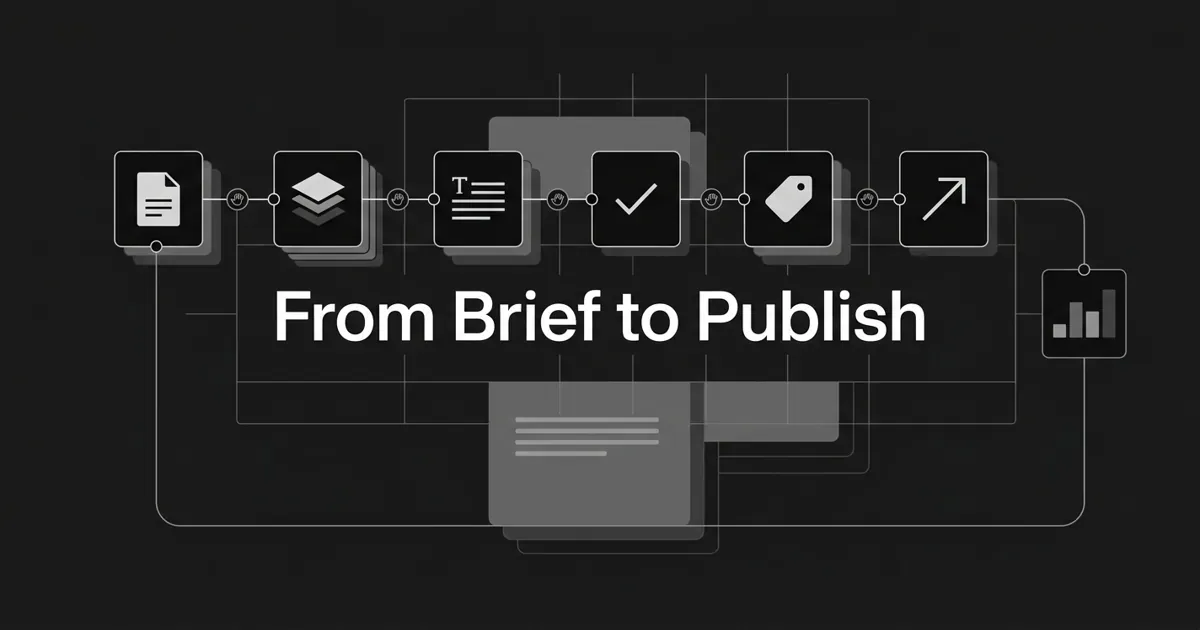
This guide gives you the nine content production workflow stages that carry one idea from brief to published page, each with a named owner and a finished artifact. By the end you can map your own ai content workflow, see where yours leaks, and set up AI content workflow stages your team repeats without you standing over it.
One thing first. AI is an execution layer inside your ai content pipeline. It drafts, links, formats, and repurposes. It does not choose the problem, supply the expertise, decide what your brand may claim, or own the outcome. You do.
See the whole workflow before you build any part of it
Nine stages, nine handoffs, nine moments where work either moves or stalls.
| Stage | Accountable owner | Handoff artifact |
|---|---|---|
| Set up the system | Marketing or content lead | Workflow map, roles, statuses, shared context |
| Opportunity and brief | Strategist or marketing lead | Approved brief |
| Research and evidence | Researcher with expert input | Source and claim matrix |
| Outline | Strategist or writer | Question-led outline |
| Grounded draft | AI writing system or writer | Draft plus metadata, links, media |
| Edit | Editor with expert input | Edited article plus open issues |
| SEO and AEO | SEO owner or editor | Publication package |
| Publish | CMS or publishing owner | Live page and publication record |
| Distribute and measure | Distribution and analytics owner | Channel assets, measurement record |
Running a team of two? Combine the roles freely. The failure mode is never role combination. It is an unnamed owner and an implicit handoff.
Set up the system before you write a single brief
Start here, not with a writing tool. This is the step everyone skips, and it is the reason the other eight wobble.
Do these seven things:
- Name one workflow owner. That person owns throughput, the backlog, and any handoff that gets stuck.
- Define your statuses. A practical sequence: New Idea, Briefed, Research Ready, Outlined, Drafting, Editing, SEO/AEO Ready, Approved, Published, Distributed, Measured.
- Attach a required artifact to every status. A status must mean a piece of work exists, not a remembered conversation.
- Create a shared context record: positioning, products, claims to make and avoid, buyer needs, brand voice, visual rules, content types, trusted sources.
- Decide how opportunities enter the queue: business priorities, buyer questions, keyword clusters, AI-search gaps, competitor citations, coverage gaps.
- Pick your baseline signals: the target prompt set, the target page, the competitors that matter, and the starting visibility state.
- Agree where handoffs live. Your writer should never scroll a chat history to find the brief.
How to tell it is done: a new teammate can take one idea and answer four questions without asking anyone. Who is this for? What evidence can we use? Who owns the next decision? What must exist before it moves?
Where people go wrong: opening a general-purpose AI chat instead of a brief and a source pack. Treating a style-guide PDF as your brand context. Adding status labels with no artifact behind them.
That shared context record is what DeepSmith's Deep IQ holds: company positioning, products and services, buyer personas, brand voice, visual guidelines, reusable content types, and a trusted-sources list. Set it once and every draft reads from it, so you stop re-briefing the same background per article.
Choose the opportunity, then write the brief
Start with the gap, not the tool. Pick a topic with a real reader need and a reason to exist now. Maybe a buyer keeps asking it. Maybe an AI answer names you but does not link you. Maybe a competitor owns a topic you have nothing on.
Then fill the brief. These fields are the whole job:
- Working title and page purpose. What can the reader do, decide, or understand afterward?
- Primary keyword or buyer prompt. For AI search, write the actual question plus the likely follow-ups.
- Audience. Role, problem, existing knowledge, desired outcome, decision context.
- Search intent. Informational, navigational, commercial, or transactional, plus the answer expected.
- Unique angle. First-hand experience, original data, a practical model, or a real gap in what exists.
- Outline requirements. Format, headings, questions to answer, examples, evidence, objections.
- Competitor and SERP notes. What strong pages cover and what they miss. Reading the top three to five ranking URLs is a working habit, not a rule.
- Link and source plan. Which internal pages, which anchor idea, which trusted sources back which claims.
- SEO package. Title tag, H1, meta description, slug, image need, alt-text direction, schema type if it applies.
- AEO package. The direct answer, definitions, follow-up questions, and the prompts you will monitor after publication.
- Success signal. What you will observe. Not a promised ranking or citation.
How to tell it is done: a writer can build the outline without guessing the audience, the intent, the angle, or the evidence. The page has one clear job.
Common mistake: giving the writer a title and a word count and calling it a brief. That is not delegation. That is handing someone your unfinished thinking.
Other frequent slips: confusing a keyword with a reader need, or promising a citation before the page exists.
Opportunity data earns its keep here. DeepSmith's Content Map crawls your pages, classifies them into topics and funnel stages, then maps competitor sites onto the same taxonomy, so coverage gaps and untapped topics become measurable instead of a hunch. Opportunity Agents turn that data into ideas that each carry the data point justifying them. The idea lands in New Ideas, and giving it a date moves it to Planned Content. Evidence walks into production alongside the idea.
Build the evidence pack before anyone drafts
Research the question the page must answer and the claims it will make. Pull from first-party product and customer knowledge, primary studies and official documentation, your subject-matter experts, current search results, and the answer histories of your target prompts.
Then build a claim matrix. One row per claim, with seven fields: the claim, its support (source, data point, planned use), its freshness date, its context (population, method, period, caveats), the owner who interprets it, its placement, and its status: found, needs confirmation, approved, or excluded.
Sanity check the target term too. Search it. Does the result type match the page you planned? For an AI-search target, note which sources get cited and where competitors appear. That snapshot is evidence, not a rule.
How to tell it is done: the writer receives a brief, a source list, a claim matrix, competitor or prompt notes, and the open questions. Nobody discovers basic evidence while drafting.
Where people go wrong: asking a model to invent sources, quotes, or customer results. Lifting a number without its population, method, or date. Researching keywords but not the objections behind them.
Pro tip: make the claim matrix part of the handoff, not a private document. If the next owner has to rediscover the evidence, you have not removed the bottleneck. You moved it.
Turn the brief into a question-led outline
An outline is a handoff document, not a list of headings. For every section, write down six things: the reader question it answers, the point it must establish, the evidence it uses, its relationship to the target prompt, its link slot, and its format (explanation, steps, table, example, checklist, FAQ).
For a how-to, use action-based H2s in the order someone would do the work. Put the direct answer near the top. Use H3s only when a step splits into distinct parts. Google's guidance is to write clear paragraphs, sections, and headings for people, and it says there is no ideal page length and no need to chop content into tiny pieces for AI. Optimize for navigation, not for a word count.
How to tell it is done: every H2 has a purpose and a question. Every required claim has a source. The writer can draft without deciding strategy mid-sentence.
Where people go wrong: headings that are topics instead of actions. Borrowing a competitor's hierarchy. Using the FAQ as a dumping ground for questions the article should answer.
Generate a grounded draft, not a blank-prompt draft
Most teams lose the plot here. They open a chat window, type the title, and hope brand voice appears. It does not.
Give the writing system everything: the approved brief, the evidence pack, the outline, your brand context, and the content-type rules. Ask for the article and the publication package together. Specify the reader and outcome, the permitted claims, the sources it must use, the answer-first structure, the voice and forbidden claims, the link targets, the metadata and image direction, and the questions it must leave for a human.
How to tell it is done: the draft answers the brief, follows the outline, uses the supplied evidence, and sounds like your stored context. No invented feature, customer result, quote, or source. Missing evidence is visible, not papered over with plausible language.
Where people go wrong: letting the model pick the angle after the brief was approved. Asking for "SEO optimized" without naming the reader, intent, structure, or metadata. Treating a fast draft as a finished page because it reads smoothly.
DeepSmith's Content Studio Writer is built for this stage. It turns a planned idea into a brand-grounded article, researched, internally and externally linked, with a cover image and publish-ready metadata, using your Deep IQ context so nothing gets re-entered per article. Autowrite is the scheduled version: configure the article when you plan it, and it writes on its date and lands in Produced Content for review and publish.
Edit for truth, expertise, and voice
Your editor is not a comma inspector. This is the judgment step. Work in this order:
- Strategic fit. Does the page solve the brief's problem for the intended reader?
- Accuracy. Does each claim match the evidence pack, with its date, definition, and caveat intact?
- Expertise. Is there real interpretation, or a rearrangement of common knowledge?
- Brand and product accuracy. Does it sound like you, and are product claims inside the supplied facts?
- Usability. Can someone scan it, understand it, and act?
- Answer integrity. Does the opening answer the question, and does every later section earn its place?
Google's standard is original, helpful, people-first content that demonstrates experience, expertise, authoritativeness, and trustworthiness. Using AI is not banned, and it earns no special advantage either. Using it primarily to manipulate rankings does violate the spam policies. The bar is usefulness, never the percentage of text a model typed. Where readers would reasonably wonder how a piece was made, a plain note about your process beats an AI byline.
How to tell it is done: your editor can state the angle in one sentence, point to the evidence behind every important claim, name the human contribution, and confirm nothing overstates the product or the research.
Where people go wrong: editing grammar while leaving generic reasoning untouched. Deleting caveats to sound more confident. Treating a citation as proof that the source supports the exact sentence.
Apply the SEO and AEO layer before the handoff
Normal SEO fundamentals still carry the weight. AEO is the layer on top: making the page easy to retrieve, understand, quote, and link to when an AI system answers the question. It is not a secret markup standard.
| Element | What to do |
|---|---|
| Title | Unique, clear, and true to the page promise |
| H1 and headings | One page topic, action or question-led sections |
| Opening answer | Answer the main question near the top, then explain |
| Meta description | Short, unique, specific to this page and not your site slogan |
| Internal links | Relevant related pages, descriptive anchors, real destinations |
| External links | Link claims to trustworthy sources that support that exact claim |
| Structured data | Use a type only when it describes visible content, then test it |
| Media | Images that inform, near related text, with descriptive alt text |
| Technical eligibility | Public, crawlable, fast, works on every device |
| AEO evidence | Definitions, source-backed facts, answers to follow-up questions |
How to tell it is done: the page has a clear title, H1, meta description, answer-first opening, relevant links, usable media, and a crawlable publication plan, with the prompts you will watch recorded.
Two boundaries keep you honest. A page has to be indexed and eligible for a normal search snippet before it can appear as a supporting link in AI Overviews or AI Mode, and meeting those requirements still guarantees nothing. There is no special AI file, Markdown, or schema for generative AI search. Structured data can clarify meaning and enable rich results, but it must describe what a reader sees.
A title under 60 characters, one H1, and alt text under 125 characters are useful defaults, not ranking thresholds.
Where people go wrong: treating AEO as a substitute for useful content. Spinning up a thin page for every wording variation. Adding FAQ schema when the page has no FAQ. Leaving links to a last-minute manual pass, which is how you get weak anchors and broken destinations. Linking is a workflow stage, not a chore you squeeze in before publishing.
Publish one complete package
Your publisher should receive a package, not a body of copy and a list of chores. Include the final body and headings, the title tag, H1, meta description, and slug, the links with their anchor text, structured data if it applies, the cover image and alt text, the CTA from the brief, and the publication date, owner, and handoff.
The CMS owner imports it, previews it, publishes it, and records the live page on the calendar. Direct CMS integration cuts copy-paste risk. It does not remove the need for an editorial owner.
How to tell it is done: the live page matches the approved package, metadata is present, links point where they should, and the record tells the distribution owner what went live.
Where people go wrong: publishing first and planning metadata, links, image, and distribution afterward. Losing headings or links while pasting rich text between systems. Forgetting to record the target prompt set, which quietly makes later measurement impossible.
Distribute, measure, and feed the learning back
Publication is not the finish line. This last stage is what turns a brief to publish process into a loop instead of a line.
Make distribution a named step. Start from the approved article and build channel-native versions: a LinkedIn post, a newsletter section, an X thread, whatever your audience reads. Each asset keeps the article's point and your voice while adapting length. Pasting the same text everywhere is not distribution.
Then record two measurement layers. The search and site layer: impressions, clicks, click-through rate, organic sessions, engagement, keyword visibility. The AI visibility layer: mention rate, citation rate, share of voice, sentiment, cited pages, prompts, competitor citations, and period-over-period change.
Know what each source can and cannot tell you. Google's Search Console generative-AI reporting shows impressions and URL-level visibility in features like AI Overviews and AI Mode. Pair it with prompt-level tracking when the real question is which answer cited you for which buyer prompt. Bing Webmaster Tools' AI Performance covers Copilot, AI summaries in Bing, and select partner integrations, with citations, cited pages, grounding queries, and citation share. Bing says plainly that its data does not measure ranking, authority, or importance, that grounding queries are grouped representations rather than exact prompts, and that it is not a complete log of every reference. Directional evidence, then. Not a scoreboard.
Set a refresh condition instead of an arbitrary interval. A page returns to the backlog when its evidence goes stale, the target answer shifts, a competitor wins the citation, or the visibility you wanted never arrives.
Common mistake: calling any AI mention a citation. A mention names your brand. A citation links to your page as a source. Track them separately, and compare platforms separately.
DeepSmith closes this loop in two places. Repurpose and the Apps Library keep distribution inside the article workflow, turning a finished piece into platform-native versions for LinkedIn, X, Medium, Substack, newsletter email, Reddit, and more. AI Visibility supplies the feedback: mention rate, citation rate, share of voice, sentiment, prompt histories, cited pages, and competitor citations. Coverage is tiered by plan, with Pro tracking ChatGPT, Grow adding Perplexity, Scale adding Gemini, and Enterprise or Custom covering all ten engines. No tool guarantees a citation. What this data does is show you the gap, so your next brief comes from evidence.
What to do next
Do not rebuild everything this week. Please don't.
Pick one content type and one opportunity source. Write the nine handoffs on a single page, with a name against each one. Run one article through the whole brief to publish process, all the way to distribution and a recorded baseline. Then find where it stuck, fix that seam, and run the next piece.
That is how you set up AI content workflow stages that survive a busy month. You are not designing all nine content production workflow stages at once. You are running one loop, then another, until the ai content pipeline moves whether or not you are watching.
If you want visibility data and production in one place, so a gap you find on Monday becomes a published page instead of a note in a doc, start a free DeepSmith trial and run one piece end to end.