I bet you have a folder of good SEO writing examples. You pulled the top five results for a keyword, highlighted what you liked, and sent them to your writer with a note: "Write something like this, but better."
Three days later, the draft comes back and it's… fine. But it's not what you had in your head. So you spend two hours rewriting it. Again.
If you're running a lean content team and trying to scale output without scaling headcount, that whole cycle is a disaster. "Inspiration that needs rewriting" isn't a system. It's a bottleneck. I've been there, and it's a fast track to burnout for you and your writer.
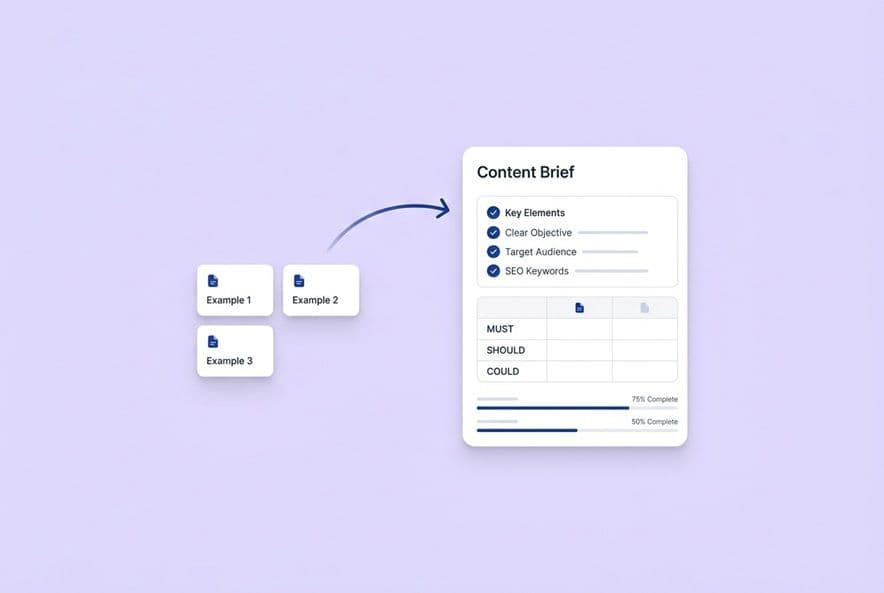
Good SEO writing examples are evidence. They're clues. Your job is to stop using them as a mood board and start treating them like inputs for a real, standardized content brief. A brief with acceptance criteria, rules, and a way to iterate. If your brief just tells writers what to feel inspired by instead of what to produce, you'll be stuck rewriting drafts forever instead of reviewing finished work.
This is the system I use for building briefs that are executable, testable, and reusable. Let's build it.
So what does this actually mean?
It means you stop treating examples as inspiration and start treating them as structured data. It's a mindset shift.
Most teams I see use examples in one of two ways. They either send them to writers as a vague reference ("see how they handled the intro?") or they mine them for a few keywords and headings, then write their own outline from scratch. Both approaches probably extract 20% of what an example can teach you. The other 80%, all the good stuff like intent signals, evidence patterns, and conversion logic, just stays invisible.
Why this usually fails to scale
The problem isn't the examples you're finding. It's the gap between seeing why a great article works and building a brief that tells a writer how to replicate that success.
That gap exists because great articles don't come with instructions. You see a great piece of content and infer the rules that made it great. But when you just hand that example to a writer, you're asking them to read your mind and reverse-engineer your taste, all while on a deadline. That's a recipe for rewrites, every single time.
The goal: a brief that's executable, testable, and reusable
A brief built this way isn't just longer; it's fundamentally different. It has three key properties that most briefs are missing:
- Constraints and freedom. A clear separation between what must be in the article (SEO needs, proof requirements, core structure) and what the writer gets to decide (the angle, the specific examples, the analogies).
- Acceptance criteria. A simple checklist that defines when the draft is done. This isn't about "it feels right," it's about meeting specific, verifiable conditions.
- Iteration hooks. A few pre-defined signals you'll check at 30, 60, and 90 days so you can improve the next brief for this topic cluster.
That's what we're building. Now let's talk about the raw materials.
How do you pick SEO examples worth modeling (and avoid copying junk)?
The SERP is full of content that ranks for bad reasons. Maybe it's a huge domain, it has a ton of old links, or it just got lucky years ago. If you model the wrong examples, you'll bake those bad patterns right into your process.
The "3-example minimum" rule
For every brief, use at least three examples from the top five organic results. The trick is to assign each one a specific job instead of treating them as interchangeable.
- The Structure Example: Find the piece that best organizes the information for this search intent. Look at its headings, where it puts the main takeaway, and how long each section is.
- The Depth Example: Find the piece that goes deepest on a key subtopic. This tells you what level of detail you'll need to really satisfy the reader.
- The Differentiation Example: Find the piece that does something the others don't. Maybe it has a unique framework, a specific comparison, or a contrarian take. This is where you find your angle.
Using all three stops you from just making a slightly worse copy of whatever happens to be ranking #1.
Red flags: when an example ranks but isn't a good model
Not everything that ranks deserves your attention. I've learned to watch for these red flags the hard way:
- Intent mismatch. The article ranks for your keyword but it's actually answering a different question. A common one is a "what is" article ranking for a "how to" keyword.
- Thin content on a strong domain. The article is shallow, but it ranks because it's on a massive, authoritative site. Modeling this just sets the bar too low.
- Outdated structure. It was published four years ago, never updated, and is just coasting on momentum. Its structure might actually mislead you about what readers expect today.
- Ranking on backlinks, not content. If a page has hundreds of powerful backlinks but the content is weak, the article's structure isn't what's doing the work. Ignore it.
What to pull from each example
For each of your three chosen examples, you need to capture these elements before you even think about writing a brief:
- The primary question it answers (in one sentence, not just the keyword)
- Word count and section count
- The H2/H3 structure (just a simple ordered list of the headings)
- Where the "actionable payoff" is (which section, how far down the page?)
- What kinds of proof it uses (data, case studies, screenshots, quotes)
- The call-to-action style and where it's placed
- What's obviously missing, the topics a reader would expect that the article just skips
That last one? That's your map to finding whitespace.
What should you extract to make your brief more than "keywords + headings"?
This is the step where most briefing processes stop short. Pulling headings and keywords is just the starting line. If you want to reduce rewrites and actually drive results, you need to extract four deeper layers from your examples.
Intent and promise: what question is the page really answering?
Every good piece of SEO content makes an implicit promise to the reader: "Read this and you will know X" or "Read this and you will be able to do Y." That promise is almost never the keyword itself.
In your brief, you need to make this explicit. Write an intent statement in this format: "After reading this, the reader can [specific outcome], even if [common obstacle]."
For an article like this one, the intent statement might be: "After reading this, the reader can build a standardized brief from SERP examples, even if their team has never used a formal briefing process before."
This one sentence does more work than a whole list of secondary keywords. It gives the writer a clear target for the entire piece.
Information architecture: how the page earns its clarity
Go a level deeper than just the headings. Look at the flow.
- Narrative sequencing. Does the article move from problem to diagnosis to solution? Or does it jump straight to tactics? What makes more sense for your reader?
- Section weight. Which sections are long and detailed? Which are short and scannable? This shows you where the reader expects real payoff.
- Transitions. How does the writer connect ideas? Good examples make the logic clear ("Now that you know X, here's why Y matters").
- Scannability. Where does the writer use bullet points versus paragraphs of text? This isn't just a style choice, it signals whether a section is a checklist or an argument.
Capture these as structural notes in your brief. "Mirror the problem-solution flow; use bullet points for checklists" is an instruction a writer can actually follow.
Evidence and trust signals: how the page proves it's credible
Readers don't trust claims, they trust evidence. You need to look at what types of proof each example uses to build credibility.
- Named frameworks ("the content flywheel," "the hub-spoke model")
- Specific processes (step-by-step instructions that show the author has done it before)
- Quantified claims ("most teams find...")
- Third-party citations (links to tools, studies, or other well-known sources)
- Scenarios and failure patterns ("when X goes wrong, it usually means Y")
In your brief, specify the required proof types. Don't just say "include examples." Say something like: "Requires at least one named framework, one failure pattern scenario, and one step-by-step process." "Be credible" isn't an instruction. That is.
Conversion design: how the page moves the reader to the next step
Your content's job is to help your reader de-risk a decision and see you as a credible guide. This means your brief needs to specify not just the conversion goal, but also the objections you need to neutralize.
Look at how the top-performing pages do this:
- Where does the call-to-action appear? (Hint: mid-article CTAs often work great.)
- What's the trigger for the conversion? A checklist download? A free template? A demo?
- How is the next step framed? As a logical conclusion, or just a separate sales pitch at the end?
In your brief, specify the CTA type, placement, and trigger logic. Don't leave this out. Brilliant content that doesn't convert is still a miss.
What's the repeatable workflow to turn 3–5 examples into one brief?
Here's my five-step process. The first time you do it, it might take an hour. Once it's a habit, you can get it done in 30 minutes.
Step 1 — Write the "single sentence brief thesis"
Before you outline anything, write one sentence that states your point of view. Not the topic, the argument.
- Bad: "This article is about SEO content briefs."
- Good: "SEO examples only become scalable when you turn them into a brief with clear constraints and acceptance criteria."
If you can't write this sentence, you're not ready to write the brief. Your writer will just end up summarizing what other people said.
Step 2 — Build a must/should/could outline
Synthesize your notes from the examples into a prioritized outline using three tiers:
- Must: Sections that appear in all your examples or are absolutely essential to answering the reader's question. These are non-negotiable.
- Should: Sections that appear in one or two examples or offer a good way to differentiate your piece. Include them if you have the space.
- Could: Nice-to-have subtopics or extra details. These are the first things to cut if the draft gets too long.
This simple prioritization prevents the most common briefing failure: trying to include everything and ending up with a bloated, unfocused draft.
Step 3 — Define acceptance criteria before anyone writes a word
This is the single highest-leverage thing you can do. Acceptance criteria are the conditions a draft must meet to be considered "done," and you write them before the draft even exists.
They look like this:
- ✅ Intent statement is satisfied (the reader can do the thing).
- ✅ Includes at least one named framework the writer can defend.
- ✅ Primary keyword in H1, first H2, and first 100 words.
- ✅ 3–5 internal links to related content.
- ✅ CTA is placed mid-article and at the end.
- ✅ No section is longer than 400 words without a visual break.
When you review the draft, you're not judging vibes, you're just checking off the criteria. This alone will cut your editing time in half.
Step 4 — Create a handoff that actually protects creativity
I split my briefs into two clear zones:
Non-negotiable constraints: The intent statement, acceptance criteria, required sections (must-haves only), required proof types, keyword rules, word count.
Open decisions: The intro hook, section sub-examples, analogies, the specific framework chosen, prose style (within our tone guardrails).
When writers know exactly what's locked and what's theirs to own, they stop second-guessing and start making smart creative choices. The content stops feeling robotic because the writer is actually writing, just within a defined field.
This is also where a good tool helps. We use DeepSmith's Deep IQ as our constraint layer. It stores our positioning, voice rules, and content templates so we don't have to re-brief them every single time. The writer handles the open decisions; the system handles the context.
Step 5 — Add the "iteration hook" fields
At the bottom of every brief, I add three fields before we publish:
- Primary signal to track: (e.g., ranking position for target keyword at 60 days)
- Secondary signal: (e.g., time on page, scroll depth)
- Trigger for brief revision: (e.g., "if ranking doesn't hit the top 10 by day 90, we need to revisit the intent statement")
This turns the brief from a one-off production doc into a learning document that gets smarter over time.
What should your standardized content brief template include? (Feel free to steal this)
Here's the basic template structure. Each section maps to a decision someone has to make.
Brief header: audience, buyer stage, job-to-be-done, and "what success means"
- Audience: [Role + context]
- Buyer stage: [Awareness / Consideration / Decision]
- Job-to-be-done: [What they're trying to accomplish — one sentence]
- Intent statement: [After reading this, the reader can ___, even if ___]
- Success metric: [Specific, measurable outcome at 60–90 days]
SEO/AEO requirements: keyword cluster, section questions, snippet-ready answers
- Primary keyword: [Exact phrase]
- Secondary keywords: [3–5 LSI/supporting terms]
- Section questions (for AEO): [The H2-level questions this article answers — formatted as actual questions]
- Snippet targets: [1–2 definitions or process answers formatted for featured snippet capture]
Content requirements: examples, edge cases, misconceptions, and required comparisons/tables
- Required proof types: [Named frameworks / process descriptions / failure patterns / specific scenarios]
- Required comparisons or tables: [Specify exactly — don't leave it optional]
- Must address misconception: [Common wrong belief the article corrects]
- Optional depth (should/could): [Subtopics that add value if word count allows]
Voice + boundaries: what you can claim, what you must avoid, and tone guardrails
- Tone: [Conversational / authoritative / peer-level — be specific]
- Claims you can make: [Grounded in product/research]
- Claims to avoid: [Specific overclaims or competitor references]
- Competitor references: [Allowed / not allowed / allowed with framing]
QA checklist: pre-draft and post-draft checks
Pre-draft (content lead checks before writer starts):
- Intent statement is specific and testable
- Acceptance criteria are written
- Must/should/could sections are labeled
- Keyword cluster is confirmed in a tool (Ahrefs/SEMrush)
Post-draft (before publish):
- All acceptance criteria met
- Internal links inserted (minimum 3)
- Metadata written (title tag ≤60 chars, meta description ≤155 chars)
- CTA placed per brief spec
- Iteration hook fields recorded
A tool like DeepSmith's Content Studio can automate some of this. It handles keyword coverage, heading structure, and metadata checks during drafting, which frees up our QA time for strategic review instead of just ticking boxes.
How do you run this with a lean team?
A great brief is useless if it just sits in a Google Doc until the draft lands in your inbox. You need a process.
Who owns what
- SEO Lead: Handles keyword research, example extraction, acceptance criteria, and iteration hooks. They own the quality of the brief's inputs.
- Content Lead: Owns the intent statement, voice and boundaries, and signs off on the final brief.
- Writer: Executes on the brief, focusing on the "open decisions," and flags any conflicts (like a must-have section that won't fit the word count). They own the draft quality against the criteria.
- SME/Product Expert: Spends 30 minutes (max) reviewing for accuracy before publishing. They are not a co-author.
The 30-minute brief review meeting
Before the writer starts, hold a 30-minute meeting to align on the plan. The goal is to agree on the direction, not to wordsmith the brief.
- Confirm the intent statement and the success metric.
- Walk through the must/should/could outline and make final cuts.
- Review the acceptance criteria to make sure they're clear.
- Confirm who owns the open decisions and set a deadline.
Avoid debating specific phrasing in the meeting. The brief is the guide for that.
How to handle conflicts
Conflicts between SEO, the writer, and your subject-matter expert are inevitable. When they happen, go back to the intent statement. It's the tie-breaker.
If SEO wants to add five more subtopics, but the intent is for a reader to "execute this workflow in one read," the intent statement wins. The subtopics get cut. If a writer wants to cut a section the SME says is crucial for accuracy, check it against the acceptance criteria. If it's a "must," it stays.
How do you know the system is working?
A briefing system that doesn't improve over time is just a more complicated version of what you were already doing.
Leading indicators: signs of quality before you publish
Before you even publish the article, look for these signals:
- Brief completeness. Does every required field have a specific answer, not just "TBD"?
- Writer questions. A good brief is unambiguous. If your writer has fewer clarifying questions, that's a great sign.
- Rounds of revision. Are you still doing two or more rounds of edits? If so, something in your brief is still unclear.
Lagging indicators: performance signals after you publish
At 60 and 90 days, you should be tracking:
- Keyword ranking position.
- Organic traffic to the page.
- Time on page and scroll depth. These are good proxies for whether you delivered on your promise.
- Conversion rate from the page.
- AI citation rate. Is your article being cited in ChatGPT, Perplexity, or Gemini? This is a huge signal of quality.
We use DeepSmith's AI Visibility tools to track which articles are earning AI citations. This helps us see what's working so we can adjust our briefs for future content. And DeepSmith Topics connects our keyword strategy to production, so we can see coverage gaps without having to manage a separate, always-outdated spreadsheet.
The monthly "brief retro"
Once a month, look at the last few articles you published and ask one question: "What pattern in the briefs predicted the results we got?"
Then, update your template, not just the next article. If you see that articles with failure-pattern scenarios are performing well, make that a required proof type. If mid-article CTAs are converting better, lock that into the template.
Once your briefing system is solid, you can start thinking about automation. A tool like DeepSmith Autowrite can generate articles on a schedule, so your content pipeline keeps moving. But get the system right first. Never, ever automate a broken process.
Build your first "example-to-brief" template this week
This isn't some six-month project. You can do this with the very next article on your calendar.
Pick a keyword, pull three SERP examples, run the extraction checklist, and write a brief with an intent statement, a must/should/could outline, and an acceptance criteria checklist. Review it with your writer. Publish it. Check the performance in 60 days. Then, update your template based on what you learned.
That's the loop. It compounds. Each brief makes the next one faster to create and the resulting article better.
The teams that scale content without scaling their headcount aren't just working harder on each article. They're working smarter on the system that produces them.
Your next brief is the first brick. Build it well.