A shopper asks ChatGPT which running shoes fit wide feet. It names five brands. Yours is not one of them.
If that stings, take a breath. Almost every ecommerce team is finding this out at the same moment, and most are earlier in the work than they would like to admit.
Here is the good news: this is fixable. AI engines choose sources, and sources can be earned.
That is what generative search optimization does. It gets your product, category, and comparison pages cited inside AI answers instead of filtered out before a shopper ever reaches your site. Generative search optimization ecommerce teams take seriously is really just a fight for shelf placement inside the answer.
This guide compares the best generative search optimization platforms ecommerce brands can buy right now: DeepSmith, AirOps, and Profound. You will get the criteria behind the ranking, an honest read on each one, and a straight call on who should pick which.
Let's start with why this matters more for stores than for anyone else.
Why AI answers hit ecommerce first
Product discovery is exactly the kind of question AI is good at. "Best X for Y" has an answer, and engines are happy to give it.
The numbers back that up. McKinsey's 2025 AI Discovery Survey found about half of consumers already use AI-powered search. Among those users, 44% treat it as their primary or preferred source for buying insight, ahead of traditional search at 31%, retailer and brand sites at 9%, and review sites at 6%.
Read that again. Your own site ranks third as a source of buying insight for people who shop with AI.
McKinsey projects $750B of US consumer spend will flow through AI-powered search by 2028, and puts 20% to 50% of traditional search traffic at risk of being intercepted earlier in the journey.
The pain is already showing up in dashboards. BigCommerce reports that 67% of ecommerce leaders have seen a measurable drop in organic search traffic as AI Overviews answer questions without a click, and cites Gartner's forecast of a 25% drop in overall search engine volume by 2026. Roughly one in three US shoppers used generative AI to research unfamiliar products in 2025.
OtterlyAI's 2026 data adds the mechanism. AI Overviews now appear on about 48% of all search queries, up from 31% a year earlier, and their presence correlates with click-through drops of up to 61% on the organic result underneath.
Here is the part worth pinning above your desk. Brands cited inside AI Overviews earn roughly 35% more organic clicks than brands that are not. Citation is not a vanity metric. It is the new shelf placement.
So the goal shifts. You are no longer trying to rank a page. You are trying to be the source an engine reaches for.
How these platforms were chosen
Three filters, applied honestly. Criteria first, because a roundup without them is just an opinion. The best generative search optimization platforms ecommerce teams can buy all clear the same three bars.
1. Ecommerce-relevant scope. The platform has to track or optimize visibility in the generative answers that actually drive shopping: product, category, comparison, best-of, and review-style queries. Support for feeds, product schema, or product-page workflows counts as a plus.
2. End-to-end production, not just dashboards. The platform must produce the content, schema, or assets that earn citations. That is the line between a product AI answer optimization platform and a monitoring tool, and it matters more than any feature list. Pure monitoring tools were excluded from the comparison and appear only as context. Knowing you are invisible is not the same as fixing it.
3. Coverage of the engines that matter. At least one of ChatGPT, Perplexity, Gemini, Claude, or Google AI Mode. Multi-engine coverage is better.
Those filters leave three credible platforms: DeepSmith, AirOps, and Profound.
Notice what fell out. Otterly.ai, Ahrefs Brand Radar, and similar trackers are good at what they do. They just stop at the dashboard, and a dashboard has never written a category page.
The shortlist at a glance
| Capability | DeepSmith | AirOps | Profound |
|---|---|---|---|
| Category | Analytics and on-brand content production in one platform | Insights plus content-ops workflow platform | Analytics plus agentic content workflows |
| Best for | Mid-market ecommerce teams that need AI visibility tracking and publish-ready production in one tool | Enterprise content teams that want bulk refresh and longtail page generation at scale | Enterprises that prioritize visibility analytics and ChatGPT Shopping tracking |
| Engines tracked | ChatGPT, Gemini, Perplexity, Claude, Google AI Overviews, Google AI Mode, Grok, Meta AI, Microsoft Copilot, DeepSeek (all 10 on Enterprise; Pro is ChatGPT, Grow adds Perplexity, Scale adds Gemini) | ChatGPT on Solo; multiple engines on higher tiers | ChatGPT, Perplexity, Google AI Overviews and AI Mode, Gemini, Copilot, Meta AI, Grok, DeepSeek, Claude (up to 10 on Enterprise) |
| Production stance | Publish-ready articles with AEO formatting built in; Autowrite publishes hands-off on a schedule | Workflow-driven refresh and generation with human-in-loop approvals | Agents for content optimization and on-site fixes; lighter on publish-ready drafts |
| Ecommerce-specific modules | Content Map turns your catalog pages and competitors' into one topic map, powering internal links, coverage gaps, and the Pages view; no native product-feed module | Longtail programmatic page generation and content refresh | Shopping Agent Analytics tracks product placement in ChatGPT Shopping |
| Pricing entry | $99/mo Pro, $199/mo Grow, $399/mo Scale, custom Enterprise | Free Insights tier; Solo, Pro, and Enterprise quoted by sales | $99/mo Starter (annual), $399/mo Growth (annual), custom Enterprise |
| Free trial | 7-day trial with real data and real drafts | 14-day trial on paid plans | Not prominently published |
1. DeepSmith

Best for: ecommerce content teams that need to see where they show up in AI answers, close the gaps with publish-ready product and category content, and do both from one workspace.
Most teams hit the same wall. You buy a tracker, you learn you are invisible for nineteen of your twenty highest-intent shopping prompts, and then you go back to the same content bottleneck that made you invisible in the first place. The dashboard turns into a weekly reminder of work you cannot staff.
DeepSmith is built around closing that loop. It is one platform for AI search analytics and content production, and that framing is deliberate: a production engine, not a writing assistant. Output is publish-ready, an on-brand finished article rather than a first draft you rescue on a Friday.
Seven modules run off one shared context, which you set up once from your website.
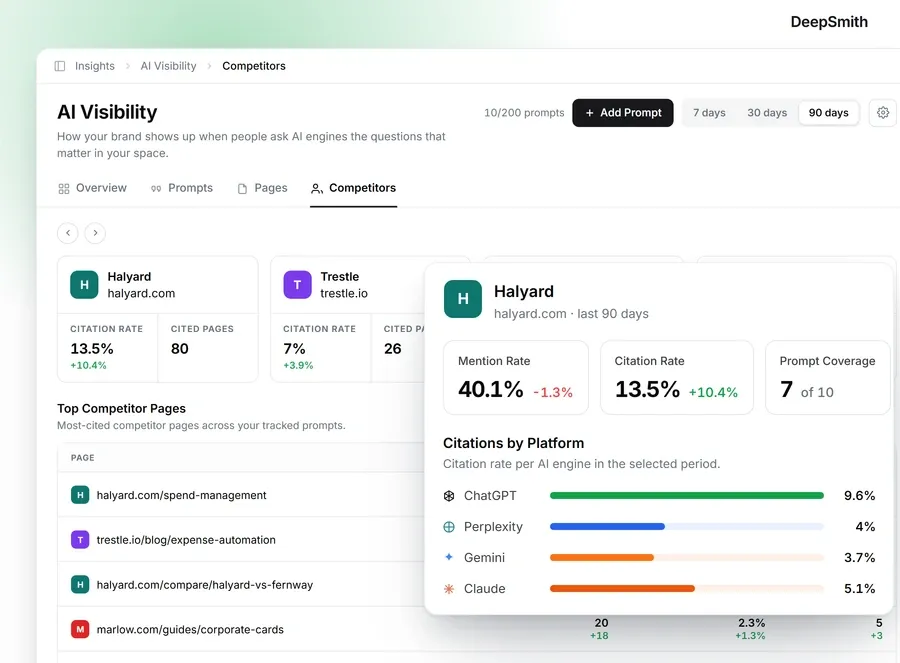
AEO (AI Search Visibility) is the tracking layer. You define the questions that matter, and the platform checks them on a schedule. The Overview gives you mention rate, citation rate, share of voice, sentiment, and visibility trend, plus a per-platform breakdown, a competitor leaderboard, and the sources AI cites most. Prompts shows per-prompt mention and citation rates with full answer history, and Discover Prompts generates a starter set from your product, persona, and buyer-stage context. Pages tells you which of your pages earn citations and which prompts drive them. Competitor Citations shows who beats you, on which exact page, on which engine.
That last view is the one that changes meetings. "We are losing" is a feeling. "We are losing this prompt to that page on Perplexity" is a task.
Content Map answers what to write next by turning your site and your competitors' sites into one map of the topics you all cover. Every page is crawled, enriched, and classified onto a granular topic and a funnel stage, with your site defining the taxonomy so comparisons are like for like. Coverage gaps show topics where a competitor publishes more than you; untapped topics show the ones where you have nothing at all. Sitemaps are re-checked every 24 hours, so new product and category pages fold in with no re-import, and the same map powers internal linking, ideation dedup, and the Pages view in AEO.
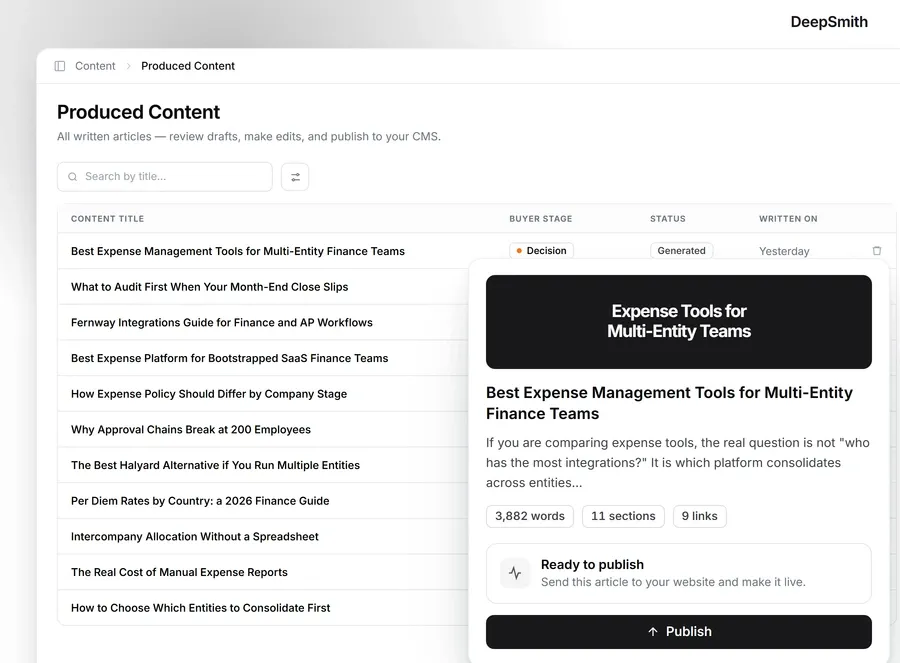
Content Studio is where ideas become published articles, moving from New Ideas to Planned to Produced. New Ideas is the single backlog, stocked from agent runs, tracked prompts, manual entry, or import. Planned Content is your calendar. The Writer turns one planned idea into a finished, brand-grounded article: researched, internally and externally linked, with a cover image and publish-ready metadata. Autowrite goes further. Configure an article at planning time and it writes itself on its scheduled date, landing in Produced Content with nobody in the app. Produced Content handles review, edits, cover regeneration, and one-click publishing to WordPress, Webflow, Strapi, Sanity, or Contentful, or to your own webhooks, with Markdown and HTML export as a fallback.
Repurpose and Apps means distribution ships with the article instead of becoming next week's guilt. Every finished piece arrives with social posts already drafted, and the Apps Library adapts it for LinkedIn, X, Medium, Substack, newsletter and nurture email, Reddit, Facebook, Instagram, Slack, Discord, and WhatsApp.
Reddit deserves a note there. OtterlyAI found Reddit is cited about 9x more often than other domains in AI answers, so having on-brand Reddit-shaped copy in the same workflow is a real advantage for stores, not a nice-to-have.
Deep IQ is the brand context layer, and it is the quiet reason the output is usable. About Company holds positioning, differentiators, and claims to make or avoid. Products and Services keeps a profile per product with category, features, value props, use cases, and an editable competitor list. Buyer Persona, Brand Voice, Visual Guidelines, and Content Types round it out. For ecommerce this is the difference between a system that describes your actual SKU and one that invents a feature you do not sell.
Opportunity Agents read your own data and hand back ideas with the reason attached. Pick an agent and it analyses your AI visibility or your Content Map and returns an analysis plus a set of ideas, each carrying the data point that justifies it: get cited for a tracked prompt, turn mentions into citations, take a competitor's citations, build authority on a topic, or close a decision-stage gap against up to four competitors at once. For a store, that is the difference between a brainstormed content calendar and one you can defend in a budget meeting.
Platform and Account covers multi-workspace support, so agencies and multi-brand retailers keep each catalog isolated with its own context and plan.
Pricing. Pro is $99/mo, Grow is $199/mo, Scale is $399/mo, and Enterprise is custom. Annual billing lowers those to $80, $160, and $299. Engine coverage rises with the tier: Pro tracks ChatGPT, Grow adds Perplexity, Scale adds Gemini, and Enterprise and Custom cover all ten engines, ChatGPT, Gemini, Perplexity, Claude, Google AI Overviews, Google AI Mode, Grok, Meta AI, Microsoft Copilot, and DeepSeek. So breadth here is a tier decision, not a ceiling. There is a 7-day free trial with real data and real drafts, no long-term contracts, and no cancellation fees.
Honest limitation. DeepSmith does not yet ship native ecommerce platform integrations (Shopify, BigCommerce, WooCommerce, Amazon) or a standalone product-feed module. Sitemap ingestion, internal linking, and coverage signals are all there, and tracked shopping prompts work fine, so you still see and close the citation gaps on your product and category queries. If your single biggest pain is feed integrity rather than content and citations, treat that as a watch-item and ask about it on the trial.
2. AirOps

Best for: mid-market and enterprise content teams that already have a strategy and want to industrialize refresh, internal linking, and longtail page production at scale.
AirOps calls itself a growth platform for AI search and AEO, and it sits closer to content engineering than to analytics. The loop is prioritize, strategize, execute, run by an agent named Quill with human-in-loop approvals.
Key features. Visibility dashboards with citation and influence scoring. Quill for refresh and link insertion. Workflows for templated refresh and generation. Grid, a bulk spreadsheet-style editor that content ops people tend to love. Brand Kits and Knowledge Bases for context. MCP plus integrations to Webflow, WordPress, Contentful, Claude, and Cursor. Marketed engines include Google, Gemini, Perplexity, Claude, and ChatGPT alongside classic SEO surfaces.
The ecommerce evidence is real, and it is worth taking seriously. Go! Retail Group reports a 13% lift in PDP conversion rates. Rare Candy reports an 18% boost in PDP-to-cart conversion. Lightspeed reports a 37% increase in conversions. Anne Klein reports 50% more organic traffic. On the citation side, Carta reports a 7x increase in AI search citations and Asana reports a 71% increase. Angi reports up to 79% better conversion on longtail pages.
If your catalog has thousands of SKUs and your bottleneck is generating and refreshing longtail pages at volume, that track record is hard to argue with.
Pricing. This is where it gets murky. Insights is free with one user, one brand kit, five knowledge base sources, and access to 30+ models. Solo covers a single user with 100 tracked prompts or pages, ChatGPT-only insights, and 20,000 production tasks. Pro adds unlimited seats, 250 tracked prompts or pages, multi-engine insights, 75,000 tasks, and weekly opportunity reports. Enterprise is custom. Dollar amounts for Solo, Pro, and Enterprise are not consistently published, so plan on a sales conversation. A 14-day trial of Scale features is available, ending when tasks run out, 14 days pass, or you upgrade.
Honest limitation. AirOps is a content workflow platform with visibility tracking layered on, not a merchant feed or product-data tool. It does not advertise a dedicated shopping-feed module. If your main pain is product feed integrity inside ChatGPT Shopping, you will need something else next to it.
3. Profound

Best for: enterprises that want the deepest answer-engine analytics available, and have the in-house team to act on what they find.
Profound is an AI search visibility analytics and activation platform, and its data depth is the reason it belongs here. It separates monitoring from production and surfaces a prioritized work queue.
Key features. Answer Engine Insights covers mention rate, citation rate, share of voice, and sentiment, per prompt and per platform, with historical answer replay. Prompt Volumes gives search-volume-style data on what people actually ask engines. Agents provide autonomous workers for marketing tasks, including an AEO-optimized FAQ Generator, Demand Gen Agent, Brand Agent, and Content Agent. Aim surfaces suggested projects and prioritized tasks.
The standout for retail is Shopping Agent Analytics, launched in November 2025. It tracks product placement and visibility inside ChatGPT Shopping with metrics like Visibility Score and Merchant Layer. Nothing else in this roundup does that, and if ChatGPT Shopping is where your category lives, that capability is genuinely differentiated.
Integrations are enterprise-grade: Akamai, CloudFront, Cloudflare, Fastly, Google Cloud CDN, Netlify, and Vercel on the edge, plus Contentful, Framer, Sanity, and WordPress for CMS, with G2, Noble, Adobe Analytics, and Google Analytics alongside.
Pricing. Starter is $99/mo billed yearly, with 50 prompts, 1,500 responses, ChatGPT only, and one seat. Growth is $399/mo billed yearly, with 100 prompts, 9,000 responses, ChatGPT plus Perplexity plus Google AI Overviews, and three seats. Enterprise is custom, with up to ten engines, SSO and SAML, SOC2, and a dedicated specialist.
Read that tiering carefully. Shopping Agent Analytics appears to require Enterprise, so the shopping capability that makes Profound compelling for retail is not in the plans you can buy with a credit card.
Honest limitation. Profound leans analytics-first, and its content production is lighter than DeepSmith's or AirOps'. Teams needing high-velocity publishing usually pair it with a second system, which means a second bill and a second workflow. Its public integrations list also does not name Shopify, BigCommerce, WooCommerce, or Amazon.
What no platform will do for you
Buying a tool does not earn a citation. Even the strongest product AI answer optimization platform is leverage on work you still have to do, not a substitute for it.
Get these right regardless of what you buy:
- Structured data. Product, Offer, AggregateRating, FAQPage, and ImageObject, validated with Google's Rich Results Test.
- Clean feeds. Consistent titles, accurate prices, populated GTIN and MPN, correct variant mapping.
- Natural-language descriptions. Write the way shoppers actually phrase questions, not the way your PIM exports them.
- Comparison and decision content. "Best X for Y" and "X vs Y" are the most-cited content types in AI answers. This is the highest-leverage thing on the list.
- Third-party validation. Reviews, Reddit threads, expert roundups. Engines weight off-site sources heavily.
- Crawler access. Implement llms.txt and confirm GPTBot, ClaudeBot, and PerplexityBot can reach you.
- Freshness. Engines prefer recently updated pages, especially on commercial queries.
Not sure where to start? Pick the third one. Comparison content compounds faster than anything else here.
How to choose
Be honest about which sentence describes you. Ranking the best generative search optimization platforms ecommerce brands shortlist only gets you so far, because the right answer depends on your bottleneck, not on a scorecard.
Choose DeepSmith if you are a mid-market ecommerce team that needs tracking and production in the same place, and your real constraint is that you cannot publish fast enough to close the gaps you find. The 7-day trial gives you real data and real drafts, so you can judge the output before you commit.
Choose AirOps if you have a large catalog, an existing content strategy, and a bottleneck in refreshing and generating longtail pages at volume. Its PDP conversion track record with retail brands is the strongest in this group, and Grid is a genuinely good bulk editor. Budget for a sales conversation.
Choose Profound if you are an enterprise with the team to act on data, and ChatGPT Shopping placement is your priority. Shopping Agent Analytics has no equivalent here. Budget for Enterprise, and plan to pair it with something that produces content.
Use two if the honest answer is analytics depth plus production velocity. Plenty of enterprise teams run a tracker next to a production platform. It costs more, and sometimes it is the right call.
Still stuck? Start with the free or cheap tier of whichever one matches your bottleneck, track twenty of your highest-intent shopping prompts, and see what the data tells you in a month. You do not need a bigger stack. You need a smaller first step.
If tracking and publishing in one place sounds like the loop you are missing, start a free DeepSmith trial and see your real citation data and real drafts inside a week.