Someone on your leadership team asked which AI engines mention your brand, and you didn't have a clean answer. That's a normal place to be right now.
Most enterprise content teams are still measuring one channel while their buyers quietly move to another. You're not behind because you did something wrong. You're behind because the ground moved.
Here's the good news: the tooling has caught up. You don't have to stitch a tracker to a writing tool to a CMS and pray the handoffs hold.
This guide compares the best generative search optimization platforms enterprise teams can actually buy: DeepSmith, Profound, Adobe LLM Optimizer, and AirOps. Every one of them measures, optimizes, or produces. Your real decision is how many of those three jobs you want living in one place.
Let's start with how these were picked, because criteria are what make a shortlist worth trusting.
How we picked these enterprise GSO platforms
A tool earned a spot here by doing three things inside one product:
- Measure. Track how your brand shows up across generative AI engines.
- Optimize. Turn measurement into a concrete next action, not just another dashboard.
- Produce. Generate publish-ready, brand-grounded content.
Point trackers and single-feature tools sat this one out. They're useful. They're just not platforms, and a rollout that needs four vendors to answer one question gets expensive fast.
Four more things mattered:
- Engine coverage. ChatGPT and Perplexity at minimum, with Gemini, Claude, and Google AI Mode as the next rung up.
- Optimize that converts. Insight has to become a content workflow or an experiment, not a PDF.
- Production quality. Output should arrive publish-ready, with SEO and AEO formatting built in rather than bolted on.
- Enterprise readiness. Role-based access, dedicated support, custom limits, and contractual data handling.
One note before the table. Generative search optimization enterprise buyers often assume the hard part is measurement. It usually isn't. Measurement is solved. Acting on it at volume is where teams stall.
Quick comparison of enterprise GSO platforms
| Platform | Best for | Measure engines | Optimize and produce scope | Pricing model |
|---|---|---|---|---|
| DeepSmith | End-to-end AEO with production and auto-publish built in | All ten on Enterprise: ChatGPT, Gemini, Perplexity, Claude, Google AI Overviews, Google AI Mode, Grok, Meta AI, Microsoft Copilot, DeepSeek | Brand-grounded articles, scheduled publishing, schema and internal linking | $99 to $399/mo self-serve, custom Enterprise |
| Profound | Prompt-level measurement depth across many engines | Broad engine coverage including ChatGPT, Perplexity, Claude, Gemini, Google AI Mode | Prompt tracking, citation analysis, alerting; no native production | Seat-based, enterprise quote |
| Adobe LLM Optimizer | Brands standardized on Adobe Experience Cloud | LLM-driven discovery surfaces, product-defined | Presence optimization and experimentation inside the Adobe stack | Bundled with Adobe enterprise agreements |
| AirOps | Industrial content workflows with human review gates | Limited native AI-engine tracking, SEO-led | Workflow-driven production, schema, internal linking, publishing | Seat-based, self-serve tiers plus Enterprise |
The best generative search optimization platforms, reviewed
1. DeepSmith

Best for: mid-market and enterprise marketing teams that want one platform to answer "are we cited?" and then fix it, without bolting a tracker to a writer to a scheduler.
DeepSmith is an AI search analytics and content production platform in one. It tracks how AI engines answer questions about your brand, finds the gaps where you're invisible or losing, and produces on-brand articles to close those gaps. Same data, same platform, no export step in the middle.
That last part is the whole argument. Most tools in this category tell you that you're losing a prompt. Fewer of them write the page that wins it back.
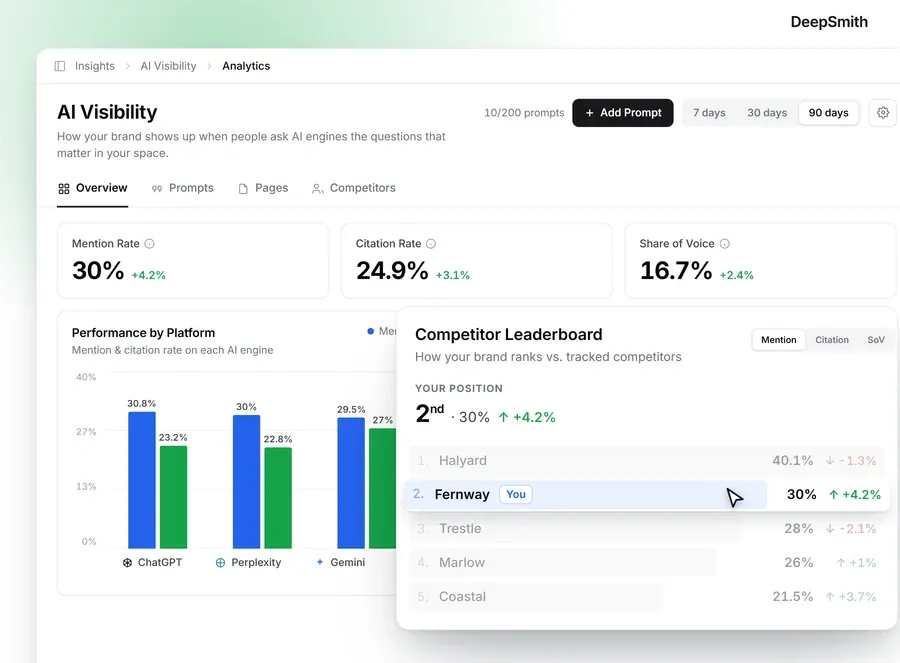
Where the measurement lives. The AEO module tracks Mention Rate, Citation Rate, Share of Voice, Sentiment, and Visibility Trend across ten engines: ChatGPT, Gemini, Perplexity, Claude, Google AI Overviews, Google AI Mode, Grok, Meta AI, Microsoft Copilot, and DeepSeek. Engine coverage ladders with your plan: Pro tracks ChatGPT, Grow adds Perplexity, Scale adds Gemini, and Enterprise and Custom cover all ten. If you're buying at the enterprise tier, that ladder mostly tells you what the cheaper plans hold back.
Four views do the work:
- Prompts. Per-prompt mention and citation rates with full answer history. Discover Prompts builds a starter set from your product, persona, and buyer-stage context, so you're not staring at an empty tracker on day one.
- Pages. Which of your pages AI cites, each page's share of your citations, and the prompts driving them.
- Competitor citations. Who wins your prompts, on which exact pages, and how each rival performs per platform.
- Overview. Trends, a per-platform breakdown, a competitor leaderboard, and the sources AI cites most.
Where the production lives. Content Studio moves ideas from New Ideas to Planned Content to Produced. New Ideas is the single backlog, stocked from Opportunity Agent runs, manual entry, or import, and filterable by source, stage, and date. The Writer turns one planned idea into a finished article with research, internal and external links, a cover image, and publish-ready metadata.
Autowrite is the piece worth pausing on. You configure an article at planning time and it writes itself on its scheduled date, landing in Produced Content with nobody in the app. From there you review, revise, regenerate the cover, and publish straight to WordPress, Webflow, Strapi, Sanity, Contentful, or your own webhooks.

What to write next. Content Map answers that without a separate research tab. Your site and your competitors' sites are crawled and classified onto one shared topic taxonomy with funnel stages, so coverage gaps (topics where a rival publishes more) and untapped topics (topics where you have nothing at all) become a measurement rather than a hunch. Sitemaps are re-checked every 24 hours, so pages a rival ships this week fold in without a re-import. Opportunity Agents then read that map and your visibility data and return ideas with the evidence attached: win a tracked prompt you're losing, take a competitor's citations, or close a decision-stage gap against up to four rivals at once.
Most teams already know they have gaps. What they lack is a queue that turns gaps into scheduled work.
Why the output sounds like you. Deep IQ stores your positioning, products, personas, brand voice, visual guidelines, and content types as structured context. Every module reads from it. That's what keeps voice from drifting at volume and stops the system inventing product claims you'd have to catch in review.
What happens after publish. Every finished article arrives with social posts already written, and the Apps Library adapts it into platform-native versions for LinkedIn, X, Medium, Substack, newsletter email, Reddit, and Slack. Distribution stops being the step that falls off the end of the week.
For multi-brand groups, Multi-Workspace isolates each brand with its own context, content, and plan.
Keyword coverage, heading structure, schema markup, internal linking, and metadata are part of the writing pipeline rather than a cleanup pass afterward. Content Map pulls your published pages in, classifies them, and powers internal links and ideation dedup.
Pricing. Pro is $99/mo, Grow is $199/mo, Scale is $399/mo, and Enterprise is custom. Annual billing drops those to $80, $160, and $299. Enterprise adds 1:1 onboarding and a dedicated account manager with custom limits on every metric. There's a 7-day free trial, and no long-term contracts or cancellation fees.
Honest limitation: that 7-day trial is short. Large enterprises usually want a longer custom evaluation before committing to a tracked-prompts plus auto-publish workflow, especially in regulated categories. Ask for one rather than trying to judge the whole platform in a week.
2. Profound

Best for: enterprise SEO and content strategy teams that need rigorous prompt-level tracking and already have writers or a production stack.
Profound is a measurement and intelligence layer for generative search. It tracks prompt-level visibility across a wide set of engines, attributes citations to specific pages, and surfaces competitor share of voice.
Engine breadth is its calling card. Alongside ChatGPT, Perplexity, Claude, Gemini, and Google AI Mode, coverage extends to newer entrants like Grok and DeepSeek. If your category has buyers scattered across emerging engines, that reach is real. Be precise about what it buys you, though: it's measurement, not production. Breadth is also no longer the separator it once was here, because DeepSmith's Enterprise tier tracks ten engines including Grok and DeepSeek, and then writes the page against them rather than stopping at the chart. Compare these two on what happens after the chart, not on logo count.
Key features:
- Prompt-level visibility tracking with per-prompt mention and citation rates, plus full answer history
- Page-level citation attribution showing which URLs AI pulls from and the prompts driving them
- Competitor leaderboards per prompt and per platform, with diff views
- Source analysis showing which third-party domains engines cite most in your category
- Workflow automations and alerting for share-of-voice shifts, new competitors, or citation drops
- Integrations with SEO suites, analytics, and BI tools, plus webhooks and an API
Pricing is seat-based and quote-driven rather than self-serve monthly, with an Enterprise tier covering custom volume, dedicated support, and contractual data handling. Budget for seats, not just the platform, because seat-based models get expensive once analysts, strategists, and regional teams all want access.
The integration story is the quiet strength. Looker Studio, Slack alerting, webhooks, and an API mean citation data lands next to every other reporting line instead of stranded in a vendor dashboard. For an enterprise analytics team, that's often the deciding feature.
Source analysis is the underrated view. Knowing which third-party domains engines lean on in your category tells you where to earn presence off your own site. That's a different play from optimizing your own pages, and one most teams never run.
Honest limitation: production isn't the product. Profound tells you what to write and where you're losing. It doesn't draft or publish the article, so you'll need a separate production stack and the budget line that comes with it. For a team that's already short on writers, a sharper picture of the gap doesn't close the gap. Worth asking honestly in your evaluation: if a perfect dashboard landed tomorrow, would anything actually change on your site next month? If the answer is no, measurement isn't your constraint.
3. Adobe LLM Optimizer

Best for: global enterprises already standardized on Adobe Experience Cloud.
Adobe LLM Optimizer measures and improves brand presence inside LLM-driven discovery. It sits in the GenStudio portfolio, next to Adobe Analytics, Target, and Experience Manager, and it inherits that estate's identity, governance, and reporting.
If your martech is already Adobe, this is the least disruptive option on the list. That advantage is mostly organizational rather than technical, and organizational advantages are the ones that decide enterprise rollouts. Shared identity, governance your legal team has already reviewed, reporting that lands where your stakeholders already read it: none of that shows up on a feature grid, and all of it shortens a procurement cycle.
Pair it with Workfront and the content request, the experiment, and the visibility reporting live in one estate.
Key features:
- Brand presence monitoring across LLM discovery surfaces, with reporting aligned to Adobe Analytics
- Experimentation workflows for testing content variations and measuring lift in AI answer visibility, following Target-style testing patterns
- Content generation and optimization tied to GenStudio, with brand-safety and claims controls
- Governance and compliance tooling suited to regulated industries like financial services, healthcare, and telecom
- Deep integration with Experience Cloud and enterprise SSO through Adobe IMS
- APIs for pushing results into downstream BI and marketing workflows
For a regulated brand, that governance layer isn't a nice-to-have. If every public claim needs review, a tool that already enforces brand-safety and claims controls saves you from building an approval process around a tool that doesn't.
The experimentation angle is the interesting one. Treating AEO like conversion testing, running variations and measuring lift, gives a mature team a mental model it already trusts. It also beats the alternative, which is publishing on instinct and hoping the engines notice.
Pricing is quote-based, bundled into GenStudio and broader Adobe enterprise agreements. There's no public list price.
Honest limitation: it's an Adobe-stack product. Off that stack, the integration burden climbs and the cross-product governance benefit mostly evaporates. Pricing is also opaque without an enterprise sales cycle, which makes fast comparison hard. If you're not already an Adobe shop, this rarely wins on merit alone, and the engine list is product-defined rather than published as a simple checklist you can compare line by line against a dedicated tracker.
4. AirOps

Best for: content and SEO teams industrializing production who want workflow control and review gates, and who are building toward AEO rather than buying a dedicated tracker first.
AirOps is an AI content operations platform built around prompts, templates, and human-in-the-loop steps. It's workflow-first: you compose chains of AI steps with approval gates, and prompt versioning keeps runs reproducible.
That last detail is worth more than it looks. When a draft comes out wrong at volume, you need to know which version of which prompt produced it. Teams that treat content like a pipeline rather than a series of one-off documents tend to appreciate AirOps quickly, and teams that want to press one button and get an article tend to find it heavy.
It's the most configurable option here, and configurability cuts both ways. You get control over every step. You also own every step, which means someone on your team is maintaining workflows as a real job.
Key features:
- Workflow builder chaining AI steps with human review and approval gates
- Prompt versioning for reproducibility across a team
- Content templates for listicles, comparisons, and how-tos with brand and SEO guidance embedded
- Schema markup and internal linking suggestions during generation
- Keyword research and on-page SEO signals tied to topic clusters
- Multi-channel publishing into Webflow, WordPress, Contentful, Shopify, and Zapier, with a broad API and webhook surface
Where AirOps genuinely wins is the messy middle of content ops. Multiple writers, multiple formats, a review step legal or product has to sign off on, and a need to run the same process a hundred times without it drifting. The structure holds even when the person changes, which is precisely what breaks in freelance-heavy operations.
Pricing is seat-based with self-serve tiers and a custom Enterprise plan.
One practical note. If you already run a tracker you trust, AirOps can sit underneath it as the production half of your stack. That's a legitimate architecture. It's just two line items, two renewals, and two vendors to manage instead of one.
Honest limitation: native AEO tracking isn't the core product. If rigorous prompt-level and citation-level measurement across many engines is your primary requirement, you'll still want a dedicated tracker running alongside it. That's two tools, two contracts, and two places to look when someone asks how the brand is doing in ChatGPT.
What separates a GSO platform from an AI visibility tracker
This is the distinction that decides your budget, so it's worth two minutes.
A tracker tells you where you stand. It checks prompts on a schedule, reports mention and citation rates, and shows you a competitor leaderboard. That's genuinely valuable, and for some teams it's enough.
An enterprise AI answer optimization platform has to do something harder: close the loop. Measurement has to produce a page, and the page has to ship. If your team can't act on the dashboard, you didn't buy visibility. You bought awareness of your own invisibility, on a subscription.
Ask a blunt question in every demo. When this tool tells me I'm losing prompt 37, what happens next, and who does it?
Three answers to listen for:
- "You'll see it in the dashboard." That's a tracker. Fine, if you have production capacity.
- "You'll get a recommendation." Better, but recommendations still need a writer, an editor, and a publish slot.
- "It writes and schedules the page." That's a platform, and it's the only answer that doesn't add work to a team that's already full.
Page-level citation attribution is the signal worth optimizing against, because improving one cited URL compounds across every prompt that pulls from it. Look for that view specifically. Generative search optimization enterprise programs tend to live or die on whether they can find that page and then actually rewrite it.
Prompt volume is the other sizing question. Fifty to 200 tracked prompts is typical for mid-market, while enterprise deployments regularly run past 500. Price the tier you'll need in year two, not the one that looks cheap in month one.
How to choose your enterprise GSO platform
Not sure which way to go? Match your situation to the list below. Be honest about which one you actually are.
Pick Profound if measurement is the whole job. You have writers. You have a CMS you like. You need prompt-level rigor plus integrations that drop citation data next to every other reporting line, and you don't want a production tool you'll never turn on. Profound is the stronger tracker in that setup.
Pick Adobe LLM Optimizer if you're an Adobe shop. Standardized on Experience Cloud, with governance requirements and a procurement process that prefers one more Adobe line item to one more vendor? This slots in cleanly. Off that stack, the math changes.
Pick AirOps if workflow control is the constraint. You need review gates, versioned prompts, and repeatable production, and your AEO needs are still forming. AirOps industrializes the writing without pretending to be a tracker.
Pick DeepSmith if the gap between knowing and fixing is where you stall. This is the common enterprise failure mode. You buy a tracker, you learn you're losing 40 prompts, and then nothing happens because production capacity was always the bottleneck. An enterprise AI answer optimization platform only pays for itself when the insight turns into a published page.
DeepSmith is the fit when you want one platform that measures presence, finds the gaps, and produces the content to close them, with scheduled publishing and one source of truth for AEO and SEO together.
Now the budget conversation. When you count strategist time, the writer, the editor, the designer, and the SEO reviewer, a single article carries a fully loaded cost most teams never put on one line. Run that number for your own team before any demo. It reframes the decision from "what does this tool cost" to "what does our current process cost," and that second question is the one your CFO is actually asking.
A note on sequencing. Track at least two engines before you touch anything else. ChatGPT plus Perplexity or Gemini is a real baseline, and you can climb to full coverage later. Then give it 90 days before you judge the trend. Shorter windows mostly measure noise.
One more honest word. The best generative search optimization platforms enterprise teams deploy still fail when nobody owns the program. Name the owner before you sign. A platform removes the manual work. It doesn't decide what your brand should be known for.
Start with one workspace, not a big rollout
You don't need a platform decision that survives the next three years. You need one workspace, one set of tracked prompts, and one published page that closes a gap you can name.
Pick your ten highest-intent prompts. Find out who wins them today. Publish against the two where you're losing worst. That's a month of work, and it'll teach you more about your GSO strategy than another vendor demo will.
If you want to see real data and real drafts before you commit budget, start a DeepSmith free trial and check your own prompts.
One step. That's it. You've got this.