You ask ChatGPT a question in your category, and there it is: a competitor's name, sitting right in the answer. Yours is nowhere. Frustrating, isn't it? Take a breath, because the fix starts with one distinction most teams never make.
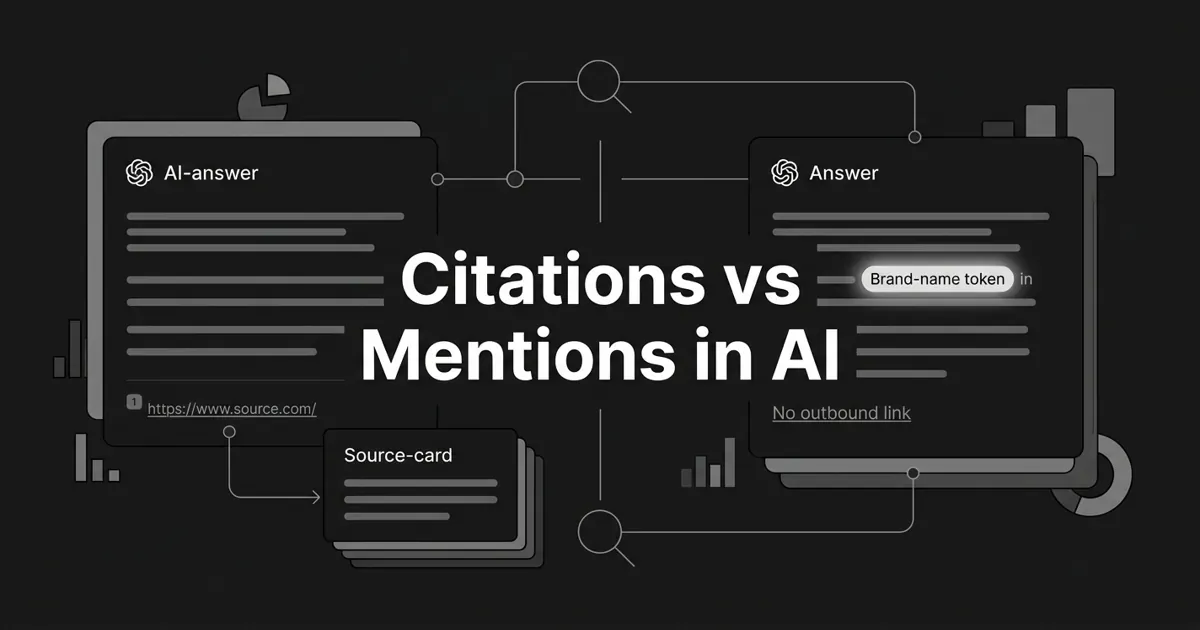
An AI citation is when an engine links to your page as the source for a claim. A brand mention is when an engine writes your name into the answer, linked or not. Those are two different things. Learning to separate ai citations vs brand mentions is the difference between guessing at your visibility and actually steering it.
Here is the promise of this guide. By the end, you will be able to look at any AI answer and name what you are seeing: a citation, a mention, or both. You will know which of the two ai search visibility signals to chase for a given goal. And you will have a map of where to go deeper on each one.
This is the hub for the whole topic. Each section ends with a door to a deeper guide, so you can read this once to get the lay of the land, then follow the path that fits your gap. You do not need to master everything today. You need to name what you are looking at and pick your next move. Let's start with the two words everyone uses and almost no one separates.
What is an AI citation?
An AI citation is a linked, attributed source that an engine attaches to a specific claim in its answer. It shows up as a footnote, a numbered reference, an inline link, or a row in the source list under the response. The link is the whole point.
So when you ask what is an AI citation in plain terms, picture a footnote. The engine just made a claim, and it is pointing at your page to say "this is where that came from." That makes a citation an evidence signal. The engine is vouching for your content as the proof behind what it said.
The metric people use here is citation rate for a single answer, and share of citation for the aggregate: the share of AI responses where your page shows up as a source. When someone says a brand has a strong citation rate, they mean the engine keeps reaching for that brand's pages as evidence.
Here is what a citation is not. It is not a casual name-drop. If the engine writes your brand name into a sentence but attaches no link, that is not a citation. The URL is what turns a name into a source. Miss that, and you will count mentions as citations and wonder why your numbers do not add up.
Why does one page get chosen as evidence and another get ignored? That is a bigger question than this hub can answer, and it deserves its own deep dive on what makes a page eligible to be cited in the first place.
What a brand mention in AI answers actually is
A brand mention is any moment an AI engine writes your name into the body of its answer, whether or not it links to you. That is the whole definition. The name in the text is the signal.
This is where people trip. Linked brand mentions are also citations, because they carry a URL. Unlinked brand mentions are mentions only. Both count as brand mentions in AI answers, and both matter, because a mention is a recommendation signal. The engine is putting your brand on the buyer's shortlist by naming it as a real option.
The metric is mention rate: how often AI names your brand across the questions you track. Notice that this is a different number from citation rate. One counts name-drops, the other counts source links. You can be high on one and invisible on the other.
Now the part that surprises most marketing leads. The unlinked mention, the one with no click and no URL, is not the weak version. It is the primary input the engine uses to build its picture of your brand. Every time your name appears near a topic, the model learns that you belong in that conversation. That shapes which brands it names next time.
And unlinked mentions are the common case, not the exception. Inside AI answers, brands get named far more often than they get cited. On ChatGPT, name-drops outnumber source links by roughly three to one, averaging around 2.4 mentions against 0.74 citations per prompt. So "talked about but not linked" is the dominant way brands actually show up.
There is a flip side worth naming, because it explains a lot of the frustration teams feel. AI does not name many brands per answer. One analysis found that about 44% of ChatGPT prompts return zero brand mentions at all, and only a tiny share name ten or more. When the engine does reach for brands in AI answers, it names a few, not a crowd. That scarcity is exactly why earning a spot in the text is worth the effort: the list is short, and you either make it or you do not.
If you want the full picture of linked versus unlinked mentions and why the unlinked ones still pull weight, that is its own guide. For here, hold onto this: a mention is the engine vouching for your brand, and a citation is the engine vouching for your content.
AI citations vs brand mentions, side by side
Here is the clean version. A citation says "I used this page to write this sentence, and here is the link." A mention says "you should know about this brand." One is evidence. The other is a recommendation. That single contrast is the spine of ai citations vs brand mentions, and this table lays it out across the dimensions that matter.
| Dimension | AI citation | Brand mention |
|---|---|---|
| What it is | A linked, attributed source tied to a specific claim | Your brand name in the answer text, linked or unlinked |
| Attribution | The engine credits your page as evidence | The engine names your brand as an option |
| Link | Always carries a URL | May carry a link, often does not |
| Where it sits | Footnotes, numbered refs, or a source list | Inline, inside the body of the answer |
| Traffic | Can drive a click to the cited page | Usually no click, raises awareness in the answer |
| Trust signal | Content authority: your page is proof | Brand authority: your name is a recommendation |
| Metric | Citation rate, share of citation | Mention rate |
| SEO cousin | The backlink or source link | Branded search volume |
| What earns it | Extractable, well-structured, citable content | Brand presence, third-party coverage, entity consistency |
Look down that last row. The two signals are earned by different work. Citations come from making your own page the cleanest, most liftable answer on the topic. Mentions come from being the brand people and platforms already talk about. You can be brilliant at one and absent from the other.
One more nuance so you are not caught off guard. When the engine writes your brand name as a hyperlink in the body of an answer, that is both at once: a mention (it named you) and a citation (it linked you). Most reporting counts that as a mention and treats pure source-list entries as separate citations. It is a small convention, but it keeps your tracking consistent.
If the citation-versus-backlink comparison is nagging at you, there is a dedicated guide on how an AI citation differs from a backlink and why you need both. And if the vocabulary around all of this feels slippery, a shared glossary of AI search terms will steady the ground under you.
Why both matter for AI visibility
Both matter because they measure two different decisions the engine makes, and most brands only earn one of them. Mention rate reflects the recommendation decision: should this brand be on the shortlist? Citation rate reflects the evidence decision: should this page be referenced for this fact? Track only one number, and you are seeing half of how the AI views you.
The gap between the two even has a name. Call it the mention-source divide: the engines happily ingest your content to build an answer, then recommend a competitor by name in the body. Your expertise powers the response. Your brand is missing from it. One index that tracked this pattern across two major engines found they agreed on the brands to name about two-thirds of the time, but agreed on the sources to cite only about a third of the time. They converge on who to recommend. They diverge on what to cite.
Here is the number that should stick with you. Only about 28% of brands manage to earn both a citation and a mention in the same response. Most get one and miss the other. And the brands that pull off both are meaningfully more likely to resurface in the next answer too. Both signals compound. Neither alone covers the buyer's journey through AI search.
They are also earned independently, which is the part that catches teams off guard. Building one does not hand you the other. Being named is the easier door to walk through; only a minority of brands that get mentioned ever graduate into being trusted, cited sources. So if your name shows up in answers but never as a footnote, that is not a fluke. It is the normal gap between recommendation and evidence, and closing it is a separate job from earning the mention in the first place.
There is a related signal that surprises SEO teams. Across studies, brand mentions correlate with AI visibility far more strongly than backlinks do, on the order of three times the strength. The lesson is not that links stopped mattering. It is that being talked about, in the plain language of the answer, is now one of the strongest things you can influence. That is a shift in what earns visibility, and it rewards presence over pure link-building.
There is a second reason both matter, and it changes the math on traffic. AI answers are largely zero-click. Research on Google users found that when an AI summary appears, people click a traditional result about 8% of the time, versus 15% when there is no summary. Clicks on links inside the summary itself sit near 1%. Broader analysis of zero-click behavior points the same way: most searches now end without a visit to any site. The click is not coming.
So what does that mean for you? It means being named in the answer is a huge part of the game. If your brand appears in the text the buyer reads, you win recognition even without the click. And when a citation does earn a click, that visit tends to convert at a higher rate than ordinary organic traffic, because the reader arrived mid-decision. Lower volume, higher intent.
This is exactly where tracking the two signals separately earns its keep. A mention-rate problem is a brand-presence problem. A citation-rate problem is a content-extractability problem. They need different fixes, so a single blended "visibility score" hides the very thing you need to act on. Platforms built for this, DeepSmith among them, track mention rate and citation rate as separate numbers across engines like ChatGPT, Gemini, Perplexity, Claude, and Google AI Mode, which turns the divide into a named list of gaps you can write against. The point is not the dashboard. The point is knowing which gap is yours.
Want to go deeper on turning these into tracked numbers? There is a full guide on measuring whether AI is actually citing your brand. Another walks through how branded and unbranded prompts change the citations and mentions you earn.
How to tell which one you are looking at
The fastest tell is position. Citations sit outside or below the answer text. Mentions sit inside it. If your brand shows up in a footnote, a numbered reference, or the source list at the bottom, that is a citation. If your name is written into the sentences themselves, that is a mention. If it is a linked name in the body, it is both.
That one rule will resolve nine out of ten cases you look at. Keep it close and you can audit an answer in seconds.
The engines dress this up a little differently, and you do not need to memorize every quirk. A quick orientation helps, though. When browsing is on, ChatGPT drops numbered footnotes you can click, and it also names brands in the body as plain mentions. Perplexity attaches inline numbered citations to almost every claim, so a brand appearing there usually means a live citation. Google's AI Overviews show a summary with a linked row of sources beside or below it. Gemini leans on inline links but cites less densely. Claude is the most conservative and often answers from training data with no web sources at all.
So if your goal is getting cited by ChatGPT specifically, remember that its footnotes and its body text are two separate surfaces. You can be named in the paragraph and still absent from the footnotes. Those are two different wins, and chasing one does not hand you the other.
The habit to build is simple. When you check an answer, ask two questions, not one. Am I named in the text? Am I linked as a source? Write down both. That is the entire mechanic behind reading ai search visibility signals, and it is the foundation every deeper measurement guide builds on.
One caution before you rely on a single look. A prompt run once is a noisy reading, because engines do not answer the same question identically every time. To trust what you find, run each prompt a handful of times and check more than one engine, since a brand can be named on one and invisible on another. Doing this by hand works for a small set of questions. Past thirty or so, the counting gets unreliable fast, and that is usually the moment teams start tracking brand mentions in AI answers with a tool instead of a spreadsheet.
Which signal to chase for your goal
Start from the goal, not the tactic. Your goal tells you which signal to chase, and the two rarely point the same direction.
If you want high-intent referral traffic, chase citations. Citations are the ones that can send a click, and the click that comes from an AI answer tends to be a buyer already deep in research. The work here is on your own pages: make them the clearest, most extractable, most obviously sourced answer to the question. That is the road to getting cited by ChatGPT, Perplexity, and the rest, and it is a content problem you control.
If you want recognition and a spot on the shortlist, chase mentions. Mentions are how the engine tells the buyer you exist and belong in the category. The work here lives mostly off your own site: third-party coverage, original data others quote, consistent entity signals, and real presence in the communities and discussions the engines lean on. Those community and reference sources carry real weight, and the engines pull heavily from large, trusted, structured platforms when they decide who to name. It is a slower, more earned kind of visibility, and for many brands it is the higher-value one.
Worth knowing before you pick: the traffic argument favors citations more than the volume numbers suggest. AI-sourced visits are fewer than organic ones, but they convert at a notably higher rate, because the reader arrived already deep in a decision. So a modest number of citations can outperform a much larger pile of ordinary organic clicks. If revenue is the goal, do not dismiss citations just because the click counts look small.
If you want durable AI visibility, chase both, in that order of urgency. Fix whichever gap is bigger first. A brand that only earns citations is invisible as a recommendation. A brand that only earns mentions is invisible as evidence. The complete picture is knowing where you are cited, where you are mentioned, and where you are neither, then producing the content that closes the specific gap.
Here is the mistake to sidestep. Do not chase mentions when what you actually need is referral traffic, and do not pour months into citation content when what you need is mindshare. Matching the signal to the goal is most of the battle. Get that right and the tactics get a lot simpler.
Whichever side you land on, there is a spoke waiting. One guide walks through the page elements that get your content cited by AI. Another covers share of voice, the competitive read on how often you are named versus your rivals. And if you are the underdog in your category, there is a path for earning visibility when you are not the obvious choice.
The bottom line
Citations and mentions are two distinct signals, not two words for the same thing. A citation is the engine using your page as evidence. A mention is the engine naming your brand as a recommendation. You cannot understand your AI visibility by watching only one, because most brands earn one and miss the other, and the answer text is where the buyer's attention actually lands.
So here is your next step, and it is small. Pick one prompt that matters in your category. Run it. Ask the two questions: am I named, am I cited? That single check tells you which gap is yours before you spend a dollar closing it.
When you are ready to track both signals across engines and produce the content that closes each gap, that is the work DeepSmith is built for. You can start a free trial and see where you show up before you commit to anything. Either way, pick the signal you are weakest on, read the spoke that closes it, and come back when you want to track both at once. You are closer than this felt a few minutes ago.