If you came here after a cited.so review search because the name sounds like it tracks AI citations, the short answer is that it does not look like one, at least not based on what the company publishes. Cited.so is a managed SEO and content-publishing service built for local businesses, priced at $99 a month for 15 articles, with human review and automatic publishing to your site. It says it optimizes content for Google and ChatGPT. It does not publish a dashboard, a set of tracked prompts, or any citation-rate numbers, so there is nothing public to evaluate on that front.
The evaluation lens here is product fit and evidence quality, not just price. Is cited.so worth it depends almost entirely on what you are buying it to do. If you want a local business blog written and published without you touching it, the offer is simple and easy to understand. If you are a marketing lead who needs prompt-level AEO reporting, engine-by-engine citation data, or competitor benchmarking, the public material does not show that cited.so citation tracking exists as a feature, so there is nothing to trust or distrust yet, which is the half that something like DeepSmith covers alongside the writing.
What Cited.so Does

Cited describes itself as done-for-you SEO. You connect a blog, tell it who your customers are, and its AI finds topics and drafts articles. You approve the plan, and from there the service researches, writes, has a human review the draft, and publishes it to your site. The company says setup takes under 10 minutes and needs no technical skills, though that is a vendor claim about their own onboarding, not something an outside reviewer tested.
The homepage says Cited is trusted by more than 500 local businesses in the United States. That is a company-reported number, worth noting as such rather than repeating as an independently verified fact. The business itself operates as Cited LLC, registered in Wyoming, and the public pages do not go into much detail about the company's history or the technology behind the product.
The core pitch is aimed at owners who do not want to write, research, or format content themselves, and who would rather have someone else run the whole loop from topic to published post.
A lot of people typing a cited so review search (with or without the dot) are trying to figure out one specific thing: whether the name means what it sounds like. It does not, at least not in the way an AEO tool would. Cited names itself after the outcome it is chasing (getting cited by Google and ChatGPT), not after a feature that measures whether that outcome is happening.
Topic Selection and Setup
The stated setup flow is short: sign up, connect or link your blog, tell Cited who your customers are, let its AI suggest topics, approve the plan, and let the service produce and publish. Cited says its AI handles keyword research and topic selection once you have described your audience. What is not published is which keyword database it draws from, how it sets search-volume estimates, whether you can target a specific city or region, or whether you can override a suggested topic before it goes into the queue. For a local business, geographic targeting matters more than almost anything else in the plan, so it is worth asking about directly if the public pages do not spell it out by the time you are ready to sign up.
Pricing
Cited publishes one plan rather than a tiered pricing table, which makes the cited.so pricing question easy to answer at least on paper.
| Plan | Price | Included | Notes |
|---|---|---|---|
| Full Autopilot | $99/month | 15 articles/month, human review, keyword research, premium AI models, automatic publishing | No contracts, no per-article fees, cancel anytime |
At the full 15-article allowance, that works out to roughly $6.60 per article at list price. That is simple arithmetic on the displayed numbers, not a separate claim Cited makes, and it only holds if you actually use all 15 slots each month.
On the trial question, the public pages do not clearly spell out a standard free trial or its length. What the Terms of Use do specify is a refund policy: first-time subscribers who are unhappy can request a full refund within seven days of their first purchase, and that offer can only be used once. The homepage separately advertises one-click cancellation with no questions asked, which is a different thing from the seven-day refund window in the terms. Worth reading both before you sign up, because they describe two different protections.
For a local business weighing the price against hiring a writer or an agency, $99 a month for 15 pieces is a low bar to clear. For a marketing team trying to justify the spend as an AEO measurement tool, the price is almost beside the point, because there is no visible reporting feature to weigh it against.
Publishing and Integrations
The part of cited.so that is documented in real detail is publishing. The integrations page lists a fairly wide set of connections:
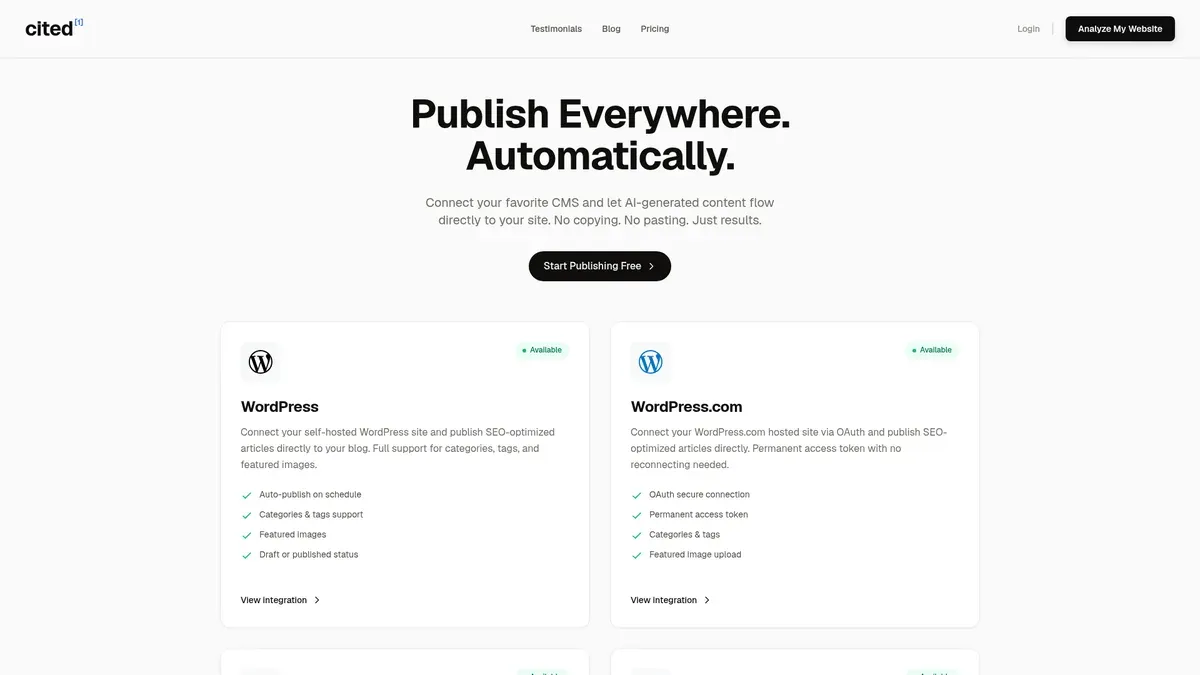
- WordPress and WordPress.com, with categories, tags, featured images, and scheduled publishing.
- Webflow, publishing into CMS collections with custom-field mapping.
- Wix, with OAuth connection and draft or published status.
- Framer, Shopify, and Duda, each with their own publishing path.
- GoDaddy, where Cited can auto-provision a hosted WordPress blog.
- Webhooks, so the content can flow into Zapier, Make, or n8n instead of a CMS directly.
That breadth is a genuine strength if your business already runs on one of these platforms, because it removes the copy-paste step that a lot of managed content services still leave to the customer. What is not documented is integration-specific pricing, rate limits, or what happens when a publish fails partway through. Those are the kinds of details you would want to confirm before committing, especially if your site runs on a less common setup.
Where It Falls Short
This is where the cited.so review gets more complicated, because the gap is not a feature that works poorly. It is a set of features that are not shown to exist at all.
The public materials do not disclose a prompt library, a schedule for querying AI engines, full answer capture, mention-rate or citation-rate numbers, a competitor comparison, page-level source attribution, sentiment tracking, historical trend data, exportable reports, or any stated accuracy methodology. None of that means the underlying tracking is bad. It means there is no public evidence that a citation-tracking and reporting system exists to judge in the first place. Cited names Google and ChatGPT as its optimization targets, but naming a target is not the same as measuring performance against it, and the pages do not explain which ChatGPT surface it means, whether it checks Google AI Overviews separately, or whether any other engine (Gemini, Perplexity, Claude) is covered at all.
The "human-reviewed" claim has the same problem. It is a meaningful distinction from a fully automated content generator, but the pages do not say who reviews the drafts, what they check for, or how many revision rounds are included.
None of this is unusual for a young product still building out its public site. But it does mean a cited.so citation tracking claim, if you have seen the product described that way somewhere, is getting ahead of what the company itself documents. The honest framing is that Cited writes content aimed at AI visibility. Whether that content is actually earning citations, and whether Cited can show you the receipts for it, are two separate questions the public pages do not answer.
Vendor Claims and Evidence
Cited's homepage carries several performance numbers: three times more traffic with half the effort, three times more customers in four months, a 35% cut in customer-acquisition cost, and a 40% increase in organic leads. It also runs customer testimonials describing similar results, and a comparison claiming a 97% saving against agency pricing.
These are worth reading as vendor-published marketing claims rather than as independently audited results. There is no disclosed methodology, sample size, baseline traffic, or date range attached to any of them, and the agency-cost comparison is built on assumptions shown only on Cited's own page. None of this means the numbers are false. It means there is not enough context here to generalize them into a statistic you can rely on, and a review that repeated them at face value would be doing readers a disservice.
The testimonials work the same way. Named business owners describe more discovery, more customers, and lower acquisition costs, and there is no reason to assume those quotes are fabricated. But a handful of testimonials on a vendor's own homepage is not a sample you can generalize from, and it does not tell you how a typical customer's results compare, or over what time period those results showed up. Treat them as anecdotes worth reading, not as a projection for your own business.
Who Cited.so Is For
Cited.so fits best if you are:
- A local business that wants a hands-off blog and does not have anyone in-house to run it.
- Comfortable judging success through ordinary traffic, leads, and search visibility rather than a formal AEO report.
- Looking for one simple monthly plan instead of a tiered dashboard with a learning curve.
- Already running WordPress, Webflow, Wix, Shopify, Framer, Duda, or GoDaddy, where the publishing integrations do most of the heavy lifting.
Who Should Skip It
You should be cautious, or look elsewhere, if you are:
- A marketing lead who specifically needs an AI citation tracker with prompt-level reporting.
- Responsible for reporting mention and citation rates across ChatGPT, Gemini, Perplexity, or Google's AI features to leadership.
- An agency that needs client-ready exports, historical charts, or an audit trail behind the numbers you present.
- Looking for page-level attribution that shows exactly which of your URLs an AI engine is citing.
- Wanting deep editorial controls or a clearly defined revision workflow, since the current pages do not spell either one out.
Alternatives to Consider
If the missing piece for you is measurement rather than production, or the other way round, these are the options worth putting next to Cited.so.
-
DeepSmith. DeepSmith tracks how AI engines (ChatGPT, Perplexity, Gemini, Claude, Google AI Overviews and five more, with coverage rising by plan) answer the prompts you care about, reporting mention rate, citation rate, share of voice and which of your pages actually get cited, and it produces publish-ready articles against the gaps that data exposes. Plans run $99, $199 and $399 a month (engine coverage rises with the tier) with a 7-day free trial, and it publishes to WordPress, Webflow, Strapi, Sanity, Contentful or your own webhooks. It is not a managed, human-reviewed service the way Cited.so is: the writing runs as a system you operate rather than work handed to someone else.

-
Byword. Byword turns a keyword list or a spreadsheet of topics into SEO-shaped articles in bulk on credit-based pricing, which suits a validated backlog more than a hands-off local business blog.
-
Content at Scale (BrandWell). Content at Scale positions itself as a long-form SEO writer that builds a full post from a keyword, URL, document or podcast and publishes to WordPress, though its own materials assume you still have someone editing and fact checking the output.
Is Cited.so Worth It?
Cited.so is worth considering at $99 a month if what you actually want is managed SEO content, written and published without you touching it, for a local business that does not have a content team. The pricing is simple, the publishing integrations are genuinely broad, and human review is included rather than optional.
It is not something we can currently recommend as a citation-tracking or AEO-reporting tool, and that is not the same as saying its tracking is inaccurate. The honest answer is that the public product pages do not show a tracking or reporting system to evaluate at all. If citation intelligence is the reason you are looking at cited.so, ask for a live demo before you pay: which engines it checks, how often, what a captured answer looks like, whether page-level attribution exists, and how the results are stored over time. Those are ordinary questions a reporting product should be able to answer plainly, and the public pages currently do not.
If you run a cited so review search a second time a few months from now, it is worth checking whether the company has published anything new on the tracking side. A managed content service can add a reporting layer later, and right now there just is not one to see.
The gap this review keeps running into is measurement, not writing, and that is the axis DeepSmith sits on. DeepSmith checks your tracked prompts against the AI engines your plan covers (ChatGPT, then Perplexity, then Gemini as you move up the tiers, and all ten including Claude, Grok and Google's AI surfaces on Enterprise) on a schedule, keeps the full answer history, and reports mention rate, citation rate, share of voice and which of your URLs are being cited, alongside a competitor leaderboard for the same prompts. The articles it writes are planned against those findings, so the piece you publish is aimed at a prompt you can already see you are losing, and you can check the same numbers a month later to see whether it moved. It does not replace what Cited.so is actually selling, which is a managed service with a human reviewing every draft at a low fixed price, so if hands-off delivery is the thing you want, Cited.so is the more direct answer.
If you would rather see the citation data before you commit to producing against it, you can start a free DeepSmith trial and look at your own prompts first.