Last week you typed your own best-selling category into ChatGPT. A competitor came back. You did not.
That stings. It also tells you exactly where your next growth problem lives.
Shoppers are moving their research into chat windows. They ask for "a durable rain jacket under $200" and get three recommendations with buy buttons attached. If your catalog is not in that answer, you lost the sale before anyone reached your site.
Here's the good news: this is fixable, and you don't need a dozen tools to fix it. You need one that matches your store, your team, and your actual bottleneck. This guide walks through the best GEO tools for ecommerce so you can pick one and start closing gaps this month.
Two shifts explain the urgency. Adobe's retail data shows AI-referred traffic growing several times over in a single year, and converting better than non-AI sources. Pew's research points the other way on clicks: when an AI summary shows up, people click through far less often than when it doesn't.
Fewer visits, better visits, fewer slots. Let's find you a seat.
What GEO actually changes for an ecommerce brand
Generative Engine Optimization is the practice of making your product and category content citable, retrievable, and recommendable inside AI-generated answers.
SEO asks a different question than GEO does. SEO optimizes for a position on a results page. GEO optimizes for inclusion inside the answer itself, either as a cited source or as a recommended product card.
Same raw materials, new bar. Your URLs, schema, content, and links still matter. What gets added is retrieval-readiness: entity completeness, freshness, answer-shaped writing, and machine-readable product feeds.
For a store, generative engine optimization ecommerce work lands on four concrete surfaces:
- Product detail and listing pages that retrieval pipelines behind ChatGPT, Perplexity, Gemini, Claude, and Google AI Mode need to find and quote.
- Comparison and "best category for use case" content, because AI answers cluster hard around buying-intent questions.
- Structured product feeds into Google Merchant Center, Bing Merchant Center, and the OpenAI product feed, which now supply AI shopping experiences as well as ads.
- Brand-entity and authority signals such as Organization schema, sameAs profiles, and third-party reviews.
That last one surprises people. Your reviews on outside platforms are often what an engine reads before it decides whether to recommend you at all.
Where do the tools fit? They handle the measurement and the production. GEO for product pages still needs your product data to be clean, which is a job no dashboard does for you.
How we picked the best GEO tools for ecommerce
A roundup is only useful when you know the bar. Every tool below was judged against five things.
Engine coverage. Which AI engines it tracks, and how quickly it adds new ones.
Action surface. Whether it only measures, or actually helps you close the gap with content.
Ecommerce fit. Whether it can handle product and category content, structured data, feeds, and catalog-scale workflows.
Integration and publishing. Native CMS support, webhooks, and exports that fit how you already ship.
Pricing transparency. Whether pricing is published, and whether the tiers match real team shapes.
We name where a competitor beats us. A list that only flatters its author is not worth your time, and you would spot it anyway.
One caveat before the table. Pricing and engine coverage in this category shift quarter to quarter, so confirm against each vendor's page before you buy.
GEO tools for ecommerce at a glance
| # | Tool | Starting price | Engines tracked | Best for | Key limitation |
|---|---|---|---|---|---|
| 1 | DeepSmith | $99/mo (Pro) | ChatGPT (Pro), plus Perplexity (Grow), plus Gemini (Scale), all 10 engines (Enterprise) | Teams wanting analytics and production in one platform | Tracking depth and engine breadth are tier-based |
| 2 | AirOps | Free Insights tier, higher tiers sales-quoted | Google, Gemini, Perplexity, Claude, ChatGPT | Enterprise content ops with agentic workflows | Public pricing only at the entry tier |
| 3 | Otterly AI | $29/mo (Lite) | ChatGPT, Perplexity, AI Overviews, Gemini, Copilot | Solo and small teams needing a low-cost entry | Analytics only, prompt caps on Lite |
| 4 | Peec AI | Not publicly listed | ChatGPT, AI Mode, AI Overviews, Copilot, Perplexity, Gemini | Teams needing Looker, MCP, or API workflows | Analytics only, no content production |
| 5 | Profound | Sales-quoted | ChatGPT, Perplexity, Claude, Gemini, AI Overviews, plus Grok, Meta AI, DeepSeek | Enterprise analytics with Shopping Agent data | Sales-led pricing |
| 6 | Scrunch AI | Sales-quoted | ChatGPT, Perplexity, Claude, Gemini, AI Overviews, Grok, Meta AI, DeepSeek, Copilot | Wide engine coverage on any plan plus AI crawl control | Sales-led pricing |
| 7 | Writesonic GEO | ~$79 to $249/mo | 10+ AI surfaces | Teams already on Writesonic | GEO module is newer, breadth varies by plan |
| 8 | Surfer AI Tracker | Bundled with Surfer | Multi-engine, varies | SEO teams already on Surfer | Analytics and on-page only |
| 9 | Semrush AI Visibility | ~$140/mo add-on | ChatGPT, Perplexity, Gemini, AI Overviews | SEO teams standardized on Semrush | A module, not a full GEO platform |
| 10 | Conductor | Sales-quoted | Multi-engine, enterprise | Global enterprises with governance needs | Premium pricing |
| 11 | Goodie.ai | Sales-quoted | Shopping-focused AI | Retailers focused on Shopping surfaces | Shopping-discovery focused |
1. DeepSmith
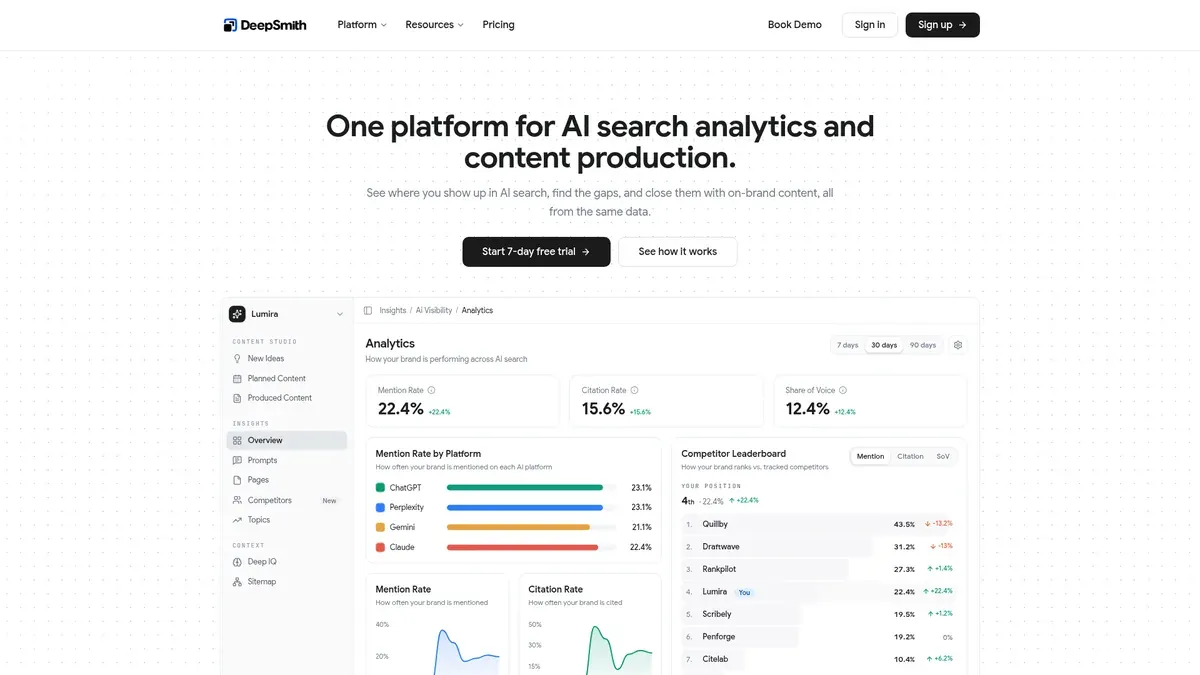
Best for: ecommerce teams that want to see where they are invisible in AI answers and produce the content that fixes it, without running two tools and a handoff between them.
Most tools in this category stop at the diagnosis. They show you a citation rate, a competitor leaderboard, and a list of prompts where you never appear. Then you export a CSV and go write.
That gap is the real bottleneck. Knowing you're missing from "best waterproof hiking boots" doesn't put you there.
DeepSmith is an AI search analytics and content production platform in one. It tracks how AI engines answer questions about your brand, finds the gaps, and produces the on-brand content to close them, all from the same context.
Here's how that works in practice.
AEO tracks the questions your buyers actually ask. You get mention rate, citation rate, share of voice, and sentiment with trends, a per-platform breakdown, a competitor leaderboard, and the sources AI cites most. The Pages view shows which of your URLs earn citations and which prompts drive them. Discover Prompts generates a starter set from your product and persona context, so you're not staring at a blank prompt list on day one.

Content Map tells you what to write next. Your site and your competitors' sites are crawled and classified onto one shared topic taxonomy with funnel stages, so coverage is a measurement instead of a hunch. Coverage gaps show topics where a rival publishes more than you do, and untapped topics show where they publish and you have nothing at all, which is how you find the category pages you never built.
Content Studio does the writing. The Writer turns one planned idea into a finished, brand-grounded article: researched, internally and externally linked, with a cover image and publish-ready metadata. Autowrite goes further and produces on a schedule with nobody in the app. Produced Content is where you review, edit, regenerate the cover, and publish to WordPress, Strapi, Webflow, Sanity, Contentful, or your own webhooks.

Deep IQ is why the output sounds like you. Your positioning, real products, personas, brand voice, and content types are stored once and used by every module. That is the difference between a draft you rewrite and a draft you ship.
Opportunity Agents turn that map into a backlog. Pick an agent and it reads your AI visibility or your Content Map and hands back ideas with the evidence attached: get cited for a tracked prompt, take a competitor's citations, or close a decision-stage gap against up to four rivals at once.
Pricing. Pro is $99/mo ($80 billed annually) for 20 articles, 50 tracked prompts, 5 seats, ChatGPT. Grow is $199/mo ($160 annually) for 40 articles, 100 prompts, 7 seats, adding Perplexity. Scale is $399/mo ($299 annually) for 90 articles, 200 prompts, 10 seats, adding Gemini. Enterprise is custom and covers all ten engines with 1:1 onboarding and a dedicated account manager. There's a 7-day free trial, no long-term contracts, and no cancellation fees.
Honest limitation. DeepSmith doesn't ship ecommerce-specific modules. There's no PDP schema auditor, no feed manager, no SKU-level tracking. If your blocker is a messy product feed, a feed tool solves that and DeepSmith won't. Engine breadth is also tier-based: Pro tracks ChatGPT only, and the full ten-engine set unlocks at Enterprise.
Where it fits a store is the content layer around the catalog: category buying guides, comparison and alternatives pages, and the "best X for Y" content that AI answers lean on for product discovery. That's a large share of the GEO surface, and it's the part most stores never staff.
2. AirOps

Best for: enterprise content operations that want an agentic layer sitting on top of playbooks rather than rigid workflows.
AirOps positions as a growth platform for AI search and AEO. Its model is Playbooks plus Workflows, letting reasoning run inside guardrails instead of a fixed step chain.
Key features. Brand Kit for consistency, Quill (an agent that drafts briefs and runs campaigns), background monitoring for content gaps, weekly opportunity reports, offsite mention management, and brand governance. There's an MCP server if you want to drive it from Claude or Cursor.
Modules. Insights, Content Refresh, Content Creation, and Social Engagement.
Engines tracked. Google, Gemini, Perplexity, Claude, and ChatGPT.
Pricing. The Insights tier starts free or low-cost with basic templates, one brand kit, five knowledge-base sources, 30+ AI models, and 10+ CMS integrations. Solo, Pro, and Pages tiers are not published publicly. Pro adds AI search visibility insights, content refresh and creation, and roughly 75,000 tasks a month. Enterprise adds custom limits, multi-region and multi-language support, custom agent builds, and unlimited seats.
Honest limitation. Only the entry tier has public pricing, so budgeting means a sales call. Ecommerce-specific features are not called out anywhere on the site.
3. Otterly AI

Best for: solo marketers and small teams who want a real answer this week without a procurement conversation.
Otterly keeps the scope tight and the price low, which is exactly right when you are testing whether AI search is worth your attention at all.
Key features. A GEO audit, brand monitoring, prompt research, sentiment tracking, and share-of-voice tracking. Public API access covers reports, prompts, and citations.
Engines tracked. ChatGPT, Perplexity, Google AI Overviews, Gemini, and Microsoft Copilot.
Pricing. Lite starts at $29/month, with a free 14-day trial.
Honest limitation. It is analytics only. There is no content production layer, so every gap it finds becomes work somewhere else. Prompt counts are capped on Lite.
4. Peec AI

Best for: marketing teams and SEO agencies that want a focused analytics dashboard feeding tools they already run.
Peec is AI search analytics for marketing teams and agencies, and it does not pretend to be more than that. If your reporting lives in Looker Studio, this fits neatly.
Key features. Daily tracking, multi-country tracking per project, a Looker Studio connector, MCP integration, and a public API.
Engines tracked. ChatGPT, AI Mode, AI Overviews, Microsoft Copilot, Perplexity, and Gemini, with three models trackable per plan.
Pricing. Starter covers one project. Pro covers two projects and three countries each. Advanced covers five projects. Enterprise runs on an annual contract with custom terms. Prices are not publicly listed.
Honest limitation. No native content production, and no public USD pricing on Starter, Pro, or Advanced.
5. Profound

Best for: retailers where AI shopping referrals have become a board-level metric.
Profound is built for enterprise analytics with agentic workflows attached, and it has the most directly ecommerce-relevant module in this roundup.
Key features. Monitor covers Answer Engine Insights, Prompt Volumes, and Shopping Agent analytics. Create covers Agents. Operate covers Aim, its workflow layer.
Engines tracked. ChatGPT, Perplexity, Claude, Gemini, and Google AI Overviews, with expanding coverage of Grok, Meta AI, and DeepSeek.
Why it matters for stores. Shopping Agent analytics is a distinct module for measuring AI-shopping-agent referrals. If you need to show leadership what AI agents are sending you, that is a purpose-built answer. It measures the referral, though. Growing that number is still content work you plan somewhere else, which is the layer DeepSmith is built to run.
Honest limitation. No public pricing and a sales-led motion. Integrations are not publicly enumerated, so expect discovery calls before you know whether it fits your stack.
6. Scrunch AI

Best for: brands with big catalogs that want wide engine coverage on any plan and control over how AI crawlers treat their pages.
Scrunch frames itself around brand trust, authority, and citations rather than production. For a retailer with tens of thousands of PDPs, the crawler-governance angle is not a footnote.
Key features. Prompt Insights, Content and Citation Optimization, Competitive Intelligence, Page-Level Analytics, Brand Authority, and AI Crawl Control.
Engines tracked. ChatGPT, Perplexity, Claude, Gemini, Google AI Overviews, Grok, Meta AI, DeepSeek, and Microsoft Copilot. That is nine engines with no enterprise tier standing in front of them.
Integrations. AEO Insights for HubSpot and Marketo, in closed beta.
Honest limitation. Pricing needs a sales conversation outside the Sprout plan, and the positioning is brand trust rather than content production. You will still need somewhere to write.
Other GEO tools worth knowing
Not every tool needs a full entry to be worth your attention. If you are already paying for one of these, start here before adding another subscription.
Writesonic GEO pairs GEO tracking with content optimization, roughly $79/month at entry and around $249/month at the agency tier.
Surfer AI Tracker bundles an AI-search visibility layer into Surfer's optimization suite. Sensible if Surfer is already in your stack.
Semrush AI Visibility Toolkit is an add-on, around $140/month, and it makes sense for SEO-led teams standardizing on Semrush.
Conductor brings enterprise SEO with an AI visibility layer, aimed at global enterprises with governance needs and priced accordingly.
Goodie.ai focuses on shopping and product-discovery AI analytics, which makes it relevant if Shopping surfaces are your whole game.
The GEO work no tool does for you
Buying a tool feels like progress. It isn't the whole job, and skipping this part is the most common way stores waste a subscription.
Every tool on this list makes ecommerce AI answer optimization faster. None of them make it automatic.
Here's the playbook they help you execute, not replace.
Get your structured data right. Publish Organization, Product, Offer, AggregateRating, Review, BreadcrumbList, and FAQPage schema on every PDP and key category page. Research on AI citations keeps pointing the same direction: pages carrying structured data are cited noticeably more often than pages without it, and a large majority of citations in Google AI Mode and ChatGPT come from pages that have it.
Keep your product attributes in sync. Price, availability, GTIN or MPN, dimensions, materials, and variants should match across on-page schema, your Merchant Center feeds, and the OpenAI product feed. Mismatches are how you get skipped.
Write answer-first. Lead each PDP and category page with a direct, citable answer to the most likely buyer question. Use a clean H2 and H3 hierarchy so retrieval can chunk your page correctly. Add a short summary block at the top of high-intent pages.
Build the comparison content. Alternatives pages, versus pages, and "best for" pages are where buying-intent answers get sourced. This is the highest-leverage gap for most stores, and it's usually empty.
Earn outside proof. Reviews on third-party platforms, expert quotes with credentials, and inline source attribution all feed the authority signals engines read. Encourage reviews, then feed AggregateRating into your schema.
Don't skip the basics. Canonicals, robots.txt, XML sitemaps, clean URLs, semantic HTML, page speed, and mobile-first design still apply. AI retrieval inherits your technical foundation, it doesn't forgive it.
If that list feels long, pick one. Structured data on your top 20 products is a real week's work with a real payoff. Momentum matters more than completeness here.
That's what ecommerce AI answer optimization comes down to: clean data, answer-shaped content, and proof that you exist.
How to choose the right GEO tool for your store
Five questions. Answer them honestly and the shortlist writes itself.
1. Do you want analytics only, or analytics plus production?
This is the fork that matters most. If you already have writers and just need to know where you're losing, Peec AI or Otterly AI are lower-friction and cheaper. If your bottleneck is producing the content that closes the gaps, DeepSmith is the only tool here that measures and produces natively.
Be honest about which one you are. Buying a dashboard when your real problem is that nobody has time to write is an expensive way to feel busy.
2. How many engines actually matter in your category?
ChatGPT dominates assistant referral share today, though its lead has been slipping as others grow. Perplexity and Gemini matter for product discovery. Claude and Google AI Mode are climbing.
Scrunch tracks nine engines without an enterprise plan. DeepSmith covers all ten, though the full set sits at Enterprise. If you only care about ChatGPT right now, don't pay for ten.
3. What is your team shape?
Solo or small: Otterly AI for the cheapest entry, or DeepSmith Grow if you want production bundled in. Agencies and multi-brand teams need workspace isolation, so look at DeepSmith Enterprise or AirOps Enterprise. In-house content ops at scale usually want an agentic layer (AirOps) or enterprise governance (Profound, Conductor).
4. Where do you publish?
If you're on WordPress, Strapi, Webflow, Sanity, or Contentful, DeepSmith publishes native to all five, and webhooks plus Markdown and HTML export cover a custom CMS. If you never publish content and only want to monitor, choose an analytics-only tool and skip the rest.
5. How mature is your ecommerce foundation?
Early stage with messy product data? Fix schema and feeds first with a feed-management tool plus a cheap analytics layer. No GEO platform saves you from a broken feed.
Mid-market and ready to operationalize? DeepSmith or AirOps.
Enterprise with multi-brand governance? Profound, Conductor, or DeepSmith Enterprise.
Pick where a competitor genuinely wins: choose Profound if Shopping Agent analytics is your board metric. Choose Scrunch AI if you need nine engines without an enterprise plan, plus crawl control. Choose Otterly AI if $29 is the honest ceiling this quarter. Choose AirOps if you want an agentic content-ops platform and can live with a sales call. Choose Writesonic, Surfer, or Semrush if you're already paying for them and just want a bolt-on.
Start with one gap, not ten
You don't need to fix everything this quarter. You need to know where you're missing and ship one thing that closes it.
Pick your ten highest-margin category prompts. Find out who gets cited instead of you. Write the one comparison page you never built. That's a real month of work with a visible result.
If you want the tracking and the production in the same place, start a free DeepSmith trial and see real data and real drafts before you pay.
You're closer to this than you think.