A shopper just asked ChatGPT which running shoes to buy under $150. Did it name you?
If you don't know, that's normal. Most ecommerce teams don't. You've spent years learning to read Google Analytics, and now a whole layer of shopping discovery happens inside a chat window where you have no dashboard at all.
Here's the good news: that layer is measurable now. The best AI visibility tools for ecommerce exist to answer one question you can't answer by hand. When a shopper asks an AI engine for a recommendation in your category, does your brand show up, does your product get named, and who gets named instead of you?
This guide walks through the tools that actually do that job. Some track your brand. A few track your individual SKUs. Most do neither well, so the differences matter more than the marketing pages suggest.
Take a breath. You only need to pick one, and by the end of this you'll know which one fits your store.
Why this got urgent
The shift is not theoretical anymore.
Adobe Analytics tracked AI-referred traffic to U.S. retail sites growing nearly 400% year over year in early 2026, with an even sharper spike over the 2025 holiday season. That traffic also behaves better than most of your channels. Adobe found AI-referred visitors spend meaningfully more per visit than paid, email, or affiliate traffic, and the 2026 conversion benchmarks from Digital Applied put AI search traffic ahead of every other channel combined.
Shoppers are already there. Capital One Shopping Research found most consumers have used generative AI for product research, a large share bought something an AI recommended in the past six months, and the clear majority plan to shop with AI this year.
So ecommerce AI search visibility is not a 2027 problem. It's an acquisition channel with your best conversion rate, and right now you probably can't see it.
That's the gap these tools close.
How we chose these tools
Roundups are only useful when you know the filter. Here's ours.
- It measures presence inside AI answers. The tool has to query at least one major AI surface (ChatGPT, Perplexity, Gemini, Claude, Google AI Mode or AI Overviews) and report mention rate, citation rate, or share of voice. Rank trackers that never touch an AI answer didn't qualify.
- Pricing is knowable. Either the vendor publishes real numbers or a credible third party does. Enterprise-only tools are included when the platform is well documented, and flagged so you don't waste a demo call.
- It's alive in 2026. Live product page, current pricing, recent shipping activity.
- It's relevant to a store, not just a SaaS blog. Brand-level tracking across the questions shoppers actually ask ("best X," "X vs Y," "top X under $Y") is the floor. SKU-level product tracking, feed optimization, or revenue attribution earn extra weight.
One honest note before the list. None of these tools control whether AI engines cite you. They measure it. Anyone promising guaranteed citations is selling something that doesn't exist.
The tools at a glance
| # | Tool | Best for | Ecommerce edge | Entry price |
|---|---|---|---|---|
| 1 | DeepSmith | Teams that want measurement plus the content to fix the gaps | Publish-ready content that closes measured gaps | $99/mo |
| 2 | Profound | Enterprise brands needing the deepest AI-search dataset | Shopping Agent Analytics, SKU tracking on Enterprise | ~$99/mo reported |
| 3 | Goodie AI | Big catalogs needing true SKU-level visibility | SKU tracking, feed optimization, Amazon Rufus | Enterprise only |
| 4 | AthenaHQ | Shopify DTC brands wanting revenue attribution | Native Shopify and GA4 integration | $295/mo |
| 5 | Peec AI | European brands and agencies on a budget | Citation analysis by URL type | €85/mo |
| 6 | Scrunch AI | Brands optimizing for AI agents that transact | Agent Experience platform, edge delivery | $300/mo |
| 7 | Evertune | Brands buying AI ad placements | Tracks AI advertising surfaces | Enterprise only |
| 8 | Ahrefs Brand Radar | Existing Ahrefs customers | 260M+ prompt database | $199/mo per engine |
| 9 | Semrush AI Visibility | Existing Semrush customers | Lives inside your SEO suite | $199/mo add-on |
| 10 | Otterly.AI | Small teams testing the category cheaply | Lowest real entry price | $29/mo |
| 11 | Rankscale | Global brands across many markets | 240+ countries, multilingual | Custom |
| 12 | Knowatoa and lighter tools | Simple scheduled check-ins | Weekly reports, low cost | ~$59/mo |
1. DeepSmith
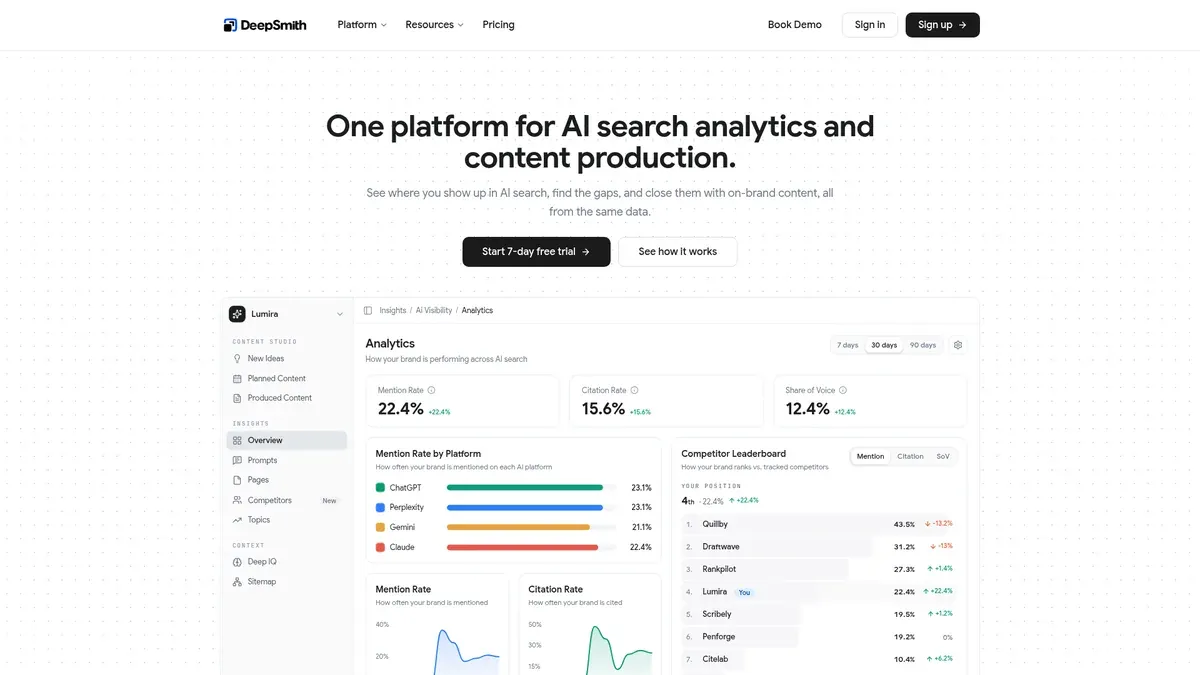
Best for: ecommerce content teams that want to see where AI answers ignore them and then actually close those gaps without adding headcount.
Yes, this is our product. Rank it against the others on the evidence below, not on the placement.
Most tools on this list stop at measurement. You get a dashboard, a share-of-voice chart, a competitor leaderboard, and then a very quiet Monday morning where you stare at a list of prompts you're losing and think: now what? Someone still has to write the comparison page, the buying guide, the category explainer. That someone is usually you.
DeepSmith is an AI search analytics and content production platform in one workspace. It tracks how AI engines answer questions about your brand, shows the gaps, and produces the on-brand content that closes them, from the same context.
What it tracks. Mention rate (how often AI names you), citation rate (how often AI links your pages as a source), share of voice against competitors, sentiment, and visibility trend over time. You get a per-platform breakdown, a competitor leaderboard, full per-prompt answer history, and the source domains AI cites most in your category. Ten engines are covered in total: ChatGPT, Gemini, Perplexity, Claude, Google AI Overviews, Google AI Mode, Grok, Meta AI, Microsoft Copilot, and DeepSeek. Coverage rises by plan: Pro tracks ChatGPT, Grow adds Perplexity, Scale adds Gemini, and Enterprise and Custom cover all ten.

What makes it different. Seven modules share one brand context. AEO measures your visibility. Content Map classifies every page on your site and your competitors' sites onto one topic taxonomy, so coverage gaps and untapped topics are a measurement instead of a hunch, and internal linking stays current. Opportunity Agents read that data and your visibility data and return ideas with the justifying data point attached. Content Studio moves those ideas from New Ideas to Planned to Produced, with the Writer turning a planned idea into a finished article that's researched, internally and externally linked, and shipped with a cover image and publish-ready metadata. Autowrite runs that unattended on a date you set. Deep IQ stores your positioning, products, personas, brand voice, and visual guidelines so output sounds like you and describes your real catalog.
Output publishes straight to WordPress, Webflow, Strapi, Sanity, or Contentful, or to your own webhooks. The stance is deliberate: a production engine, not a writing assistant that leaves you a first draft to rescue.

Pricing. Pro $99/mo (20 articles, 50 prompts, 5 seats). Grow $199/mo (40 articles, 100 prompts, 7 seats). Scale $399/mo (90 articles, 200 prompts, 10 seats). Annual billing drops those to $80, $160, and $299. Enterprise is custom with all ten engines, 1:1 onboarding, and a dedicated account manager. There's a 7-day free trial, no long-term contract, no cancellation fee.
Limitation, honestly. If your primary need is SKU-level product placement inside AI shopping answers, this isn't the sharpest tool for that job. Profound and Goodie AI own that niche. We'd rather tell you now than have you find out in month two. DeepSmith tracks brand and page-level visibility across the questions shoppers ask, and it's strongest when the answer to those questions is content you publish. One more thing to know: the Pro tier is ChatGPT only, and multi-engine coverage starts at Grow. That's a smaller net than it sounds, because ChatGPT alone has passed 900 million weekly users, so Pro puts you on the single largest AI surface first, and you widen to Perplexity at Grow, Gemini at Scale, and all ten engines on Enterprise.
2. Profound

Best for: enterprise brands and analysts who want the deepest AI-search dataset available, with real product-level tracking.
Profound is the most complete analytics platform in the category. It reports mention rate, citation rate, sentiment, and share of voice across 10+ AI surfaces, including ChatGPT, Perplexity, Claude, Gemini, Google AI Overviews, Grok, Meta AI, DeepSeek, and Copilot. That's broader engine coverage than almost anyone.
For ecommerce the standout is Shopping Agent Analytics, which tracks when AI shopping answers surface your products, whether your product image appears, and how you benchmark against named retailer competitors. That's what makes it a true AI shopping visibility tracker rather than a brand monitor with a shopping tab. SKU-level tracking is an Enterprise add-on. Prompt Volumes uses a clickstream panel to estimate real query demand, so you can prioritize prompts by actual shopper interest rather than instinct. Conversation Explorer helps you find prompts worth tracking in the first place.
Pricing. The official page lists Enterprise custom only. Third-party reviewers report a Starter tier around $82 to $99/mo and Growth around $332 to $399/mo, though those aren't posted by the vendor. At real enterprise scale, expect the figure to climb well into four or five figures monthly.
Limitation. It's analytics only. There's no native content production, so once Profound tells you which prompts you're losing, you still need a separate tool and a writer to do something about it.
3. Goodie AI

Best for: large retail and ecommerce brands with hundreds or thousands of SKUs, where product placement matters more than blog visibility.
If you want genuine product visibility tracking AI shoppers actually see, Goodie is built for exactly that. It's an enterprise AEO platform organized around product-level visibility rather than brand mentions. Tracked engines include ChatGPT, Claude, Perplexity, Gemini, Google AI Overviews, Grok, Meta AI, DeepSeek, and Amazon Rufus. It's the only tool here that explicitly monitors Rufus, which matters if Amazon is a real channel for you.
The AEO Content Hub produces product-feed-optimized content, and the platform also tracks brand recommendations surfaced inside Walmart, Instacart, and Uber Eats. That's a genuinely different map of the shopping surface than everyone else is drawing.
Pricing. Enterprise only, custom quote.
Limitation. Enterprise-only pricing puts it out of reach for SMB and mid-market teams. If you're running a 40-SKU DTC brand, this is not your tool this year.
4. AthenaHQ

Best for: Shopify-native DTC brands that want AI visibility connected to actual revenue.
Most tools show you a visibility score and leave the business case to you. AthenaHQ integrates natively with Shopify and GA4, which lets it tie AI visibility to store revenue. That's the closest thing in the category to real attribution from AI citations, and it's a strong answer when your CEO asks what any of this is worth.
Tracked engines: ChatGPT, Perplexity, Gemini, Claude, and Google AI Overviews. Autonomous agents can write and ship content optimizations on their own. Self-serve starts at $295/mo, with Enterprise custom.
Limitation. It's Shopify-optimized. On BigCommerce, WooCommerce, Magento, or a custom stack, the integration that makes it special is exactly what you lose.
5. Peec AI

Best for: European ecommerce brands, agencies running many clients, and teams who want serious tracking without a serious invoice.
Peec is Berlin-built, with EU data residency that matters if your legal team asks. Engines: ChatGPT, Perplexity, Gemini, Copilot, Google AI Mode, and Google AI Overviews.
Two things stand out for stores. The tag system lets you organize prompts by product line, persona, or funnel stage, so you can see visibility for "running shoes" separately from "trail gear." And the citation analysis breaks down whether the cited URL is a product page, a category page, an editorial article, or a comparison page. That tells you what kind of page earns citations in your category, which is the most actionable thing a tracker can hand you.
Pricing. Starter €85/mo (roughly $92), Pro €245/mo, Enterprise €499+/mo, with agency plans.
Limitation. Analytics only, no content production. It'll show you the gap with unusual clarity and then hand the work back to you.
6. Scrunch AI

Best for: brands whose strategy explicitly includes AI agents buying on behalf of shoppers.
Scrunch bets on a specific future: agents, not just people, will do the shopping. Its Agent Experience platform structures your content for machines to ingest, and its Edge Delivery Network serves agent-optimized structured content (product schema, knowledge-graph fragments) at the edge so agents parse and cite it quickly.
Tracked engines: ChatGPT, Gemini, Perplexity, Google AI Mode, Google AI Overviews, Meta AI, and Claude. Starter is $300/mo, Growth $500/mo, Enterprise custom.
Limitation. The pricing and orientation aim at large, content-heavy brands. If agent commerce isn't in your plan yet, you're paying for a thesis you haven't adopted.
7. Evertune

Best for: large consumer brands with real AI advertising budgets.
Evertune tracks something almost nobody else does: your brand's presence in AI advertising surfaces inside ChatGPT, Perplexity, and Gemini, not just organic mentions. It adds marketer-persona analysis showing how your brand gets represented to different audience types. If you're buying AI placements and earning organic ones, it's a single source of truth.
Pricing. Enterprise only, reportedly $2,000 to $5,000+/month depending on scope.
Limitation. It's the narrowest ecommerce fit here. Without an AI ad budget, most of what you're paying for doesn't apply to you.
8. Ahrefs Brand Radar

Best for: teams already living in Ahrefs who want AI visibility in the same tab.
Brand Radar sits inside the Ahrefs suite and runs on a 260M+ prompt database, the largest cited in the category. It tracks Google AI Overviews, Google AI Mode, ChatGPT, Perplexity, Gemini, and Copilot, with solid citation tracking and share-of-voice reporting. The AI Content Assistant helps draft and optimize.
If your team already trusts Ahrefs data, adoption is close to free in human terms. That's worth more than most feature comparisons admit.
Pricing. $199/month per engine, or $699/month for all six bundled. An Ahrefs subscription is generally required on top.
Limitation. Per-engine pricing adds up fast, and tracking is brand-level only. No product-level granularity, which is the thing ecommerce needs most.
9. Semrush AI Visibility Toolkit

Best for: existing Semrush customers who want AI tracking without a new login.
The toolkit tracks ChatGPT, Google AI Overviews, Gemini, and Perplexity, with prompt-level tracking, brand presence, sentiment, competitor benchmarking, and an AI content assistant, all inside the Semrush dashboard your team already knows.
Pricing. $199/month as an add-on to a Semrush Starter subscription or above.
Limitation. A smaller prompt database than standalone competitors, and brand-level tracking only. You're trading depth for convenience, which is a fine trade as long as you make it on purpose.
10. Otterly.AI

Best for: solo founders and small teams who want to test this category without a budget conversation.
Otterly is the cheapest honest entry point here. It tracks ChatGPT, Perplexity, Google AI Overviews, Gemini, and Copilot for brand mentions and links, and includes Search Optimization for prompt refinement plus a Content Lab for asset recommendations. GA4 and Looker Studio integrations are available.
Pricing. Lite $29/mo (15 prompts), Standard $189/mo (50 prompts), Premium $489/mo (200 prompts).
Limitation. Brand-level only, no product or SKU tracking, and 15 prompts goes quickly once you start mapping real shopper questions. Treat Lite as a diagnostic, not a program.
11. Rankscale

Best for: global brands selling across many countries and languages.
Rankscale has the broadest coverage in the category: 17+ engines including ChatGPT, Perplexity, Claude, Gemini, DeepSeek, and Mistral, across 240+ countries with multilingual prompts. It also runs 94+ technical GEO checkpoints that audit whether your site is even eligible to be cited. If your visibility problem differs by market, this is the only tool that shows you that clearly.
Pricing. Custom, sales-led.
Limitation. Enterprise-only pricing and analytics only. Single-market brands are buying coverage they'll never use.
12. Lighter trackers worth knowing
A few tools do less on purpose, and sometimes that's right.
Knowatoa (~$59/mo) sends weekly AI-visibility reports with competitor benchmarking across ChatGPT, Perplexity, and Google AI. Affordable and simple, though weekly cadence is slower than daily-refresh rivals, and it's brand-level only.

Conductor Intelligence and Authoritas are enterprise platforms that fold AEO into existing SEO and SERP workflows. Both make sense if you're already a customer, and neither makes sense if you're not.
KIME targets agencies running many client brands, with an Action Center that generates execution briefs and author-outreach contacts. It pushes further toward action than most, though it still doesn't produce content natively.
LLMrefs, LLM Pulse, Sonar, Brandlight, Mention, and SE Ranking Visible are lightweight monitors, typically €49 to €149/month across three to eight engines. Fine as a complement or a first look. Not a primary stack for a store with real catalog scale.
How to choose the right tool for your store
You don't need to evaluate twelve tools. You need to find your situation below.
You have a big catalog and product placement is the whole game. Go with Goodie AI, or Profound with SKU tracking. Most product visibility tracking AI vendors price this tier for enterprise, so budget for a quote, not a credit card. When the question is whether your specific SKU appears in an AI shopping answer, you need an AI shopping visibility tracker, and brand-level tools will only frustrate you.
You're on Shopify and need to prove revenue. AthenaHQ. The GA4 and Shopify integration answers the attribution question nobody else fully answers.
You want the deepest data and have the budget. Profound. Its clickstream prompt-volume panel has no equivalent here, and its engine list runs as broad as anything analytics-only.
You're in Europe or running client accounts on a budget. Peec AI. Strong prompt organization, EU data residency, sane pricing.
You already pay for Ahrefs or Semrush. Start with their AI module. Adoption is the hardest part of any tool, and you've already solved it.
You're just starting and want to see the shape of the problem. Otterly Lite for a month. Spend $29 before you spend $299.
You can already see the gaps and need content to close them. That's DeepSmith. If your bottleneck isn't knowing you're invisible but producing the pages that fix it, a tracker plus a writing tool plus your evenings is a worse system than one platform doing both.
Notice the pattern? The right tool depends on whether your bottleneck is measurement or production. Most ecommerce teams discover, painfully, that measurement was the easy half.
Start with one prompt
Here's your smallest next step, and you can take it today.
Open ChatGPT. Ask it the question your best customer would ask before buying from your category. Read the answer honestly. Are you in it?
That single prompt tells you more than another week of reading roundups. Whatever you find, you're now measuring something you were guessing at yesterday, and that's real progress.
When you want that check running across every prompt that matters, on a schedule, with the content pipeline attached to fix what it finds, start a free DeepSmith trial. Seven days, real data and real drafts before you pay, no contract.
You've got this. One prompt at a time.