You opened ChatGPT, asked the question your best buyers ask, and someone else got named. That stings. Then you started shopping for a tool to measure it, and every vendor page promised the same four things in slightly different words.
Take a breath. This category is younger than it looks, and the differences between these products are real once you know where to look.
This guide covers eight xFunnel alternatives that read AI-generated answers and tell you where your brand stands. Some are pure trackers. One connects what it measures to what you publish next. We are not reviewing xFunnel itself here, and the alternatives to xFunnel below share one trait: they look inside an AI answer, so ordinary marketing-funnel analytics are out of scope.
Here is the honest framing before we start. DeepSmith is our product, and we put it first because of who this article is for: a marketing lead who has both a measurement problem and a production bottleneck. If you only need analytics, several tools below will serve you better, and we say which ones and why.
How we picked these xFunnel alternatives
A ranking is only useful if you can see the reasoning. The best xFunnel alternatives here earned their order against eight tests, and these are the tests.
- Answer visibility measurement. Does it actually inspect AI-generated answers, or just conventional search rankings?
- Useful granularity. Can you work at the prompt, keyword, engine, country, page, source, competitor, or time-series level?
- Citation intelligence. Does it show which pages AI engines cite, including the competitor page cited instead of yours?
- Competitive context. Does it benchmark share of voice, position, sentiment, or citation performance against rivals?
- Actionability. Do you get audits, recommendations, agents, or an operational path from insight to change?
- Workflow fit for a marketing lead. Does it help with brand context, planning, production, reporting, and distribution, or does it stop at a dashboard?
- Scale and governance. Engine count, prompts or credits, responses, regions, languages, seats, workspaces, API access, BI connections, and SSO.
- Price transparency. Published prices win. Custom enterprise plans and unpublished annual rates get labeled plainly.
One warning before the table. A tool advertising more engines is not automatically giving you more insight. Check prompt volume, geographic coverage, citation detail, refresh cadence, and export rights too.
Quick comparison of the best xFunnel alternatives
| # | Tool | Best for | Engine coverage the vendor states | Public entry price | Main tradeoff |
|---|---|---|---|---|---|
| 1 | DeepSmith | Teams that need the visibility gap to feed production | Ten named engines at Enterprise, ramping from ChatGPT on Pro to ChatGPT, Perplexity and Gemini on Scale | $99/month Pro | All ten engines require Enterprise or Custom |
| 2 | AthenaHQ | Enterprise AEO teams needing governance and recommendations | Five engines on Essential, ten on Starter, more on request | Free Essential, $295/month Starter | Starter covers one country and one language, API costs extra |
| 3 | Profound | Answer-engine demand research, AEO reporting and agents | ChatGPT on Starter, three engines on Growth, up to nine on Enterprise | $99/month billed yearly | Starter is ChatGPT only with no API or exports |
| 4 | Rankscale | Agencies monitoring many engines, brands, products and ads | 17-plus engines including ChatGPT, Perplexity, Claude, Gemini and AI Mode | Starting at $20/month Essentials | Credit model, and Essentials capacity is not published |
| 5 | LLMrefs | A lean, low-cost keyword and citation analytics layer | All listed engines, including ChatGPT, AI Overviews, AI Mode, Gemini and Claude | $79/month, marked limited-time | Keyword-led, at-least-weekly refresh, 500 prompts |
| 6 | OtterlyAI | Small teams starting out, plus GEO page audits | Homepage names seven platforms, the pricing table lists four | $29/month Lite | Lite has 15 prompts, and the two engine lists differ |
| 7 | Peec AI | Daily multi-model reporting and agency or BI workflows | Six default brand models, add-ons and broader Enterprise access | $95/month brand Starter | Annual prices are not published, brand plans cap models |
| 8 | Scrunch | AI visibility joined to site and agent-traffic diagnostics | Four LLMs on Core, nine on Enterprise, model names not listed | $250/month Core | Core allows one country, five competitors, one page optimization a month |
First, check the units before you compare prices
This is the mistake that costs the most money, and almost everyone makes it. Let's fix it now.
A prompt, a keyword, a credit, an AI response, an audit, and an engine are six different units. They do not convert. AthenaHQ defines one credit as one AI response. A Peec agency credit is one prompt multiplied by one model multiplied by one day. A Rankscale credit queries an AI engine. Comparing "1,200 credits" against "500 prompts" tells you nothing on its own.
Two more things to watch. Paid tiers often change engine coverage, so a cheap plan can be cheap because it covers one engine. And product pages sometimes show a broad list on the homepage and a narrower one in the pricing table. When the two disagree, believe the pricing table and confirm at signup.
The xFunnel AI competitors on this list price in six different units. So when you weigh xFunnel pricing against any of them, write the unit next to every number. Do that one thing and the shortlist gets much easier.
1. DeepSmith
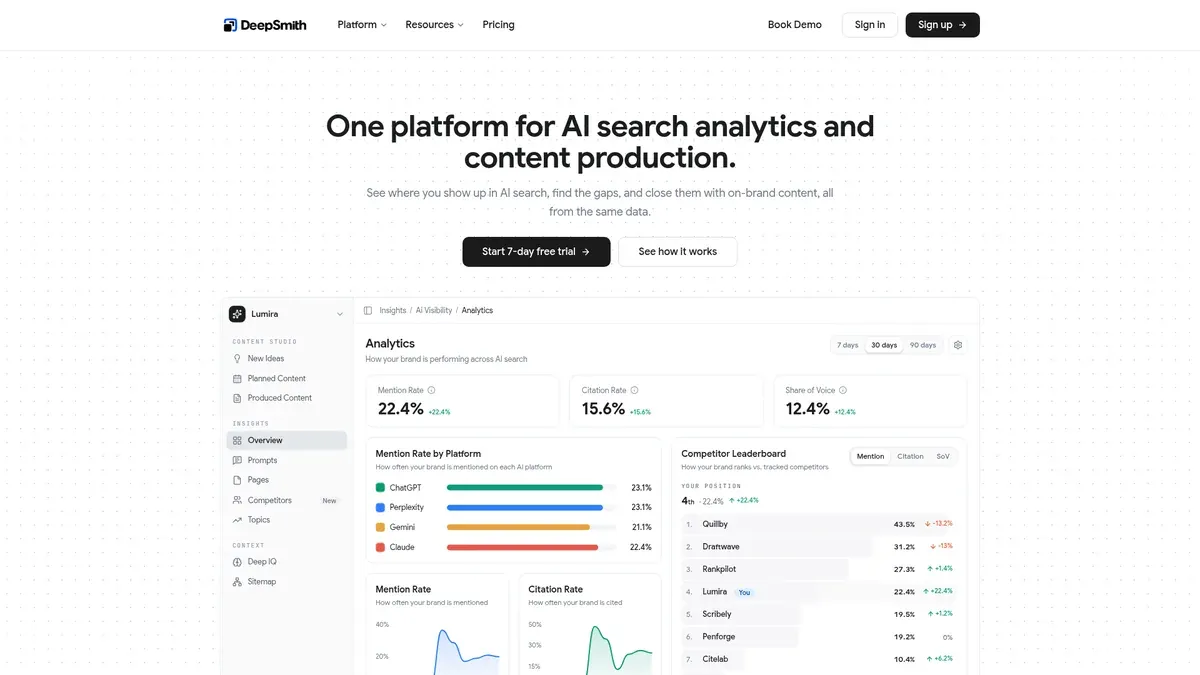
Best for: marketing and content leads answering two questions in one system. Where are we invisible in AI answers, and what do we publish next to fix it?
Most tools on this list stop at the dashboard. You learn a competitor won the citation, and then the real work starts somewhere else: a brief, a writer, an SEO pass, internal linking, a cover image, publishing, and a LinkedIn post that never gets written.
DeepSmith closes that loop inside one platform. AI Visibility reports Mention Rate, Citation Rate, Share of Voice, Sentiment, and Visibility Trend, with a per-platform breakdown, a competitor leaderboard, and the sources AI cites most. Prompts carry their own mention and citation rates with full answer history, and Discover Prompts builds a starter set from your product, persona, and buyer-stage context. Pages shows which of your own URLs AI actually cites and the prompts driving each one. Competitor citations name the rival, the exact page winning the citation, and how that rival performs by platform.

Content Map turns your site and your competitors' sites into one topic and funnel-stage taxonomy, so coverage becomes a measurement instead of a hunch. It surfaces coverage gaps, untapped topics, and per-topic funnel distribution. Sitemaps are re-checked every 24 hours, so new pages fold in without a re-import.
Opportunity Agents read that data and return ideas with the evidence attached. An agent can target a tracked prompt you never get cited for, convert mentions into citations, take a competitor's citations, correct how AI describes you, or close a funnel-stage gap against up to four competitors at once. Every idea travels with the data point that justifies it, which is what lets you defend a backlog instead of guessing at it.
Then production. Content Studio runs New Ideas to Planned Content to the Writer to Produced Content. The Writer returns a researched, brand-grounded article with internal and external links, a cover image, and publish-ready metadata. Autowrite writes a planned article on its scheduled date with nobody in the app. Deep IQ stores your company positioning, products, personas, brand voice, visual guidelines, and content types once, so output sounds like you every time. Publishing goes to WordPress, Webflow, Strapi, Sanity, Contentful, or your own webhooks, with Markdown and HTML export as a fallback. Repurpose and Apps Library turn the finished piece into LinkedIn, X, Medium, Substack, newsletter, Reddit, and more.

Key features: mention, citation, share of voice, sentiment and trend metrics, per-prompt answer history, page-level citation attribution, competitor citation tracking, Content Map coverage gaps, Opportunity Agents with evidence, Content Studio, Autowrite, Deep IQ brand context, five CMS integrations, and channel repurposing.
Pricing: Pro is $99/month, Grow is $199/month, Scale is $399/month, with annual-equivalent monthly rates of $80, $160, and $299. Pro includes 20 articles, 50 tracked prompts, and 5 seats. Grow gives 40 articles, 100 prompts, and 7 seats. Scale gives 90 articles, 200 prompts, and 10 seats. Enterprise is custom, with 1:1 onboarding and a dedicated account manager. There is a 7-day free trial, no long-term contracts, and no cancellation fees.
Honest limitation: engine coverage is tiered. Pro tracks ChatGPT, Grow adds Perplexity, and Scale adds Gemini. If your buyers live in Google AI Mode or Claude today, or you need all ten named engines, that is Enterprise or Custom. For most teams starting deliberately with ChatGPT and expanding, the lower tiers are the right entry point, and the ten engines are there when you need them.
2. AthenaHQ

Best for: enterprise AEO and GEO teams, agencies, and executives who need recommendations, governance, and board-ready reporting.
AthenaHQ tracks brand mentions across 11 or more LLMs and reports visibility, share of voice, sentiment, citation rate, recommendation coverage, traffic, conversions, and AI-influenced demos. It monitors competitor visibility in real time, spots content gaps, and analyzes citation sources. AthenaHQ Content maps recommendations to the passages and sources models actually pull from, and those recommendations can be on-page or off-page. Ask Athena is an account-specific copilot running on your own AEO data.
Essential covers ChatGPT, Perplexity, Google AI Overviews, Gemini, and Copilot. Paid plans add Google AI Mode, Claude, Grok, DeepSeek, and Meta AI, and the site says more models are available on request. Documented integrations include GA4, Google Search Console, Shopify, Webflow, Framer, Wix, WordPress, and Payload CMS, with Tableau, Power BI, and Looker at the Enterprise level.
Pricing: Essential is free with 300 credits and a $25 free credit. Starter is $295/month with 3,600 credits and visibility across 10 models. Enterprise is custom, where one credit equals one AI response, and adds SSO, audit logs, persona targeting, multi-region support, and the Citation and Recommendation Engines. Annual billing is marked 17% off.
Honest limitation: the paid entry point is high next to the low-cost trackers, and Starter is limited to one country and one language. API access and extra credits are add-ons on top of the subscription. If your requirement is a modest prompt set, this is not the economical first tracker.
3. Profound
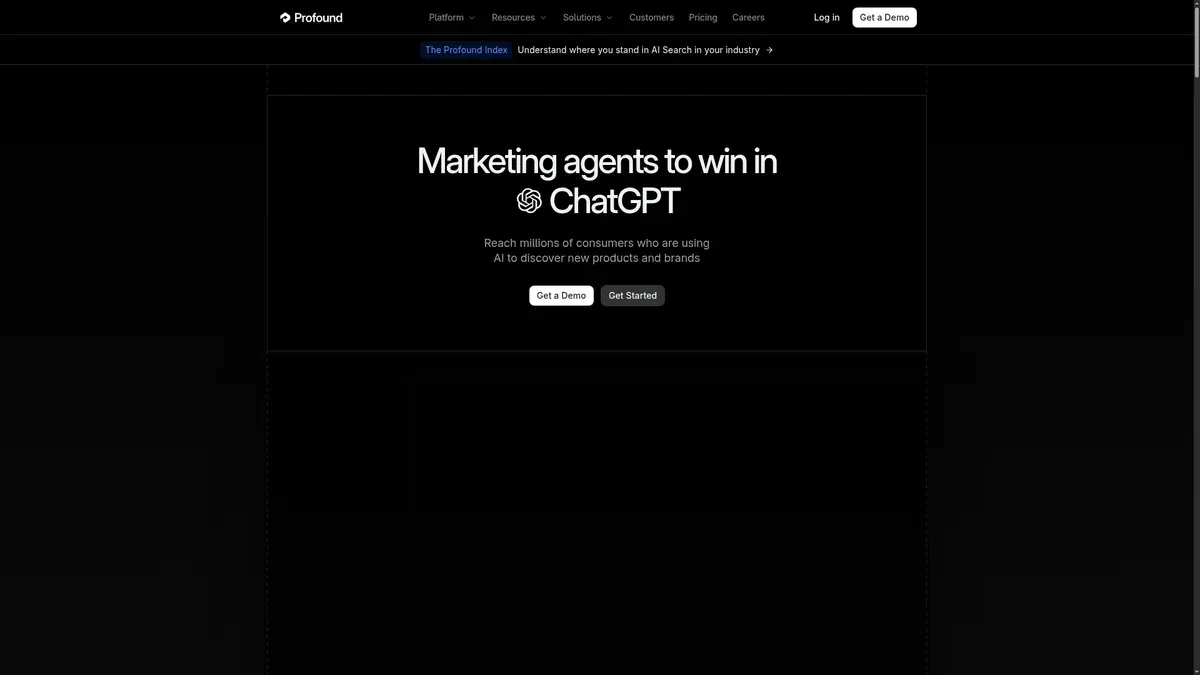
Best for: teams that want answer-engine demand research, source analysis, and agents doing marketing work.
Profound tracks how a site is interpreted and crawled across engines, and its homepage lists Perplexity, ChatGPT, Claude, Gemini, Grok, Microsoft Copilot, DeepSeek, Meta AI, and Google AI Overviews. Prompt Volumes is built around discovering what people actually ask AI, which is a genuinely different starting point from tracking prompts you wrote yourself. The AEO Report covers AI Visibility, Source Citations, Brand Sentiment, and Content AEO. Agents are presented as autonomous workers, with a demonstrated example generating AEO-optimized FAQs for landing pages, and templates help generate content aimed at AI search visibility.
Pricing: Starter is $99/month billed yearly with 50 prompts, 1,500 responses a month, ChatGPT only, 100 agent credits, one seat, one language, and one region. Growth is $399/month billed yearly with 100 prompts, 9,000 responses, three answer engines, 400 agent credits, Profound Sheets, unlimited domains, and CSV and JSON exports. Enterprise is custom, reaching up to nine answer engines with API access, SSO and SAML, SOC 2, and a 24-hour SLA.
Honest limitation: Starter is a narrow first step. One engine, one seat, one region, no API, no exports. Growth widens it to three engines but still has no API or SSO at $399/month on annual billing. Judge Profound on its Enterprise package if you need breadth, not on Starter against an all-engine tracker.
4. Rankscale
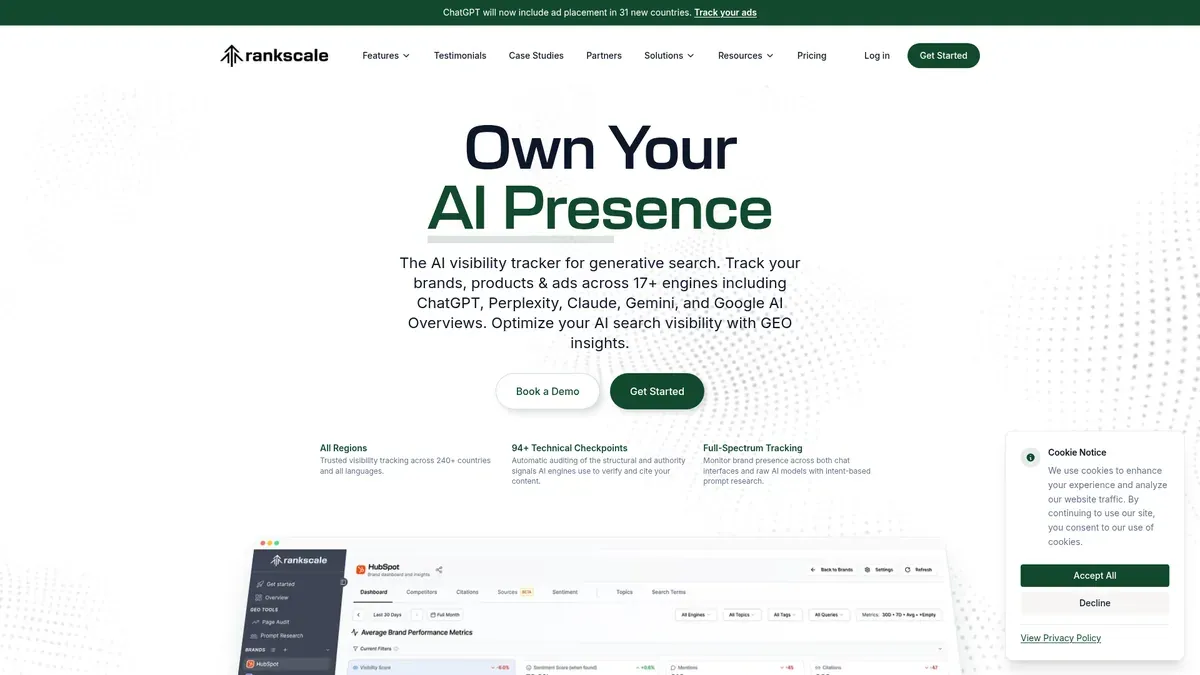
Best for: agencies and brands monitoring a lot of surfaces at once, including products and ads.
Rankscale tracks brands, products, and ads across 17 or more engines, with named examples including ChatGPT, Perplexity, Claude, Gemini, Google AI Overviews, Microsoft Copilot, DeepSeek, Grok, Mistral, and AI Mode. It reports an AI visibility score, rankings, sentiment, brand mentions, citations, and share of voice. It identifies competitors in AI results automatically, surfaces cited sources, and tracks sentiment by brand, topic, and model. Page Audits evaluate more than 200 factors including AI-bot crawlability and technical SEO signals, and prompt-volume estimation uses semantic reconstruction rather than traditional keyword volume alone. The platform states coverage of more than 240 countries and all languages.
Pricing: Essentials starts at $20/month. Pro is $99/month with 1,200 credits, up to 4,800 tracked answers, 10 dashboards, and 50 audits. Growth is $385/month with 5,500 credits and up to 22,000 answers. Enterprise is $780/month with 12,000 credits and up to 48,000 answers. Annual billing saves 15%, credits renew each cycle, and unused credits roll over up to two times on Pro and three times on Growth and Enterprise. A Looker Studio connector is listed for Pro and above, and REST API access is listed for Growth and Enterprise.
Honest limitation: the credit model makes capacity hard to compare at a glance, and the public Essentials table does not show included answers, dashboards, audits, or credits. Model your real engine, prompt, and refresh needs before you treat the $20 starting price as your operating cost.
5. LLMrefs
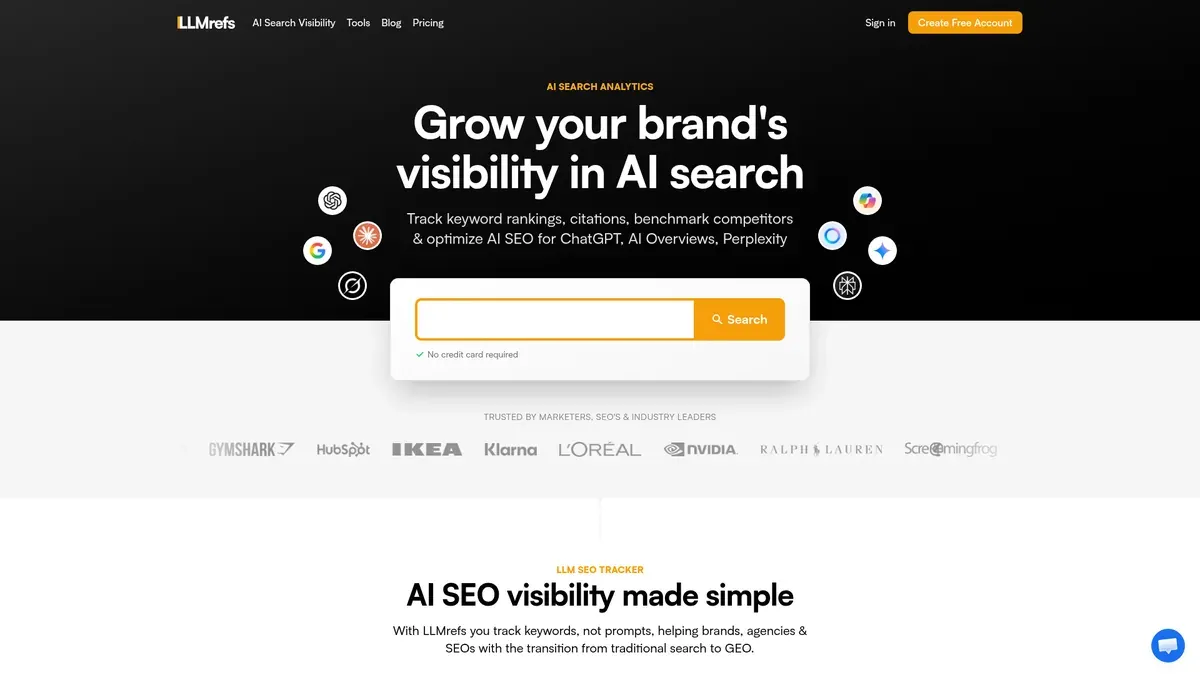
Best for: an SEO or marketing team that wants a transparent, inexpensive analytics layer.
LLMrefs organizes around keywords rather than hand-written prompts, then generates fan-out prompts from real conversations people have with AI chatbots. That is a meaningful difference if your team already thinks in keywords. It ranks brands against each other on Share of Voice and Position, aggregated and weighted across prompts for each keyword, and it shows and filters the source URLs generative engines cite. You also get citations, competitor visibility, weekly reports, monthly prompt-volume estimates, content gaps, and outreach opportunities, filterable by engine and country. Listed engines include ChatGPT, Google AI Overviews, Google AI Mode, Gemini, Perplexity, Claude, Grok, Copilot, Meta AI, and DeepSeek.
Pricing: one All in One plan at $79/month, marked limited-time. It includes 500 prompts, unlimited projects, unlimited team members, all listed engines with no extra engine fee, geo-targeting across 50-plus countries and 20-plus languages, weekly visibility reports, citation tracking, competitor benchmarking, keyword rankings, CSV export, and API access. There is a seven-day free trial with no credit card required.
Honest limitation: it is a tracker first. Each keyword updates at least once a week, which is fine for trends and poor for diagnosing a campaign this afternoon. The plan allows 500 prompts and the page does not publish the price of expanding. If you need a content calendar or publish-ready articles, that lives in another tool.
6. OtterlyAI

Best for: solo marketers and small teams who want a low entry price plus a real audit layer.
AI Prompt Research uncovers the prompts, topics, and intent patterns in your category. The Brand Visibility Index measures appearances, mentions, coverage rate, share of voice, platform visibility, sentiment, and change over time. Link Citations Analysis shows the sources AI platforms use, and Domain Ranking compares you with competitors and finds pages where a rival is cited instead of you. The Generative Engine Optimization Audit scores crawlability, AI readiness, citation potential, and content performance, then Recommendations tell you which pages to optimize and which third-party sites to pursue.
Pricing: Lite is $29/month, or $25/month on the annual-equivalent rate, with 15 search prompts, 1,000 GEO audits a month, one workspace, and three recommendations a week. Standard is $189/month, or $160/month annually, with 100 prompts, 5,000 URL audits, a Looker Studio connector, and 2,000 API and 2,000 MCP requests a month. Premium is $489/month, or $422/month annually, with 400 prompts and 10,000 audits. Enterprise is custom, starting from $1,000/month, and adds SSO and a quarterly GEO Health Check.
Honest limitation: two things to check before you buy. Lite is genuinely small at 15 search prompts. And the homepage names seven platforms while the pricing table lists four, ChatGPT, Google AI Overviews, Perplexity, and Microsoft Copilot, so confirm engine availability for the tier you pick. The homepage also shows both a seven-day and a 14-day trial in different places.
7. Peec AI

Best for: marketing teams and agencies that want daily multi-model measurement feeding a BI stack.
Peec tracks visibility, position, and sentiment, including brand mentions, impressions, and sentiment scoring. You can set up, uncover, organize, and add prompts, with AI-suggested prompts and search volume pointing at opportunities. Default brand coverage includes ChatGPT, Google AI Overviews, Google AI Mode, Microsoft Copilot, Perplexity, and Gemini. Brand plans track daily, which is a real advantage over weekly refreshes when you are watching a launch. Data leaves through CSV, Looker Studio, the Peec REST API, or conversational querying.
Pricing: brand plans are $95/month Starter with 50 prompts, $245/month Pro with 150 prompts, and $495/month Advanced with 350 prompts, each choosing three models, with the Additional Models add-on at $35, $85, and $165/month respectively. Agency plans are $245/month Essential with 10,000 credits, $495/month Growth with 25,000, $795/month Scale with 65,000, and a custom Comprehensive tier. One agency credit is one prompt multiplied by one model multiplied by one day. Looker Studio arrives at agency Growth, while API, MCP, and SSO are Comprehensive only.
Honest limitation: exact annual prices are not published, and brand plans cap models, projects, and countries. Needing more than three models, many client workspaces, or broad API access pushes you to Enterprise or agency Comprehensive. The reviewed materials describe analytics and data connections, not an article-production workflow.
8. Scrunch

Best for: enterprise and agency teams who treat AI visibility as part of a wider AI customer experience.
Scrunch describes an Agent Experience Platform with four relevant areas: visibility monitoring, website auditing, content optimization, and content delivery. You add buyer questions as prompts and track brand presence, competitor presence, position, sentiment, citations, shopping responses, AI search volume, AI bot traffic, and AI referral traffic. Alerts explain what changed, why it matters, and what to do. Website analysis gives domain-level and page-level recommendations for citeability and retrievability, and the sitemap view exposes URL-level performance for agent traffic and referrals. Scrunch can also detect agent traffic and serve optimized content to AI agents at the edge while the human-facing site stays as it is. Three APIs are documented: Query for aggregate metrics, Responses for full AI answers with citations and metadata, and an Agent traffic API for bot logs.
Pricing: Core is $250/month billed monthly, with 125 unique prompts, 5 site audits a month, 1 brand workspace, 5 user licenses, 4 LLMs, 1 country, 3 personas, 2 languages, 5 competitors, 25 sitemap pages, and 1 page optimization a month. Enterprise is custom and reaches 9 LLMs, unlimited countries, multi-brand configuration, API access, and full site audits.
Honest limitation: only Core's price is public, and Core is tightly bounded. One country, two languages, five competitors, and one page optimization a month is an evaluation plan, not an operating plan for most teams. Scrunch earns its price when you need the site diagnostics, agent-traffic data, or raw-response API, not when you want the cheapest prompt tracker.
How to choose between these xFunnel AI competitors
Not sure where to start? Match your situation to one line below.
You need measurement and more published content. Choose DeepSmith. The gap you find becomes an evidence-backed idea, then a finished article, then a LinkedIn post, without leaving the platform.
Enterprise governance and executive reporting come first. Choose AthenaHQ, for the SSO, audit logs, persona targeting, multi-region tracking, and BI connections.
You want to know what people ask AI, not just how you rank. Choose Profound, for Prompt Volumes, source citations, and agents.
You monitor many brands, products, ads, and engines. Choose Rankscale, and model your credits first.
You want a lean analytics layer at a published price. Choose LLMrefs at $79/month, as long as weekly keyword refreshes fit how you work.
You are starting small and want an audit layer. Choose OtterlyAI Lite at $29/month, and confirm the engine list for your tier.
You need daily data flowing into Looker Studio. Choose Peec AI.
Your problem includes AI bots on your own site. Choose Scrunch.
Here is the good news. You do not have to get this perfect. Pick the one that matches your actual bottleneck this quarter, track a small prompt set well, and expand from there. Most teams learn more in the first two weeks of real data than in a month of comparing feature tables.
If your bottleneck is that you can see the gaps and cannot publish fast enough to close them, DeepSmith gives you both halves in one place. Start a 7-day free trial and bring one real prompt set with you.