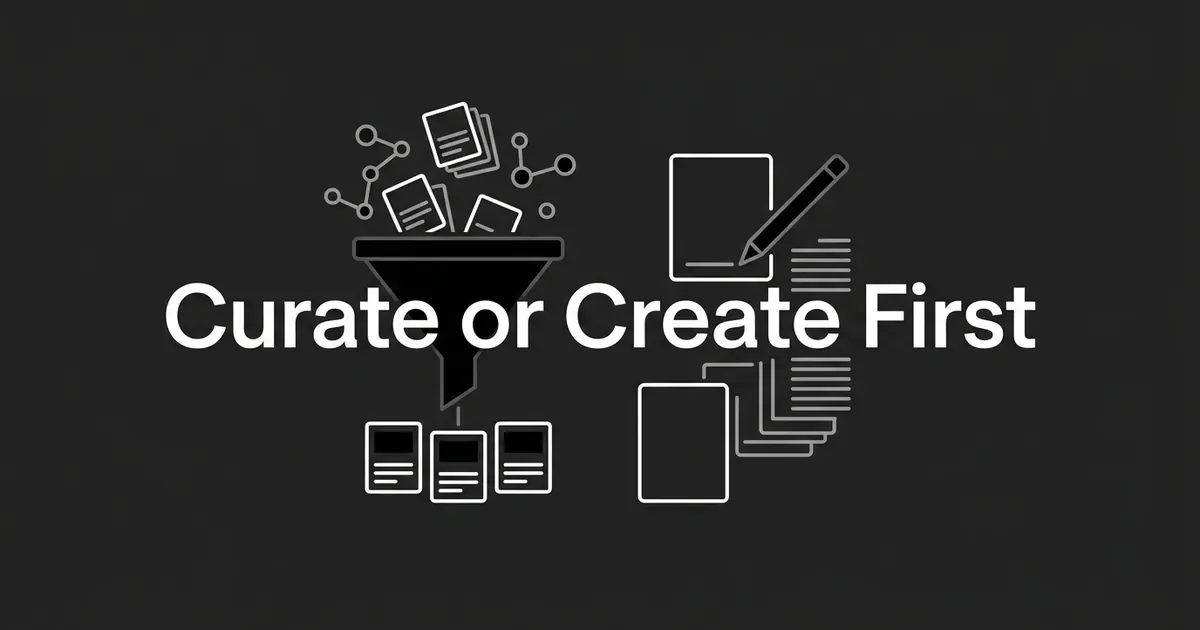
If you are staring at a content calendar that has more slots than your team has hours, you have probably asked yourself whether every one of those slots needs a brand new article. It doesn't. Content curation vs creation is really a question about where your best hours should go, not a contest between a cheap option and a serious one. Curation means finding, selecting, organizing, and explaining useful material that already exists somewhere else. Creation means producing something original from your own team, your own data, or your own point of view. The short version: curate when the reader mainly needs help finding and understanding what already exists, and create when the reader needs something only you can give them.
Here is a quick look at how the two actually differ before we get into the detail.
| What you're weighing | Curation | Creation |
|---|---|---|
| Where the material comes from | Existing work from outside sources | Original work from your team |
| What you're really offering | Selection, context, and interpretation | First-party knowledge and evidence |
| Typical speed | Faster once a good source exists | Slower, because it needs research and drafting |
| Who controls the message | Limited, the source sets the facts | You control the framing and the claims |
| Biggest risk | Turning into a reposting channel | Repeating advice everyone already has |
That table is a starting point for the conversation, not a scoreboard. The right mix depends on your audience, your channel, and what you actually know that other people don't, and it's a call worth making deliberately instead of by whichever slot is open on the calendar.
What content curation actually means
Curation is a deliberate editorial job, not a stream of links you pushed out because the calendar needed something. When you curate, you're making a series of small judgment calls: which sources are actually credible, which specific pieces are worth someone's attention, how to group them so they make sense together, and what you personally agree with, question, or want to add. A curated piece might be an annotated list of recent research reports, a newsletter digest that explains why each item matters this week, or a roundup of expert opinions on something your audience is arguing about.
It helps to know what curation is not, because a lot of what gets called curation is actually something weaker. Aggregation is collecting or republishing material with little or no human judgment applied, which might be useful as a private research feed but isn't a finished piece of content on its own. A bare share or a copied headline distributes someone else's work without giving your reader a real reason to care. And content farming, producing or lightly rewriting large volumes of someone else's material, is the opposite of careful curation: it's volume without judgment.
One more boundary worth naming: curation is not a permanent substitute for having your own things to say. A brand that only ever points at other people's work becomes a useful filter, but it never gets to show what it actually knows, sells, or believes. Curation should support your original content, not replace the need for it.
What content creation actually means
Creation is the production of original material by you, your team, or someone you've brought in specifically for their expertise. You own the message, the format, the point of view, and when it goes out. That covers a how-to built on what your team has actually learned, a product explanation, a proprietary research report, a case study built on your own customer data, or an original framework you've tested and can defend.
Creation is the better fit whenever the value of the piece is information you uniquely hold or can interpret better than anyone quoting from the outside. Nobody else can write your product explanation for you, because nobody else knows your product's real limits and real strengths the way you do. Nobody else can hand your reader a case study from your own customers. That's the whole reason to create instead of curate: the content only works if it comes from you.
Speed and production capacity
Curated content can usually get out the door faster than an original piece, because the raw material already exists. That makes it genuinely useful for filling a temporary gap while a bigger original piece is still being researched, or for keeping a newsletter or social channel active between full articles. But "faster" doesn't mean "no work." You still have to read the source closely, check that it's actually credible, write the framing, and get the attribution right. A curated item thrown together in ten minutes usually reads like it, and a reader can tell the difference between a share and an explanation.
Creation takes longer almost every time, because research, drafting, review, and approval all have to happen before anything goes live. That's the tradeoff: curation buys you speed and coverage, creation buys you a piece that's entirely yours, at the cost of time.
Expertise and evidence
This is usually the axis that decides content curation vs creation in practice, more than any calendar deadline does. It's where a lot of teams get honest with themselves. Curate when your internal expertise on a topic isn't deep enough yet to defend an original claim, but your audience still needs something useful today. Outside sources can bring in specialist perspectives, research from recognized institutions, or a look at both sides of a live debate that your team can select, explain, and put in context. Curation lets you show that you understand a field and know where the reliable information lives, which is a real form of credibility even without an original opinion attached.
What it doesn't let you do is borrow someone else's expertise and wear it as your own. If a claim belongs to an outside source, the article needs to say so plainly. And if the topic touches a product claim, a regulated area, or a promise to customers, thin internal expertise is a sign to get qualified review or build the knowledge first, not a green light to publish either a curated piece or an original one without that check. Create, on the other hand, when the value is exactly the thing curation can't fake: your own tested method, your own dataset, your own six months of campaign results. That's information nobody else can hand your reader, no matter how well you curate.
Differentiation on saturated topics
A saturated topic is one where a dozen publishers have already written the same basic advice, the same definitions, and the same listicle. It's tempting to think the answer here is automatic: everyone's covered it, so curate instead of adding one more generic article. That's too simple a rule, and it's worth resisting. A topic being saturated doesn't mean you have nothing to add. It means you need to check honestly whether you have something to add.
If your planned original article would just repeat common advice with no first-party evidence and no real angle, curation is probably the better call: filter the best existing material, show where experts disagree, and explain what's actually worth reading. But if you have a unique dataset, a tested approach, or a genuinely different point of view, saturation is not a reason to back off from creating. The real question on a crowded topic is never "has this been written about." Almost everything has. The question is what you can add that the existing material doesn't already say.
Search and AI-search risk
It's worth being straight about this instead of hand-waving it: curated content is not automatically safer for search than original content, and creation is not automatically safer either. Search engines care about whether a page gives readers something they didn't already have, not about where the raw material came from. What gets pages penalized is republishing content without adding anything, copying and lightly rewording it, or stitching material from several other pages together with no real value added. Those are curation failures, not curation itself.
The same logic holds for AI-written content. Generating a lot of pages fast doesn't create risk by itself, but generating a lot of pages that don't add value to the reader does, whether a human or a model wrote them. And curation earning search or AI-search visibility isn't guaranteed either, no matter how many authoritative sources it links out to. What actually helps in both cases is the same list: a clear answer near the top, real organization, honest attribution, and a page that has an actual reason to exist for the person reading it.
When to curate instead of write
Knowing when to curate content instead of writing something new comes down to a short checklist. Curation earns its place when most of the following are true for the piece you're considering:
- The topic is timely or moving faster than a full original article can keep up with.
- Your audience mainly needs help finding and understanding the best existing material, not an original take.
- Strong material already exists outside your organization, and you can explain it better than the average reader could on their own.
- Your internal expertise on the topic isn't deep enough yet for a defensible original claim.
- You have a real publishing gap to fill, not just an empty calendar slot.
- You can add a genuine editorial lens: a structure, a comparison, an interpretation, something beyond a list of links.
- You can attribute the sources properly and check that you're not overstepping any permission or copyright line.
When you do curate, the framing is the actual work. Every item should answer, at least briefly, why you picked it, what it adds, and who it's useful for. "Interesting article" is not framing. Group items by the reader's actual question rather than by which source they came from, and keep the collection tight: a short, well-chosen set beats a long dump every time, because the benefit to the reader is less searching and evaluating, not more links to scroll past. Quote only what you need to make your point, then send the reader to the original, since publishing someone else's full piece defeats the purpose and can create real permission problems. Some published guidance suggests marketers split their output somewhere around two-thirds original and one-quarter curated, with a smaller slice syndicated, while other sources land closer to an even split or slightly more curated than created. Treat any number like that as a snapshot of one study's audience, not a target for yours. Your mix should follow what your audience actually needs, not a ratio you read somewhere.
When original creation is the better call
Creation wins when most of the following are true instead:
- The information is proprietary: your data, your customers, your experiment, your framework.
- The page has to explain your own product, service, or promise, where ownership and accuracy matter and outside sources can't stand in for you.
- Your reader needs a definitive answer they can rely on, not a reading list to work through themselves.
- You have a genuinely distinctive point of view, a dataset, or a tested approach that existing material doesn't cover.
- The topic is commercially important enough that you need full control over what's actually being claimed.
- The piece needs to hold up as a durable reference or a resource your own team keeps sending people back to.
A lot of the strongest pieces end up being a hybrid rather than a pure pick. You can curate a handful of outside perspectives and then state your own conclusion on top of them, or publish an original framework with a short, clearly attributed list of further reading at the end. The rule that keeps a hybrid honest is simple: keep the boundary visible. A reader should always be able to tell which sentence is an outside claim you're reporting and which one is your own reasoning, because blurring that line is where curation quietly turns into something closer to plagiarism, even by accident.
The decision that actually matters
None of this is about deciding curation is the cheap option and creation is the serious one. They solve two different problems for your reader. Creation is right when your own knowledge is the actual product on the page. Curation is right when your judgment, your filtering, and your framing are the product, and the underlying facts can come from anywhere credible. The mistake worth watching for isn't picking the wrong one of the two. It's publishing either one without giving the reader a clear reason it exists.
If you're building out a content calendar and this decision keeps coming up piece by piece, it's worth deciding your content curation strategy in advance rather than relitigating it every week: which recurring slots are genuinely curation jobs (industry roundups, weekly digests, filling a gap while a bigger piece gets researched) and which ones need to be original because the topic is core to what you sell or believe. Once you've made that call by slot type, deciding when to curate content stops being a weekly argument and becomes a rule you can actually follow.