You typed your best question into ChatGPT, and a competitor came back as the source. Not you. That stings, and it also confuses, because your page is genuinely good.
Here's the good news: the gap is rarely quality. It's usually trust signals you never knew you were supposed to build.
This guide maps the whole picture of E-E-A-T for AI search: what the framework really is, how AI engines judge trust when they pick sources, the five signals that decide who gets cited, where the engines disagree, and what to fix first. It's the hub. Each signal has its own deep dive, and I'll point you at them as we go.
Let's start with the thing most articles get wrong.
What E-E-A-T actually is, and what changed when AI started answering
E-E-A-T is not a score. It's a lens.
Experience, Expertise, Authoritativeness, and Trustworthiness came out of Google's Search Quality Rater Guidelines, the handbook human raters use to evaluate pages. Google has said, repeatedly, that it is not a single ranking factor. Nobody at Google computes your E-E-A-T number. No answer engine does either.
The four letters are worth separating, because they fail in different ways and most teams are only strong at one:
- Experience is whether you've actually done the thing. Used the product, run the process, made the mistake. It's the newest letter and the hardest to fake.
- Expertise is whether you know the subject formally. Credentials, training, a track record of being right in public.
- Authoritativeness is whether other people treat you as a reference. You don't award yourself this one.
- Trustworthiness is whether you can be relied on: accurate, transparent, honest about limits, easy to verify.
Notice that two of those live entirely outside your website. You can write a perfect page and still be missing half the framework.
So why does it matter more now than it did five years ago?
Because of where the lens got pointed. When search meant ten blue links, E-E-A-T described page quality. Now that generative engines answer the question directly, they have to choose a handful of sources to build that answer from. The qualities E-E-A-T names, real experience with the topic, credentials and track record, third-party validation, and factual reliability, turned out to be exactly the qualities that make a source safe to quote.
The lens moved from page quality to source selection. That's the whole shift.
This matters for how you read every claim in this space. The EEAT answer engines lean on is not the rater framework running inside a model. It's a set of underlying signals that engines weigh in their own way, with their own weights, and those weights change. When someone tells you "optimize for E-E-A-T and the AI will cite you," they're describing a correlation as if it were a control panel.
I want to be precise here, because the sloppy version of this claim is everywhere. Answer engines did not adopt E-E-A-T. There is no module inside ChatGPT scoring your Authoritativeness. What happened is convergence: Google's raters were asked to look for the things that make a source credible, and engines building answers independently needed the same things for a different reason. Two systems arrived at similar criteria because the underlying problem is similar. E-E-A-T is useful to you as vocabulary and as a map, not as a mechanism.
That distinction saves you money. It's why "we added an E-E-A-T section to our pages" does nothing, while "we put a credentialed human on the byline and got covered by the trade press" does something.
Your action for this section: stop hunting for an E-E-A-T score to raise. Start treating E-E-A-T as a checklist of evidence you can show an engine that has to decide whether quoting you is risky.
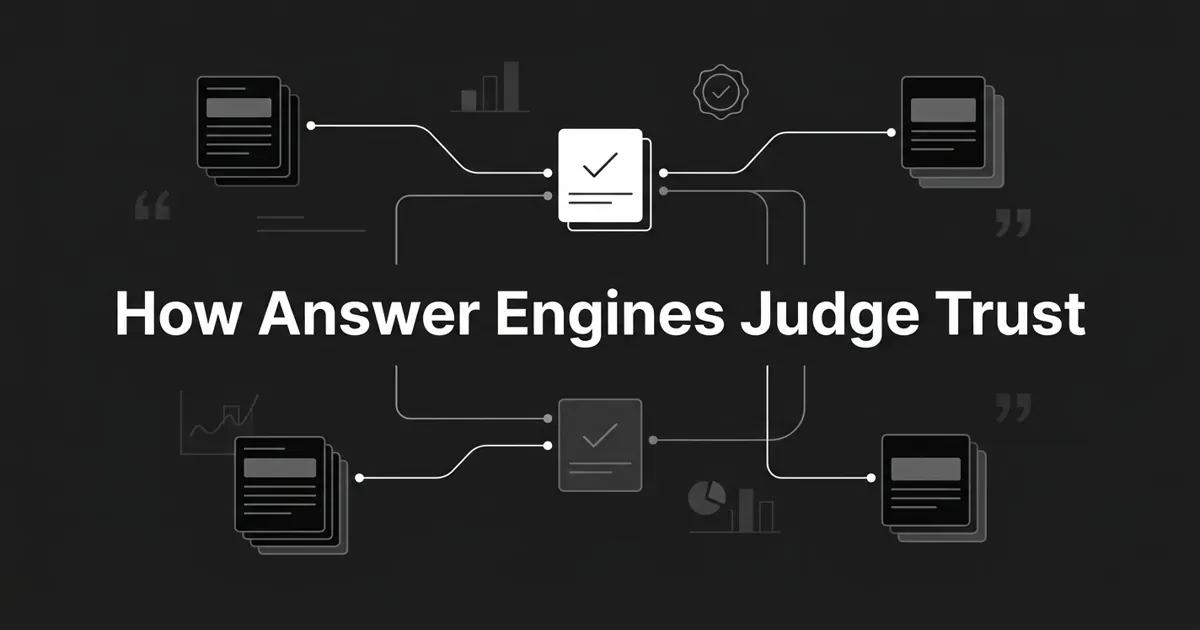
How AI engines judge trust when they pick a source
Short answer: they don't grade you, they hedge against being wrong.
An answer engine is doing retrieval and then grounding. It pulls candidate passages, then builds a response it has to stand behind. Every source it quotes is a small bet. This is how AI engines judge trust in practice: not by admiring your writing, but by asking whether citing you is likely to make the answer wrong.
That reframe changes what you build. Ask yourself what makes a source a low-risk bet:
- A real person with credentials stands behind it.
- The brand resolves cleanly to a known entity, so the engine isn't guessing who you are.
- The site covers this topic repeatedly, not once.
- The claim traces back to data the engine can attribute.
- The rest of the internet broadly agrees you're legitimate.
Read that list again. It's E-E-A-T, described from the engine's side of the table.
This also explains a pattern that frustrates good writers. Craft is not a trust signal. An engine cannot tell that your prose is better than the competitor's, and it isn't trying to. It's looking for evidence that survives being repeated to a stranger. A mediocre paragraph attached to a credentialed author, a recognizable entity, and a number you generated yourself will beat a beautiful paragraph attached to nobody.
That's not a reason to write worse. It's a reason to stop assuming quality alone will get you picked up.
There's a humbling corollary here. Even a well-built page can be absent from an answer simply because retrieval never surfaced it, and generative engines can get sources wrong on their own. You are influencing a probability, not flipping a switch. Anyone promising guaranteed citations is selling something.
If that feels discouraging, take a breath. Probabilities respond to evidence, and evidence is buildable. That's the rest of this guide.
The five trust signals answer engines actually weigh
If you only remember one section, make it this one. These are the authority signals for AI citations that show up again and again across engines and studies.
1. Author identity
Put a real, named human on every article, with a bio that proves they know the thing.
Attributable expertise is the cheapest lift available to most brands. Industry analysis has found that content carrying a named author byline earns meaningfully more citations from ChatGPT, Perplexity, and Google AI Overviews than the same content published anonymously, roughly double in one study, with a further lift reported when those author credentials are built out properly.
What "built out properly" means: a byline that links to a real bio page listing role, employer, areas of expertise, and notable work, with links out to the places that verify the person exists professionally. Marked up so machines can read it, not just humans.
What it isn't: a stock headshot and the words "Content Team."
Why does a byline move anything? Because it converts an anonymous claim into an attributable one. An engine quoting "according to a blog post" is exposed. An engine quoting a named practitioner with a verifiable history is not. Author markup also helps engines disambiguate expertise at the entity level, connecting the person to the topic and the organization rather than leaving three people with the same name in a pile.
The deeper mechanics of reviewer credentials, bio construction, and proving firsthand experience each get their own treatment. For now, the action is small: pick your five best-performing pages and give them a real byline this week.
2. Entity recognition
Make sure engines know who you are before you ask them to trust you.
An engine can't weigh your authority if it can't resolve your brand to a distinct thing. That's entity recognition: your company, your products, and your key people existing as disambiguated entities in the knowledge bases models are trained on and grounded against.
The evidence here is blunt. Wikipedia is the most-cited source in AI answers by a distance, appearing in roughly four in ten Google AI Overviews and in the large majority of ChatGPT and Perplexity answers. That's not an invitation to spam Wikipedia. The bar there is notability, earned through independent coverage, and you cannot buy your way in.
The practical move for most brands is one rung down: a claimed structured entry in the open knowledge base that feeds those graphs, consistent naming and details everywhere you're listed, and schema that points at the same identity from every direction. Boring, and it moves the needle more than another blog post.
Here's the failure mode to watch for. If your brand name collides with a common word, another company, or an older product, engines hedge. Ambiguity is risk, and risk means they reach for a source they can resolve instead. Plenty of brands read this as "the AI doesn't like us" when the truth is "the AI isn't sure we're a single thing."
Entity setup is its own project, and a dull one. It's also the cheapest way to stop being invisible for reasons that have nothing to do with your content.
3. Topical depth
Engines cite the site that clearly owns a subject, not the site that mentions it.
A site with thirty tightly interlinked articles on one topic outperforms a site with three hundred scattered posts. Depth signals completeness: if you've covered the pillar, the edge cases, and the long-tail questions, you're the safer source for any of them.
This is why topic clusters keep coming up in AEO advice, and why this article is a pillar with spokes rather than a lone 4,000-word monolith. The pattern that works: one pillar page per core topic, supported by eight to thirty cluster pages, all linking back and sideways, updated together so freshness stays coherent.
The proxies engines lean on here are things like how densely your pages link to each other, how completely you cover the question space, and whether the cluster stays current. None of that works if the pages are thin. Thirty interlinked stubs is a content farm with extra steps, and it reads that way to an engine too.
Depth is also the one signal that a small team can genuinely win. You will not out-publish an enterprise blog. You can absolutely out-cover them on the narrow subject you actually know.
Your action: name the one subject you intend to own. Not five. One.
4. Original data
Publish something nobody else can copy.
First-party data, surveys, benchmarks, and proprietary analysis earn citations at a higher rate than derivative content, and the reason is mechanical. A primary source is hard to confabulate. If an engine wants to state a number, quoting the organization that produced the number is the lowest-risk way to do it.
Original data also compounds. It attracts third-party coverage, and that coverage feeds signal five.
One data asset a quarter, with the methodology written down and the numbers in a clean table on a stable URL, beats a monthly opinion post. If your team is small, start with what you already have: you're sitting on usage patterns, benchmarks, and aggregate numbers nobody else can see.
5. Reputation and third-party consensus
What everyone else says about you is a signal you don't control, and it counts.
Engines treat outside consensus as the closest available thing to a reputation score. Reviews, trade press, podcasts, forums, and roundups all feed it. Brand mentions work here even when nobody links to you, which is the part that surprises people: the hyperlink is not the currency, the mention is. Persistent negative sentiment cuts the other way and suppresses citation probability.
This is the signal that punishes shortcuts hardest. Review gating, paid links from irrelevant sites, and placements in outlets nobody reads don't build consensus, they build noise. What builds it is unglamorous: named experts saying useful things in public, on podcasts, at conferences, in trade press, over and over, until the pattern is undeniable.
Reputation is also the one place where your product has to cooperate. No amount of content strategy fixes a chorus of unhappy customers, and it shouldn't.
The action: know what's being said before you try to change it. Reputation correction is its own discipline, and it starts with measurement.
Those five are the authority signals for AI citations worth building. Everything else in this space is a tactic hanging off one of them.
Where the engines actually disagree
They agree on the core and diverge on the long tail. That's the summary.
Citation overlap between the major engines is tiny across the full web but very high when you look only at the top-cited domains. Everyone trusts the same small trusted core. The differences show up underneath it:
- ChatGPT leans hard on well-known publishers and reference sites, and treats domain-level authority as a filter before it worries about topical fit. Wikipedia dominates its source mix.
- Perplexity cites more sources per answer than anyone else and mixes them widely, pulling in niche expert blogs, academic work, forums, and video. It has a strong recency bias.
- Google AI Overviews and AI Mode overlap most with the classic organic results, and lean on Wikipedia for definitions and video for how-to. They're the strictest about rater-style quality signals.
- Gemini behaves much like AI Overviews, sharing infrastructure, with heavier use of Google's own surfaces.
- Claude has less public citation data, though grounded products follow similar source-mix patterns with real weight on reputational signals.
Query type shifts the mix as much as the engine does. Definitional questions pull toward reference sites. How-to questions pull toward video. Opinion and experience questions pull toward forums and communities, which is why your competitor keeps getting cited from a thread they didn't write. Product and comparison questions pull toward review platforms and marketplaces. The same engine behaves differently depending on what's being asked, so "how do we show up in Perplexity" is the wrong size of question. "How do we show up for this question in Perplexity" is answerable.
Don't over-engineer for one engine. The trust signals generative search rewards are mostly shared, and single-engine tactics have a short shelf life. Engine behavior shifts often enough that any one vendor study ages fast: the citation patterns people documented in 2024 changed materially as backends and products shifted underneath them. Build for the shared core, and treat per-engine quirks as tuning.
Your action: pick the one or two engines your buyers actually use, and check what they say about you today. Not what you hope they say.
Who actually gets cited, and the myth worth killing
Citations concentrate. The top ten domains account for something like a third to two-fifths of all AI citations, and Wikipedia, forums, video, and major publishers sit at the top of nearly every list. Generative engines cite far fewer unique domains than a classic results page shows you.
Read that as encouragement, oddly. The long tail is long, and niche sites that cover one topic deeply get pulled in constantly. You are not competing with Wikipedia for the definitional query. You're competing for the specific question your buyer asks at 11pm.
Two data points worth internalizing:
Citations are not rankings. Only a small fraction of AI Overview citations come from the number one organic result, and only about a third from the top ten. The majority come from outside the traditional top ten entirely. Ranking first does not buy you the citation.
Citations are not traffic. When an AI summary appears, clicks drop sharply. Optimizing for citations and optimizing for sessions are different jobs with different scoreboards.
Two more myths deserve a quick burial while we're here. "Wikipedia citations mean authority" gets the causation backwards: Wikipedia reflects notability you earned elsewhere, it doesn't confer it. And "volume beats depth" is the expensive one, because it's the belief that turns a content team into a treadmill. Engines reward depth and originality. Post count is not a trust signal, and never was.
Now the big myth. Schema markup does not get you cited. A study tracking nearly two thousand pages that added structured data found no meaningful lift in AI citation rate, and schema shows up slightly less often on cited pages than on top-ranking ones. A minority of studies find small effects, so treat it as contested rather than settled. The honest read: schema is hygiene. It helps engines disambiguate you, which supports entity recognition, and that's a real but indirect job. It is not a citation lever, and if someone sold you schema as an AEO strategy, that's where your lift went missing.
What to fix first
Sequence beats effort. The pattern is identity, then entity, then data, then mentions, then freshness.
Here's the order for a brand starting from a low baseline:
- Author identity on every article. Highest single-page lift, lowest cost.
- A structured entity record and consistent brand details everywhere. This is what lets every engine know who you are.
- An original data program. One asset per quarter. The single most cite-worthy thing you can make.
- One topical cluster you can out-author anyone on. Pillar plus supporting pages.
- Mentions in places that matter. Trade press, podcasts, recognized reviews, linked or not.
- Schema that ties author, publisher, and organization together. Hygiene, not magic.
- Reviews on the platforms your buyers actually read.
- A freshness cadence. Roughly half of cited content is under three months old, so quarterly refreshes of your cluster are not vanity.
Already strong on authorship and entity? Your next dollar goes to original data. Already have the data? Spend on mentions.
One caveat that changes the math: if you touch health, money, law, or safety, the bar goes up. Engines apply stricter scrutiny to YMYL topics, leaning harder on credentialed authors, primary sources, and institutional domains, and pulling in fewer niche blogs. They also weight consensus and recency more heavily, especially in medicine. Real credentials on the byline stop being nice-to-have, and a visible editorial policy stops being decoration. That standard isn't applied evenly across engines, and it's a deeper topic than this hub can carry, so it deserves its own read.
Notice what's not on this list: publishing more. Volume is not a trust signal, and a faster treadmill is still a treadmill.
Notice something else. Items one, two, five, and seven are not writing tasks. If your AEO plan is entirely a content calendar, you're working on a quarter of the problem.
Start where the evidence is
If this feels like a lot, that's normal. Nobody builds all five signals this quarter, and you don't need to.
You need to know which one is costing you right now. The trust signals generative search weighs are not equally broken at every company. A brand that's invisible because engines can't resolve its identity needs a different fix than a brand that's visible but described wrong, and both look like "we're not getting cited" from the outside.
That's the gap worth closing first, and it's a measurement problem before it's a content problem. Tracking how ChatGPT, Perplexity, Gemini, Claude, and Google AI Mode already answer the questions your buyers ask tells you which signal is broken. DeepSmith exists for exactly that: see where you show up, see who's cited instead, then produce the content that closes the gap. You can start a free trial and look at real data on your own brand before you commit to a plan.
Pick one signal. Fix it this month. Momentum matters more than completeness here.