You can get a draft out of an AI tool in ten minutes. So why does your blog still feel stuck?
Because writing was never the bottleneck. The bottleneck is everything around the writing. Deciding what to publish. Checking the claims. Adding the links. Pushing it live. Telling anyone it exists. Then finding out whether it did anything at all.
That gap is what content operations for lean teams actually means, and it is the part nobody hands you a template for.
Here's the good news. You do not need a department. You need a small system you can repeat.
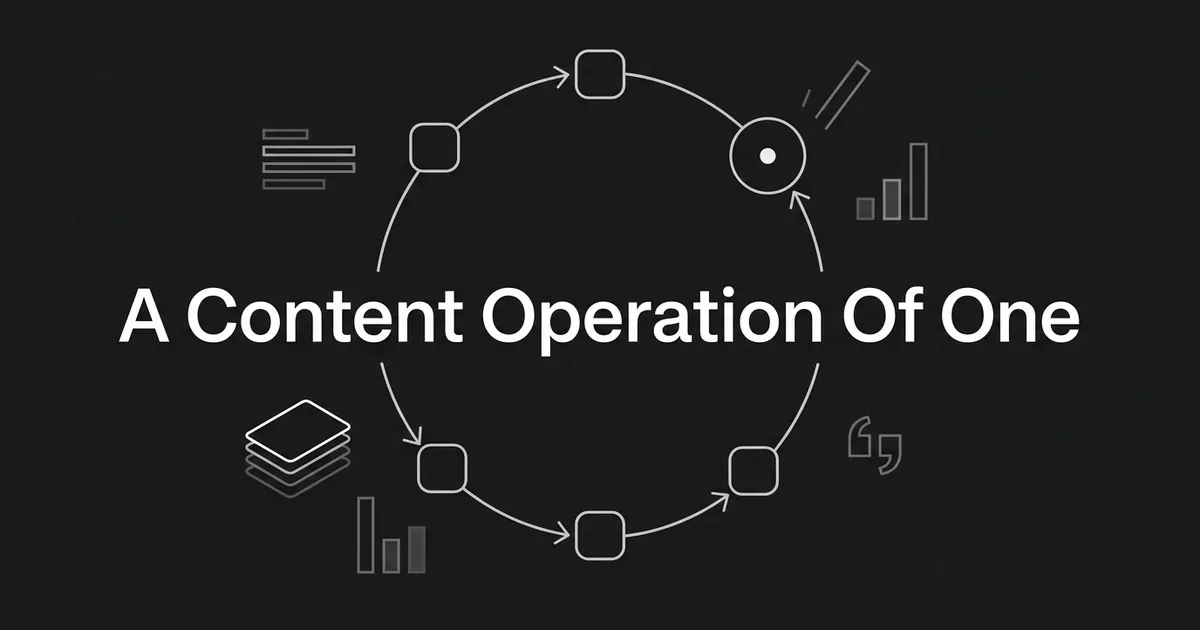
This guide maps the whole thing: plan, produce, distribute, measure, improve. You'll see what makes a page easy for an AI engine to use, what you can honestly promise yourself about what it takes to get cited by AI, and where to go deeper on each stage. Take it one piece at a time.
What a lean content operation actually is
A content operation is the system that turns a business priority into a published, distributed, measured page, over and over.
That's the whole definition. It is not a calendar. It is not a writing tool. Content operations are the people, processes, technology, governance, and measurement that create, manage, distribute, maintain, and improve content across its life. Strategy decides what matters. Operations is how the work actually happens.
The lifecycle has six stages:
- Plan. Pick the reader problem, the business outcome, the question, the content type, the evidence you need, and the owner.
- Create. Research, outline, draft, fact-check, edit, link, and prepare metadata.
- Manage. Store the asset, keep your source material, and make the page findable inside your own site.
- Distribute. Publish where your readers already are, and build the derivative pieces each channel needs.
- Optimize. Measure engagement, visibility, citations, and action. Then revise or extend.
- Update. Refresh claims when the product, the market, or the search environment moves.
If you're a team of one, you do all six. That's normal. The trap is doing them silently, in your head, in a slightly different order every time.
Name the stages anyway. A solo founder is the strategist, the subject expert, the editor, and the publisher. When those roles are written down as checkpoints, none of them gets quietly skipped on a busy week. That one habit is most of what separates a small team content workflow that holds up from one that collapses the first time something urgent lands.
There is a second system running alongside the first. Call it the visibility layer. It asks a different question: can readers and AI engines find this page, understand it, trust it, and cite it? You need both. A perfect operation that publishes invisible pages is still a hobby.
That pairing is what makes content operations for lean teams different from the version a twelve-person department runs. You have less capacity, so every page has to work harder, and you cannot afford to find out six months later that nothing was measured.
Plan around questions, evidence, and outcomes
Start with the question one specific reader is trying to answer, not with a topic or a keyword list.
That's the shift. A topic is a category. A question is a job. Only one of them tells you what the page has to accomplish.
Before anything goes into production, write down the short version:
- Who is this for, and what stage are they at: awareness, consideration, or decision?
- What problem does it solve?
- What business outcome does it support?
- What exact question or prompt should it answer?
- What can you say here that nobody else can?
- What evidence backs the important claims?
- Which existing pages should it link to?
- Where will it be distributed?
- Who owns the final call on accuracy?
A good plan is short enough that you actually use it. If your brief is longer than the outline, you built the wrong brief.
The last bullet matters more than it looks. Your first-hand knowledge is your real advantage, and it is the one thing an AI engine cannot get from a competitor's page. How you solved a problem. What changed after you introduced a process. Which trade-offs you made. What failed, and why. Where the recommendation stops working.
That is the heart of a solid solo founder content strategy: fewer pages, each carrying something only you could write.
So learn to reject ideas. If a topic is interesting but connects to no reader need, no business priority, and no evidence you can uniquely provide, it does not earn your scarce capacity. Filling a calendar is easy. Filling it with pages worth trusting is the hard part.
Keep one visible backlog, and give every idea a written reason to exist. A customer question. A product gap. A prompt where a competitor gets cited instead of you. A funnel stage with nothing in it. A page that gets attention but drives no next step. When capacity runs short, the reason is what you sort on.
One backlog beats several. Ideas scattered across notes, a doc, and your head are not a plan, they're a guilt pile. Put them in one place, even a plain list, and the choosing gets easier immediately.
Produce content that AI engines can actually use
Citation-ready content is content a person and a machine can both extract an answer from quickly.
There is no universal formula for this, and anyone selling you one is guessing. What the evidence supports is a set of conditions, not a recipe. Here's what actually helps.
Answer first, then elaborate. Put the direct answer near the top of each section. Use clear headings, short paragraphs, real definitions, and lists where they fit. Make the link between the question and the answer obvious. This helps readers first, and it gives retrieval systems cleaner units of meaning to work with.
Do not take that too far. Google says there is no requirement to chop content into tiny fragments and no ideal page length. Write to the depth the reader needs, then stop.
Add something that isn't commodity content. A first-hand review, an original example, a real product experience, a transparent comparison, a defensible point of view. Repeating what every other page says gives an engine no reason to pick yours.
Keep the claim no wider than the evidence, though. Label an example as an example. Do not turn one customer story into a statistic.
Check the claims before you publish. AI systems repeat errors happily. For every important claim, ask what the source is, whether it's primary or secondary, whether it actually says what you wrote, and whether it's still current. Then ask the harder one: would a reasonable reader misread this without more context?
Keep the key information in text. If your main answer only exists inside an image, a chart, or a widget, text-based retrieval cannot reach it. Use media where it helps a human. Do not hide the point inside it.
Stay crawlable and internally discoverable. For Google's AI features, the page has to meet the normal Search technical requirements. It needs to be reachable by crawlers, return a successful response, contain indexable content, and be eligible for a snippet. Internal links matter here too, because a page nothing points to is a page nothing finds.
Other engines have their own doors. OpenAI names OAI-SearchBot as the crawler behind ChatGPT Search results and recommends allowing it if you want to be eligible. Perplexity names PerplexityBot for the same purpose. Robots changes can take around a day to register on both. Being on the open web is not the same as being available to every AI product, so treat crawler access as a check you actually run.
Now the honest part. Google states plainly that meeting these conditions does not guarantee crawling, indexing, serving, or inclusion. No process guarantees a citation. What a real system gives you is measurable opportunity and better conditions, not a promise.
There is research pointing the same direction. A 2024 academic study on generative engine optimization tested content changes across a 10,000-query benchmark and reported visibility improvements of roughly 30% to 40% for its strongest methods. Read it as evidence for a direction, not as a forecast for your site. The authors note the effect varies by domain, engines are black boxes, and they change over time. Keyword stuffing, notably, performed badly.
Where AI helps, and where it must not decide
Content ops with AI works when the machine takes the repetitive work and you keep the consequential calls.
Hand over the parts that drain attention without needing judgment: turning a documented brief into an outline, organizing research notes, spotting missing sections, drafting channel versions of a finished piece, flagging claims that need a source, suggesting internal links for you to approve, checking terminology, tracking recurring prompts.
Keep these for yourself:
- What your audience actually needs.
- Which topic deserves your scarce capacity.
- What your company knows from experience.
- Whether a source is good enough.
- Whether a claim is accurate and current.
- Whether the page sounds like you.
- Whether it deserves to be published at all.
Google's own position is that AI-generated content gets no special ranking gain. Useful, original, accurate work can perform well however it was produced, and mass-produced pages built to manipulate rankings can violate spam policy. So the review standard is not optional overhead. It is the thing that makes the speed safe.
The failure mode to watch for is subtle. Content ops with AI goes wrong when output rises and the review standard stays undocumented, because nobody notices the drift until a customer or a competitor points at a claim you cannot support. Write the standard down before you turn up the volume.
Distribute every finished asset
A published article with no distribution has not finished the operation. It's a draft with a URL.
Plan distribution before you publish, not after. For each main piece, decide in advance:
- The primary owned destination, usually your site.
- The one or two channels that already hold the right readers.
- Which parts become channel-native posts, newsletter material, or sales enablement.
- Who or what prepares each derivative.
- The order you publish them in.
- Which distribution signals you'll measure separately from the article.
Two rules keep this sane. Adapt the format to the channel while preserving the core claim, and do not spin out near-duplicate pages just to raise your page count. A LinkedIn post that says something in its own shape is distribution. A copy-paste is noise.
Feeling like this is the stage that always falls off? It usually is. That's exactly why it belongs in the plan rather than in your good intentions. The goal is not to be everywhere. The goal is for distribution to survive your busy weeks.
Pick one primary channel and one secondary format to start. A small team content workflow that reliably does two things beats an ambitious one that does six in theory and none in practice.
Measure mentions, citations, and business impact
Track two layers, and never let one stand in for the other.
Layer one is visibility. Is the page crawlable and indexed? What are the impressions and clicks? Which queries bring people in? Is your brand mentioned in AI answers? Is your page cited as a source? Which prompts produce a mention but no citation? Which produce neither? Who gets cited instead of you, and on which engine? What changed after you published or revised?
Layer two is business value. Qualified visits. Signups, sales conversations, purchases. Returning readers. Assisted conversions. Feedback from support and sales. Your production cycle time and maintenance cost.
Here's the distinction most people skip. A mention is an engine naming your brand. A citation is an engine linking your page as a source. They are not the same event, they do not always happen together, and only one of them sends you a reader.
And a citation is not a business result by itself. It means an engine used your page in an answer. It does not mean anyone converted. Traffic alone doesn't prove much either. Watch both layers or you'll optimize the wrong one.
One more trap worth naming. Google Search Console now has a generative AI performance report, and Google says it finished rolling out to all sites worldwide as of August 31, 2026. It covers impressions from AI Overviews and AI Mode, grouped by page, country, date, and device. It's genuinely useful. It is also Google-only, with the usual 1,000-row limit and preliminary recent data. It will never tell you what ChatGPT or Perplexity did with your content. For those, you need per-engine prompt tracking.
This is the point where measurement should feed planning rather than sit in a separate tab. When you can see which prompts you lose, which pages get cited, and which competitor shows up instead, your backlog writes part of itself. DeepSmith is built around that loop: it tracks mention rate, citation rate, share of voice, cited pages, and competitor citations, then turns those gaps into content ideas that carry the data point explaining why each one exists. It won't tell you which idea is strategically right. That call stays yours.
Then set a review cadence you can actually keep. Ask the same short list every time: which pages get discovered, which get cited, which bring the right visitors, what's missing from the library, where a competitor appears instead, and what should be updated, expanded, merged, or retired.
Build governance when the team is one person
Governance is not bureaucracy. It's writing down the decisions you'd otherwise have to re-make while tired.
For a lean operation, the smallest useful version is ten short items. Most of them fit on one page:
- A mission. What this content operation is for.
- A priority rule. How you choose when capacity runs out.
- A brief. What every approved piece defines before production starts.
- A source policy. What counts as evidence, and how you label uncertainty.
- Brand and product context. Positioning, approved claims, claims to avoid, audience, voice.
- A workflow. The stages from idea to publish to distribute to measure to update.
- A final approver. The person accountable for accuracy, even when that person is you.
- A quality checklist. Your minimum bar for usefulness, structure, accuracy, and technical readiness.
- A measurement record. The metrics and dates you judge performance on.
- A maintenance rule. How outdated pages get found and fixed.
Content Marketing Institute guidance suggests documenting roles, responsibilities, task progression, and how long each step usually takes. For you, those role names are checkpoints, not people: strategist, expert, writer, fact-checker, editor, publisher, distributor, analyst. Same person, eight hats, each one named so it doesn't get dropped.
Does this feel like a lot? Start with three: the brief, the quality checklist, and the final approver. Those three catch most of what goes wrong. Add the rest as you hit the problem each one solves.
That short version is a perfectly good solo founder content strategy on its own. It is not the finished operation, but it is the part that stops the same three mistakes from repeating every month.
One caution. Templates protect your attention, they don't replace your judgment. Leave room in every one of them for the original example that makes the page worth citing.
Worth knowing: research on B2B content teams suggests documented operations are the exception rather than the rule. In a 2025 industry benchmark of 980 B2B marketers, only about one in three reported having a scalable model for content creation, most teams described their AI use as ad hoc, and a small minority had AI genuinely integrated into daily workflows. Lack of resources was the biggest reported challenge. Those are large-organization numbers, not solo-founder numbers. They still suggest that a documented system is a real advantage, not table stakes.
Where to go deeper next
You now have the shape of the operation. Each stage has its own depth, and you don't need all of it this month.
Pick the one that hurts most right now:
- Workflow. If you're improvising the stages each time, define the stages, owners, handoffs, and quality gates properly.
- Tracking on a small budget. If you have no idea whether you get cited by AI today, start with prompt-level monitoring before an enterprise program.
- ROI. If someone is asking what content returns, connect production effort to qualified action.
- Batching. If context switching is eating your week, group similar work instead of chasing volume.
- Repurposing. If distribution keeps falling off, learn to turn one article into a month of channel-native assets.
- Calendar. If planned work keeps going invisible, build an editorial calendar you can actually keep.
- Prioritization. If your backlog exceeds your capacity, get a framework for deciding what to write next.
- Minimum stack. If your tools are the problem, find the smallest set that supports the workflow.
- Roles. If everything depends on you, separate the responsibilities even while you hold them all.
- Velocity. If you're chasing output, learn what content velocity really means before raw volume backfires.
Start with one. Get it stable. Then take the next.
The throughline
Getting cited is not a one-time optimization task. It's the output of a system that repeatedly turns real expertise into content that's accessible, distributed, and measured.
That's the whole idea. Plan around a real question. Produce something only you could write, and make it easy to extract. Distribute it on purpose. Measure mentions and citations separately from business impact. Write down enough governance that the system survives your busy weeks.
Run that loop for a few months and you'll stop wondering whether you get cited by AI, because you'll be watching it happen or not happen, prompt by prompt, with something you can actually change.
You don't need a bigger team. You need a smaller first step, taken consistently.
If you want the tracking and the writing living in one place instead of five tabs, start a free DeepSmith trial and see what your prompts and pages look like before you commit to anything.