You got the draft in ninety seconds. Then you spent four hours fixing it.
If that is your week, nothing is wrong with you. The tool did its job. It just did a small slice of the job.
So what is content engineering, and why does the phrase keep showing up when teams talk about publishing more without burning out? Here is the short answer. Content engineering is the discipline of designing the system around the writing: the data, the structure, the reusable parts, the checks, the handoffs, and the learning loop, so that producing good content becomes repeatable instead of heroic.
Here is what you will walk away with. A definition you can say out loud in a meeting. A clear line between a system and a prompt. The parts that make scale possible. And an honest read on where your team sits right now.
Take a breath. This is more learnable than it sounds.
What is content engineering?
Content engineering is the practice of designing structured content systems that reliably turn information and strategy into consistent, reusable, measurable content across the channels and audiences your business serves.
That is the content engineering definition worth memorizing, and four things inside it do the heavy lifting.
It is a discipline, not a feature. It can involve information architecture, content modeling, metadata, modular components, templates, automation, publishing pipelines, governance, analytics, and lifecycle maintenance. No single tool is the discipline.
It covers the whole lifecycle. Drafting is one stage. Engineering also covers the inputs, the approvals, the delivery, the reuse, the measurement, and the improvement around the finished piece.
It is about repeatability. Content can be generated, derived, assembled, linked, or personalized by rules when its meaning and relationships are clear enough for software to work with.
It is still creative and human. Engineering does not remove authors or make every article identical. It creates reliable constraints and removes repetitive work so editorial judgment has more room to matter.
Worth knowing: the term is older than generative AI. Practitioners have long described a content engineer as someone who understands how content can be generated, derived, and manipulated by algorithms. Think API documentation assembled from source code plus human-written explanation, or structured writing that validates its own consistency. That history stops you from defining the whole discipline as "using AI to write blog posts."
What content engineering is not
A content engineering definition is only half useful until it also says what it excludes.
- Not content strategy. Strategy decides the audience, the objective, the positioning, the subject, and the priority. Engineering designs the system that executes those decisions repeatedly.
- Not content operations. Operations runs the day-to-day work, the people, the approvals, the calendar. Engineering designs the underlying mechanisms that make those operations reliable.
- Not a CMS. A CMS stores and publishes. Engineering also covers the model, the relationships, the reusable components, the metadata, the quality controls, and the learning loop.
- Not a template. A template gives recurring content a shape. Engineering defines the data that fills the shape, the rules, the checks, and what happens after publication.
- Not automation on its own. Automation removes manual steps. Engineering asks what should be automated, where a human must decide, and how failure gets caught.
- Not mass production. More pieces are not automatically better. The goal is more useful, better connected output without a matching rise in repetitive labor.
A practitioner shorthand helps here. Strategy handles the who, what, when, and why. Engineering handles the how. Operations handles the daily execution. It is a useful model, not an official job taxonomy.
Content engineering vs AI writer: what actually changes
An AI writer answers one question: what text can the model produce from this instruction?
A content system answers a bigger one: what process can reliably turn trusted information and strategic intent into the right content, validate it, deliver it, and learn from what happens next?
That is the whole content engineering vs AI writer distinction in two sentences. The writer is a generation capability. It does not, by itself, give you durable context, content relationships, ownership, workflow state, approvals, distribution, or measurement.
| Dimension | Ad hoc AI writing | Content engineering system |
|---|---|---|
| Unit of work | A prompt and a generated draft | A governed item moving through a repeatable lifecycle |
| Inputs | Instructions pasted into the current session | Structured source data, strategy, audience context, taxonomy, approved references |
| Context | Recreated by hand, inconsistently | Stored, maintained, and available to every stage that needs it |
| Output | Text that still needs checking, formatting, linking, and publishing | A validated asset with structure, metadata, relationships, and a next state |
| Consistency | Rides on prompt quality and the individual operator | Held by models, templates, components, rules, and quality gates |
| Quality | Humans discover problems after generation | Validation designed into the pipeline, judgment left to humans |
| Scale | More prompts, more manual rescue | More throughput through reuse, automation, and less rework |
| Distribution | A separate manual chore | Planned into the lifecycle, supported by structured parts |
| Feedback | The operator may or may not tweak the prompt | Results change the next asset, the rules, or the priorities |
| Failure mode | A plausible but generic or wrong draft | A traceable system failure you can locate and fix |
None of this argues against AI. It is the reason to treat AI as a component inside a system rather than as the system.
Generative models predict plausible patterns. They do not verify truth. A response can sound confident while being wrong, unverifiable, or built on the wrong context. In a multi-step process, one unsupported claim becomes the next stage's input and travels downstream.
So the controls matter: curated source material, retrieval from an approved knowledge base, explicit output formats, rules for when the system is unsure, fact and claim checks, and human oversight where the stakes are real.
One nuance to hold onto. Google's guidance says generative AI can genuinely help with research and structure, while producing many pages with no added value counts as scaled content abuse. The standard is not whether AI was involved. It is whether the content is accurate, relevant, and useful. That is a fairer bar than "AI content gets penalized," which the guidance does not say.
The building blocks of content systems at scale
Content systems at scale rest on four layers. You do not need all four to be perfect. You do need to know which one is missing.
1. A source of truth, not a blank prompt
An engineered system starts with governed inputs that get reused. Depending on your program, those can include:
- Product facts, capabilities, limits, approved claims, and claims to avoid.
- Persona detail: goals, questions, objections, and the language buyers actually use.
- Strategic priorities: topics, funnel stages, buyer questions, and the outcome each piece should support.
- Source material: documentation, research, customer conversations, internal expertise, approved references.
- Brand voice expressed as usable decisions, not a style guide PDF nobody opens.
- Taxonomy, content types, metadata, relationships, and lifecycle status.
- Existing pages you can reuse, link, refresh, or mark as a gap.
The point is not paperwork. Nobody, human or model, should have to rebuild the same context from scratch every single time.
One warning worth taking seriously. If the source information is stale or wrong, automation spreads the error faster. Maintaining the source of truth is part of the engineering, not a chore that happens before it.
2. A content model, so content is data with meaning
A content model defines what kinds of content exist and what information each kind carries. An article might hold a title, body, author, audience, topic, stage, status, and metadata. A product might hold a name, category, features, use cases, approved description, and related resources.
Relationships matter as much as fields. A post can reference an author, a product, a topic, a source, a call to action. Once those relationships exist, the system can retrieve, link, validate, or update the related item instead of trusting someone to copy and paste it correctly.
Here is the practical difference:
- Page thinking: each page is a finished block. Reuse means copying text out of one and pasting it into another.
- Structured thinking: a page is assembled from meaningful parts whose type and relationships are known. The same approved component ships to different contexts without being rewritten.
Structured content is not just text with headings. The property that matters is machine-readable meaning: the system can tell that this element is a product name, that one is a CTA, and that both relate to the same product.
3. Components and templates as controlled building blocks
Component thinking breaks a content experience into reusable parts: a hero, an author block, a product description, a comparison row, a fact block, a CTA, a related-resources module.
A template gives you a repeatable editorial shape. A component is a reusable unit inside that shape. The content model supplies the fields and relationships behind both. That is why a template alone is not a content system.
The payoff is reuse with consistency. One approved product description can appear in a blog, a product page, a sales asset, and a social summary without being re-authored from memory. An author profile is maintained once. A CTA gets updated centrally instead of hand-edited across forty pages.
Structure should constrain what needs consistency, not flatten what needs judgment. Standardize the fields, the required information, and the checks. Leave the angle, the examples, and the voice to a person.
4. Metadata and taxonomy that actually do work
Metadata is data about content: topic, audience, funnel stage, author, product, format, status, source, relationships. Taxonomy gives everyone a shared way to classify and find it.
That layer drives more than search filters. It powers related-content recommendations and internal links, gap analysis and deduplication, channel-specific assembly, automated validation, and performance analysis by topic or stage. It also gives AI systems the right source to work from.
Metadata turns a pile of pages into a library you can reason about. Without it, you can have plenty of content and still no reliable answer to "what do we already have, which version is authoritative, and is it current?"
This is where stored brand context earns its keep. In DeepSmith, Deep IQ holds positioning, product profiles, personas, brand voice, and content types as structured data that every other module reads. The point is bigger than any tool: context that lives in one governed place beats context re-typed into a chat window every Tuesday.
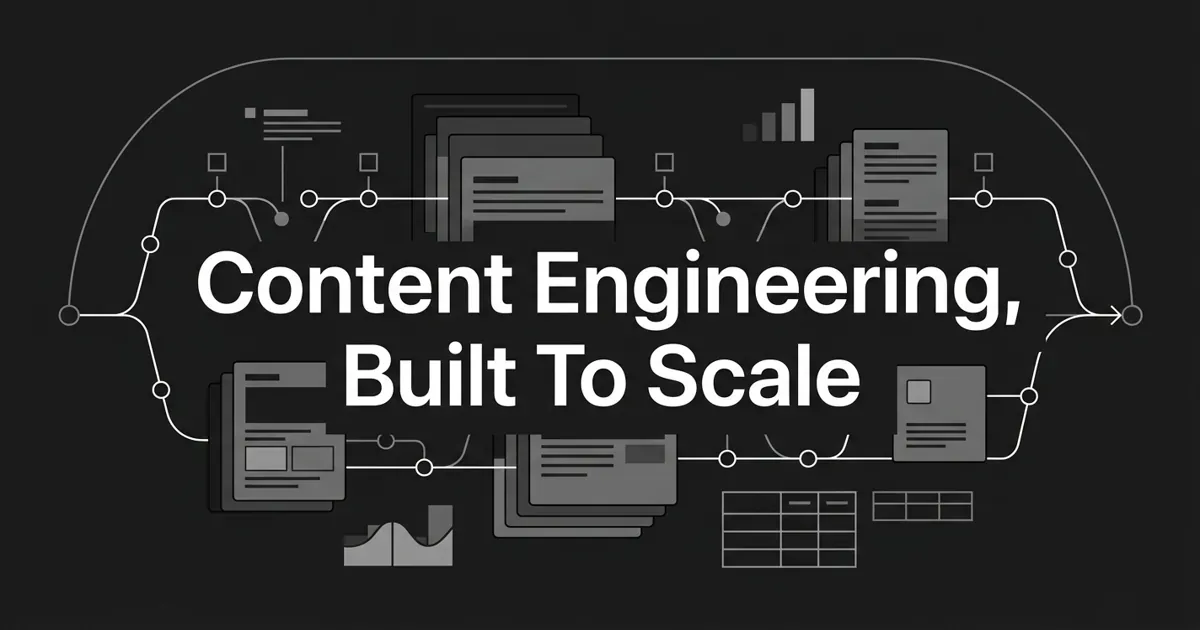
How a content pipeline turns inputs into published work
A pipeline is the repeatable path from an idea and its source material to a reviewed, distributed, measurable asset. Not a task list. A path with states, owners, rules, quality gates, and feedback.
Conceptually it runs in six stages:
- Prioritize and frame. A gap, a buyer question, a product update, or a measured opportunity enters the system, along with the reason it matters.
- Enrich the idea. The item gets connected to source material, audience context, taxonomy, existing pages, product facts, and the required format. This is the stage that prevents thin briefs.
- Generate or assemble. Authors, automation, AI, reusable components, or some mix produce the content. Generation is one stage, not the pipeline.
- Validate and review. Accuracy, source grounding, structure, brand voice, compliance, accessibility, SEO and AEO requirements, links, metadata, duplication. Humans stay in the loop for judgment and risk.
- Publish and distribute. The approved asset goes to its channels, and its structured parts support repurposing instead of a new project per format.
- Measure and maintain. Performance and feedback come back in, and they change what gets planned, refreshed, or retired next.
The leverage is in the separation. Strategy, data definitions, brand context, reusable components, and quality rules get maintained once. Individual pieces still get real editorial decisions. What disappears is rebuilding the same scaffolding for every article.
DeepSmith is one example of that shape: ideas move into Planned Content, the Writer turns a planned idea into a researched, linked, publish-ready article with metadata and a cover image, and Autowrite produces scheduled pieces on their date without anyone opening the app. That is an illustration of the pattern, not the definition of it.
Governance and quality checks that survive volume
Scale exposes every ambiguity you were quietly tolerating. When nobody owns a step, work stalls. Outdated pages survive. Quality varies by whoever happened to review it.
Governance is how you turn expectations into operating rules.
A working governance layer makes clear:
- Who owns each stage and each content type.
- Who can create, edit, approve, publish, archive, or retire.
- Which quality, brand, legal, accessibility, and AEO standards apply.
- Which claims and sources are approved, restricted, or need escalation.
- What the review checkpoints are, and how versions and changes get tracked.
- How outdated, duplicated, or low-performing content gets refreshed or removed.
- How exceptions get handled instead of silently bypassing the system.
A style guide is useful and not sufficient. Governance is what makes guidance executable through fields, checks, ownership, and review stages.
Quality assurance works better in layers than as one final proofread:
- Source quality: are the facts current, attributable, and right for this audience?
- Content quality: is it accurate, useful, complete, and original enough to earn attention?
- Brand and risk: approved positioning and voice, no invented product claims.
- Structural quality: required fields, headings, metadata, relationships, links, channel constraints.
- Experience quality: does it work in the intended channel, format, and accessibility context?
- Outcome quality: did it help the reader and move the goal it was created for?
Match the control to the risk. A social variation and a regulated product explanation should not travel the same approval path. Engineering means writing that difference down instead of relying on who remembers what.
Feedback loops: how the system improves instead of just producing
A production line with no feedback is an output machine. A system learns.
Feedback arrives from more places than your analytics dashboard:
- Internal: writers, editors, subject-matter experts, sales, customer success, product, support.
- External: customers, prospects, readers, subscribers, community members.
- Behavioral: traffic, search intent, engagement, conversions, support deflection.
- AI search: whether your brand is mentioned, which pages get cited, which prompts drive those citations, and which competitors show up instead of you.
- Operational: cycle time, review queues, rework, failed checks, and the exact places where a person keeps repairing the system by hand.
Do not collect every possible metric. Connect each measurement to a decision.
The loop itself is simple enough to run this quarter:
- Define what success means before production starts.
- Collect both the numbers and the qualitative feedback.
- Look for repeated patterns, not one loud comment.
- Decide what changes: the content, the source data, a component, a rule, a review gate, or the priority.
- Apply it and measure again.
At system level, measure categories rather than a vanity dashboard: throughput, flow, rework, quality, reuse, distribution, audience outcomes, search and AI visibility, and what actually changed as a result.
This is where AI search analytics stops being a report and starts being an input. DeepSmith tracks mention rate, citation rate, share of voice, and which of your pages AI engines cite, then its Content Map and Opportunity Agents turn those gaps into content ideas that carry the evidence with them. The principle holds with or without a platform: intelligence that does not feed production is just a slide.
One honest caveat. Visibility tracking shows how an engine answered a tracked question when it was measured. It does not prove one article caused the change, and it guarantees nothing about next month.
And please do not treat a higher publishing count as proof of success. A system that ships more low-value pages creates cleanup, not compounding.
Does content engineering replace writers?
No. It removes the scaffolding work that was eating your writers alive.
Research retrieval, reformatting, hunting for internal links, rebuilding the same context, chasing metadata, sourcing a cover image. None of that is the work you hired them for. Take it off their plate and you get more of what only they can do: angle, originality, empathy, and the judgment to know when the obvious take is wrong.
It helps to know where you stand. Most teams sit on one of these rungs:
- Ad hoc: blank pages, context in someone's head, informal review, performance rarely changes the next assignment.
- AI-assisted: drafts come faster, and you still supply context, fix structure, check facts, link, format, publish, and repurpose by hand.
- Repeatable: documented stages, owners, content types, reusable context, templates, and a visible calendar. Predictable, even if manual.
- Engineered: structured data, automation, quality gates, distribution, governance, and measurement work together, and you can trace why any piece exists.
- Adaptive: feedback changes priorities, source data, components, and rules. The system gets better at choosing what to produce, not just faster at producing.
You do not need an engineering department to move up a rung. A small team can systematize content production with modest tools: make context reusable, define your content types, name an owner per stage, write down what "good" means, and measure what happens. The maturity comes from explicit structure and learning, not from headcount.
Pick the rung above you. That is the only move that matters this month.
Start with the layer you are missing
Here is the throughline. Scale is a property of the system, not of the prompt. A faster writer inside a broken process gives you faster mess.
So do not build the whole thing. Choose one layer: write down your source of truth, define three content types, add one quality gate, or connect one measurement to one planning decision. Run it for a month and see what stops hurting.
You are closer than you think. Most teams already have the strategy and the talent. What they lack is the structure that keeps both from being re-invented every week.
If you want to systematize content production with your AI visibility data and your production pipeline in the same place, start a free DeepSmith trial and see real data and real drafts before you pay.