You have a long list of prompts and a plan that only tracks so many. That gap is stressful, and it is also completely normal. The good news: you do not need a bigger budget to fix it. You need a way to prioritize AI prompts to track so the slots you have go to the questions that actually move pipeline.
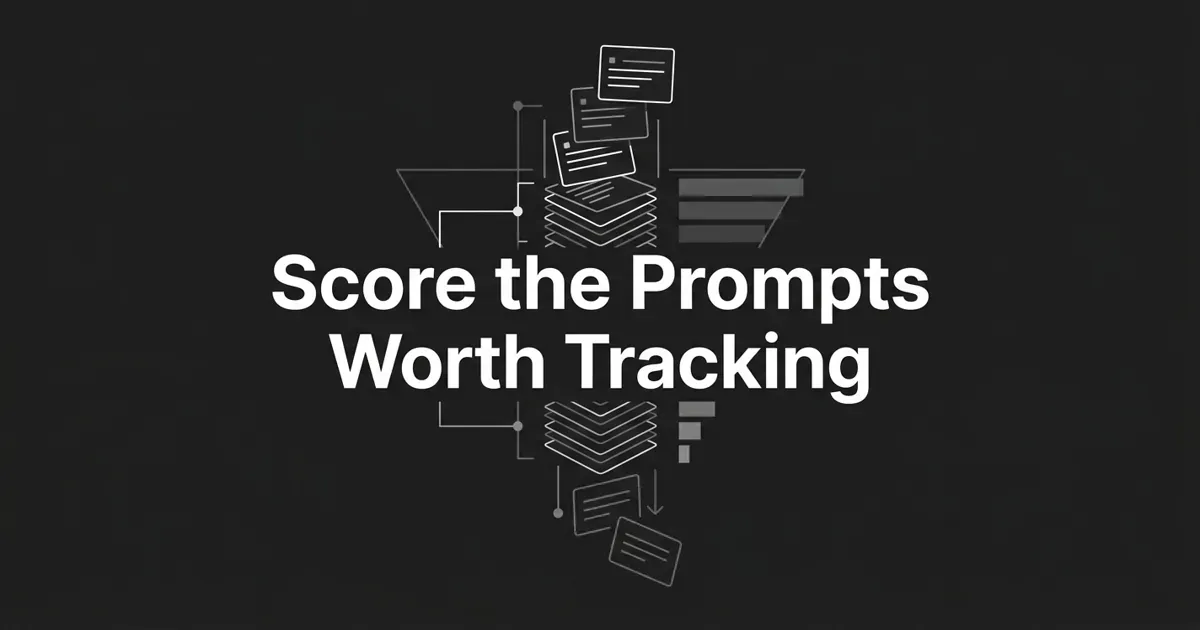
This guide gives you that. We will filter your list, sort it into buckets, and score each prompt on three things that decide its worth: buyer intent, pipeline value, and how winnable it is. By the end you will have a ranked shortlist and a rule for what to cut. It assumes you already have a candidate list in hand. If you do not yet, sort out where the prompts come from first, then come back here to rank them.
One thing to keep in mind before we start. Every tracker sells capacity in two dimensions at once: prompts and engines per prompt. A single prompt tracked across four engines quietly eats four slots. So "I can track 100 prompts" often means far fewer real questions than it sounds. That is exactly why the ability to prioritize AI prompts to track is the whole game, not a nice-to-have. Get the ranking right and a small plan outperforms a big one used carelessly.
Let's take it one step at a time.
Step 1: Clean your list before you score a single prompt
Scoring a messy list just ranks noise. So the first move is a quick hygiene pass, and it feels great because it shrinks the pile fast.
Run each candidate prompt through a few filters:
- One intent per prompt. Split compound questions like "best and cheapest AEO platform" into two. A prompt that asks two things returns a muddy answer you cannot act on.
- Real buyer voice. Pull phrasing from sales calls, support tickets, review sites, and Search Console queries, not your internal product language. Aim for a natural, specific question, roughly 180 to 200 characters. Too short returns generic answers; too long is over-specified.
- The refusal test. Run each prompt once. If an engine refuses it or hands back a non-answer, that is not a data point, it is noise. Replace it.
- The stability test. Run the survivors two or three times across your engines. If the cited brand list swings wildly between runs, the prompt is too volatile to track reliably. Move it to a watchlist rather than a tracked slot.
You are done with this step when every prompt left is one clear question, in buyer language, that returns a steady answer you could actually read and learn from.
Where people go wrong: they skip this and score everything, then wonder why their dashboard is jumpy. A volatile prompt will burn a slot and teach you nothing. Filter first, score second.
Step 2: Sort each prompt into one of five buckets
Before you rank prompts against each other, group them. Every serious AEO playbook lands on the same five buckets, and naming them is the fastest way to see what your list is missing.
- Branded (defensive). Your brand name is in the question. "[Brand] pricing," "[Brand] vs [Competitor]." Low volume, high conversion, and you track them so you notice the day your share slips.
- Unbranded comparison. "Best AEO platforms," "alternatives to X," "top tools for B2B SaaS." This is usually your largest and highest-return bucket because the buyer is actively building a shortlist.
- Category or definitional. "What is AEO," "how does share of voice work." Top of funnel, good for authority, rarely converts on its own.
- Use-case or job-to-be-done. "AEO platform for agencies," "AI visibility tool for fintech." High intent, filtered to your ideal customer, and often underused.
- Problem or pain-state. "Why isn't my brand showing up in ChatGPT," "how to track AI citations." These are high-intent AI prompts because the person asking is already feeling the pain you solve. Problem-state and comparison prompts are usually where your high-intent AI prompts concentrate, so give these buckets room.
Here is a healthy shape to aim for. Think of it as a target, not a law:
| Bucket | Share of tracked prompts |
|---|---|
| Branded (defensive) | 15 to 20% |
| Unbranded comparison | 35 to 45% |
| Use-case / job-to-be-done | 20 to 25% |
| Category / definitional | 10 to 15% |
| Problem / pain-state | 10 to 15% |
You know this step is working when you can see your gaps at a glance. If 80% of your prompts are "what is" questions, you have a portfolio problem no amount of tracking will fix. The mix is the story.
The distinction between the branded and unbranded buckets matters more than it looks, because they answer two different questions about your brand. Sort honestly here and the scoring in the next steps gets much easier.
Step 3: Score buyer intent (1 to 5)
Now the ai prompt scoring framework begins in earnest. The whole ai prompt scoring framework rests on three axes, and the first is buyer intent: what the person is actually trying to do when they ask. A definition-seeker and a shortlist-builder are worlds apart, even if the words look similar.
Score each prompt 1 to 5:
- 1 = pure definition. "What is AEO?"
- 2 = category education. "How does AEO work?"
- 3 = commercial investigation, weak signal. "Common AEO platforms."
- 4 = strong commercial investigation. "Best AEO platform for B2B SaaS."
- 5 = high intent, branded or buyer-qualifier. "[Brand] pricing," "[Brand] vs [Competitor]."
The pattern to notice: comparison and "vs" prompts, plus use-case questions tied to your customer, cluster at the top. Pure "what is" questions sit at the bottom. That is not because definitions are worthless, it is because the buyer behind them is nowhere near a decision yet.
You are done when every prompt has an intent number and you can defend it in one sentence. Search intent has always been the real spec behind good content, and it is doing the same job here.
Where people go wrong: they read intent off the keyword instead of the buyer. "Best marketing tool" looks high intent until you realize the asker might be a student writing a paper. Ask who is really behind the question, then score.
Step 4: Score pipeline value (1 to 5)
Intent tells you how ready the buyer is. Pipeline value tells you how much a win here could actually be worth to you. This is the axis teams most often get wrong, usually by chasing volume.
Weigh four things together:
- Audience fit. Does the asker look like your ideal customer? "AEO tool for agencies" is a perfect fit for an agency-focused vendor and only so-so for everyone else.
- Funnel stage. Bottom-of-funnel prompts (pricing, demo, comparison) beat top-of-funnel ones (definitions) on this axis.
- Deal size. Can the buyer behind this question close a real deal, or are they a free-trial tire-kicker? Both are fine to track. They just score differently.
- Competitive density. If an answer already names eight brands, your marginal win is diluted. A cleaner answer is worth more.
Score it 1 to 5, where 1 is wrong audience and tiny value, and 5 is your exact customer at the decision stage with a meaningful, recurring deal behind them.
A quick word on volume, because it trips everyone up. AI search "volume" is much smaller and noisier than Google keyword volume. A prompt with almost no measurable Google volume can still be high-value in AI search, and a high-volume keyword can be worthless if the wrong people ask it. Treat volume as one input to pipeline value, not the whole score.
Where people go wrong: they let a big volume number override poor audience fit. If the people asking are not your buyers, the citation does not pay. When you eventually connect citations to attribution and revenue, this axis is what you will wish you had scored honestly from day one.
Step 5: Score win probability (1 to 5)
The third axis keeps you honest: can you realistically get cited for this prompt in the next 30 to 90 days? A prompt you cannot win, no matter how valuable, is a slot spent watching someone else succeed.
Look at four signals:
- Existing authority. Do you already rank for the underlying topic in regular search? That is a strong predictor you can be cited in AI answers too.
- Direct-answer content. Is there a page on your site that answers this exact question, with clear headings and quotable lines? If the content is not citation-eligible, no amount of tracking changes the result.
- Third-party corroboration. Review-site presence, Reddit threads, industry mentions. AI engines lean on these.
- Competitive entrenchment. If one competitor owns 70% or more of the answers today, treat the prompt as effectively unwinnable this quarter and score it low.
Rate each 1 to 5, where 1 is no content and an entrenched rival, and 5 is dominant authority, a purpose-built page, and a weak incumbent.
This is where a tracker earns its keep, because winnability is hard to eyeball across dozens of prompts. A platform like DeepSmith shows you, per prompt, which competitor pages are actually winning the citation and on which engine. That competitor-citation view turns "I think we could win this" into "here is exactly who we are up against and where." Seeing the entrenched prompts clearly is what lets you skip them without guilt.
Where people go wrong: they score winnability on hope. If there is no page and no authority behind a prompt, the honest score is low, and a low score here is useful, not discouraging. It just means "not this quarter," and it frees the slot for one you can win now.
Step 6: Combine the three scores and set your cutoff
Three numbers per prompt, now you fold them into one. Multiply each axis by a weight and add them up. A common, sensible starting split is 30% intent, 35% pipeline value, and 35% win probability.
Then adjust the weights to your situation:
- New brand, little authority? Lean harder on intent and pipeline value, and go easy on win probability, or you will disqualify every prompt before you have built anything.
- Established brand with strong content? Upweight win probability. You have already done half the work, so lean into prompts you can actually take.
- Low-price, self-serve product? Let volume carry a bit more weight inside pipeline value; individual deal size matters less.
- High-value, enterprise product? Upweight pipeline value and audience fit. One right customer pays for the whole program.
Now set a cutoff. A simple rule from the field: keep prompts scoring above 3.5 out of 5 (or just take the top quartile). Everything below goes to a watchlist to revisit later, not into a tracked slot today.
Here is what that looks like on a 100-prompt portfolio for a B2B SaaS team:
- 15 branded prompts, composite 4.6
- 40 unbranded comparison prompts, composite 4.2
- 12 use-case prompts, composite 3.9
- 18 problem-state prompts, composite 3.1
- 15 category or definitional prompts, composite 2.4
That adds up to 100, with a mix of 40% comparison, 18% problem-state, 15% use-case, 15% branded, and 12% definitional. A healthy shape, and the low-scoring definitional prompts are the first to move to the watchlist when space gets tight. This is the core of prompt tracking prioritization: one score, one cutoff, one clean line between tracked and watched. Done this way, prompt tracking prioritization stops being a gut call and becomes a number you can defend to anyone who asks.
Step 7: Match engines to the score, not the other way around
Remember the hidden multiplier from the start? Here is where it pays off. Because most trackers charge per prompt-and-engine, your real capacity is prompts times engines, and you should spend engine coverage in proportion to a prompt's score.
A simple allocation:
- Top-quartile prompts: track across every engine you can. These are the ones worth full coverage.
- Mid-quartile prompts: track on one or two priority engines. For most B2B teams that is ChatGPT plus Perplexity, the surfaces where buyers actually research.
- Bottom-quartile prompts: a single engine, or drop them entirely.
This is also how tool tiers should map to your list. DeepSmith tracks ChatGPT, Perplexity, Gemini, Claude, and Google AI Mode, and coverage rises by plan. Pro covers ChatGPT and suits early, comparison-heavy work. Grow adds Perplexity, a natural fit for a B2B team that needs both broad comparison coverage and branded defense across two engines. Scale adds Gemini for a fuller five-bucket mix, and Enterprise opens every engine. The point is not which plan, it is to let your scored list decide how many prompts and engines you actually need, instead of paying for coverage your best prompts do not use.
You know this step is done when each prompt has an engine allocation that matches its score, and your total prompt-times-engine count fits your plan with room to spare.
Where people go wrong: single-engine bias. Tracking only ChatGPT because it has the most users ignores Perplexity's outsized pull in B2B research and Gemini's share of top-of-funnel discovery. Spread coverage by score, not by habit.
Step 8: Re-score on a cadence, not just once
You did the hard part. Now protect it, because buyer language moves and today's perfect list drifts. The trick is to separate quick check-ins from real re-scoring so this never becomes a monthly chore.
A rhythm that holds up:
- Weekly: glance at the raw data. Citation movements, anomalies. No re-scoring.
- Monthly: review competitor shifts and new entrants. Triage only.
- Quarterly: re-score every prompt with the full framework. Move prompts between keep, optimize, watch, and cut. Add fresh prompts pulled from recent sales calls and support tickets.
- Trigger events: a product launch, a rebrand, a new competitor, or a big engine change earns an off-cycle re-score.
A helpful nudge here: many platforms can surface new candidate prompts for you. DeepSmith's Discover Prompts generates a starter set from your product, persona, and buyer-stage context, so your quarterly refresh starts from suggestions instead of a blank page. You still score them with the same framework. You just are not sourcing from scratch every time.
You know your cadence is working when your tracked set changes a little each quarter and never lurches. A list that has not moved in a year is tracking the buyer you had, not the one you have now.
Pro tip: never drop a prompt just because you already win it. Track your wins defensively. Share of voice can slip without warning as competitors optimize, and the early-warning cost of one slot is tiny next to finding out late.
What to do next
You now have a repeatable way to decide which AI prompts matter most: filter, bucket, score three ways, set a cutoff, allocate engines, and re-score on a cadence. Knowing which AI prompts matter most is not a one-time verdict, it is a habit you can run every quarter. Start small. Take your current list, run Step 1 today, and score just your top twenty by hand. Momentum matters more than a perfect spreadsheet.
If you would rather see winnability and competitor citations scored for you, instead of eyeballing them across dozens of prompts, that is exactly the manual work a platform removes. You can start a DeepSmith free trial and see real prompt and citation data for your own brand before you commit a slot.