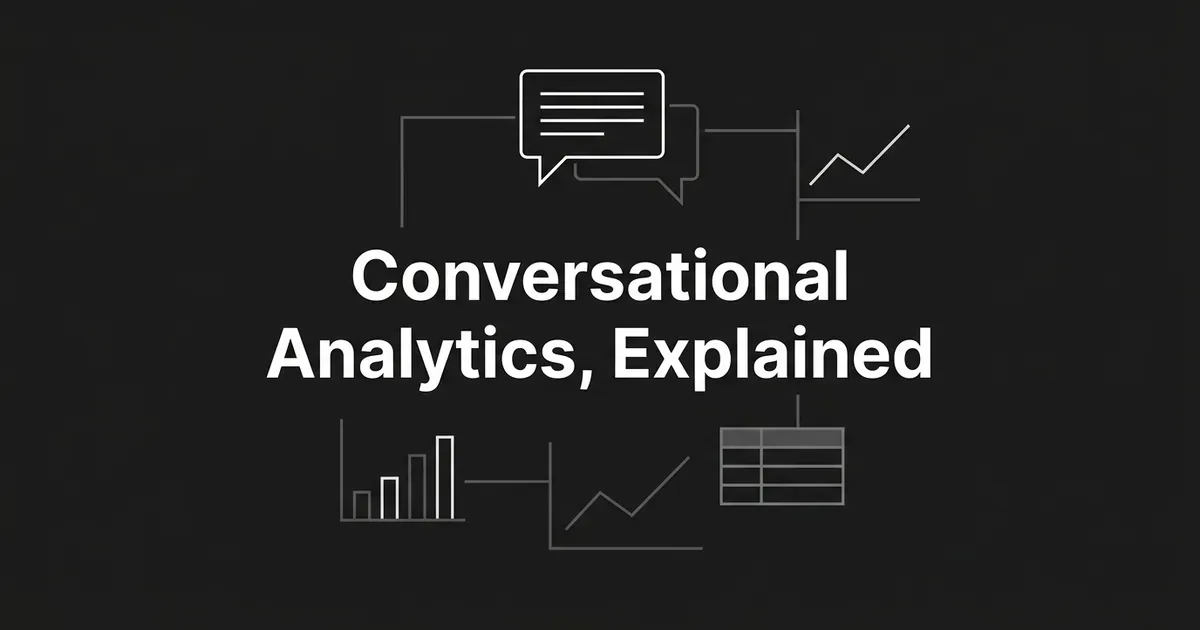
Conversational analytics is a way to ask questions about your governed business data in plain language and get an answer grounded in your actual numbers, not a guess. In marketing terms, it means you can type "which campaigns generated the most qualified pipeline last quarter" instead of opening a dashboard, picking filters, and hoping someone already built the view you need. You chat with marketing data the way you'd ask a colleague, and the system runs a real query behind the scenes to answer you.
If you've felt the gap between the question in your head and the report you actually have access to, this is the category built to close it. It's worth understanding clearly, because the term gets used loosely and it's easy to confuse it with a chatbot that's simply good at sounding confident.
What is conversational analytics?
Conversational analytics lets you ask questions about structured business data in ordinary language and get answers, visualizations, or follow-up analysis without writing SQL or building a report from scratch. The word that matters most here is grounded. A real conversational analytics system isn't a general chatbot improvising from what it learned during training. It's connected to your actual data, it uses defined metric logic, it respects your access controls, and it answers from your organization's real records.
You'll also see this called conversational BI marketing, natural-language analytics, or chat-with-your-data analytics. The naming isn't fully settled yet. Some people use "conversation analytics" to mean something else entirely: analyzing customer conversations like support calls or chat transcripts. This piece is about the business-intelligence sense of the term, talking to your structured marketing and business data, not analyzing customer conversations as a category of data.
It also isn't the same as a dashboard with a search bar bolted on, and it isn't automatically an autonomous AI agent either. Both of those distinctions matter enough that they get their own sections below.
How does conversational analytics actually work?
The interface feels like a conversation, but there's a full analytics pipeline running underneath it. A typical system works through these steps:
It receives your question in the language you'd normally use, about a metric, a time period, a comparison, or an explanation. Then it interprets the request: figuring out which measures, dimensions, date range, filters, and grouping you actually mean, and often what kind of chart would represent the answer well.
From there it resolves business meaning. This is the part that separates a serious system from a toy. Words like "pipeline," "qualified lead," "conversion," or "active customer" get mapped to your organization's approved definitions instead of being treated as generic English. The system generates an analytical query, usually SQL or something equivalent, sometimes Python, depending on how it's built. Google's documentation for its Looker implementation describes natural-language questions being translated into Python code that then runs against your data.
That query executes against a connected warehouse, BI model, or semantic layer, and the answer should reflect your current available data, not the language model's general training knowledge. You get back a number, a table, a chart, a written explanation, or some mix of those. Then you can keep going: "break that down by region," "compare it to last quarter," "which landing pages drove most of that." The system carries the context forward so you don't have to restate the whole question each time.
A trustworthy implementation also shows you enough to check its work: the metric definition it used, the filters, the time period, the underlying query. That's a quality bar for production use, not something every tool marketed under this label actually meets. A 2026 benchmark grounding queries in a semantic layer raised accuracy on a standard text-to-SQL test from 84.1 percent to 100 percent, a reminder that the gap between a fluent answer and a correct one comes down to what sits underneath the chat window. It's worth checking for before you trust an answer, especially on anything that will inform a budget decision.
What can marketers actually ask?
The honest answer is: it depends on what data is connected, how clean it is, and how well it's modeled. But here's the shape of what a working system can typically handle, assuming the underlying data supports it.
On performance and budget, you could ask which channels generated the most pipeline this quarter, how paid-search spend and qualified pipeline moved week over week, or what cost per qualified opportunity looks like by channel and region. On funnel questions, you could ask where the biggest drop-off happens between lead and opportunity, or which sources bring in a lot of leads but few sales-qualified ones. On campaign and creative performance, you could compare email engagement by audience segment or ask which ad creative converts best once you control for audience and placement.
Where this gets genuinely useful is diagnosis, not just lookup. A single number rarely tells you what to do next, but a conversation can walk you there. You might ask why qualified pipeline dropped last month, then ask for that broken down by channel, then narrow to the specific campaigns driving the paid-social change, then compare those campaigns to the prior month, then look at the result by audience and landing page. That's five questions that, without conversational analytics, would usually mean five separate dashboard builds or an analyst request that sits in a queue for a week.
One boundary is worth being upfront about. If you ask whether performance changed after you updated a campaign's targeting or creative, the system can calculate a clean before-and-after comparison. It can't prove that the change you made caused the result. That kind of causal claim usually needs a proper experiment, a control group, or attribution modeling, not just a comparison of two time periods. Some of that pipeline increasingly starts with an AI-generated answer instead of a search results page, and tracing revenue back to those citations is its own attribution problem worth solving separately from campaign-level analysis.
How is conversational analytics different from a dashboard?
Dashboards and conversational analytics solve different jobs, and the strongest way to think about them is as complements, not competitors.
A dashboard is built to monitor known metrics and keep a team aligned on a shared view. You select filters, tabs, and date ranges within views someone already designed. The output is a persistent chart or scorecard meant to be checked on a recurring cadence, daily, weekly, or monthly. A dashboard's whole job is to unite data sources and give at-a-glance feedback on performance against the goals that matter, which is exactly what makes dashboards valuable for budget pacing, pipeline reviews, and executive reporting. Everyone looks at the same numbers, defined the same way, every time.
Conversational analytics is built for investigating questions nobody anticipated when the dashboard was designed. You ask a question, look at the answer, and ask a follow-up, all in the same thread. This is what makes it feel less like reading a report and more like a way to chat with marketing data directly. Its strength is flexibility and speed on the ad hoc question. Its weakness is that an answer can be ambiguous or wrong if the underlying data model, definitions, or permissions are weak, since there's no analyst quietly catching an odd result before it reaches you.
The practical way to hold both at once: dashboards are for watching and aligning, conversational analytics is for asking and investigating, and a governed data foundation supports both of them. Be careful with the idea that conversational analytics replaces dashboards outright. It can reduce how often you build a one-off dashboard just to answer a single question, but it doesn't remove the value of a persistent view for the metrics your team checks every week.
How is conversational analytics different from agentic analytics?
This is the distinction that gets blurred most often, and it's worth being precise about, because "agentic" gets attached to almost anything with a chat interface lately.
Conversational analytics is generally user-led. You ask a question, the system analyzes the data you requested, and you decide what to ask next. Agentic analytics is generally more autonomous. Databricks describes agentic systems as ones that can reason across multiple data sources and carry out several analytical steps largely on their own, generating insights proactively and, in some implementations, recommending or initiating actions. The real difference is about initiative, not about whether there's a chat box involved.
Conversational analytics is triggered by you asking something. Agentic analytics can be triggered by a schedule, an event, a threshold, or a standing objective you gave it once. In a conversational system, you decide what deserves attention. In an agentic one, the system can flag what deserves attention before you've thought to look. The output differs too: a conversational system gives you an answer to your question, while an agentic system can surface a proactive alert or a recommendation you didn't ask for.
These categories overlap in practice. Plenty of agentic analytics products offer a conversational interface as their front door, and a conversational analytics product might add scheduled alerts or lightweight agentic workflows on top. But don't assume a tool is agentic just because it uses a large language model or lets you type a question. The clean split is user-directed inquiry versus more autonomous detection and action, not chat versus no chat.
Where does conversational analytics break?
The interface is the easy part. The reliability of what comes back depends on things that have nothing to do with how fluent the answer sounds.
It doesn't repair bad or incomplete data. If campaign names are inconsistent, spend data is missing, or your CRM stages aren't synced properly, a fluent, confident-sounding answer can still be flat wrong. Natural language makes asking the question easier. It does nothing to clean up what's underneath.
It doesn't remove metric-definition disputes. If your sales team and your marketing team define "pipeline" differently, the system needs an approved definition to work from, or it needs to surface that ambiguity rather than silently pick one. A confident answer built on an undefined term isn't actually a trustworthy answer, no matter how well it's phrased.
It doesn't guarantee correct query generation. The system can misread an ambiguous request, choose the wrong data source, apply the wrong date field, or use an aggregation that doesn't match what you meant. That's why the ability to inspect the query and the filters behind an answer matters so much in a production setting. Without it, you're trusting a black box with your budget conversations.
It doesn't make governance optional, and if anything it raises the stakes on it. Marketing data can include customer information, confidential spend figures, and restricted account details. A chat interface can make sensitive data easier to ask for, which is exactly why permissions, row-level security, and audit logs matter more here, not less.
And it doesn't replace your judgment. You still need to ask a precise enough question, notice when a result looks implausible, and decide what to actually do with the answer. A long conversation can also accumulate assumptions you no longer intend, a date range or filter from three questions ago quietly carrying forward. A well-built system should make that inherited context visible and let you reset it.
None of this means the category isn't useful. It means the value depends far more on the data foundation underneath the chat box than on the chat box itself. Before trusting a system, it's fair to ask whether metric definitions are documented and owned by the business, whether answers can be traced back to the query and source behind them, and whether the system can tell you a question is ambiguous instead of guessing.
Where this fits

For a marketing team weighing whether conversational BI marketing tools are worth adopting, the practical rule holds up well: dashboards show you the numbers your team has already agreed it needs to watch every week. Conversational analytics helps you chase down what changed when one of those numbers moves. Most marketing teams end up needing both, not one instead of the other, and the real work is building a data foundation solid enough that either interface gives you an answer you can actually trust.
DeepSmith doesn't do conversational analysis of your ad spend or CRM data, that's a different category from what's described here. What it tracks is a related but distinct kind of visibility, starting with what AI visibility actually measures: how your brand shows up when buyers ask AI engines questions about your space. From there it moves into mention and citation rates tracked page by page over time. Benchmarked against competitors, those numbers become metrics that actually predict who is winning ground you aren't. Getting that measurement right takes the same kind of governance discipline this piece describes for marketing data, just aimed at a different kind of question.