Let's be honest. Measuring your site-wide AI visibility is a mess right now. If leadership is asking for an "AI search strategy" and you're handing them GA4 sessions and a few screenshots from ChatGPT, you know how hollow that feels. You can't tell if you're winning or losing. You see competitors getting cited and it feels like a total black box. And "we need to show up in AI answers" isn't a strategy anyone can actually execute.
I've been there. The good news is you can build a real measurement system. It won't give you a perfect 0-to-100 score, because that doesn't exist. What it will give you is a system based on trends, share of voice, and diagnostics that helps you make much better decisions, even without perfect attribution.
This is the playbook we built to get a handle on it. It’s a governance system, not a one-time audit, and it will help you report progress, diagnose problems, and decide what to publish next.
What is "site-wide AI visibility," and how is it different from SEO performance?
When I talk about site-wide AI visibility, I mean your brand's aggregate presence across AI-generated answers. This includes mentions, citations, and how you're described, measured across a defined set of prompts, platforms, and time. It's not about one query, one page, or one platform snapshot.
Classic SEO is about rankings and traffic. AI visibility is totally different. We're measuring whether our content is being used as an answer ingredient, even if no one clicks. A buyer can read a ChatGPT answer that pulls from your methodology, decide they like your approach, and never visit your site. We've seen it happen. That's real influence, and if you're only tracking clicks, you're flying blind.
A few things AI visibility is not:
- It's not "rank tracking for ChatGPT." AI answers don't have ranked positions like search results do.
- It's not a single global score you can compare to an industry average. That doesn't exist.
- It's not a static metric. Models update constantly, and the same prompt can give you different answers tomorrow.
That volatility is exactly why you have to look at aggregates. Checking a single prompt is noisy and will drive you crazy. But checking a stable set of prompts, consistently over time and across multiple platforms, starts to show you the real signal.
What changed: discovery is moving upstream of website visits
AI answers are compressing the research phase of the buying journey. A prospect who used to spend 20 minutes reading three of your competitors' blog posts now gets a single AI-generated summary that synthesizes those same sources. They're forming opinions and preferences before they ever click a link.
This changes what "visibility" even means. Being mentioned or cited in an AI answer is now a leading indicator of influence, not just a vanity metric. If you're not tracking it, you're measuring downstream effects like traffic and conversions while completely missing the upstream cause. And accuracy matters, too. I’d argue that being mentioned incorrectly is often worse than not being mentioned at all.
What "good" looks like when there's no universal benchmark
Good AI visibility isn't a single number. It's a set of relative frames that give you context:
- Trendlines: Is your mention rate going up or down over time?
- Share vs. competitors: For the prompts that matter, who gets cited more often, you or them?
- Coverage breadth: How many of your most important prompt clusters do you show up in at all?
- Platform consistency: Are you a star on Perplexity but a ghost on Google's AI Overviews? That's a gap you need to dig into.
These frames give you something you can actually act on. An absolute score just gives you a number to argue about.
Which KPIs should you use to measure site-wide AI visibility (without lying to yourself)?
After a lot of trial and error, we landed on a four-layer KPI stack. The layers are ordered this way for a reason: each one helps you diagnose why the layer above it is moving.
| KPI Layer | What It Measures | Common Pitfall | Review Cadence |
|---|---|---|---|
| AI Visibility | Mention rate across platforms for defined prompt sets | Treating any mention as positive | Weekly spot checks |
| Citation Performance | How often your domain/pages are cited as sources | Conflating mentions with citations | Weekly |
| Brand Representation & Trust | Accuracy, consistency, and sentiment of how you're described | Ignoring inaccurate positive mentions | Monthly |
| AI-Influenced Outcomes | AI referral traffic, assisted conversions, branded search lift | Claiming causal attribution | Monthly |
Why this matters:
- Visibility can rise without traffic. You can get mentioned in a zero-click answer. If you're only staring at GA4, you'll think nothing happened.
- Citations are a proxy for authority. Being cited with a link or source is a much stronger signal than a passing mention.
- Representation can quietly drift. We've seen AIs start describing a product incorrectly. You won't catch it unless you're checking.
- Outcomes are directional, not definitive. AI referral traffic suggests influence. It doesn't prove it. Be honest about this.
Here’s a definition that burned us early on, so please internalize it: a mention is not a citation. A mention is just your brand name showing up. A citation is when the AI explicitly sources your content, like linking to your domain. And a citation is definitely not a click. If you track them all as the same thing, you will completely misread what's happening.
KPI definitions that prevent "score theater"
The biggest mistake I see is teams treating a single "visibility score" as a fact. Your score is only as good as your prompt set, so be intentional about building it.
Your prompt set should include:
- Core customer pain points ("how do I reduce churn in SaaS")
- Jobs-to-be-done queries ("best tool for content operations teams")
- Comparison prompts ("X vs. Y" queries in your category)
- "Best of" queries that real buyers ask
Once you have that set, use rolling averages (weekly and monthly), not daily readings. Daily AI visibility data is almost always too noisy and will give you false alarms. The real signal is in the month-over-month trends.
Tools like DeepSmith's AI Visibility — Prompts module let you define this prompt set and track your mention and citation rates across major platforms. The value isn't a score on any given day; it's the trend you see over time.
The minimum KPI set for a lean content team
If you're on a lean team, please, keep your dashboard simple. Start with these eight KPIs, maximum. Dashboard bloat is the enemy of governance. I've seen so many teams build these massive, beautiful dashboards that become decoration because nobody knows what to do with them.
- Mention rate (% of prompt checks where your brand appears)
- Citation rate (% of prompt checks where your domain is sourced)
- Share of visibility vs. top 3 competitors
- Number of priority prompts where you appear at least once
- Top cited pages (ranked by citation frequency)
- Citation trendline (rolling 30/90 day)
- AI referral sessions (if you can track them)
- Branded search volume trend (a good downstream proxy)
This is enough to report up and guide your next move. Don't add more until you have a real process for acting on these eight.
How do you collect AI visibility data across platforms (and what are the limitations)?
Okay, so how do you get this data? You'll need to stitch together three different methods. Sorry, there's no magic bullet here; no single tool gives you the whole picture.
Method 1: Prompt-level querying across platforms. Run your list of prompts against each AI platform on a regular schedule. This is where most of your signal comes from. It's also why you need to check multiple platforms. It's common for a brand to be well-cited on Perplexity but nearly invisible in Google's AI Overviews, which tells you something important about your content.
Method 2: Citation dashboards where available. Some platforms are starting to provide publisher-facing reports. Use them. You want to know which of your URLs are getting cited most often and how that changes over time.
Method 3: Server logs as retrieval evidence. Your server logs are your proof of life. They record every time a bot fetches your content, even if it doesn't lead to a click. This is directional evidence that AI systems are actively looking at your stuff.
This part can feel frustrating. You often can't connect the dots perfectly from prompt to retrieval to citation. It's messy. But my philosophy is that directional governance beats false precision every time. Acknowledge the mess and make good decisions anyway.
Prioritizing platforms: track where your buyers actually are
You don't need to be everywhere. Prioritize the platforms where your buyers actually hang out. For most of my B2B SaaS friends, that's ChatGPT, Perplexity, and Google AI Overviews, with Gemini and Claude picking up steam.
Also, consider which platforms are even measurable and which are strategically important. If your audience is highly technical, Claude and Perplexity might be more important than the others.
Start with two or three platforms where you can get consistent data. You can always expand later.
How do you confirm AI bots can access your site (crawlability/indexability) with live tests?
This is the part everyone skips, and it's probably the most common reason AI strategies fail. Fix access before you optimize content. I know, it's not as fun as content strategy. But I can't tell you how many smart teams I've seen pour months into creating "AI-optimized" content that the bots could never even see. It’s a painful, unforced error.
Here's what to test and what you'll catch:
| Test | What It Catches |
|---|---|
| robots.txt review vs. known AI user agents | Unintentional blocks on GPTBot, PerplexityBot, ClaudeBot |
| Response code check on priority URLs | 403s, 404s, 500s, and redirects that confuse bots |
| TTFB / load time check | Timeouts that make bots give up |
| Staging rules leak audit | Disallow rules for staging that accidentally got pushed live |
| WAF / geo-restriction check | Firewall rules that block bot traffic patterns or non-US IPs |
The output of these tests should be a simple fix list with two labels: blockers (anything that prevents access) and warnings (anything that hurts access reliability).
A simple live-test regimen you can run monthly
Here's the simple monthly checkup we run. It's a lifesaver. Grab a representative set of 30-50 URLs, including:
- Top traffic pages
- Top conversion pages
- Pillar/cluster hub pages
- Recently published content
- Key template pages (pricing, product, etc.)
Step-by-step:
- Pull your URL list.
- Check your robots.txt against GPTBot, PerplexityBot, ClaudeBot, and Googlebot.
- Run response code checks and log anything that isn't a 200 OK.
- Check TTFB on key pages; flag anything over 3 seconds.
- Log your results with a timestamp and owner.
- Assign fixes and give them a deadline before the next test.
"Pass" criteria: The URL returns a 200 OK with stable server-rendered HTML, isn't blocked by robots.txt or a firewall, and has a TTFB under 3 seconds.
Robots and directives: what you can and can't control
Your robots.txt file is your main lever. Unlike Googlebot, which generally respects noindex tags, many AI crawlers primarily rely on allow/disallow rules in robots.txt. They don't consistently honor meta robots tags.
This means you have to make an explicit decision: which AI crawlers do you want to let in? Make that choice, write it into your robots.txt, and then verify it monthly. Most access problems come from a mismatch between what you think your robots.txt says and what it actually says.
How can server logs validate AI retrieval (and what does "ChatGPT-User" actually tell you)?
Your server logs are the closest thing you'll get to a smoking gun for AI retrieval. When an AI fetches your page, it leaves a footprint, even if you never get a click.
The big one to look for is ChatGPT-User. When we first saw this in our logs, it was a huge "aha" moment. It's different from GPTBot (the training crawler). ChatGPT-User means your content is being actively pulled to answer a real person's question right now. That's a huge signal.
A practical checklist for your logs:
- Filter by user agent + status code. You only care about 200 OK responses from known AI bots.
- Validate content type. Filter for
text/htmlto focus on actual page fetches. - IP verification. If you can, cross-reference IPs against the published ranges for AI crawlers to filter out fakes.
- Cluster parallel requests. AIs often hit a URL multiple times at once. Deduplicate these to avoid inflating your numbers.
The reality check is that logs tell you what was fetched, not why. You can't see the prompt that triggered it. But you can see patterns, like which pages get hit most often, and those patterns are incredibly valuable for governance.
The technical gotcha: AI crawlers don't execute JavaScript
This is a big one that trips up a lot of modern marketing sites. Most AI crawlers don't execute JavaScript. If your site is a fancy single-page application built in React or Vue, where the content loads after the initial HTML, the bots are probably seeing a blank page. You think you're handing them a beautiful article, but they're getting an empty shell.
Your options:
- Make sure critical content is in the server-rendered HTML.
- Use server-side rendering (SSR) or static site generation (SSG) for your important pages.
- At the very least, look at the raw HTML for your highest-priority pages to see what a bot sees.
This is exactly why that boring technical testing is so fundamental. You can't out-optimize a rendering problem. You have to fix the infrastructure.
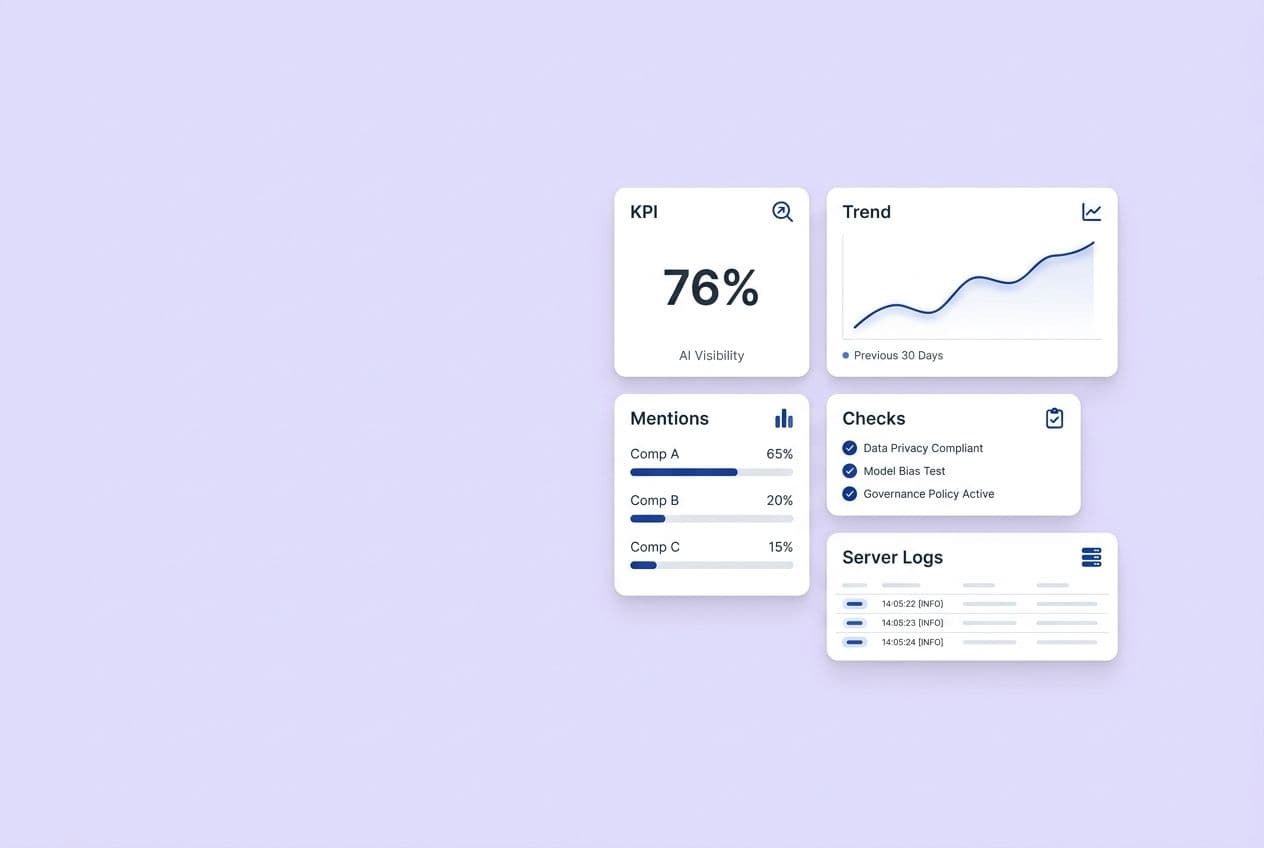
What should an AI visibility dashboard include (and how do you connect it to SEO + outcomes)?
The dashboard that finally worked for us has three separate panes. I beg you, don't mix them together. If you do, you'll confuse your leadership, frustrate your team, and end up making bad decisions.
Pane 1: Exec Summary (for leadership)
| Metric | Source | Update Frequency | Labeled As |
|---|---|---|---|
| AI visibility trend (rolling 30/90 day) | Prompt tracking tool | Weekly | Leading indicator |
| Citation trend + share vs. competitors | Citation monitoring | Weekly | Share metric |
| Representation health (spot check error rate) | Manual + monitoring | Monthly | Quality signal |
| AI referral sessions | GA4 / analytics | Monthly | Directional outcome |
| Branded search trend | GSC / Ahrefs | Monthly | Directional outcome |
And please, when you show this to leadership, never present AI-influenced numbers as hard revenue attribution. Label them honestly as "directional outcomes." I promise you, they will trust you more for it. Overstating the case is how you lose credibility.
Pane 2: Diagnostics (for your team)
This is where your content and SEO teams live. It should show:
- Platform breakdown: where you're strong versus where you're weak.
- Prompt cluster coverage: which topics have good presence and which have gaps.
- Top cited pages and pages with declining citation trends.
- Discovery queries: what pages are getting retrieved that you haven't even targeted.
Tools like DeepSmith's AI Visibility — Pages module are built for this. They show which pages are earning citations, their trend lines, and their share of your total visibility. This isn't a replacement for your CRM; it's the missing layer that connects content to AI presence.
Pane 3: Action Queue (what to do next)
- Pages to refresh (based on declining citations and outdated content).
- New topics/prompts to target (based on competitor wins and coverage gaps).
- Third-party citation opportunities (trusted sites where you should earn a link).
What to leave off the dashboard:
- Vanity totals like "324 mentions" without any context.
- Noisy daily charts that just cause panic.
- Any kind of blended "AI + SEO score" that mashes together different signals.
A dashboard template you can copy into your BI tool or spreadsheet
| Metric | Definition | Source System | Owner | Update Frequency | Target Type | Decision It Supports |
|---|---|---|---|---|---|---|
| AI mention rate | % of prompt checks with brand mention | Prompt tracker | Content lead | Weekly | Trend (up) | Content priority |
| Citation rate | % of checks where domain is sourced | Citation tool | Content lead | Weekly | Trend (up) | Authority gaps |
| Visibility share | Your citations ÷ total citations in prompt set | Citation tool | Content lead | Monthly | Share vs. comps | Competitive response |
| Representation error rate | % of checks with inaccurate brand description | Manual + tool | PMM/Brand | Monthly | Threshold (< 10%) | Correction queue |
| AI referral sessions | Sessions from AI referral sources in GA4 | GA4 | Analytics | Monthly | Trend (directional) | Pipeline connection |
| Top cited pages | Pages ranked by citation frequency | Citation tool | Content lead | Monthly | Coverage | Refresh/expand decisions |
| Crawl pass rate | % of tested URLs returning 200 OK | Log / tech audit | SEO/Tech | Monthly | Threshold (>95%) | Access governance |
| Branded search trend | Branded query volume trend | GSC / Ahrefs | Analytics | Monthly | Trend (directional) | Awareness lift signal |
How do you turn measurement into ongoing governance (cadence, owners, and playbooks)?
A dashboard is just a picture. A governance system is a rhythm. This is the operating model that makes the measurement loop actually work and compound over time. It requires clear owners and a non-negotiable cadence.
Weekly (30 minutes):
- Spot-check 10–15 core prompts across your main platforms.
- Flag any big wins (new citations) or losses (disappearing mentions).
- Review top page movers from the last week.
- Update the action queue.
Monthly (60–90 minutes):
- Run your full live bot access tests.
- Review server logs for AI bot activity.
- Present the exec dashboard to leadership and explain the trends.
- Reprioritize your content plan based on coverage gaps.
Quarterly:
- Revisit and update your prompt set.
- Do a deeper audit of how your brand is being represented.
- Refresh your most important pillar pages.
Ownership model:
| Function | Owns |
|---|---|
| Content lead | Prompt sets, topic coverage, action queue |
| SEO/Tech | Crawl access, logs, rendering issues |
| Analytics | Instrumentation, referral tracking, branded search |
| PMM/Brand | Representation checks, accuracy corrections |
When you can see a competitor is winning citation share for a key topic, you need a process for responding. Tools like DeepSmith's AI Visibility — Competitors module are great for this, as they show you which competitor pages are winning. The goal isn't to copy them. It's to understand where they've built authority so you can decide whether to compete head-on or find an adjacent area where you can win.
Playbooks for common scenarios:
Here are a few playbooks for situations you're almost guaranteed to face.
You're seeing visibility go up, but traffic is flat.
- Check if your citations are in zero-click summaries vs. actual source links. Make sure your cited pages have strong internal linking to your conversion-focused pages.
Citations suddenly drop after a site change.
- Check your robots.txt immediately. Look at server logs for access drops around the deployment date. Check page rendering. If you find the cause, reverse the change.
A competitor suddenly starts owning a topic.
- Don't just panic-publish a copycat post. Diagnose why they're winning. Is it content depth? Backlinks? Page structure? Then decide if you want to fight them for it or find an easier battle to win nearby.
One final guardrail: as you speed up, build in human review. Shipping generic, AI-generated content just to check a box won't earn you citations. It will just dilute your brand's credibility.
What are the most common failure modes (and how do you troubleshoot them fast)?
When things go wrong with your AI visibility, it usually comes down to one of these five problems. I've run into all of them. Here's a quick decision tree to help you troubleshoot without panicking.
Failure Mode 1: Blocked access Symptom: AI bots aren't in your logs; no citations even with good content. Check: Your robots.txt file, firewall rules, and any geo-restrictions. Fix: Update robots.txt to explicitly allow the bots you want; review firewall filtering rules. Priority: Fix this first. Nothing else matters if bots can't get in.
Failure Mode 2: JS-rendered content is invisible
Symptom: Logs show bots fetching pages, but you're still not getting cited.
Check: Look at the raw HTML of your key pages (use curl, not a browser). Is your main content actually in there?
Fix: Move critical content to server-rendered HTML. Implement SSR or SSG.
Failure Mode 3: Content is hard to extract Symptom: Bots can access the page and it's server-rendered, but you're still not getting cited. Check: Does the page answer a question clearly? Is the answer buried under a long, rambling intro? Fix: Restructure the page to lead with a direct answer. Use clear, descriptive headings. Break up walls of text.
Failure Mode 4: No third-party reinforcement Symptom: Your content is solid and technically sound, but competitors keep winning. Check: Are competitors cited on high-authority industry sites? Fix: Go earn some credible third-party mentions through partner content, contributed articles, or publishing data that gets referenced. AIs weigh corroborated authority.
Failure Mode 5: Representation errors Symptom: You're showing up in answers, but the description of your product is wrong. Check: Run spot checks every month. Compare what the AIs say against your actual positioning. Fix: Clean up the copy on your core, source-of-truth pages (homepage, product pages, about us). Make your language clear and consistent.