Your engineer says MCP in a standup. A vendor puts it on a slide. Someone forwards you a thread about it. And you nod, because asking now feels like admitting you should have asked three months ago.
You do not need to feel behind. Let's answer what is an MCP server without the jargon, and then talk about the part that actually touches your job.
MCP stands for the Model Context Protocol. It is a standard way to connect AI agents to tools and data you already use. Your CMS. Your analytics. Your brand guidelines. Your AI visibility tracker.
Here is the promise of this guide. By the end, you will be able to explain an MCP server to your CEO in one sentence, describe what it lets an AI agent read and do inside your stack, and know which questions to ask before you turn one on. No code required.
So what is an MCP server?
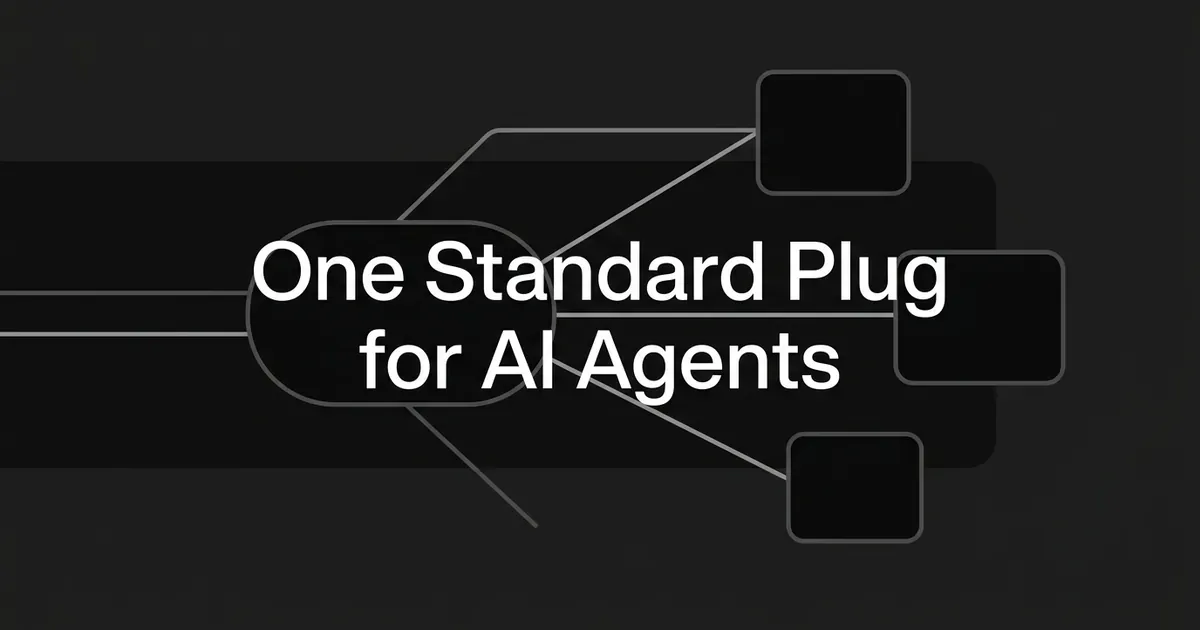
An MCP server is a program that exposes one piece of your stack through a shared protocol, so any AI app that speaks that protocol can use it.
That is the whole idea. The official docs use a USB-C analogy, and it is a good one. Just as USB-C gives you one standard way to plug a device into a laptop, MCP gives you one standard way to plug an AI application into an external system.
One caution before you get excited. The protocol's only job is to connect AI agents to tools and data that already exist. It does not make a model smarter. It gives a model more to work with, which is a different and much more useful thing.
Think about what that replaces. Before, every AI tool needed its own custom connector for every system. One for Slack. One for Notion. One for your CMS. Each one built separately, each one maintained separately.
With MCP, the system exposes itself once, in a shape everything else already understands.
So when your CMS vendor ships an MCP server, they are not shipping you a chatbot. They are shipping a small program that says, out loud and in a standard format: here is what I hold, and here is what I can do. Any compliant AI application can then connect to it.
The AI applications on the other end are called hosts. Claude Desktop, ChatGPT, Cursor and VS Code are among the hosts named in vendor documentation today. There is no single official list, so check your own tools rather than assuming.
Your action this week: open your CMS and your AI visibility tool, search their docs for MCP, and note whether each one has a server, a REST API, or neither. That five-minute check tells you more about your options than any think piece will.
Why the Model Context Protocol exists
MCP exists because models were smart and blind at the same time.
Anthropic open-sourced the protocol on November 25, 2024. The launch framed the problem plainly: even the most capable models were trapped behind information silos and legacy systems. The fix was a universal, open standard for connecting AI systems to data sources, replacing fragmented integrations with a single protocol.
Three things shipped that day. The specification and its SDKs. Local server support in the Claude desktop apps. And an open-source set of pre-built servers for common systems: Google Drive, Slack, GitHub, Git, Postgres and Puppeteer.
Notice that list. It is developer-shaped, and that is why MCP still reads as an engineering topic. It started as one.
It is not one anymore. The same protocol that lets an agent read a Git repo lets an agent read your content calendar, your published pages and your citation data.
Here is the part worth carrying into your next budget conversation. When leadership asks whether your new AI tool can see your CMS, the answer used to be a build project with a timeline. If both sides speak MCP, the answer becomes a setting.
Tools, resources and prompts: the three things a server hands over
Every MCP server exposes up to three kinds of things. They look similar from the outside. They are governed very differently, and that difference is the most useful thing in this article.
Tools are model-controlled. A tool is an action. The AI model can discover a tool and decide to call it, based on the conversation and your prompt. Publish this article. Generate social posts for this URL. Fetch the last ten mentions of our brand. Every tool carries a name and a schema describing exactly what inputs it takes.
Resources are application-driven. A resource is a read-only view of something, identified by an address. Your brand voice file. Your CMS taxonomy. The list of pages an AI engine cited last week. The host application, not the model, decides which resources to hand over and when. The protocol does not force anything into the model's context.
Prompts are user-controlled. A prompt is a template the server offers and a person picks. Audit this article for brand voice. Summarize this week's citation report. Draft a LinkedIn post from this article. They usually show up in the interface as commands you choose on purpose.
If you remember one sentence from this whole guide, make it this one. Tools are model-controlled, resources are application-controlled, prompts are user-controlled.
That sentence is a governance map. Anything that writes, sends or publishes is a tool, and tools are the ones a model can reach for on its own. That is where your review process belongs.

How your agent and the server actually talk
You will hear two words a lot: local and remote. They are the practical split.
A local server is a program your desktop app launches on your own machine. It talks over stdio, which is just a plain stream of messages between two processes on the same computer.
A remote server lives on the internet or behind your company network. It talks over Streamable HTTP, where each message is a normal web request.
Both carry the same messages in the same format, JSON-RPC, encoded as UTF-8. The protocol semantics do not change with the pipe.
You do not need to memorize any of this. You need to know which one you are turning on, because the two have very different risk profiles, and we get to that shortly.
One more thing worth knowing so a vendor call does not throw you. The current specification revision is 2026-07-28, and it made MCP a stateless protocol. Every request now carries its own version and capabilities, and nothing depends on a session being held open. That is why you may hear "stateless" and "header-routed" in a demo. It means requests can land on any server instance behind a plain load balancer, which is how these systems scale.
Older servers still use the previous handshake-based approach. Both eras coexist during the transition, and a modern client generally will not work against a legacy-only server. If a connection fails on day one, that mismatch is a fair first thing to ask about. It is not a sign you did something wrong.
What MCP for marketers actually changes
Good news: the protocol is the boring part. This section is the part that changes your week. Every argument below comes back to one thing, which is that you can now connect AI agents to tools you already pay for without a build project in between.
You stop paying for the connector, again and again. Every new AI tool used to bring its own integration bill. When both ends speak one protocol, your stack stops being a pile of custom wiring. It becomes a set of connections you switch on. That is why consolidating your content stack gets easier, not harder, as you add AI to it.
Reading and writing land in the same place. This is the piece most explanations skip. Resources are how an agent reads: get the brief, get the taxonomy, get last week's citation report. Tools are how an agent writes: update the draft, publish the page, generate the social version. Same protocol, both directions.
That combination is what makes agent work useful instead of impressive. An agent that can only read gives you a summary. An agent that can read your visibility data and write a draft back into your CMS closes a loop.
Here is a shape you can picture. An agent reads your published pages and your citation data as resources, notices which tracked prompts you never appear in, drafts a piece aimed at one of them, and pushes it into your CMS as a draft through a tool. A human opens the draft and decides. That is not science fiction and it is not one click either. It is a workflow with a person still in it.
Governance moves out of the prompt. If your standards live in a prompt, they leak. Every new agent, every new teammate, every new tool starts from zero and you retype "remember our brand voice" forever.
The protocol moves standards into the server. The tool descriptions define what can be done. The resources define what can be read. The prompt templates define the approved ways to ask. Your rules become data instead of a sentence somebody remembered to paste.
That is a real relief if you have ever tried to keep brand voice consistent across drafts at volume. The rules stop depending on who is typing.
The repetitive work is the first thing to hand over. The best starting jobs are the ones you have been avoiding. Alt text missing across thousands of images. Focus keywords never filled in. Documentation that drifted out of date. None of that needs creative judgment. All of it needs a system that can read and write.
The goal was never to remove people. It is to remove the clicking, and keep the judgment.
The security rails you cannot skip
Take a breath, because this section is shorter than you fear. You do not need to implement any of it. You need to ask about it.
Human in the loop is written into the protocol. The specification says there should always be a human able to deny a tool call. Applications should show which tools exist, show visually when one runs, and ask for confirmation on sensitive actions. If a vendor demo shows an agent publishing with no approval step, that is a product choice, not a protocol requirement.
Approvals are set by the host, not the protocol. OpenAI's guidance, for example, says approval is requested by default before data is shared with a connector or remote server, and can be tuned per tool. Other hosts have other defaults. Check yours.
Remote servers use OAuth 2.1. That is the same login-and-grant-access flow you already use when you connect any app to your Google account. Authorization is optional in the spec, and strongly recommended whenever a server touches user data or performs administrative actions. In practice, for anything remote, treat it as required.
Local servers deserve real caution. A local server runs on your machine with your permissions. It can do whatever you can do. Treat an unfamiliar local server the way you would treat any unknown program someone asked you to run.
Give it the smallest possible access. The published security guidance is blunt about scopes: no catch-all permissions, split access per capability, use short-lived tokens, and never grant an agent more than the person it acts for. If a junior editor cannot publish without approval, neither should their agent.
Slack's public posture is a good model to copy. Servers are off by default until an admin turns them on. Admins can see exactly which server domains an app is asking for. Adding a server from a new domain requires fresh approval.
Before you add anything to your MCP content stack, ask four questions. Who authorizes the connection? What is the smallest scope that still works? Which tools can write, and what stops them? And can we see, later, what the agent actually did?
If your vendor cannot answer those four, the answer is not yet.
Where MCP for marketers stands today
Honest picture: the ecosystem is real, uneven, and moving.
There is an official MCP Registry, a central place where server metadata is published. Two things to know about it. It is still in preview. And it is designed to be consumed by marketplaces and discovery tools, not browsed directly as a shopping list. It publishes metadata, not a security audit.
So do not go hunting for a master list of every server. Go to the vendors you already pay: your CMS, your AEO platform, your host application. Ask each what they expose and how.
On the AEO side specifically, the field is genuinely mixed. Some visibility vendors ship a REST API, some ship a dedicated MCP server, some ship both, and some ship neither yet. Any of those can be the right answer for you. A REST API gives a client you control the same data with different ergonomics. A server is for the assistant that calls tools on your behalf.
One constraint applies across every one of them. AI visibility data publishes on a delay, so plan for 24 to 48 hours of lag in any dashboard or automated workflow you build on it. That is not a flaw in a specific tool. It is how the category works right now.
DeepSmith sits on this map honestly. It tracks mention rate, citation rate, share of voice and sentiment across ten AI engines, maps your topic coverage against competitors, and produces publish-ready articles from that same data. Its programmatic surface today is publishing webhooks that fire when an article goes live, plus direct pushes to WordPress, Webflow, Strapi, Sanity and Contentful. That is the current surface, and we would rather tell you that than let you find out later.
Which is the honest state of MCP for marketers in general. Mostly a buying question this year, not a building one. Your job is not to write a server. Your job is to know what one is, ask the four questions, and pick vendors whose answers you like.
You are further along than you think. You just read the whole architecture, and none of it required code.
Start with one connection, not nine. Pick the system that costs you the most manual clicking, find out whether it speaks the protocol, and turn on read access before you ever turn on write. Momentum matters more than coverage here. Your MCP content stack gets safer the slower you build it.
And if the underlying problem is that your visibility data and your content production live in two different tools, that gap is worth closing before you automate across it. You can see both in one place with a DeepSmith free trial, and decide from there what deserves an agent.