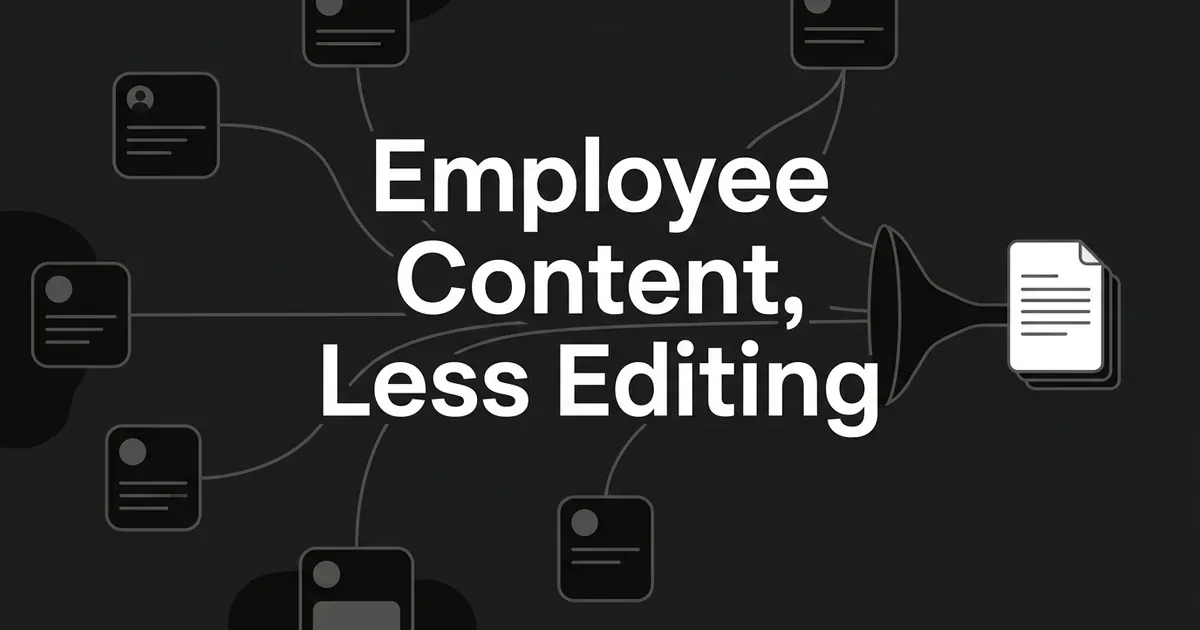
If you run a small SaaS team, you probably already know that the best material for your blog sits in the heads of your engineers, support staff, and salespeople, and you probably also know how hard it is to get it out. This guide walks you through setting up a standing program for employee generated content, so that busy people can share what they know on a regular basis and you don't end up rewriting every submission from scratch. By the end you'll have an intake path, a short brief, a clear split between editing and fact-checking, and a queue that tells everyone what happens next.
Before you start, it helps to know the short answer to the question most founders ask, which is how to get employees who aren't writers to contribute blog content. You ask them for what they know instead of asking them for an article. You give them a clear reader and question, a small structured way to answer, and a review path they can predict. Then you, or one editor, handle the structure and the writing, and the expert checks the facts. The seven steps below fill in the details.
1. Pick topics where employee experience matters
Start with the questions your buyers and customers keep asking. Recurring support tickets, sales objections, implementation problems, and "how do I actually do this" threads are all good sources, because an employee who deals with them every week can say something specific that a generic summary would miss.
For each topic you choose, write down four things: the reader, the question that reader has, why someone at your company has first-hand knowledge of it, and who that person is. If you can't fill in one of those, the topic isn't ready.
Then build a small roster of internal content contributors based on who actually runs into the problem, not who has the most senior title. On a lean team that might be one engineer, one person from support or customer success, one from product, and one from sales. If you're wondering how many people you really need around that roster, our piece on the roles a lean content team needs is a useful check. Give the program one owner, usually you or one marketer, and give each piece one subject expert who is responsible for its accuracy. Add a separate approver only when the topic genuinely needs one.
You'll know this step is done when each planned topic has a named reader, a specific reader question, a reason your company knows the answer, and a contributor who can verify it.
Common mistake: Picking topics only because they are easy to publish or have good keyword volume. Search demand doesn't replace expertise. Google's guidance on people-first content asks whether the page serves a real audience, shows first-hand experience, and helps the reader reach their goal, and that's a useful test to run before you commit a contributor's time.
2. Set expectations and boundaries before you ask for anything
A request to "write something for the blog" is open-ended, and that's why it tends to get ignored. Make participation a defined activity instead. Agree with the contributor, and with their manager where it makes sense, on what you're asking for, roughly how much time it takes, and when you need it.
It also helps to offer several ways to take part, so nobody feels they have to produce an essay to join in. A contributor can:
- Suggest a recurring customer question or a common misconception.
- Send structured notes, an example, or an explanation of a process.
- Review an outline or a draft for technical accuracy.
- Draft a section or a whole article, if they want to and have the time.
Spell out how editorial decisions work. The editor organizes, clarifies, and polishes. The expert confirms the facts and the meaning. The company decides what gets published. Agree on how people want to be credited, and write down what can't be shared, such as confidential customer details or product promises that haven't been approved. Treat those limits as your own company policy to define, and check anything legal with the people who handle that for you.
You're done when each contributor can tell you what they're being asked for, how long it should take, what review they'll get, how they'll be credited, and what they must not disclose.
Common mistake: Calling participation voluntary while quietly making it an unplanned extra job. If there's no agreed amount of time and no support from a manager, an SME content program turns into an occasional favor, and the favors dry up. This is an operating suggestion on our part, not a research benchmark, but it matches how these programs tend to stall.
3. Use one intake path and a short brief
If you want to crowdsource content from employees without it turning into chaos, give them one visible place to submit ideas and see what happened to them. A shared form works, and so does a channel your team already uses. What matters is that nobody has to guess who to message or what to include.
A short intake form can ask:
- What recurring customer question, misconception, or problem does this address?
- Who is the reader, and what should they understand or be able to do afterward?
- What is your main answer or point of view?
- What example, sequence, decision, or trade-off makes the answer concrete?
- What source or internal owner can verify any factual claim?
- What must not be disclosed or promised?
- Who can confirm technical or customer details, and by when?
When you accept an idea, pair it with a brief. A good brief covers the working title, the purpose, the audience, the key message, the scope, an outline or the required points, the assets and references, a single point person, a deadline, and who approves. HubSpot's guidance on content briefs supports the same basics of clear assignment, responsibility, and deadlines. Keep yours light. A brief isn't a research assignment for someone who already has a full-time job, and if you want a working example of how to make it a repeatable system, our piece on a content briefing system goes through it.
The prompts you use matter more than the form. Generic questions get generic answers. The Content Marketing Institute suggests asking things like "What are customers getting wrong about this?" and "What have you changed your mind about?", and those two surface real experience quickly. You can add your own, such as "What does a newcomer usually miss?" or "What's the trade-off people should understand?"
You're done when a contributor can read the brief and know the task, the reader, what you need from them, the deadline, and who will review it, without a separate conversation with you.
Common mistake: Asking for a vague thought leadership post with no reader, question, scope, or evidence. You'll get broad opinions, and you'll be the one reshaping and fact-checking them from the beginning. If that's the kind of content your team wants to avoid, our note on what counts as thought leadership is a helpful companion.
4. Capture expertise in a format the contributor can finish
Employee generated content works best when you ask for substance before you ask for polished writing. Short prompts that invite concrete answers work best: what happened, how the person noticed the problem, what steps or decision followed, what worked and what didn't, what a customer should watch for, and what is still uncertain. Ask them to separate their own experience from general claims, and to attach a source for anything that needs evidence.
The input should be specific enough that you can draft without guessing. For a technical process, ask for the actual sequence and its limits. For a support pattern, ask for the recurring issue and a safe, anonymized explanation. For a sales misconception, ask for the question buyers ask and an accurate answer, not details from a specific deal.
Some people will want to write the draft themselves, and that's fine. Give them the same reader, scope, and outline you'd give anyone else. A draft is one acceptable way to contribute, and it isn't the price of joining. The workflow guidance from CXL says plainly not to expect experts to write full blog posts, and recommends that the editorial team shape the material while keeping the expert's voice. If you want help with that second part, our guide on adding original insight to a draft covers how to keep the expert's reasoning visible.
You're done when a submission has a clear answer, supporting detail or an example, the relevant caveats, and a way to check the important facts, and you can say what the article's main point is without making up the missing expertise.
Common mistake: Sending a blank document and saying "write something." That hands topic selection, structure, writing, and editorial judgment to the person who is least comfortable with them.
5. Edit for the reader, then send the expert a focused fact-check
Give one person responsibility for structure, clarity, audience fit, and the voice of your blog. That person can turn structured notes into a clear article, remove repetition, add the transitions, and flag statements that nothing supports. They keep the expert's reasoning and vocabulary where it helps the reader, and they never fill a gap with an invented product fact, technical step, or experience to make the piece feel complete. When several people are contributing, keeping one brand voice across many contributors is mostly this editor's job.
It helps to keep two kinds of review separate:
- Editorial review: you or your editor own the purpose, structure, clarity, and fit with the brief.
- Expert review: the contributor confirms that the technical statements, examples, limits, and attributed views are accurate and still say what they meant.
Then send the expert a focused request. Ask them to correct factual errors, missing constraints, or changed meaning. Don't ask them to line-edit style unless a change alters what they meant. Bundle your questions together so nobody gets pulled into several rounds of piecemeal feedback. A single consolidated fact-check round is an operating practice that we suggest, and the research behind this guide doesn't set a number for how many rounds are right, so adjust it to what your team can handle.
Pro tip: Ask for a response to specific questions or marked claims, never a general "thoughts?" A narrow request lets the expert spend their few minutes on the parts that only they can judge.
This is also the step where brand context can save you real time. If your voice, positioning, and product details live in one place that the writer or the tool works from, you aren't re-explaining them on every article. In DeepSmith, Deep IQ holds your company, products, personas, and brand voice as structured context that the platform uses when it produces content, so an article starts closer to your voice and your product facts. It doesn't check what a contributor knows, and the expert still confirms anything that depends on their expertise. If you'd like to set up the same thing by hand, our guide on documenting your brand voice for humans and AI is a good place to begin.
You're done when the editor can publish a clear article with no open factual questions, and the expert has confirmed the claims and meaning that depend on them.
Common mistake: Treating expert approval as a rubber stamp, or as a request that the expert copyedit the article. The editorial team should do the editorial work, and the expert should be able to correct what only they know.
6. Map the approvals, publish, and keep the piece accurate
A good SME content program has a written path from idea to publication. Write down who owns each stage, who verifies which claims, which approvals are required, and when review counts as finished. The U.S. Department of Labor's guidance on content governance recommends identifying everyone involved, mapping planning, publication, accuracy review, and any required approval, and planning how content is maintained over time. It also says the exact workflow depends on the organization, which is a good reminder to keep yours proportionate.
Set a simple review rule. The expert verifies the subject matter. Legal, security, product, or leadership review is routed in only when the content or the claim makes it necessary under your policy, and not for every routine article. Before you publish, check for permission and confidentiality limits, quotes and examples, product promises, and any claim that could go out of date.
Let the expert see the final version that will actually go live, so they can catch an accidental change in meaning. Then record who owns future updates, so that someone can mark the article for review, correction, or retirement when a product or process changes. If you want a ready-made structure for the checking stage, our article on human review and QA gates lays out where those checks usually go.
You're done when, for each article, the publishing owner, the expert, any conditional approver, the point at which review is complete, and the person who owns updates are all known.
Common mistake: Making every stakeholder a required approver, or leaving approval undefined. The first creates a bottleneck, and the second leads to arguments late in the process about who had the authority to say yes.
7. Run it as a visible queue that fits your capacity
Keep a simple calendar or queue with a status for every item. A practical set of statuses is: idea submitted, accepted, briefed, contribution in progress, editing, expert fact-check, conditional approval, scheduled, published, and update needed. These labels are a suggestion, not a standard, so rename them to fit.
Plan around the real people who contribute and review. The Content Marketing Institute's guidance stresses that content should draw on a range of viewpoints, and it names experts, writers, editors, designers, and distribution roles as possible participants. For a sense of how distributed publishing works at a large company, Nielsen Norman Group describes the ConocoPhillips intranet process, where employees and experts could submit content, a central team managed global content, and each of 15 locations had one to four local publishers. That's a description of one organization's intranet, so don't read it as a staffing ratio for a SaaS blog. It does point out that the local publishers did this alongside their other full-time jobs, which is why an efficient process mattered so much there, and it matters for you too.
Choose a cadence your editor and your experts can sustain. The sources behind this guide don't give a universal publishing frequency, so start small and see what holds up. Our piece on a realistic content cadence for teams where marketing is one of several jobs is worth a look if you're unsure where to start.
After a pilot, look at where the work gets stuck. Useful things to track include how many ideas are accepted, where items stall, how much editor time each piece takes, how often the editor is missing facts, how many review rounds each piece needs, and whether the published pieces answer the questions they were meant to. These are diagnostics to help you adjust, and nothing in the research sets targets for them.
Recognize your internal content contributors, too. Credit them as authors where it fits, share the published piece inside the company, and tell them how their input was used. People keep contributing when they can see what happened to their time.
This is also where a content platform can take over the production side. Once the topic and the expert's input are agreed, the work of turning an idea into an article involves research, planning, writing, internal and external linking, a cover image, and publish-ready metadata. In DeepSmith, ideas move through New Ideas and Planned Content, and the Writer produces the article with those pieces in place, so the editor's time goes to the expert's material and the final read. If you'd like to see how that fits a small team, take a look at our article on setting up an AI-assisted editorial workflow when you're the only editor.
You're done when contributors and reviewers can see what's next, who owns it, and what's blocked, and the cadence is one the team can actually support.
Common mistake: Measuring success only by how many pieces went out. A lot of articles without first-hand expertise, accuracy, or reader value is not a working program.
What to do next
The easiest way to crowdsource content from employees is to start small. Pick one topic this week and run it through the whole path with one contributor: the brief, the structured input, one edit, one focused fact-check, and a published piece. You'll learn more from that single run than from planning the full program, and you'll see exactly where your own editing time goes. If you're the one who has been carrying the blog, it's also a good time to read why founder-led content stalls so you know what you're moving away from. Once the first run works, add a second and a third contributor, and keep the queue visible as you grow.
If you'd like help with the production side of that loop, you can start a free trial of DeepSmith and see how the Writer handles research, linking, and metadata once your experts have supplied the substance.