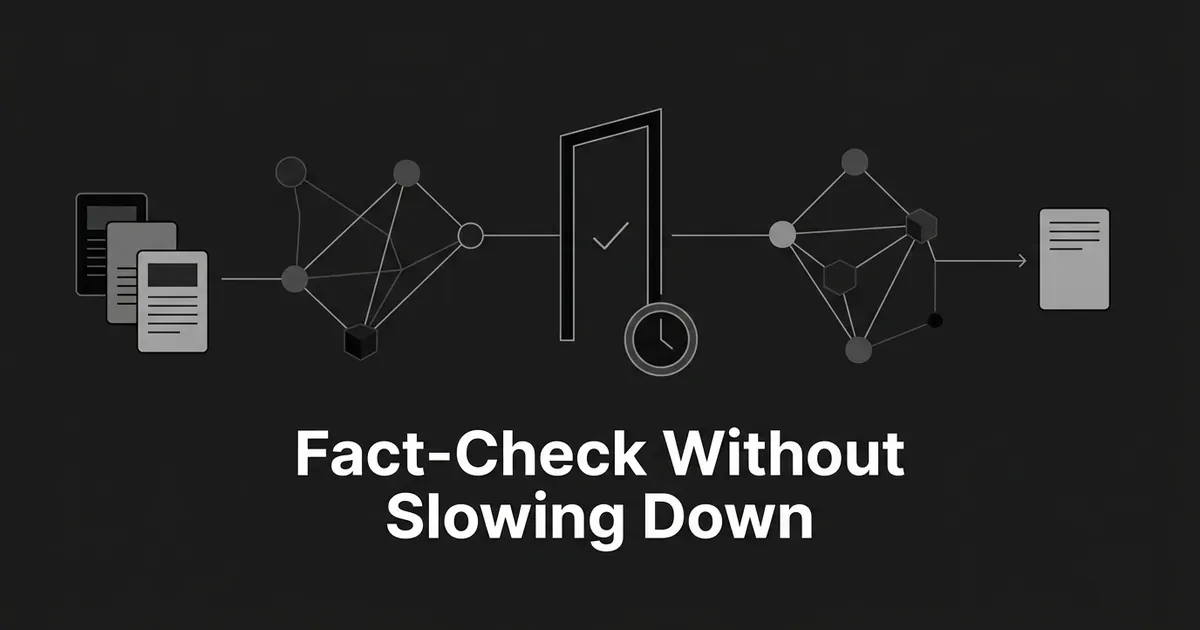
If you run a content team, you probably already know that fact checking content matters, and you probably also know how easy it is for it to turn into the slowest part of your week. This guide is for the person who owns the pipeline and wants a verification pass that catches unsupported claims and bad citations before they go live, without adding a new queue that everything sits in. By the end you will have a small, time-boxed gate with a named owner, two review lanes, and a simple way to see whether it is helping or getting in the way.
One thing to settle up front. This guide is about where the check sits, who owns it, when it is a full pass or a spot check, and how long it gets. It does not teach you how to verify a single claim or spot a made-up source. For that part, the guide on how to fact-check an AI draft covers the techniques, and you can plug them into the gate you build here.
Why a fact check pipeline stalls so often
Most teams that struggle with this don't have a shortage of care. They have a shortage of structure. The check happens when someone remembers, it covers whatever the reviewer happens to notice, and nobody is sure whether it is finished. So it either gets skipped when things are busy, or it grows until every article waits on it.
A small study of fact-checkers gives a feel for the real tension. Researchers interviewed eight members of fact-checking teams from two organizations, and the people they spoke with described how hard it is to check things both robustly and promptly. It is a small interview study, so it isn't a benchmark for how long your articles should take. It does show that the speed problem is a normal one, even for people whose whole job is checking.
The fix is not a heavier process. It is a clearer one, and a clearer content accuracy process is mostly a matter of writing a few decisions down. You decide in advance which pieces need how much checking, who does it, how long they get, and what happens when the time runs out. Then the gate runs the same way every time and nobody has to argue about it.
A quick note on the numbers you will see below. The 15 and 45 minute caps are starting points for a pilot. Nothing we found establishes a standard time limit for a marketing article, so treat them as settings to test and adjust with your own data.
1. Sort every piece into a review lane before it is written
Start by giving each planned piece a review tier, and do it before production, not after the draft lands on someone's desk. Two lanes is enough to begin with: routine, and elevated risk. The lane tells the reviewer whether this piece gets a spot check or a full pass, so they aren't deciding from scratch every time.
Some content belongs in the full lane almost by default. Glean's guidance on AI content review workflows separates low-risk content from higher-risk material and lists examples that should get deeper scrutiny or escalation: regulated claims, executive messaging, pricing pages, customer-facing policy language, competitive claims, product commitments, customer-data references, legal or compliance language, and financial projections. You can use that list as a starting set and add signals of your own. Label your own additions as your team's policy rather than as universal rules, so nobody mistakes them for an industry standard.
A spot check can fit routine pieces where none of those signals apply, like a straightforward how-to or an internal update. The important part is that you define what the spot check covers. A spot check with no defined sample is just a skipped check with a nicer name.
You are done with this step when the tier, the lane, and the reason for any escalation are written down on the content item itself. If you plan work in a tool like DeepSmith, Planned Content is a natural place for that, since giving an idea a date is what plans it and you can add the lane note at the same moment. The point is that the decision is made at planning time and travels with the piece.
Where people go wrong: sending every piece through the same heavy review creates work that doesn't pay for itself, and sending every piece through a light check ignores the fact that some mistakes cost far more than others. Don't assume a piece is low risk just because it is short or familiar. A short post that quotes a price is still a pricing claim.
2. Put the gate near publication, after the draft is stable
Place the accuracy check late in the process, once the draft is stable enough to review and before final approval. Treat it as its own gate, separate from copy editing. If it is placed too early, the content will still be changing and you will check the same claims twice. If it is placed after publishing, it is a correction process and not a way to verify claims before publish.
Editorial teams have worked this way for a long time. An educational journalism text on fact-checking describes it as something that happens after stories have been written and edited but before they are finalized, and a broadcaster's 2025 editorial guidance requires a fact-checking procedure at program completion. Those are newsroom policies and not rules for marketing teams, but the placement logic carries over well.
Add one rule here that saves a lot of grief. If a later edit changes a factual statement or the source behind it, the affected piece goes back through the gate before it publishes. Without that rule, a clean check on Tuesday gets quietly undone by a "small tweak" on Thursday.
You are done with this step when the final approver can see a recorded pass, or a documented exception, before anything is published. A piece with an unresolved factual issue, or with required checks that weren't finished, is not ready.
Where people go wrong: treating the gate as a place to fix everything. The next step is about keeping it narrow.
3. Keep the scope to claims and their sources
The gate has one job, which is to look at factual assertions and the citations attached to them. For a full pass, that means every factual assertion and its citation. For a spot check, it means a sample, and you write down how the sample is chosen. Give reviewers three simple outcomes to pick from: cleared, changes required, or escalate.
It helps to say out loud what the gate is not. It isn't a check on voice, structure, SEO, or general line editing, and it isn't a plagiarism or originality check. Those jobs live elsewhere in your pipeline. If the accuracy reviewer starts rewriting headings, you now have a second editorial round with a different name, and ownership gets blurry. If you want a separate pass for line-level cleanup, the AI draft editing checklist is a good fit for that stage.
You are done with this step when the scope is visible to the reviewer before the timer starts, and each required item has a recorded outcome.
Where people go wrong: letting the reviewer's attention drift to whatever bothers them most. Give them the scope on the handoff, and ask them to put anything outside it in a separate note for the editor.
Common mistake: adding "while you're in there, can you also tighten the intro?" to the request. It sounds small, and it is exactly how a 15 minute spot check becomes a 40 minute edit.
4. Name the people who do the work and make the call
Every piece that goes through the gate needs three roles filled by named people: a reviewer who owns the accuracy pass, an author or content owner who resolves requested changes, and one accountable approver who decides whether the piece moves on. A subject-matter expert can be the reviewer when the topic needs specialist knowledge. For higher-risk work, having someone other than the author do the check is a sensible local policy, though you should present it as your policy, not as something research requires.
The single approver is the part teams skip, and it is the part that keeps things moving. The content approval example we reviewed assigns work, consultation, and final accountability to separate roles, with one accountable person acting as the decision point. When a draft goes to a group with no clear decider, you tend to get conflicting comments and a lot of waiting. Writers, editors, subject-matter experts, and approvers shouldn't be treated as interchangeable. A writer drafts, an editor shapes voice and structure, a subject-matter expert confirms accuracy, and an approver confirms the piece is ready.
If you have a very small team, one person may hold several of these roles. That is fine for low-risk work. For anything in the full lane, try to make sure the person who wrote the claim isn't the only one who signs off on it.
You are done with this step when the content item shows a reviewer, a revision owner, a final decision-maker, and a due time for the review.
Where people go wrong: copying five people on the review "to be safe." It feels careful, but it is how a simple check turns into a week of replies.
5. Start with explicit time caps, then adjust them
This is the step that keeps the gate from becoming a bottleneck. For a pilot, try an active review cap of 15 minutes for a routine spot check and 45 minutes for a standard full pass on an ordinary article. Remember that these are proposed starting settings and not published benchmarks. Your first month of data will tell you whether they are too tight or too loose.
Here are a few ways to make the caps work in practice.
- Start the timer when the reviewer actually has the assigned draft and the review materials, not when the request was sent.
- Track active review time separately from time spent waiting in a queue, because those two have different fixes.
- Give unusually long or complex pieces a separately scheduled review window, so they don't quietly eat the cap meant for ordinary ones.
Then decide what happens at the cap, in advance. When time is up, the reviewer records the outcome. If the required coverage isn't complete, or something needs more work, the piece is marked blocked and routed to the named owner or approver with a bounded next action. It is not approved to hit a target. The timer limits the work and it doesn't lower the standard.
This is the one rule that most affects whether people trust the gate. If a piece can pass because the clock ran out, the gate is just a delay with a checkbox.
You are done with this step when each lane has a stated cap, an escalation path, and a rule that unfinished work can't be marked as passed.
Where people go wrong: treating an overrun as someone's personal failure. More often the article had more review work than the lane was built for. That is a signal to change the lane definition or the cap, not to blame the reviewer. The opposite mistake is lowering the required coverage on high-risk content just to hit the time.
6. Make the handoff and approval cycle easy to finish
A lot of the elapsed time in review is waiting and re-sending, not checking. A clean handoff takes most of that out. Send one assigned version of the draft along with the review scope, the deadline, and the person who handles revisions. Keep the comments and the status in one shared place so nobody has to hunt through email and chat to find what was said.
A fact check pipeline moves faster when the reviewer returns one consolidated list of accuracy issues rather than a trickle of notes through different channels. Keep final approval as a go or no-go decision. It shouldn't open a fresh round of edits by default.
A content approval document from a public-sector team gives a useful picture of this. It uses a one-week feedback window and aims for one to two feedback rounds, with the expectation that the first round of feedback is thorough. That is an example of designing the process with explicit deadlines, not a standard turnaround for fact checking and not something to copy as a number. What carries over is the idea of bounding the number of rounds.
If your drafts live in a content platform, it helps when the review happens in the same place the piece will be published from. In DeepSmith, finished articles land in Produced Content, where you can review, edit, and publish, so the reviewer works on the version that will go out. Webhooks can also send a signed notification when a piece's content status changes, which you can use to open a review task in whatever tool your team already tracks work in. To be clear about the limits, none of that checks a claim for you. It just gets the right draft in front of the right person without extra forwarding.
You are done with this step when the reviewer knows which version to assess, where to record the result, and who resolves conflicting direction.
Where people go wrong: sending the review request with no deadline and no version label, so the reviewer starts on an old copy and the author edits a different one.
7. Watch the numbers and tune the lanes
Once the gate is running, give it a few weeks and then look at how it is behaving, because that is how you learn whether you can still verify claims before publish at the pace you publish. Track at least these things: active review time, queue waiting time, the share of pieces routed to the full lane, the number of blocked or escalated pieces, how many revisions come back to the author, and total time from draft handoff to publication.
Collect a baseline first and set targets only after you have seen your own workload. It is tempting to pick a target in the first week, but you won't know yet whether a slow week was caused by the gate or by something unrelated.
What you are looking for is where delay actually comes from. Is it the queue before review starts, a scope that is too wide, unclear ownership, or repeat rounds? Each of those has a different fix. A long queue is a staffing or scheduling problem. A wide scope means the lane definitions need tightening. Repeat rounds usually point back to the handoff.
Pro tip: keep a short note on why each piece went to the full lane and why any review went over its cap. After a month, the repeated reasons tell you what to change, whether that is the routing rules, who is available, or what you send to reviewers.
You are done with this step when you can tell whether delay comes from queueing, scope, unclear ownership, or repeat review, and there is a regular point on the calendar to adjust the policy.
Where people go wrong: measuring only the minutes the checker spent. That can make the process look quick while waiting time and rework pile up somewhere else, so measure elapsed time and review outcomes as well.

What to expect from automation
It is reasonable to want software to take some of this off your plate, and parts of it can help. Tools can enforce process steps, like making sure a piece has a lane assigned, a reviewer named, and a status set before it can move on. They can send reminders and keep the record in one place.
What they can't do is take over the editorial responsibility. A flag from a tool still needs a person to decide what to do with it, and you shouldn't tell anyone that a workflow or a writing tool has verified factual accuracy unless you have independently established that it did. The same goes for DeepSmith. Deep IQ holds your company context and your trusted-sources list, which gives writers and reviewers a shared starting point, and Content Studio produces publish-ready drafts with research and links built in. Neither one replaces the person who checks the claims. Your content accuracy process still needs a human-owned gate, and the steps above are what make that gate small enough to keep.
What to do next
If you only do one thing this week, take the next five pieces on your calendar and tag each one with a lane and a named reviewer. Run the 15 and 45 minute caps on those five, so you can see how fact checking content behaves with a clock on it, note where the time actually went, and adjust. After a month you will have your own numbers, which are worth far more than any number from outside your team.
If you would like one place to plan, produce, review, and publish while you set this up, you can start a free trial of DeepSmith and run your first few pieces through it.