Funnel, Flywheel, or Buyer's Journey: Comparing Content Strategy Models
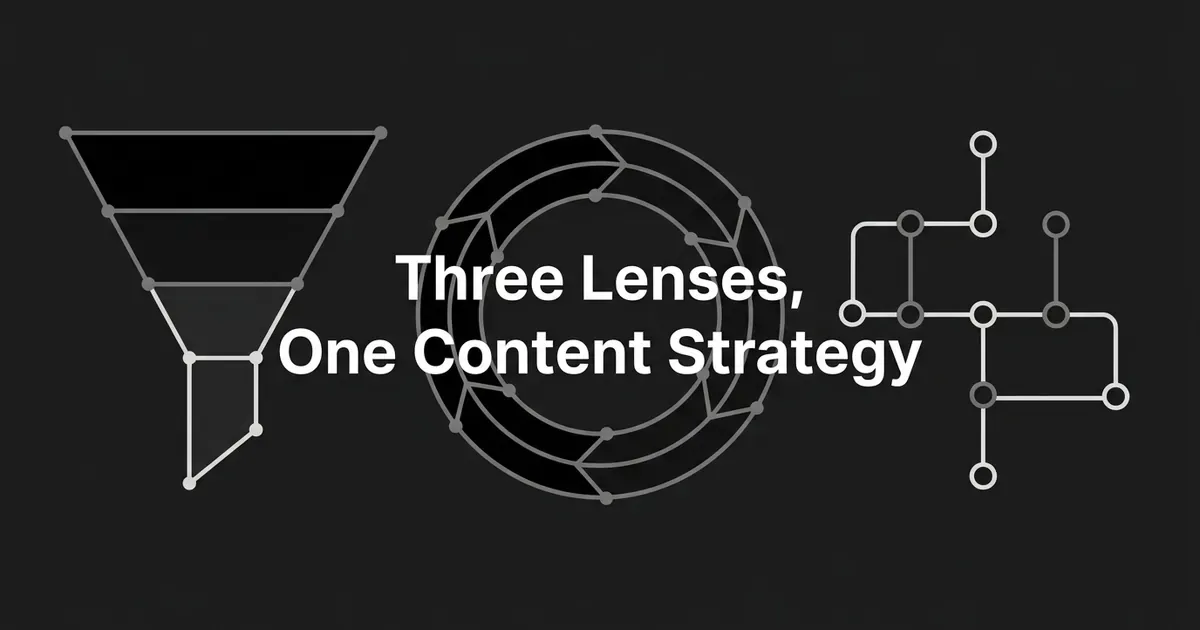
You've probably typed tofu mofu bofu into a search bar at some point, trying to remember which acronym goes with which stage, and then found three different diagrams that all claim to explain how content strategy works. That mix-up is normal. The content marketing funnel, the buyer's journey, and the flywheel are not three names for the same idea. They are three different lenses, built to answer three different planning questions, and the content marketing funnel vs flywheel question people usually ask is really a question about which job you need the model to do.
Here is the short version. Reach for the funnel when you need to audit whether your content library covers early, middle, and late buying interest. Reach for the buyer's journey model when you need to understand what a specific reader is trying to figure out right now. Reach for the flywheel when the problem is what happens after someone buys, and whether your happiest customers are helping you grow or just sitting quietly in a CRM.
| Model | What it centers on | Best planning question |
|---|---|---|
| Funnel | The prospect's progress toward a conversion | Do we have the right content at each stage? |
| Buyer's journey | The buyer's changing questions and tasks | What does this reader need to know right now? |
| Flywheel | The customer relationship and what drives growth | What creates momentum, and what adds friction? |
What the content marketing funnel actually shows you
The funnel sorts content by where someone sits on the path to a purchase, usually top, middle, and bottom. It is a portfolio model, not a map of any one person's brain. Its whole job is to let you ask a blunt question: do we have enough of the right content at each part of the buying process, or are we lopsided.
Top of funnel, or TOFU, is for someone becoming aware of a problem or a category. They may not know your brand yet and might not have a clearly defined need. This is where blog posts, social content, podcasts, and question-answering pages live, and it's usually measured by reach, traffic, and new audience growth.
Middle of funnel, or MOFU, is for someone who understands the problem and is now researching solutions, categories, or providers. They want education, comparison, and evidence, so this is where webinars, guides, comparison pages, and case studies sit. Funnel.io's guide on the model reports a 75% conversion rate for effective middle-of-funnel strategies, though that figure comes from their own analysis rather than a universal industry number, so treat it as one data point rather than a promise.
Bottom of funnel, or BOFU, is for someone close to deciding. They want proof, reassurance, and a clear next step: demos, trials, testimonials, pricing pages, and implementation details. The same Funnel.io guide notes that only 14% of marketing teams say they actively prepare BOFU content, against 50% who produce TOFU material regularly. If that split sounds familiar, it's worth checking your own calendar against it.
What the funnel is good at: telling you where your content library is thin. What it hides: it implies a straight line, and real buyers don't walk one. Someone can land on a comparison page before ever reading an introductory post, or come back to early-stage material after their situation changes. A funnel stage is a planning label for your content, not a diagnosis of the person reading it.
What the buyer's journey model actually shows you
Where the funnel organizes your content, the buyer's journey model organizes the reader's experience. It describes the questions, tasks, and decisions someone works through before, during, and sometimes after a purchase, and its center of attention is the buyer, not your content calendar.
The familiar three-stage version uses awareness, consideration, and decision, which map loosely onto TOFU, MOFU, and BOFU. But the labels aren't interchangeable. TOFU, MOFU, and BOFU describe your content's position in a portfolio. Awareness, consideration, and decision describe what the person reading it is actually trying to do. The overlap is real, but so is the gap.
In awareness, the buyer is asking whether something needs to change at all: is this actually a problem worth solving. In consideration, they're asking what approaches could address it and what criteria matter. In decision, they're asking which specific provider to choose and how to justify that choice internally. Some versions of the model add a retention stage, where the question shifts to whether the purchase is delivering value and whether it's worth renewing.
Gartner's research on B2B buying pushes this further. Instead of one linear sequence, Gartner frames the modern B2B path as six buying jobs: problem identification, solution exploration, requirements building, supplier selection, validation, and consensus creation. Buyers work these jobs in parallel, revisit them, and don't complete them once in a tidy order. That framing matters because it exposes work a simple three-stage journey can compress or skip entirely, like the internal work of building consensus across a buying committee.
What the buyer's journey model is good at: matching content to what a real person is trying to accomplish, including readers who arrive out of order or represent different stakeholders in the same deal. What it hides: your own operating model. It doesn't show you which team owns which content, where handoffs create friction, or how a happy customer turns into a referral. Those are flywheel questions.
What the flywheel actually shows you
The flywheel is HubSpot's circular growth model, built around three phases: attract, engage, and delight. Where the funnel treats a conversion as the end of the story, the flywheel treats the customer as an ongoing source of energy for the whole system. A delighted customer creates word of mouth, referrals, and repeat business, so the model puts customer success inside the growth engine instead of filing it away as a separate department's job.
Attract means using useful content and real expertise to start relationships with the right people, without forcing an immediate sale. Engage means making evaluation and buying easier through comparisons, guidance, and responsive support on the buyer's own timeline. Delight means helping customers actually succeed after they buy, through onboarding, support content, and the kind of resources that turn a customer into someone who recommends you.
The flywheel also gives you a vocabulary the funnel doesn't have: force and friction. Force is anything that speeds the wheel up, like a strong referral program or a genuinely frictionless signup. Friction is anything that slows it down, like poor handoffs between marketing and customer success, or a support experience that leaves customers frustrated. HubSpot has said its own shift toward this model led it to invest more heavily in customer marketing and onboarding, which is a real example of a model reshaping where a team spends its budget, not just how it draws a diagram.
What the flywheel is good at: making post-purchase growth, retention, and advocacy a normal part of content planning instead of an afterthought. What it hides: the buyer's journey model's level of detail. "Engage" can cover everything from early research to procurement, and "delight" can span onboarding, support, and advocacy all at once, so it won't tell you exactly what a buyer needs to read at a specific moment.
Content strategy models compared, axis by axis
Laying the three models against each other, axis by axis, makes the real differences clearer than describing them one at a time.
Unit of analysis. The funnel looks at a stage or a cohort of prospects. The buyer's journey looks at a person, a role, or a specific buying job. The flywheel looks at the customer relationship and the system built around it.
Shape of movement. The funnel narrows and points one direction, which is useful for showing volume and drop-off but can wrongly suggest a one-way path. The buyer's journey can be linear, cyclical, or task-based depending on the audience, and should reflect how complicated the actual purchase is. The flywheel is circular by design, built to show recurrence and momentum rather than a fixed order.
What gets measured. The funnel tracks reach, progression, qualification, and revenue. The buyer's journey model tracks whether content actually helped someone move toward an informed decision, which is harder to quantify but closer to what the reader experienced. The flywheel tracks retention, churn, referrals, and the friction between teams that slows growth down.
Treatment of what happens after the sale. A basic funnel often stops at the conversion line, though a more complete one can add retention stages. The buyer's journey model only includes post-purchase behavior if the chosen version adds it. The flywheel makes the post-purchase relationship the center of the whole model.
Handling of buyers who don't move in a straight line. The funnel can only represent nonlinear behavior with extra conventions bolted on, since its default shape already implies progression. The buyer's journey model, especially versions built around buying jobs, handles this best: it can show loops, re-entry, and parallel work by different stakeholders. The flywheel captures recurrence and feedback at a system level, but not the specific order or content need of any one task.
This is really what the content marketing funnel vs flywheel comparison comes down to: one is built to audit your content portfolio, and the other is built to audit your growth system. They're not competing for the same job.
When each model actually wins
Choose the funnel when your problem is coverage. If you suspect your content library is heavy on broad awareness posts and thin on comparison or proof content, the funnel gives you a fast way to check, and to organize a calendar around a more balanced mix. It's also the easiest model for talking to leadership about pipeline and drop-off, because it maps cleanly onto the numbers they already track.
Choose the buyer's journey model when your problem is relevance. If your team keeps producing content that doesn't seem to land, the buyer's journey model forces you to ask what a specific reader is actually trying to accomplish, rather than what stage a spreadsheet says they should be in. It's also the better fit for B2B content with several stakeholders, since it can represent the different questions each person in a buying group is working through at the same time.
Choose the flywheel when your problem is what happens after the sale. If onboarding content, customer education, and advocacy programs keep getting deprioritized in favor of new-lead content, the flywheel gives those efforts a formal place in the plan and a reason for leadership to fund them. It's also the right frame when you suspect friction between teams, not a lack of content, is what's actually slowing growth.
None of this requires building three separate content systems. A workable approach uses the buyer's journey to understand what your audience needs at each moment, the funnel to check that your content portfolio actually covers early, middle, and late commercial intent, and the flywheel to extend the plan past the purchase into onboarding, retention, and advocacy. Once you've got these content strategy models compared side by side like this, the choice usually stops feeling like a philosophy debate and starts feeling like a checklist: match the model to the question you're actually asking this quarter. If you're ready to put a chosen model into practice, mapping buyer stages across a topic cluster is the natural next step.
If auditing your own coverage against a model like this sounds like the kind of task that quietly eats an afternoon, that's usually a sign the process is manual rather than a sign the funnel is the wrong tool. DeepSmith's Content Map classifies every page on your site onto a funnel stage automatically and shows where awareness, consideration, or decision coverage is thin, so the audit becomes something you check rather than something you build from scratch. You can try it during the 7-day free trial at deepsmith.ai.