Your cluster probably answers one person very well. That person is the champion, and they are not the one who signs. In a long B2B deal, your champion has to carry the argument to finance, IT, security, legal and procurement, and if your pages stop at their desk, the deal stalls somewhere you never see. This guide shows you how to map a topic cluster to the whole buying committee journey, so every role gets an answer and your b2b buying committee content works for the group instead of one fan.
You need one topic, a spreadsheet, and about two hours to start. That's genuinely it. Nobody maps a buying committee journey perfectly on the first pass, and you don't have to either.
Step 1: Name the committee and draw the decision boundary
Pick one buying situation, not your whole market. Write down the problem, the solution category, the kind of account, and the decision you want the group to reach. That's your boundary.
Now list every role that touches it. Not job titles, roles. Initiator, champion, economic buyer, executive sponsor, technical evaluator, security reviewer, procurement, legal, end user, subject-matter influencer, and whoever holds a quiet veto.
For each one, capture six things: what they own, when they show up, what they need to believe, what they can block, where they research, and who introduces them.
Then draw the lines between them. Champion to economic buyer. Technical evaluator to security. Procurement to legal. That relationship map matters more than the list, because your content has to survive the handoffs.
Keep your guesses and your evidence in separate columns. A role you heard named on one call is a hypothesis. A role that signed something is a fact. Good b2b content mapping starts by admitting which is which, and you can go fill the gaps later.
You're done when every role has a name, a job and a blocking power, and no one is filed under "decision-maker."
Where people go wrong: treating the first contact as the whole committee. One contact proves one participant exists. It proves nothing about the other eleven. Forrester's 2026 research puts a typical business decision at more than a dozen internal stakeholders plus a set of outside influencers, and it found procurement acting as a decision-maker in roughly half of buying cycles.
Step 2: Map each role's entry point across the three shared stages
Use three stages as your spine:
- Recognition. The organization decides the problem is real and worth acting on.
- Selection. Requirements get written, approaches get compared, a shortlist forms.
- Validation and approval. Claims get checked, risk gets resolved, someone signs.
Here's the part most maps get wrong. Those stages are shared, but nobody moves through them together. Your champion may be comparing vendors while legal has never heard of you. Your economic buyer may appear only when a business case is needed. Security often arrives late and asks questions you should have answered early.
So mark each role's own status separately: unaware, problem-aware, solution-aware, evaluating, validating, approving, blocking. Add the trigger that pulls them in.
A workable sheet has these columns: role, shared stage, role status, entry trigger, question being answered, decision affected, blocking power, evidence required, content asset, handoff, owner, review date.
That grid is the heart of your map. Everything after this fills it in.
You're done when every role has at least one real question in every stage where it can influence, approve or block.
Where people go wrong: treating a funnel stage like a calendar week. Committee stages overlap and loop backward. Multi stakeholder buyer journey content has to hold up when someone reads step seven before step one, because that is how it actually gets read.

Step 3: Collect the real questions each role asks
Roles don't search in role language. They search in their own words, and that's what you need.
Pull questions from sales calls, support tickets, win-loss notes, customer interviews, CRM comments, site search, and the questions your technical, legal and procurement reviewers actually sent last quarter. Ask your champion the best question of all: what did you have to forward internally, and what did you have to rewrite yourself?
For every role and stage, write at least these nine:
- Definition. What is this problem?
- Impact. Why act now?
- Fit. Does this apply to us?
- Comparison. How is this different from the alternatives?
- Proof. What evidence backs the claim?
- Risk. What breaks, and how is it controlled?
- Execution. How does rollout and support work?
- Commercial. What does it cost, and how do we judge value?
- Approval. What has to be signed before we buy?
Buyers are also asking those questions somewhere you can't watch. 6sense's research on generative AI in buying found the large majority of B2B buyers now use LLMs during the process, often separately, with different tools, forming private opinions before anyone talks to you. So write the questions the way a person would type them into ChatGPT, not the way a keyword tool phrases them.
This is where a visibility tool earns its keep. DeepSmith's AI Visibility stores the prompts you care about, checks them on a schedule, and keeps the full answer history, so you can see what each role's question actually returns. Discover Prompts will generate a starter set from your product, persona and buyer-stage context. You still have to add the awkward ones yourself, because the technical, security and legal questions are the ones a generic starter set misses.
You're done when every cell in your grid has a question in buyer language, a reason it matters, and either an answer or an honest gap. That question list is the raw material for all of your b2b buying committee content, so keep it somewhere your whole team can add to it.
Pro tip: write the forwardable answer for each question. Your champion should be able to send IT one technical page, the CFO one business case and legal one bounded terms summary without rewriting your argument for you.
Step 4: Give every question one page and one job
Group your questions by the answer they need, not by keyword similarity. Then give each page one primary job.
Here's a page map that holds up across most B2B categories:
| Page job | Who it serves | Format that works | Done when |
|---|---|---|---|
| Define the problem | Initiator, champion | Explainer, diagnostic, checklist | The reader can name the problem and its cost |
| Establish relevance | Champion, sponsor | Strategic guide, executive brief | The problem connects to shared priorities |
| Explain the options | Champion, influencers | Comparison, evaluation framework | The reader can compare using stated criteria |
| Prove value | Economic buyer, sponsor | Business case, TCO model | Inputs, assumptions and risks are explicit |
| Prove technical fit | Technical, security, privacy | Architecture, integration, data-flow guide | Questions are answered or routed to real docs |
| Prove operational fit | End users, operations | Tutorial, workflow, pilot plan | The reader can picture daily use |
| Resolve commercial and legal risk | Procurement, legal | Checklist, SLA and terms explainer | It says what's known, promises nothing unapproved |
| Support approval | The whole group | Decision checklist, mutual action plan | Open issues, owners and next actions are visible |
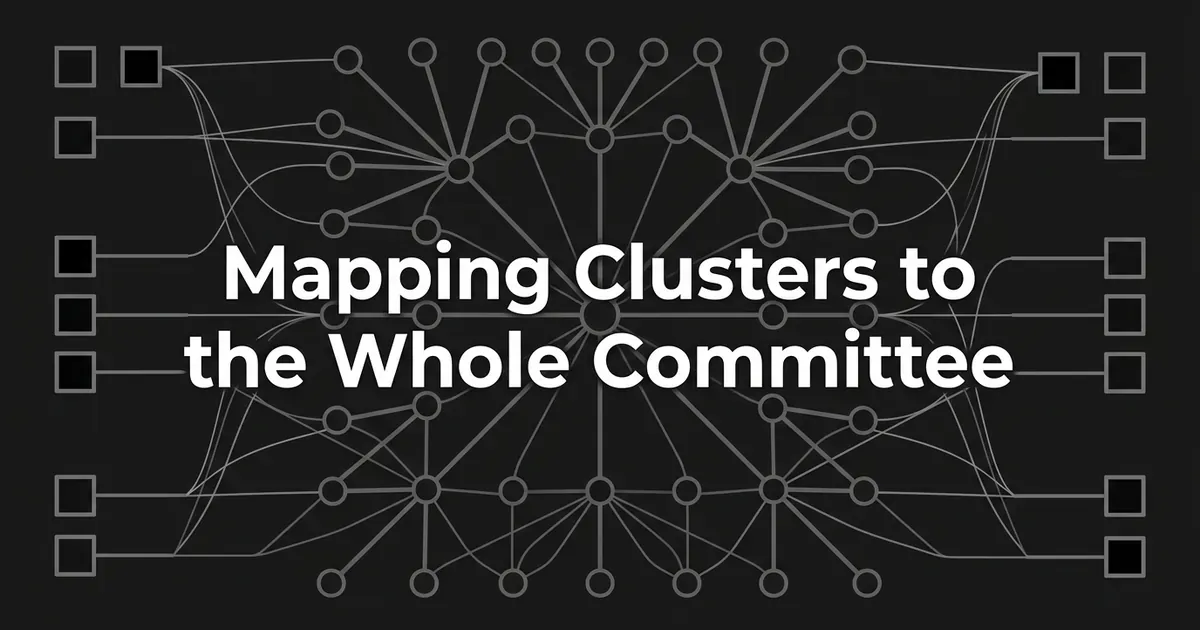
Your hub explains the shared decision and routes each role to the right spoke. Your spokes go deep on one question each. Link sideways too, so your security page reaches implementation and your ROI page reaches adoption assumptions.
One page can serve several roles, and often should. What it must not do is bury the technical answer or the pricing answer under three screens of general marketing copy. If a reviewer has to scroll to find their part, they leave and tell your champion the page was useless.
You're done when every page has one question, one job, one audience, one stage and a link path forward.
The most common mistake in stakeholder content b2b work: building a separate page per job title with the same generic answer inside. That's duplication wearing a persona costume. Split a page only when the question, the evidence or the decision genuinely changes.
One more thing worth sitting with. Gartner's research on buying groups found that content built for the group's shared decision helped teams reach consensus, while content tailored to one individual actively worked against it. The same research found most B2B buyer teams hit unhealthy conflict on the way to a decision, and the teams that reached consensus were far more likely to call the deal a good one. Your job is not to make each person happy. It's to help them agree.
Step 5: Audit what you already have and find the empty cells
You almost certainly have more coverage than you think. Go find it before you commission anything.
Inventory your pages and label each by topic, role, stage, question, format, evidence strength, freshness and owner. Then score every cell in your grid:
- Covered. One current page answers it directly and links onward.
- Partial. A page mentions it but skips the evidence or the next step.
- Missing. Nothing answers it.
- Conflicted. Two pages say different things.
- Untrusted. The claim exists with no source, author or date behind it.
Now prioritize by decision risk, not search volume. This is the one habit that separates real b2b content mapping from a keyword list with personas stapled on. A missing definition costs you some discovery. A missing security or procurement answer can end the deal. Sort for high blocking power, late stage, competitor-owned, and any cell where an AI engine answers the question without you in it.
This is the step where tooling saves you a week. DeepSmith's Content Map crawls your site and your competitors' sites into one shared taxonomy, classifies every page onto a granular topic and a funnel stage, and shows you per-topic depth plus coverage gaps and untapped topics. Sitemaps re-check every 24 hours, so new pages fold in on their own. Opportunity Agents then read that data and return content ideas with the justifying data point attached, which is what lets you defend a backlog instead of guessing at one.
It handles topic and stage. It does not know your committee. You add the role and decision-risk layer by hand, and that layer is the whole point.

You're done when you have a gap backlog with a status, an impact, a proposed page, an owner and a priority for every weak cell.
Where people go wrong: counting a topic as covered because it's mentioned once. Coverage means a direct answer, real evidence, a named owner and a route to the next decision.
Step 6: Build pages that work when someone lands cold
Assume every reader arrives mid-committee, with no context, forwarded a link by someone else. Write for that. It is the defining constraint of multi stakeholder buyer journey content, and it changes how every page opens.
Put the answer near the top, before the persuasion. Use headings that match the actual question. Define your terms. Separate what you claim from what you assume. Show your evidence and name your limits. Add the table or checklist where it makes the page easier to scan.
Then wire the links deliberately:
- Hub to every major role question.
- Every spoke back to the hub.
- Champion pages to the forwardable finance, technical, security and legal answers.
- Technical pages to implementation and adoption.
- Business-case pages to assumptions and risk.
On the AI side, keep your feet on the ground. Google's own guidance is that a page has to be indexed and eligible to show with a snippet before it's eligible for generative features, and that there's no special file, markup or format that buys you a place in an AI answer. Normal, helpful, original content is still the work. AI-generated pages get no advantage, and pages produced mainly to game rankings break the spam policies.
Production is where most teams run out of road, and it's the one part you can hand off. DeepSmith's Writer turns one planned idea into a finished, brand-grounded article with internal and external links, a cover image and publish-ready metadata, with keyword coverage, heading structure, schema and citation-ready formatting built in during writing rather than bolted on. Deep IQ holds your positioning, personas, voice and content types, so a page written for procurement still sounds like you. Autowrite will produce a scheduled piece hands-off and land it in Produced Content for review.
That's execution support, not a guarantee. Nothing here promises you a citation.
You're done when a reviewer can land on any spoke, find its answer, check its claims, tell who it's for, and reach the next page without using your site search.
Step 7: Measure coverage, then re-test your prompts
Two numbers, not one.
The first is coverage: what share of your required role-stage cells are covered, partial, missing, conflicted or untrusted. That's a spreadsheet count, and it's the honest measure of whether your buying committee journey map is finished.
It is also the number to show your boss. Traffic goes up and down for reasons you don't control. Coverage only moves when you do the work.
The second is visibility: mention rate, citation rate, share of voice, sentiment, trend, which of your pages get cited, and which prompts drive those citations. DeepSmith reports those across ten engines, ChatGPT, Gemini, Perplexity, Claude, Google AI Overviews, Google AI Mode, Grok, Meta AI, Microsoft Copilot and DeepSeek, with coverage rising by plan. Pro tracks ChatGPT, Grow adds Perplexity, Scale adds Gemini, and Enterprise covers all ten.
Keep mention and citation apart in your head. A mention means an engine named you. A citation means it linked your page as a source. They move differently and they mean different things.
Here's the trap. Do not treat citation rate as a committee-coverage metric. An engine can cite your champion page all day while your security, legal and pricing questions sit unanswered. Run separate prompt sets by role and stage. Track problem definition, alternatives, ROI, integration, security, implementation, procurement and approval as their own tests. Check the answer history and see which competitor pages win the ones you lose.
You're done when every cell has an owner and a review date, every priority prompt has a baseline, and every new page is connected to the map.
What to do next
Pick one high-value topic. Build the role-by-stage grid for it. Find the three riskiest empty cells and write those first, not the ones with the best search volume.
Then re-run your role prompts a month later and see what moved. That loop is the actual job, and it gets easier every time you run it.
You don't need the whole map finished this quarter. You need one topic mapped honestly, and three pages that answer someone nobody else has been writing for.
If you want the measurement and the production in one place, start a DeepSmith free trial and test it on your real prompts, your real coverage data and a real draft. Seven days, no contract.