Your AI visibility score went up this quarter. Nice. But do you actually know where you're winning and where you're vanishing?
Here's the uncomfortable part. One topline number hides almost everything that matters. You can post a healthy overall mention rate and still be completely absent from the prompts that close deals. You can dominate "what is" questions and never show up when someone asks "best tool for my exact situation."
That's the trap this guide gets you out of. You'll learn to segment AI visibility two ways, by buyer stage and by persona, so you can see the real story under the average. We'll tag your prompts, build a simple segment report, and turn the gaps into a content list you can actually work from. Let's take it one step at a time.
Reframe the number: measure coverage, not mentions
Before you tag anything, shift how you think about the score.
A single aggregate number answers the wrong question. It tells you how often you appear. It doesn't tell you whether you appear where a buyer is deciding. Those are very different things, and only one of them moves revenue.
So measure the share of buyer-journey prompts you're cited on, not the raw count of generic mentions. This is the same logic you already use for funnel coverage in paid or SEO, applied to the answer-engine layer. The market has a name for it: AEO funnel coverage, the percentage of awareness, consideration, and decision prompts where an AI engine names you as a recommendation.
Why does this matter so much right now? Because AI-referred visitors convert at a much higher clip than traditional organic in early published benchmarks. One March 2026 synthesis put AI search conversion at roughly five times Google organic. Treat that as a directional, vendor-affiliated figure rather than gospel. But the direction is clear: the buyers arriving through AI answers are further along and more ready to act. Being invisible on their decision prompts costs you more than a low awareness score ever will.
Buyer journey AI visibility is the frame for this whole guide. Two axes carry it: funnel stage and persona. Get those in place and the average stops lying to you. Strong AEO funnel coverage means you show up across all three stages, not just the easy ones at the top.
Set your two segmentation axes
Every serious tool in this space converges on the same two primary cuts. Start here.
Axis one: funnel stage. When you slice AI visibility by funnel stage, you're asking where each prompt sits in the buyer's journey.
- Awareness. The person knows they have a problem but not which brands matter yet. Prompts are definitional and educational. "What is LLM brand tracking?" "How do you measure visibility in AI search?"
- Consideration. They've defined the problem and are building a shortlist. Prompts compare approaches and surface criteria. "Best tools to track ChatGPT mentions." "Top LLM brand tracking platforms."
- Decision. They've narrowed to one or a few options and want validation, pricing, or fit confirmation. "Is this tool worth it for a team of five?" "Brand A vs Brand B for SaaS."
Axis two: persona. Who is asking? Segment AI visibility by persona the same way you segment any B2B audience: by role, seniority, industry, and company size. A CMO at a mid-market SaaS company asks different questions than a data lead at an enterprise. Those questions pull up different answers, and you win or lose them separately.
The most useful persona tag is compound. Not just "marketer" but something like CMO | VP | SaaS | Mid-Market. That compound form is what actually maps to a distinct set of prompts.
Once these two axes are working, you can layer secondary cuts when you're ready: intent type, geography, product line, and engine. Don't reach for those on day one. Two axes first. You can always go deeper later.
Tag every prompt with a simple four-part scheme
This is the step everything else stands on, and it's simpler than it sounds.
Give each prompt four tags:
- Funnel stage. One of Awareness, Consideration, Decision.
- Persona slug. A compound string like
<Role> | <Seniority> | <Industry> | <Company Size>. Use a fixed vocabulary for each slot so tags stay consistent. - Topic or product area. A short slug:
llm-tracking,pricing,integrations,compliance. - Intent. Informational, Commercial Investigation, or Transactional.
So the prompt "What is LLM brand tracking?" becomes [Awareness] [CMO | VP | SaaS | Mid-Market] [llm-tracking] [Informational]. That's the whole scheme. Four tags, one line, done.
A few conventions keep this clean, and they matter more than they look:
- One stage per prompt. "Best tool pricing" is Decision, not Decision-plus-Consideration. Pick the dominant intent and commit.
- The persona tag describes the asker, not the answer. A CFO asking about a marketing tool is still a CFO persona.
- Keep the persona list tight. Five to eight personas is the workable range. Go past that and every cell in your report ends up empty.
- Tag when you create the prompt, not at report time. Retro-tagging breaks your historical comparisons and invites inconsistent labels.
- Write down the rubric. One page defining Awareness vs Consideration vs Decision, and what counts as each intent. Without it, two teammates tag the same prompt two different ways.
If you're running your tracking on a spreadsheet, this is where you add four columns. If you're on a platform built for this, the tags should live on the prompt itself. DeepSmith carries stage and persona tags per prompt inside its AEO module, so the segment cuts you're about to build come from the tag, not from a separate sheet you maintain by hand. Either way, the principle is the same: tag once, tag consistently, and never tag from memory.
Not sure your prompt set is even the right one to tag? That's a fair worry, and worth a quick gut check against how you choose which prompts to track before you invest in labeling. Tag the prompts that reflect real buyer questions, not the ones you wish people asked.
Build a starter tagged set you can trust
You don't need hundreds of prompts to start. You need enough per cell to make the comparison mean something.
The rule of thumb: aim for 15 to 25 prompts per segment cell (each stage-and-persona combination) so per-cell numbers aren't just noise. A 30-prompt starter that spans all three stages and a few personas is plenty for a first pass. Keep the split roughly even, about a third per stage, so no single stage dominates the picture by accident.
Here's what a slice of that starter set looks like:
| Prompt | Stage | Persona | Topic | Intent |
|---|---|---|---|---|
| What is LLM brand tracking? | Awareness | Marketer | llm-tracking | Informational |
| How do you measure visibility in AI search? | Awareness | Marketer | llm-tracking | Informational |
| Best tools to track ChatGPT mentions | Consideration | Marketer | llm-tracking | Commercial |
| Best LLM tracking tool for enterprise teams | Consideration | CMO | llm-tracking | Commercial |
| Is this tool worth it for a team of five? | Decision | Marketer | pricing | Transactional |
| Compare the top three platforms for SaaS | Decision | Marketer | pricing | Transactional |
Notice it deliberately reaches into every stage and more than one persona. That coverage is the point. A set that's all awareness prompts will tell you you're doing great and quietly hide your decision-stage problem.
If you're staring at a blank spreadsheet, this is a good moment to lean on prompt discovery rather than brainstorming from scratch. DeepSmith's Discover Prompts generates a starter set from your product, persona, and buyer-stage context, which gives you tagged coverage across the grid without you inventing every question yourself. Building the set from zero is its own project, and one worth doing carefully. Here we're focused on slicing and reading what you already track.
Pick the right metric for each segment
You have a few metrics to choose from, and picking the wrong one for the wrong comparison is the most common way teams fool themselves. Let's keep it clear.
Mention Rate. The share of AI responses to a prompt set that name your brand. Responses naming you, divided by total responses. Good as a baseline presence check, but it blurs presence with prominence.
Citation Rate. The share of responses that link one of your pages as a source. This is distinct from mention rate, because you can be named without being cited, and cited without being named. If you've never separated those two, the difference between citations and brand mentions is worth ten minutes of your time.
Share of Voice. Your brand's share of all brand mentions in the set, measured against a fixed competitor group. Your mentions divided by your mentions plus every competitor's. This is the metric to use for cross-stage or cross-persona comparison, because it normalizes for prompt volume and for who you're up against.
Here's the rule that saves you from a bad conclusion. Don't compare mention rates across stages. Awareness prompts and decision prompts have different volumes and different competition, so their mention rates aren't on the same scale. Compare share of voice within a stage instead. If you want the fuller menu of what to track and what to ignore, our guide to AI visibility metrics that matter lays out the KPIs worth your attention.
One more you can add later: sentiment. Among the responses where you appear, what share are positive, neutral, or negative? A brand can be praised in awareness answers and quietly knocked in decision answers, which is a fit-versus-expectation signal you'd otherwise miss.
Build the segment report
Now you turn tagged prompts and a chosen metric into something you can read at a glance. The standard deliverable is a stage-by-persona view, and it has a few blocks.
Block one: the stage breakdown. A simple bar chart of mention rate, citation rate, and share of voice across Awareness, Consideration, and Decision. This is your AI visibility by funnel stage in one picture, and it's the single most diagnostic view you'll build, because the topline-lies pattern jumps out immediately.
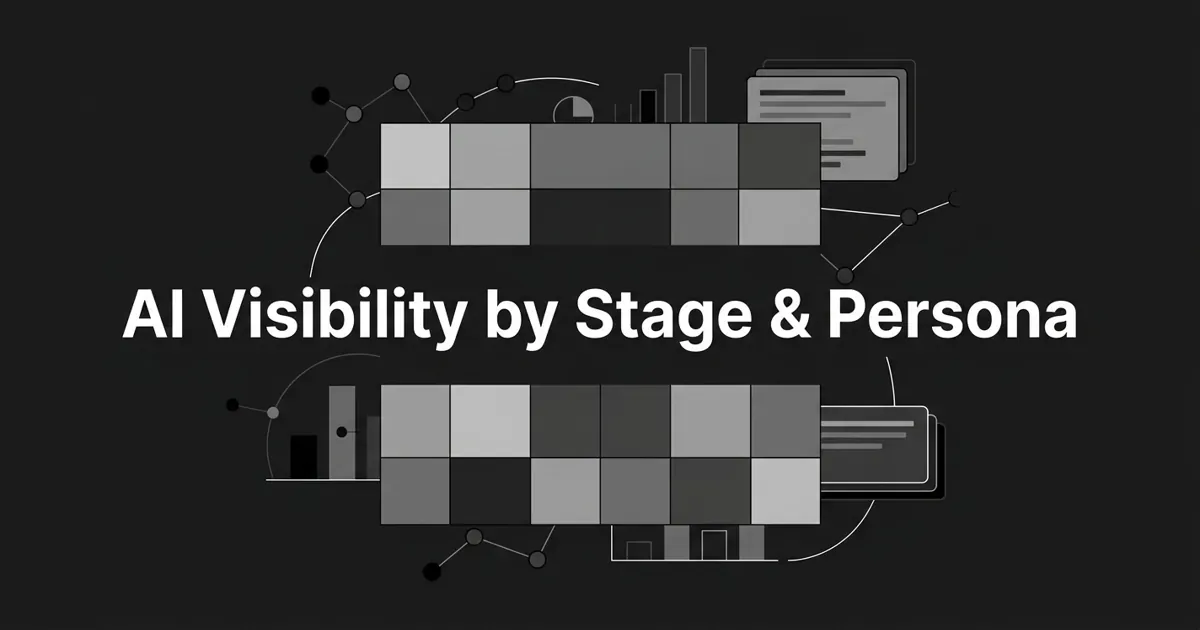
Block two: the persona-by-stage heatmap. Rows are your personas, columns are the three stages, each cell holds your chosen metric plus the prompt count behind it. Color it by quartile, red to green, so the gaps light up.
Block three: the decision-stage shortlist view. One bar per persona comparing you against your top competitors, on decision prompts only. This is the buyer's-shortlist battle, and it's where deals are quietly won or lost.
Block four: the gap list. A plain table sorted by gap size, largest first. Columns: persona, stage, your share of voice, the leader's share of voice, the gap. This is the list your team actually works from.
Block five (optional, high-leverage): the engine split. The same stage breakdown, broken out by engine. More on that in a moment.
If you'd rather not rebuild this in a spreadsheet every week, per-persona and per-stage cuts are first-class views inside DeepSmith's AEO module, with mention and citation rates already broken out by segment. The value isn't the chart, though. It's what the chart makes you notice.
Read the report: four patterns to look for
Once the heatmap is in front of you, you're looking for one of four repeating shapes. Each one points at a different fix.
Awareness-strong, decision-weak. You show up in "what is" and "how does" queries and disappear on "best," "compare," and pricing queries. This is the most common failure mode by far. The diagnosis is usually simple: you have education content and not enough comparison or proof content. The fix is to build the content formats that get cited at the bottom of the funnel, comparison pages, case studies, honest pricing, and third-party reviews. Winning high-intent buyer questions is a different job than winning explainers, and it needs different pages.
Decision-strong, awareness-weak. You win comparison and pricing prompts but never appear in the category explainers. In-market buyers find you; brand-new prospects never encounter you while they're still learning. The fix runs the other direction: produce top-of-funnel explainers, glossary entries, and conceptual guides.
Strong on one persona, invisible on another. This is where AI visibility by persona earns its keep. Marketing personas see you and technical or financial personas don't. Your content is angled for one slice of the buying committee. The fix is to produce content for the missing persona's natural questions, in the sources they trust.
Strong on one engine, weak on another. More on this next, because it deserves its own step.
Notice that reading the report is really about turning a color into a cause. A red cell isn't a verdict. It's a question: why aren't we here, and what page would fix it? If you want a broader tour of the ways teams end up invisible, these AI search visibility mistakes are worth a scan alongside your own heatmap.
Split by engine when the segment view isn't enough
Here's a pattern that surprises almost everyone the first time. You can be strong on one engine and near-invisible on another for the exact same segment.
Why? Because different engines trust different sources. Published source-mix analyses show the overlap between what ChatGPT and Perplexity cite is small, only about one in ten domains appearing in both. Perplexity has leaned heavily on community and review sites; other engines lean more on editorial and reference content. Same prompt, different source diet, different answer.
So when a segment looks weak, split it by engine before you conclude anything. The fix for a weak engine isn't more content in general. It's earned presence on the specific domains that engine trusts. The way citation selection differs across engines is the map for where to focus.
This is the step where an aggregate really falls apart. A blended score across five engines can look fine while hiding that you own one and lose four. Break it out.
Turn segment gaps into a content action list
A report you don't act on is just a nicer-looking average. This last step is where segmentation pays off.
Walk a quick worked example. Say a brand runs 120 tracked prompts across three engines for a month. The stage breakdown shows Awareness at 64%, Consideration at 41%, and Decision at 12%. Right away you know decision-stage visibility is the company-wide problem, not a persona quirk.
Now the persona-by-stage heatmap adds detail. Marketing personas are strong at awareness and thin at decision. Non-marketing personas, say RevOps and data leads, are thin everywhere, not just at the bottom. That tells you two separate stories: a decision-content gap for the whole brand, and a whole-funnel gap for the personas your content never addresses.
Sort the gaps by size and the action list writes itself:
- Build decision-stage content for the personas with the biggest decision gaps first.
- Build awareness content for the personas sitting under 50% everywhere.
- Protect and refresh the decision content for the persona you already win, so you don't lose the position.
This is where the loop closes. To know which pages to build, you need to know which competitor pages are winning the prompts you're losing. DeepSmith's Pages and Competitor Citations views surface exactly which competitor URLs earn citations on your tracked prompts, so a red cell in your heatmap turns into a specific page to answer. And when you want to pressure-test your gaps against rivals on equal footing, benchmark your AI visibility against competitors with the prompt and engine sets held constant, so the comparison is fair.
Common mistake to avoid: don't optimize only for decision prompts because they feel closest to revenue. Decision prompts are high-intent but low-volume. Skip awareness entirely and you never enter the consideration set in the first place. Segment so you can balance both, not so you can chase one.
What to do next
You don't have to build all of this in a week. Start smaller than you think.
Tag your existing prompts with just the two primary axes, stage and persona. Run one stage breakdown. See whether your awareness strength is quietly hiding a decision gap. That one chart usually changes the conversation, and it takes an afternoon, not a quarter.
From there, add the heatmap, then the gap list, then the engine split as you get comfortable. Momentum matters more than completeness here. Buyer journey AI visibility is a habit, not a one-time report, and every cut you keep makes your next content decision a little sharper. Each cut you add makes the average a little less able to lie to you. If you want to zoom out first, a full AI visibility audit gives you the wider baseline this segmentation then sharpens, and the AEO glossary is a handy reference for any term here that's new to you.
Want to skip the spreadsheet entirely and see your visibility already sliced by stage and persona? You can start a free DeepSmith trial and get real segment data before you commit to anything.