Your cluster can look impressive and still only speak to one kind of reader. Twelve articles, one hub, plenty of internal links, and almost every page answering a problem-level question nobody has moved past yet. That is the quiet failure of most clusters, and buyer stage content mapping is how you catch it. By the end of this guide you will have audited one full funnel topic cluster, found the stages you are missing, and turned those gaps into a short list of pages to write next.
You need three things to start: a list of your cluster's current URLs, a spreadsheet, and about two focused hours.
Step 1: Write the decision path before you open a single page
Pick one central topic. Then, before you look at what you have already published, write down where the cluster is supposed to take someone.
Buyer stage content mapping works backward, so start at the end. What is the final decision a qualified reader should be able to make after reading your cluster? Work backward from there. What must they weigh before they can decide? What must they understand before they can weigh anything?
That backward walk is your decision path, and it is the fastest way to map buyer journey to content without getting lost in keywords.
Write a short brief with these lines:
- The central topic, defined in plain language.
- Who the reader is and what they already know.
- The problem or opportunity the cluster addresses.
- The solution category, without naming one vendor yet.
- The final decision the cluster should support.
- Your existing hub or pillar page.
- Candidate subtopics.
- One primary question for each planned page.
- The primary stage for each question.
- The handoff to the next stage.
Done when: you can describe the cluster in one sentence, name the decision it supports, and list at least one real Awareness question, one Consideration question, and one Decision question. They have to represent different buyer states, not three rewordings of the same query.
Where people go wrong: starting from a keyword export or a list of existing URLs. That gives you a keyword inventory, not a stage map. The other common slip is letting the hub swell until it tries to be every spoke at once. A hub orients and routes. Spokes answer narrower questions in depth.
If this step feels slow, that is normal. It is the only step that decides whether the rest of the audit measures anything real.
Step 2: Build your buyer-question matrix
Now turn the decision path into rows. One row per real buyer question, written the way a person would actually ask it, not as a keyword label. This matrix is the artifact you use to map buyer journey to content, one line at a time.
Here is what each stage sounds like.
Awareness. The reader has noticed something is wrong but may not have words for it yet. They ask questions like "Why do projects keep going off track?" or "How can I improve team productivity?" Your job is to define and validate the problem, not to pitch.
Consideration. They have named the problem and are exploring ways to solve it. They ask "What approaches solve this?" and "Which method fits a distributed team?" and "Software versus spreadsheets, what are the trade-offs?" Your job is to explain the options, the criteria, and the trade-offs honestly.
Decision. They have narrowed the field and want proof and a clear next step. They ask "Which product fits our requirements?" and "What does it cost?" and "How does option A compare with option B?" Your job is to remove the last of the uncertainty.
For every row, record the topic, the buyer question, the primary stage, the search intent, what the reader already knows, the answer they should leave with, the evidence you will need, the format, the handoff to the next stage, the existing URL if there is one, and a status of keep, improve, create, merge, redirect, or validate.
Done when: every important question carries exactly one primary stage, and each stage holds questions that reflect its own buyer state.
Pro tip: search intent is a diagnostic, not a rule. Informational intent often lands in Awareness, commercial intent often lands in Consideration, and transactional intent often lands in Decision. Look at the actual question and the actual results before you commit to a label.
Where people go wrong: treating "beginner," "best," "versus," and "pricing" as interchangeable flavors of the same thing. "What is this problem?" and "Which vendor should I choose?" need different evidence, different structure, and different calls to action. They are not neighbors.
Step 3: Inventory every page in the cluster
Export or crawl what you already have. All of it.
Not just blog posts. Include the hub, documentation, product pages, comparison pages, the pricing page, and any conversion assets that belong to this topic. A full funnel topic cluster is everything a buyer can reach on the subject, not the subfolder your blog lives in.
For each URL, capture the title, the topic, the primary question it answers, its stage, its format, when it was last updated, how well it is evidenced, its current internal links, its CTA, and any performance signal you have.
Then give every page one of five dispositions:
- Keep. Right stage, right question, current, useful, connected.
- Improve. The role is valid but the page is thin, dated, misaligned, weakly evidenced, or stranded.
- Merge. Two pages answer the same primary question, or one intent got split for no reason.
- Create. The question or the stage is simply absent.
- Redirect or remove. The page is obsolete, inaccurate, duplicative, or has no defensible job.
While you are in there, look for outdated facts, developments the page never absorbed, related terms it never covers, declining rankings or impressions, and a format that does not match what the search results are actually rewarding. Pages that are slipping are often the cheapest wins in the whole audit.
Done when: every URL has a primary question, a stage, and a disposition. No unclassified rows. No "miscellaneous" bucket quietly hiding the pages you could not label.
Where people go wrong: auditing only the pages that already rank. The pages that never got traction are the ones most likely to be sitting in the wrong stage, in the wrong format, with the wrong evidence, or with nothing linking to them. Those are exactly the diagnoses you came for.
Step 4: Score coverage on a topic-by-stage grid
This is the step where the shape of your cluster finally becomes visible. A funnel stage content cluster audit lives or dies on this one grid.
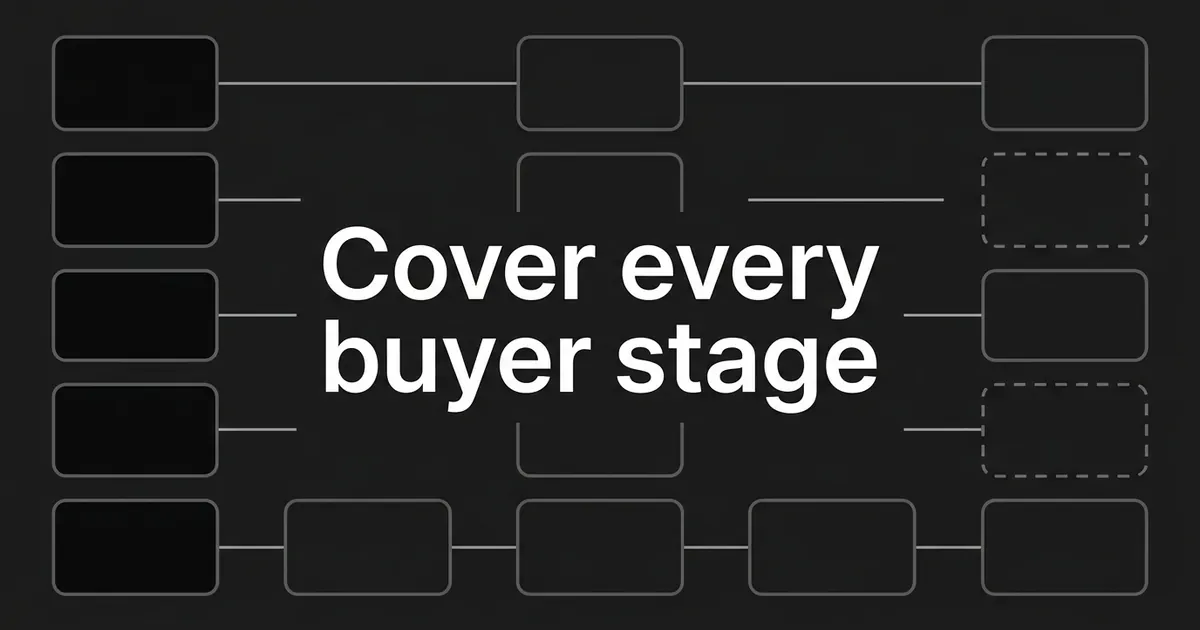
Build a grid. Rows are your subtopics or buyer questions. Columns are Awareness, Consideration, and Decision. Drop each page into the cell for its primary question and stage. One page, one cell.
Then score each cell:
- 0, missing. Nothing answers the question.
- 1, thin. A page exists but it is shallow, dated, badly matched to intent, unsupported, or disconnected.
- 2, covered. A current page answers the question at a sensible depth and format.
- 3, strong. It answers the question well, carries real evidence and a clear next step, and links to the stages on either side.
Write the reason next to every 0 and every 1. Future you will need it.
This score is an editorial audit device. It is not a search engine score, and no engine sees it. Its whole job is to let you look at your awareness consideration decision content in one view and say "that topic is top-heavy" or "we never built the page that helps someone actually choose."
Done when: you can point at top-heavy topics, missing Consideration pages, missing Decision pages, duplicates, and broken handoffs without reopening a single URL.
Where people go wrong: declaring a cluster complete because there is one page in each column. Coverage needs a real question-to-page match. Three pages all circling the same narrow subtopic do not prove you cover the topic broadly.
Doing this by hand is fine for one cluster. It gets heavy across a whole site, which is where a tool earns its keep. DeepSmith's Content Map crawls and enriches every page on your site, classifies each one onto a granular topic and a funnel stage of Awareness, Consideration, or Decision, and shows page counts and funnel distribution per topic. A topic that is thin, top-heavy, or missing its Decision pages shows up as a distribution, not as a hunch. Sitemaps are rechecked every 24 hours, so new pages fold in on their own.

Step 5: Check your gaps against competitors and the search results
A gap is only worth filling if you can fill it better than what already exists. So take each missing or thin cell and go look.
For every gap, record which competitor pages answer the question you do not, what format they use, what evidence they bring, and which stage they seem to serve. Compare like with like. A competitor's Decision comparison page is not the equivalent of your Awareness explainer, even when both are about the same topic.
Then validate the intent yourself. Search the question and read the top results. If the results are templates and checklists but your planned page is a general overview, that is a format gap. If the results are comparisons and your page only defines the category, your page probably belongs earlier in the journey than the query does.
Done when: every high-priority gap has a reason attached, grounded in your matrix, the current results, and what competitors actually publish. And the page you plan has a clear way to be more useful, more specific, or better evidenced than what is winning now.
Common mistake: treating a competitor's page as proof that you should write the same page. Competitor coverage is evidence of a gap. It is not a brief. Do not inherit their structure, their claims, or their unsourced statistics.
Step 6: Prioritize the gaps into a short, ordered backlog
You will not close every cell this quarter. Good. Pick the ones that move the cluster the most.
Sort the work into four buckets: update, create, merge, and link. Then, for each candidate, note the stage gap and question, how relevant it is to the business, whether you can actually evidence it, how strong the existing page is if there is one, the competitive pressure, the production effort, anything it depends on, and who owns it.
Five rules make most of these calls for you:
- Update when the topic is right but the page is missing evidence, examples, freshness, related terms, or whole sections.
- Create when the question or the stage is genuinely absent.
- Merge when several URLs compete for one primary question and none has a distinct stage role.
- Link when the content already exists but readers have no way to move between stages.
- Defer a Decision page when you cannot yet substantiate the claims, pricing, proof, or requirements it needs. A claims-heavy page with invented evidence is worse than no page.
You will see a 40/40/20 mix quoted a lot, roughly 40% Awareness, 40% Consideration, and 20% Decision. Treat it as a starting heuristic from one marketing guide, nothing more. A cluster in an established category usually needs more Decision support. A cluster in a category people have not heard of needs more Awareness. Let your matrix and your real demand set the ratio. The requirement is that every relevant stage is represented, not that you hit someone else's percentages.
Done when: your backlog is a short ordered list, each item tied to one gap and one stage. "Write more content" is not an action.
If turning audit findings into a defensible queue is the part that stalls, that is where DeepSmith's Opportunity Agents help. They read your own Content Map and AI Visibility data and return ideas with the data point that justifies each one attached, including agents for growing Awareness, Consideration, or Decision coverage and for closing a stage gap against up to four competitors at once. You still decide what is worth writing. You just get to defend the backlog instead of guessing at it.
Step 7: Connect the stages, publish, and re-audit
A cluster with a page at every stage and no path between them is still broken. Readers cannot teleport.
Build the paths deliberately:
- Link Awareness articles forward to the most relevant Consideration guide, comparison, or solution explainer.
- Link Consideration pages forward to Decision resources: proof, requirements, pricing, vendor comparisons, demos, trials.
- Link Decision pages back to definitions and implementation guidance, because buyers loop backward more often than funnel diagrams admit.
- Use anchor text that tells the reader what they get next.
- Make the hub a genuine route through the cluster, not a wall of generic links.
Then brief each new page properly: one primary stage, one primary question, the reader's starting knowledge, the answer they leave with, the evidence slots, the format, the CTA, the handoff, and the internal links. Before you publish, check the page for stage purity. It can gesture at the next stage. Its body has to finish the job it was assigned.
After you publish or update, re-audit. Confirm that the new page sits in the cell you meant it to, that no other URL is competing for its question, that it links to the hub and to the stages beside it, that the gap actually closed rather than got renamed, that the evidence and CTA are honest, and that the page is crawlable and indexable like any other.
This is the loop, and it is the part that keeps working. Audit, prioritize, produce, re-audit.

Production is the usual bottleneck here, which is why it is worth naming what closes it. DeepSmith's Content Studio takes an approved idea through research, planning, drafting, and production, and the Writer returns a researched article with headings, internal and external links, metadata, and a cover image. Deep IQ holds your company, product, persona, brand voice, visual guidelines, and content types so drafts are grounded in your real claims instead of a fresh brief every time. Planned Content and Autowrite schedule a piece for a date and produce it there, and Produced Content is where you review and publish. None of that replaces your judgment on stage fit and evidence. It removes the work around it.
Be honest about what full-funnel coverage does not promise
Broad stage coverage makes your site useful for a wider set of buyer questions. That is the real benefit, and it is enough.
It is not a promise that AI engines will cite every page. Google's own guidance is clear that ordinary SEO fundamentals still apply to its AI features, that there are no special optimizations or extra requirements to appear, and that a page has to be indexed and eligible in Search to be usable as a supporting link. Meeting the requirements still does not guarantee crawling, indexing, or serving. AI Overviews and AI Mode may also fan a query out into several related searches across subtopics, which is one more reason a cluster that answers many distinct questions is better positioned than one that answers a few.
So map the question set, make each page genuinely answer its question, connect them, and keep them crawlable. Then measure what actually happens rather than promising it in advance.
Pro tip: keep coverage and visibility in separate columns. A complete matrix means the content exists and fits its purpose. It says nothing yet about traffic or citations.
Measure the audit before you measure the outcome. Count your awareness consideration decision content per topic and stage, count the questions each stage carries, how many 0 and 1 cells you have, how many pages are missing, thin, duplicated, or disconnected, and how many stage handoffs actually exist. After publishing, use stage-appropriate signals: impressions and engagement for Awareness, return visits and resource use for Consideration, trial and demo requests for Decision. A change in traffic or citations does not prove one content change caused it.
For observed AI visibility specifically, DeepSmith's AI Visibility module lets you define your buyer questions as tracked prompts, checks them on a schedule, and reports mention rate, citation rate, share of voice, sentiment, and trend, plus which of your pages get cited and which competitor pages win the prompts you care about. Mention rate is how often AI names you. Citation rate is how often it links to your pages as a source. Those are different numbers and worth keeping apart.
What to do next
Do not try to fix the whole site. Pick your single most important cluster and run steps 1 through 4 this week. The grid alone usually tells you what to write next, and it is the step people skip.
Then rerun your funnel stage content cluster grid after each publishing cycle. Watch for new competitor coverage and new questions your buyers start asking. Keep the hub, the spokes, the handoffs, and the evidence current.
You are probably closer than you think. Most clusters are not empty, they are lopsided, and lopsided is fixable with two or three well-placed pages.
If you want the audit, the evidence-backed backlog, and the production to live in one place, start a free DeepSmith trial and map your first cluster with real data.