If you are tracking a handful of "best tool" and "X vs Y" prompts and calling it AI-search coverage, take a breath, because you are auditing the very last step of a journey the AI has already walked for your buyer. This guide shows you how to map AI prompts to buyer journey stages, so the questions you track span awareness, consideration, and decision instead of clustering at the bottom. It is for the marketing lead who knows AI visibility matters but has no system for organizing it yet. By the end, you will have a labeled portfolio of prompts you can run on a schedule, score, and audit stage by stage.
Here is the good news: you are closer than you think. You do not need hundreds of prompts on day one. You need a way to sort the ones you have, spot the stage where you are invisible, and fix it. Let's build that together.
How the buyer journey moved inside the answer box
The old funnel had a buyer running five separate searches over a week. What causes slow content production. Best AI content tools. This vendor versus that one. Pricing. Reviews. Each search was a chance for you to show up.
AI search compressed all of that into a single answer. A buyer can now ask "what is the best AI content tool for a two-person SaaS team" and get a named, ranked recommendation in one reply. The AI did the consideration work on the buyer's behalf. It assembled the candidates, compared them, and handed over a shortlist.
That changes what you have to measure. When you only track bottom-funnel comparisons, you are watching the tail end of a trip the buyer already took. If you were absent when the AI taught them the category, you were never a candidate for the shortlist, and you cannot win the pricing question that comes after. Skipping a stage collapses the whole funnel behind it.
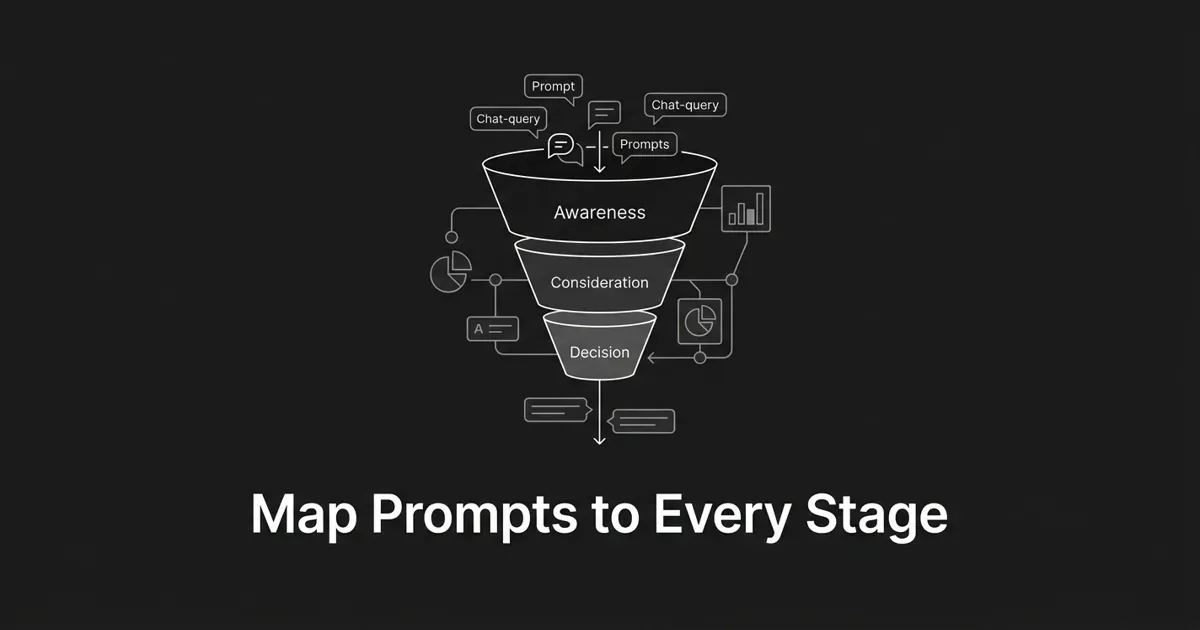
So the fix is not more prompts. It is prompts that cover the full journey. Organizing your AI prompts by funnel stage is how you see the gaps that are quietly costing you revenue, the awareness questions where the buyer never even entered the path your tracking assumes. When you map AI prompts to buyer journey stages this way, your AEO funnel coverage stops being a single vanity number and becomes a diagnosis you can act on.
The five prompt types, and the stage each one serves
Before you sort anything, you need a shared language for what you are sorting. There are two lenses here, and you want both.
Prompt type describes the shape of a question. Funnel stage describes the job that question is doing for the buyer. "Best CRM for startups" is comparative by shape, but consideration by job. "Is this vendor HIPAA compliant" is brand-specific by shape, but decision by job. Tag both, always, and you will never confuse a question's wording for a buyer's intent.
Here are the five prompt types and where they sit:
| Prompt type | Funnel stage | What it does | Example |
|---|---|---|---|
| Informational | Awareness | Reaches buyers before category language exists; seeds your presence | "What causes slow content production for a small SaaS team?" |
| Comparative | Consideration | The heart of AI shortlists; where options get assembled and ranked | "Best AI content tools for a 3-person marketing team versus hiring an agency" |
| Instructional | Consideration to Decision | Buyers ask "how" right before they pick; high intent | "How do I build an AEO strategy without adding headcount?" |
| Brand-specific | All stages | Hygiene: is your brand described accurately when named? | "What does [your brand] do and who is it for?" |
| Transactional or migration | Decision | Late objections; mirrors what your sales team hears | "How do I migrate from one content tool to another without losing rankings?" |
A few rules of thumb to keep in your back pocket. Comparative prompts are usually the highest-value in B2B, because the AI's answer is literally a ranked list of who to buy. Informational prompts are usually the highest-volume, because that is where category education happens. Brand-specific prompts are hygiene, not growth, so track them but do not pour production into them. Instructional and transactional prompts are smaller in number but close deals, because they are how a buyer validates a choice they have nearly made.
That is your map legend. Now let's fill in the map. The seven steps below run in order, and each one tells you what to do, how to know it is done, and where people usually trip.
Step 1: Start from real buyer language, not keyword tools
Open where your buyers actually speak, not where a keyword tool guesses they do. The richest prompts live in your support tickets ("we almost went with a competitor because"), your sales call transcripts (objections, "we're also looking at"), your churn notes, your demo form fields, and your onboarding questions. Add Reddit threads, G2 reviews, niche community posts, and LinkedIn comments on competitor content. You can even ask ChatGPT itself: "what questions do people ask before buying in this category?" Treat that as a starter list, not a verdict.
Collect every prompt in the buyer's own phrasing. Long, conversational, multi-clause. Not tidy head terms.
You are done with this step when you have a long list of prompts written the way people actually talk, with no SEO-style head terms hiding in it.
Where people go wrong: leaning on one keyword tool and treating its output as the whole universe. Keyword tools systematically miss the long, conversational prompts that make up most of what people type into AI engines. If your list looks like a keyword report, you have the wrong list.
If starting from a blank page feels heavy, this is one spot where a tool earns its place. DeepSmith's Discover Prompts generates a starter prompt set from your product profile, your persona, and your buyer-stage context, so you begin with a draft to react to instead of an empty sheet. You still refine it with your real buyer language. The tool just gets you off zero.
Step 2: Tag every prompt with a type and a stage
Now give every prompt two labels. One column for type: informational, comparative, instructional, brand-specific, or transactional. One column for stage: awareness, consideration, or decision. No exceptions, no blanks.
This is buyer stage prompt mapping in its plainest form, and it is the step that makes everything after it possible. Once every prompt carries a stage, you can count how many awareness prompts you track versus decision prompts, and the imbalance jumps out immediately.
You are done when every prompt has both tags and you can count prompts per stage without scrolling or manual sorting.
Where people go wrong: tagging by type alone. "Best content tool" looks comparative, but a buyer asking "best content tool for my mom who runs a bakery" is still standing at awareness. The wording is shape. The intent is stage. Read for the intent signals hiding inside the phrasing: "for my team," "for a startup," "without hiring," "migrating from." Those little qualifiers are the real stage markers, not the words "best" or "versus."
Step 3: Right-size your prompt portfolio per stage
You do not need a giant list. You need a balanced one. Right-sizing your AI prompts by funnel stage keeps you honest about where the effort actually goes. Here are sane bands to aim for:
- Starter, if you are new to this: 30 to 50 prompts total, split roughly 35 percent awareness, 40 percent consideration, 25 percent decision. That is enough to see patterns without drowning in noise.
- Working, once you have an active baseline: 100 to 200 prompts, with the split matched to your actual buyer mix.
- Mature, for multi-product or multi-persona brands: several hundred prompts, sub-tagged by persona, use case, and platform.
Notice the split. Your awareness consideration decision prompts should lean toward the top and middle of the funnel, not pile up at the bottom. Track fewer prompts carefully rather than more prompts carelessly.
You are done when you can justify both your portfolio size and your stage split in a single sentence, an answer to "why these numbers."
Where people go wrong: loading up on decision-stage prompts because they feel closest to the sale. They do convert highest per prompt, but they are useless if the buyer never saw you at awareness. A shortlist you never made cannot be won at the pricing stage.
Step 4: Rewrite vague prompts into buyer-shaped ones
A prompt like "best AI content tool" is a wasted tracking slot. The model picks whoever it likes, and you learn nothing about which buyer's journey is being served. Sharpen each prompt so the AI is forced to recommend for a specific person in a specific situation.
Three templates make this fast:
- Persona plus constraint plus criterion: "What's the best [category] for a [persona] who needs [constraint] and cares most about [criterion]?"
- Vendor comparison for a use case: "Compare [Vendor A] versus [Vendor B] for [use case], including [specific criteria]."
- Job to be done with a trade-off: "How do I [job] without [common risk]?"
You are done when every prompt carries at least one persona, constraint, or criterion modifier, so the AI has to recommend rather than describe.
Where people go wrong: tracking "best [category]" exactly as written. Underspecified prompts give you a coin flip, not a signal. A modifier turns a vague query into a real test of whether you show up for the buyer you actually want.
Step 5: Baseline across at least two AI engines
Now you measure. Run every prompt through ChatGPT plus at least one of Perplexity, Gemini, Claude, or Google AI Mode. For each run, record five things: was your brand mentioned, was a URL of yours cited (and which one), which competitors appeared, your rank inside the answer, and the sentiment or position. Take your first baseline today. Take the second at least 30 days later, on the same day of the week and the same time of day.
You are done when you have a dated baseline table with mention, citation, rank, and competitor fields filled in for every prompt on every platform.
Where people go wrong: testing once and believing it. AI answers are non-deterministic. The same prompt on the same platform can return different brands and different cited URLs on two runs. One snapshot tells you almost nothing. Direction over a window is what you can act on.
Running dozens of prompts across engines by hand, on a schedule, month after month, is exactly the kind of work that quietly falls off your plate. This is the second place a tool genuinely helps. DeepSmith's AEO Overview captures mention rate, citation rate, share of voice, a competitor leaderboard, and a per-platform breakdown on a set schedule, alongside a Pages view of which of your URLs get cited and a Competitor Citations view of which rival pages are winning. You are not re-prompting by hand every month. You are reading a dashboard that is already current. Engine coverage rises by plan: ChatGPT on Pro, Perplexity added on Grow, Gemini on Scale, and all five on Enterprise.
Step 6: Diagnose coverage gaps by stage, not by total score
This is the step that pays for the whole exercise, so give it real attention. A single overall visibility score hides the thing you most need to see. Break it down by stage.
The math is simple, and you can do it in a spreadsheet:
- Pull the prompts tagged to each stage. Step 2 already gave you the labels.
- For each stage, calculate your mention rate: mentions in the stage divided by prompts in the stage.
- Do the same for citation rate, competitor mentions, and competitor citations.
- The stage with the lowest rate is your biggest opportunity, not the stage where you already lead.
That last line is the whole point. Your AEO funnel coverage is only as strong as its weakest stage. Lay your awareness consideration decision prompts side by side, and a brand that dominates decision prompts can still be losing the funnel, because nobody reaches the decision without passing through awareness first.
Three patterns are worth naming as you read your table:
- Strong mention rate but weak citation rate means the AI knows you but cannot find a page to link. The fix is citable evidence: original data, case studies, third-party reviews.
- Strong on consideration but weak on awareness means your comparison content is winning while your category education is invisible. The buyer never enters the funnel your prompts assume.
- Underrepresented on Gemini versus ChatGPT usually means your source footprint (press, Reddit, reviews) is thinner in that engine's retrieval universe.
You are done when you can name your lowest-coverage stage with a number and a one-line reason.
Where people go wrong: optimizing the stage they already win. If you are strong on decision prompts, you do not need more of them. You need to fix the awareness gap that is starving everything downstream. This per-stage view is exactly what the per-prompt and per-stage breakdowns in DeepSmith are built to surface, so the weakest stage is not something you have to hunt for.
Step 7: Turn each gap into one owned asset
A gap is not a verdict. It is an assignment. For each stage where you are thin, ship one definitive piece of content the AI can cite:
- An awareness gap wants category explainers, glossary posts, and "what is" or "why does this matter" pieces that plant you in a category the buyer has not named yet.
- A consideration gap wants comparison posts, alternatives pages, integration articles, and case studies the AI can pull from.
- A decision gap wants pricing pages, migration guides, security and compliance docs, and objection-handling articles tied to what your sales team actually hears.
You are done when every tracked gap has an owner, a target asset, and a re-baseline date on the calendar.
Where people go wrong: publishing a piece and assuming it worked. AI engines re-crawl on their own timelines, anywhere from days to several weeks. The only way to confirm a gap closed is to re-run the same prompts after a full crawl cycle. Ship, wait a cycle, re-baseline, then decide what is next.
What to do next
Do not try to do all seven steps this week. Pick one. If your tracked prompts skew bottom-funnel, and most do, start at Step 6 with the prompts you already have. Split them by stage, run the mention-rate math, and find the one stage where you are quietest. That single number will tell you more than any all-up visibility score ever did.
Then work backward. Source a few real awareness prompts if that stage is empty. Tag them. Baseline them. Ship one asset. This is buyer stage prompt mapping working for you instead of a spreadsheet you dread opening. Momentum matters more than a perfect portfolio, and you only need a smaller first step, not a bigger team.
When you want the sourcing, tracking, and gap diagnosis to run on their own instead of living in a spreadsheet you maintain by hand, that is what DeepSmith is built to carry. You can start a free trial and see your own prompts, mapped by stage, with real data before you pay.