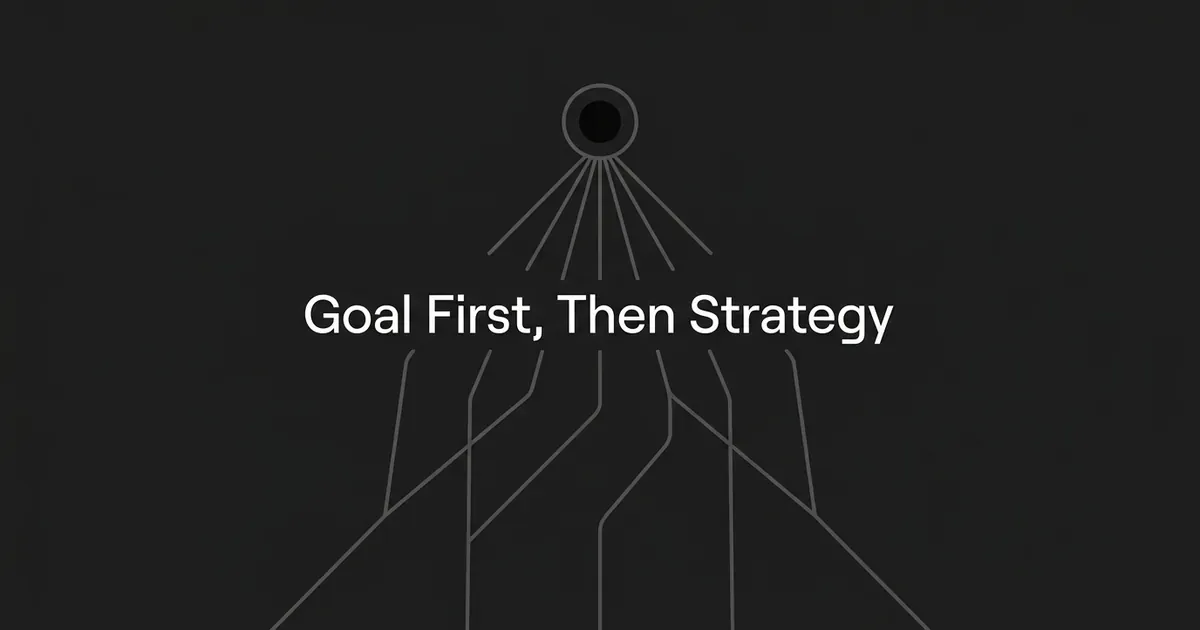
Set the goal first. Decide what business result content is supposed to move, then build the content strategy as the plan for reaching it. That is the short answer to the goals vs strategy question that trips up a lot of teams: whether to lock goals before picking a content strategy, or run some content first and let the results tell you what goals are even realistic. The goal comes first, and the strategy stays open to change as you learn.
That answer needs a little unpacking, because "set goals before content strategy" does not mean freezing everything on day one. You are not required to know the exact number before you start. You are required to know what you are trying to change.
What is the difference between a goal and a content strategy?
These words get used interchangeably around a content calendar, and that is where a lot of the confusion starts. Each one does a different job.
A goal is the outcome the business wants. Growing an owned audience, generating qualified demand, supporting the sales team, keeping customers around longer, or cutting support costs are all goals. None of them describes a piece of content. They describe a change in the business.
An objective is the same goal made specific enough to act on. It adds a number, a timeframe, or a defined audience. "Grow qualified pipeline from content" is a goal. "Grow qualified pipeline from content by 20% this quarter, from marketing leads at mid-size teams" is closer to an objective.
A strategy is how you plan to get there. It covers who you are writing for, what problem you are helping them solve, which topics you will own, which formats and channels fit that audience, and just as importantly, what you will not do. Strategy is a set of choices, and choices only make sense once you know what they are supposed to achieve.
A tactic is one action inside that strategy: one article, one newsletter send, one headline test. A tactic is never a strategy by itself, no matter how well it performs.
A content plan sits below strategy. It is the calendar: what gets written, by whom, and when. The Content Marketing Institute draws this line clearly, treating the tactical layer that executes a strategy already decided.
Lined up, the chain looks like this: business goal, marketing objective, content strategy, content plan, tactics, and the metrics you watch to see if any of it worked. Skipping a link in that chain is where teams get stuck. A calendar full of topics is not a strategy. A strategy without a goal behind it is just a set of preferences, and that is the real substance of the goals vs strategy debate: each one is a different layer, not two competing starting points.
Why goals come before content strategy
A strategy is a set of trade-offs. You cannot decide which topics deserve sustained coverage, which formats fit your team, or which channels are worth the effort, without something to measure those choices against. That something is the goal.
Without a goal stated up front, a content program tends to define itself by output instead: publish more, cover more keywords, show up on more channels. Those can be reasonable activities, but they do not tell you why you are doing them, and they will not tell you when to stop doing something that is not working.
A goal also gives measurement a reason to exist. The right order is to agree on the objective first, define what result would show that objective is being met, then choose the KPIs that indicate progress toward that result, and only then pick the detailed metrics that feed those KPIs. Picking a dashboard metric before the objective is backwards. A number can make a program look measured while nobody on the team can actually say what success would look like.
This is also why strategy has to follow goals rather than sit next to them as an equal starting point. Strategy, in the classic sense, is about making choices and accepting that you will not do everything. You need a fixed point to make those trade-offs against, and the goal is that fixed point. Without it, you can produce a full content plan, and it might even look organized, but you will not be able to explain why it is the right plan rather than a different one.
How the content strategy planning sequence actually works
Once you accept that goals come first, the rest of the sequence follows in a fairly natural order.
Start with the business problem. Ask what the business is struggling with that content might help. That could be a market where nobody knows you yet, a product that is hard for sales to explain on its own, a support team fielding the same questions over and over, or customers who churn before they see the value. This step is broader than picking a topic, but narrower than deciding you should "do content."
Set an initial outcome goal. Decide what result content is expected to move: a bigger owned audience, more qualified demand, easier sales conversations, better retention, lower support load, or traction for a new product. You do not need a perfectly confident number yet. A directional goal, stated plainly, is enough to start.
Define the audience and the problem they have. With the goal in place, figure out who you actually need to reach to move it, what they are stuck on right now, where they are in their buying journey, and what you want them to do after reading. This step does not compete with setting the goal first. It makes the goal realistic instead of theoretical.
Choose the strategy. This is where you decide the actual shape of the work: the audience and their priority problem, your point of view on it, the topics you will own consistently, the formats you can produce well, the channels your audience actually uses, and who owns the process. This is also where you decide what you will deliberately skip, which is just as much a strategic choice as what you commit to.
Turn the strategy into a plan. Only now do you build the calendar: what gets written, in what order, by whom, and on what schedule. This is execution, not strategy, and it should feel like the easy part once the earlier steps are settled.
Run bounded experiments. Test a specific assumption inside the strategy rather than the whole thing at once. Maybe you are not sure if your audience responds better to a problem-first article than a product-first one, or whether a comparison format pulls more qualified readers than a general explainer. State what you are testing, over what window, and what result would tell you something useful either way.
That sequence, purpose, goal, audience, strategy, plan, experiment, holds together because each step depends on the one before it. It is the content strategy planning sequence in practice, not a theory: jump straight to a content plan without a goal, and you end up defending a calendar you cannot explain.
How experiments should change the plan, not the goal
Here is where the "let content inform the goal" instinct comes from, and it is not entirely wrong. It is just aimed at the wrong layer.
It helps to think about content planning as three levels held at different degrees of firmness. Business direction, the underlying problem or opportunity you are solving for, should stay fairly stable unless something changes in the business itself. The strategic hypothesis, your beliefs about audience, message, format, and channel, is meant to be tested and revised. Tactical execution, the individual pieces and headlines and calls to action, should be the most adjustable of all.
Experiments are built to shake the bottom two levels, not the top one. A weak result usually means the audience, message, format, or channel needs adjusting, not that the underlying business goal was wrong to begin with. If a piece underperforms, the more useful question is whether it reached the right reader with the right proof, not whether qualified demand was ever a legitimate goal.
Experiments can absolutely change the target attached to a goal. If your first number was a guess based on thin historical data, new evidence should update it, up or down. What experiments should rarely touch is the underlying business direction itself. That only moves when something changes in the business: a shift in market conditions, a new product, a change in what leadership actually needs content to do. A single underperforming article is not that kind of evidence.
The practical version of this rule: hold the outcome steady long enough to learn something real from it, but hold the route to that outcome loosely enough that you can change it the moment evidence says you should.
Where the goals-first rule breaks down
None of this means the goal has to arrive fully formed and permanently fixed.
You do not need a precise number on day one. Early-stage teams often lack a reliable baseline. "Build qualified demand among a specific audience" is a fine starting direction even without a confident forecast attached. Pair it with a clear learning objective (what you need to find out before you can set a tighter number) and let early evidence sharpen the target over time.
The strategy is not a document you write once. Mission and business goals tend to hold steady, but the audience definition, topics, formats, and channels are meant to be revisited on a cadence. Reviewing and adjusting is normal maintenance, not a sign the original plan failed.
Not every goal has to end in a last-click sale. Content can contribute at different points in the customer relationship. Growing a newsletter list, helping a prospect self-educate before a sales call, or reducing repeat support tickets can all be legitimate goals, as long as you can say what business result they are meant to support. The problem is not an intermediate goal. The problem is a decorative one, like counting pageviews with no story for what those visits are supposed to change.
A slow start is not proof the goal was wrong. A weak early result can come from the wrong topic, a message that missed, a format the audience did not want, a broken conversion path, or simply not enough time for the channel to show a signal. Work through those possibilities before deciding the goal itself needs to change.
Vague goals cause a version of the same problem from the other direction. Brand awareness and education are common goals on paper, but they are hard to measure and even harder to defend in a budget conversation unless you attach them to something concrete: awareness meant to drive branded demand, or education meant to shorten the path to purchase. Name the business change the vague term is standing in for, or replace it with one that already names it.
What to do next
If you strip this down to something you can actually run, it looks like a short chain rather than a formal document:
- Business outcome. What result does the business actually need to move?
- Content's contribution. What part of that result can content realistically influence?
- Audience. Whose understanding or behavior has to change for that to happen?
- Strategic choice. What will you focus on, and what are you willing to skip?
- Evidence. What result from your first pieces would tell you the strategy is working?
- Adjustment rule. What evidence would change the tactic, the strategy, the target, or the underlying goal, and which of those is it likely to be?
Working through that chain protects the part of your time that should not get eaten by production. Once the goal and the strategy are settled, the writing, linking, formatting, and image sourcing are the part you can hand off. DeepSmith is built to take on that production layer once you know what it should be producing toward, tracking where you show up in AI answers and turning the gaps it finds into on-brand articles. It is not a substitute for the decision covered in this article. It picks up after that decision is made, not before. If you want to see it working with your own goal in place, you can start a free trial. None of that replaces deciding, first, what business result the content is actually for.
The sequence holds up because each step earns the next one. Goal, strategy, plan, experiment, evidence, adjustment. Not goals or strategy. Goals, then strategy, kept honest by what you learn along the way.