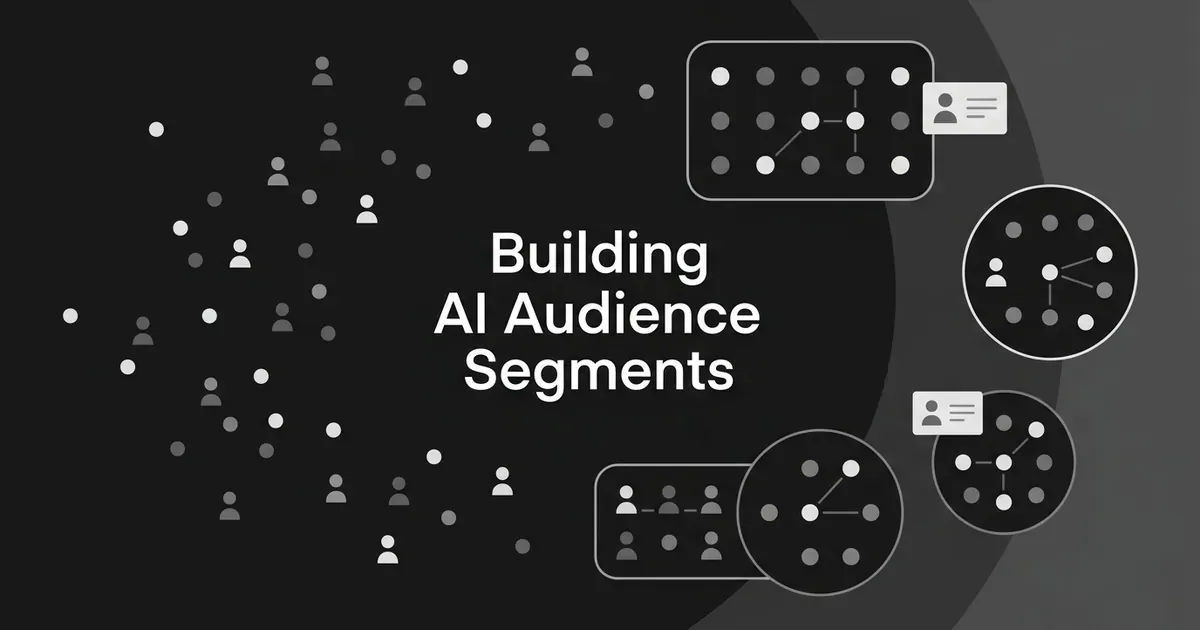
If you have ever written "marketing teams at growing software companies" on a slide and called it your target audience, you already know the problem. That sentence describes a lot of people, and it does not tell you which of them think or act differently enough to change what you build, price, or write. This guide walks through a repeatable way to use an AI target audience process to turn that kind of vague idea into a small set of testable segments and AI buyer personas, backed by evidence instead of a guess. It stays focused on the research and definition step: getting from data to a validated persona through AI audience segmentation, not on writing persona-targeted content once you have one.
Step 1: Define the decision before you ask AI to find segments
Before you open a chat window and ask for your AI target audience, write down the decision the segmentation has to support. Are you deciding which customer groups to prioritize this quarter? Which users need a different onboarding flow? Which buyer roles you should interview first? Each of those is a different question, and each one points to a different kind of evidence.
Pick a unit of analysis too: a person, a buyer role, an account, a product user, a subscriber, or a prospect. Then write one sentence stating your current audience hypothesis, something like "we believe marketing leads at small software companies are a priority audience because they need more content but cannot add headcount." Under that sentence, list what you still need to prove. Is the real dividing line team size, publishing workload, the pressure they feel from AI search, or something else?
This is where AI earns its first real job: turning your brief into a list of testable assumptions, not conclusions. Ask it to specify what evidence would support each assumption, what would contradict it, and which data source could actually test it. Do not let it invent customer facts at this stage. It has none yet.
You are done with this step when you have one decision statement, one unit of analysis, one broad hypothesis, a list of assumptions, and a plain definition of what would make two groups meaningfully different to you.
Common mistake: typing "find my target audience" into a model with no decision attached. That prompt gives the AI nothing to optimize for, so it falls back on generic demographic guesses. Start with the decision, and the evidence needed to make it, every time.
Step 2: Build a data inventory and remove unsafe inputs
Before any AI audience segmentation work starts, list what you actually have. Website analytics, CRM records, product usage data, renewal and cancellation history, email engagement, support tickets, sales win-loss notes, site-search terms, customer reviews, interview transcripts, and survey responses all count. Most teams have more of this than they realize, scattered across five different tools.
For each source, write down who owns it, what date range it covers, what fields it has, what is missing, and whether it represents customers, prospects, or a mix of both. Separate observed facts from interpretations while you are at it. "Visited the pricing page three times" is a fact. "Is highly motivated" is your read on that fact, and it belongs in a different column.
Before anything gets pasted into a commercial AI tool, strip out direct identifiers and unnecessary personal details. Check the provider's terms on retention, training use, and where the data lives. Use aggregated or redacted versions wherever you can. This matters for two reasons: privacy obligations can apply to both what you enter and what the model generates about a real, identifiable person, so an incorrect inference still creates exposure even if you never meant it to.
A data dictionary is worth the hour it takes. Ask AI to review it (the dictionary, not the raw records) and flag ambiguous fields, inconsistent labels, and anything that looks like an unsafe proxy for a sensitive trait.
Pro tip: a clean spreadsheet is not the same as unbiased evidence. A CRM overrepresents sales-qualified leads. Analytics overrepresents anonymous researchers who never convert. The customers who agree to be interviewed are usually your most engaged ones. Write these limits down before you draw conclusions from the data.
Step 3: Gather direct customer evidence to explain the numbers
Numbers tell you what happened. They rarely tell you why. Once you have a data inventory, go talk to a mix of current customers, recent prospects, people who considered you and walked away, former customers, and the support or sales people who talk to all of them daily.
Ask about things that actually happened, not hypotheticals. What was going on right before they started looking for a solution. What they tried first. What made the problem urgent enough to act on. Who else got pulled into the decision. What almost stopped them. A useful starting point is three to five interviews per persona candidate, with a mix of customers and people who did not buy, though treat that as a rough guide rather than a rule carved in stone.
Once interview themes start repeating, a survey can tell you how common they are across a wider group. Keep each question specific and about one idea at a time, avoid combining two questions into one, and make sure the answer choices do not overlap or leave out an obvious response. Test new questions on a handful of people before sending them wide.
You know this step is done when you have a recruiting plan, an interview guide, a survey if you need one, and an honest note about who you did not manage to reach.
Common mistake: asking "would you buy this?" and treating the answer as if it were real behavior. People are bad at predicting their own future actions. Ask about the last time they actually had the problem, what they did about it, and what happened next.
Step 4: Use AI to clean, classify, and synthesize the evidence
This is where an AI buyer personas project usually goes wrong: someone dumps every transcript and spreadsheet into a model at once and asks for "the segments." Work in smaller, inspectable passes instead. Normalize field names, remove permitted duplicates, flag anything missing or contradictory, then pull recurring topics out of the open-ended and interview data.
Build a codebook first, with a definition, an inclusion rule, an exclusion rule, and an example for each code. A code called "trigger" might include a leadership request, a deadline, or a failure that pushed someone to act, and exclude a vague, long-running wish for something better. Ask AI to apply that codebook consistently across your material and to surface disagreement rather than smoothing it over. If two transcripts could reasonably be coded two different ways, keep both readings visible for a human to settle.
This is the kind of work AI genuinely helps with: summarizing large amounts of text, applying a codebook the same way every time, comparing groups, and flagging contradictions a tired researcher might miss on pass three. It is not a substitute for deciding what the business objective is, confirming a pattern is causal rather than coincidental, or approving a segment that will affect pricing, access, or eligibility for real people.
Common mistake: letting frequent wording pass for strategic importance. A complaint that shows up in every third transcript feels significant, but a rare, high-value objection from your biggest accounts can matter more than a common, low-stakes preference.
Step 5: Generate candidate segments from evidence, not stereotypes
With coded, traceable evidence in hand, ask AI to propose a small number of candidate segments, each one tied to variables that actually connect to your decision. For each candidate, require a name, a plain definition, inclusion and exclusion criteria, the evidence behind it, the main trigger and desired outcome, current alternatives or workarounds, and a confidence level. Leave room for an "unclear" or "mixed evidence" bucket rather than forcing every record into a tidy box.
If you are working from structured, quantitative data, clustering methods like K-means can surface groups that were not obvious from eyeballing a spreadsheet. A widely cited Microsoft customer-segmentation walkthrough uses a 28-day usage window and metrics based on recency and engagement, applies K-means, and uses the elbow method to pick a candidate number of clusters, landing on labels like Champion, Loyalist, Potential, and At Risk. That is one example of a method, not a template to copy. For a B2B marketing audience, the more useful variables might be company size, publishing workload, or how urgent the problem feels, not the metrics that happen to fit a product-usage dataset.
An algorithm finding a neat cluster is not proof the group matters strategically. Look at the resulting profiles and ask whether a person could recognize the group in the real world, and whether your team would actually act differently because it exists.
Common mistake: naming a cluster "The Busy Achiever" before proving what behavior or need that label actually represents. Start with a descriptive, evidence-based name. Add a catchy shorthand only after the definition holds up.
Step 6: Turn priority segments into evidence-backed personas
Not every candidate segment deserves a persona. Pick the ones that pass your decision tests, the ones you would genuinely treat differently, and build a profile for each. A useful persona template covers the role and context, the primary job the person is trying to get done, their desired outcome in their own words, what triggers them to start looking, their current workaround, their real objections, who else is involved in the decision, and the language they actually use.
Keep facts, interpretations, and open questions visibly separate on the page. Do not fill gaps with an invented age, income bracket, or personality type just because the template has a slot for it. A colleague who never sat in on a single interview should be able to read the persona and tell you who belongs in it, why it matters, and where the evidence behind each claim lives.
Once a persona has been through this review, it needs a place to live that does not depend on one person's memory. This is a natural fit for Deep IQ, DeepSmith's structured store for brand and buyer context: it holds the persona's goals, triggers, requirements, and challenges as data that every other module, from opportunity ideas to draft generation, can reference. Deep IQ is a home for the validated understanding your research produced, not a substitute for doing that research in the first place.

Common mistake: producing a persona card that reads well but has no operational teeth. A persona with no trigger, no decision criteria, and no evidence attached to it is a character sketch, not a research tool your team can act on.
Step 7: Validate segments against behavior and direct feedback
A segment is not proven just because it sounds coherent in a document. Test it against actual outcomes: conversion rate, product adoption, renewal, support volume, sales-cycle length, or trial activation, depending on what the segment is supposed to predict. Watch for circular logic here. If you built a segment directly from engagement data, that same engagement data cannot also be the proof the segment works.
Go back to real customers and ask whether the description matches their situation, including people who sit right on the border between two segments. Turn your interview themes into survey questions and check whether the pattern holds across a wider sample, without asking people to simply agree or disagree with the label you gave them. Ask sales, support, and customer success whether they recognize the segment in their day-to-day conversations, and dig into any disagreement between their read and the AI's classification.
If you have historical data available, hold some of it back and check whether the segment still predicts the outcome you built it for on a later period or a separate sample. A segment that only worked on the data used to create it is not validated, it is described.
Once you have a defined, documented audience hypothesis, DeepSmith's AI Visibility can act as one more outside check: its Discover Prompts feature generates a starter set of buyer questions from your product, persona, and buyer-stage context, so you can compare what your persona would plausibly ask against the prompts you are actually tracking in AI search. That comparison is useful context, not proof your persona is right. It works alongside customer research and behavioral testing, not instead of them.
What weak validation looks like: asking only internal stakeholders whether a persona "feels right," treating a model's confident tone as statistical confidence, or using one convenient customer group as a stand-in for the whole market.
Step 8: Govern, document, and refine the model over time
Treat your segments and personas as living documents, not a one-time deliverable. Revisit them when customer behavior shifts, when pricing or the product changes, when a segment stops predicting what it used to, or when your tracking definitions change underneath you. A reasonable cadence for most teams is a quarterly check-in with a fuller refresh at least once a year, plus an immediate look after any major change to the market or the product.
Keep a version history: what the definition used to say, what changed, what evidence drove the change, who approved it, and when it is due for another look. Score each segment on things like evidence strength, distinctiveness, measurability, and validation status rather than asking a vague "does this still feel accurate?"
If any of this touches automated classification of real people, keep the human able to inspect the evidence, challenge a conclusion, and reject a segment outright. Use only the data you actually need, set a retention period, and check for bias or inaccuracy in how the model is treating different groups. These obligations vary by where your customers and your business are located, so treat this section as a prompt to loop in legal or privacy review, not as a substitute for it.

What to do next
Start with the decision you actually need to make this quarter, not a full audience overhaul. Pick two or three candidate personas worth the research effort, run them through steps one to seven, and store the validated versions somewhere your team can find them. If you want a structured, single place to hold that validated persona work alongside your product and voice context, you can start a free trial of DeepSmith and set it up from your own site in minutes.