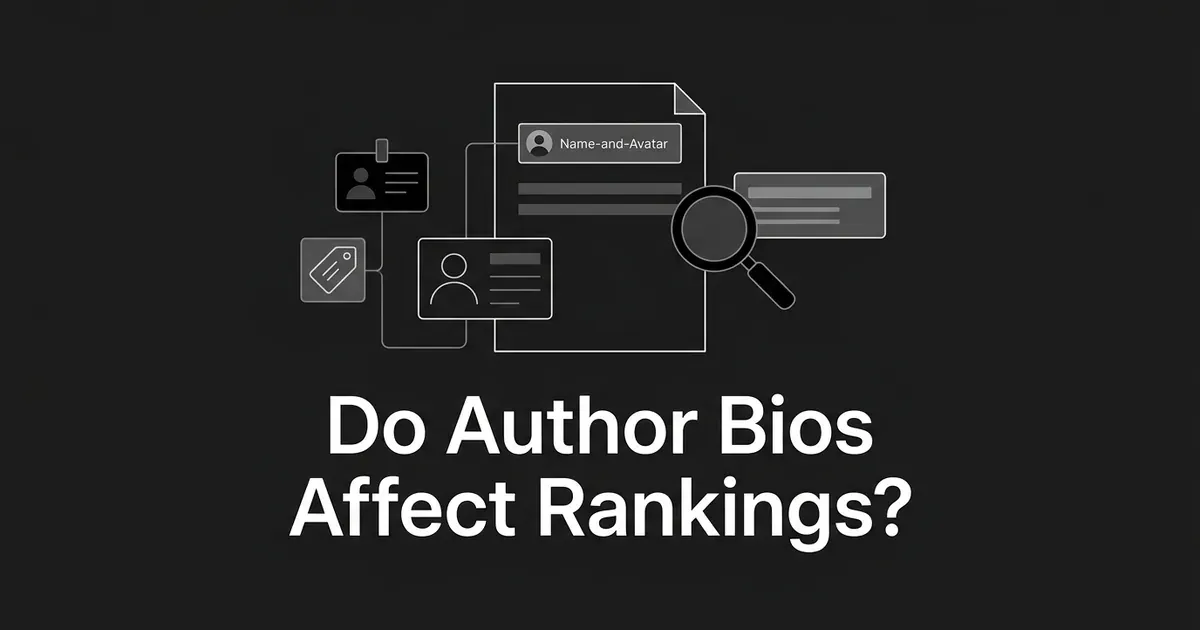
Here's the claim you've probably heard passed around a content team or a client call: add a byline, build out an author bio, maybe stand up an author archive page, and your E-E-A-T goes up, so your rankings go up. It sounds reasonable. It is also not what Google has said.
The liftable answer is this: a byline can help readers understand who wrote something, but Google has said plainly that adding one does not, by itself, improve how an article ranks. There's no confirmed ranking boost for author bios or archive pages either.
The evidence grade here is mixed on purpose. The claim that a byline is not a direct ranking boost is confirmed, straight from Google's own Search Liaison. The claim that adding a bio or an archive page raises rankings is weak at best. And whether Google's systems use author information in some quieter, undisclosed way alongside everything else, nobody outside Google actually knows. This article walks through what's confirmed, what's assumed, and what a marketing lead should actually do about author bio SEO advice that oversells its own case.
What the claim actually says, and where it came from
Google's people-first content guidance, last updated December 10, 2025, asks three questions about any given piece of content. Is it obvious to visitors who wrote it? Is there a byline where a reader would expect one? Does that byline lead somewhere, to information about the author and what they write about?
Those are reasonable editorial questions. Somewhere along the way, a lot of SEO advice turned them into a rule: add a bio, get an E-E-A-T bump, watch the rankings move. That's the leap the guidance doesn't support. Google is telling you what makes authorship clear to a human reader. It is not telling you that author pages earn points, or that Google runs a background check on your writers before it decides where to rank your article.
E-E-A-T itself, which stands for experience, expertise, authoritativeness and trustworthiness, is worth being precise about too. Google's own documentation says E-E-A-T is not a specific ranking factor. It's a framework for thinking about quality, not a score sitting somewhere in an algorithm that a templated bio nudges upward. Author identification might help a reader judge those qualities for themselves. It isn't a number you increase by publishing a headshot and three sentences of credentials.
The honest case for taking authorship seriously anyway
None of this means bylines and bios are a waste of time. There's a real, separate case for doing them well, just not the ranking case.
Google's own recommendation, restated in that December 2025 update, is that making the creator of a piece clear helps people intuitively judge its trustworthiness. That's a genuine editorial reason. Readers on a health page, a financial page, or anywhere Google applies its higher YMYL bar, "your money or your life," want to know who's behind what they're reading. A clear byline and a real bio serve that reader directly, independent of what it does or doesn't do for search position.
Google's Search Quality Evaluator Guidelines, dated September 11, 2025, back this up from a different angle. They instruct human evaluators to look for information about who created the main content of a page, unless there's a good reason for anonymity. For well-known creators, evaluators expect to find reputation information. But the guidelines are explicit that a lack of that information for an ordinary or lesser-known writer is not, on its own, a sign of low quality. That's an important nuance most byline SEO advice skips: not having a famous author isn't a penalty.
There's also a structural reason to get this right. Google's Article structured-data documentation recommends marking up an author's type and a URL, or a sameAs property, pointing to a page that identifies them, an about-me page, a social profile, a bio page. If that page lives on your own site, Google recommends marking it up as a ProfilePage. The stated purpose is to help Google understand who the author is and, potentially, present that information in search. It is not framed as a ranking lever. It's closer to giving Google (and a reader) a clean, unambiguous answer to "who wrote this," which is useful on its own terms.
John Mueller made a similar point back in June 2020, discussing content where readers need to be able to trust the source. An author page, he said, can make sense for building that trust. He also pushed back on the idea that such pages are universally essential or some kind of technical fix you install to satisfy Google. Read that as a reasonable, human-scale recommendation, not a confirmed ranking mechanism.
What Google has said directly, and it isn't subtle
If the case above sounds like it's building toward "so add the bylines and watch your rankings climb," the next set of statements closes that door.
On January 8, 2024, Search Liaison Danny Sullivan said this almost exactly: author bylines aren't something you do for Google, and they don't help you rank better. They're something you do for your readers. He added an important qualifier, that publications using bylines may also happen to have other characteristics ranking systems associate with useful content. That's a correlation, not a cause, and he was careful to say so himself.
A few days later, asked directly whether Google somehow checks a writer's credentials as part of general ranking, Sullivan rejected that framing outright. Google does not verify a person's degree, employment history, or professional license as some kind of ranking prerequisite. And when asked point blank whether someone should add an author bio specifically to rank better, his answer was a flat no. His stated reason for having a bio at all was that a publication's readers might expect one, which is the reader-facing case again, not a technical one.
John Mueller gave the same answer on archive pages back in January 2022. Someone asked whether noindexing an author's archive page would lower their "E-A-T score." Mueller's response was that Google doesn't have an E-A-T score to lower in the first place. He said removing an unimportant archive, or trimming unnecessary markup, was fine in that person's specific case. But he also flagged the other side of it: a collection of one author's work can be genuinely useful if people are actively searching for that author by name. That's not a blanket instruction either way. It's a judgment call about whether the archive itself is useful to someone.
What the primary documentation actually establishes, and what it doesn't
It helps to separate what Google's own pages say from what gets repeated about them. Here's the shape of that gap across the four documents most often cited in author bio SEO discussions.
Google's people-first content guidance supports clear attribution and informative bylines where readers would expect them, and it frames E-E-A-T as a way to help assess content, not as a ranking input on its own. What it does not establish is a required bio format, a universal rule that every page needs a named byline, or a numerical E-E-A-T score baked into ranking.
The Search Quality Evaluator Guidelines support context-sensitive evaluation of who created something and their reputation, with real allowance for lesser-known creators and legitimate anonymity. What they don't establish is a rule that every author needs a public professional profile, or that an evaluator's judgment translates into a measurable ranking weight for an author page.
The Article structured-data documentation supports identifying the author clearly through markup, so Google can understand who they are and potentially present that information. It has no required properties and does not guarantee any feature will actually show up in results from adding it. It's an identification tool, not a promise.
The ProfilePage documentation recognizes a news-site author page or a blog's about-me page as a valid use case for that markup type. It doesn't require every contributor to have a dedicated archive, and it doesn't promise that archive will rank for anything.
Put together, there's a clear pattern here: Google's guidance keeps describing what makes authorship legible to people and to its own systems, and industry advice keeps translating "legible" into "ranks better." Those are different claims, and only one of them has anything backing it.
Author archives are a different decision than bylines
It's worth separating these two things because they get lumped together constantly. A byline answers one question: who wrote this specific article? An archive page answers a different one: show me everything this person has written.
Mueller's 2022 answer on this was specific to the case in front of him, a fairly unimportant archive that probably wasn't worth indexing. He wasn't handing down a rule that archives never matter. If people search for a specific author by name and land on a page that collects their work, that page is doing something useful, independent of anything it does for the individual articles listed on it.
The practical takeaway for a marketing lead is to treat an author archive as a navigation and identity feature for your actual readers, not as a required SEO asset you build for every contributor on principle. Whether a given archive earns enough author-name searches to matter is going to be specific to your site and your writers. There's no universal traffic threshold in anything Google has said publicly.
The verdict, and what changes for your team
Here's where that leaves a byline SEO decision in practice. If your readers benefit from knowing who wrote something, and on most topics they do, make that clear. Give them a real bio with real, relevant context, not a padded list of credentials designed to look impressive to an algorithm. That's a reasonable editorial standard on its own, separate from anything to do with rankings.
What the evidence does not support is treating author bios as a lever you pull for position. If a business case in front of you depends on the idea that adding fifty templated bios or a batch of author archive pages is going to mechanically move your rankings, that case isn't backed by anything Google has actually said. Sullivan and Mueller have both addressed this directly, more than once, and the answer each time has been some version of no.
There's a narrower point that matters here too. "No confirmed direct boost" is not the same claim as "Google can never use anything about an author, ever." Google has denied the specific byline-as-ranking-boost claim. It hasn't published every detail of how its systems weigh every possible signal. The honest position sits between those two extremes: build clear, trustworthy authorship because your readers deserve it, and don't sell it internally as a ranking tactic, because the people who'd know have said it isn't one.
What would change this verdict is either a direct statement from Google reversing its own position, or credible, isolated evidence tying an authorship element specifically to a ranking change, separate from everything else a well-run publication tends to do at the same time. Neither exists right now.
If clear authorship is something your team keeps circling back to without a system for it, that's less an SEO problem and more a production consistency one. DeepSmith keeps author and brand context in one place so every piece a team publishes carries the same accurate attribution without someone rebuilding it article by article. You can try it with a 7-day free trial.