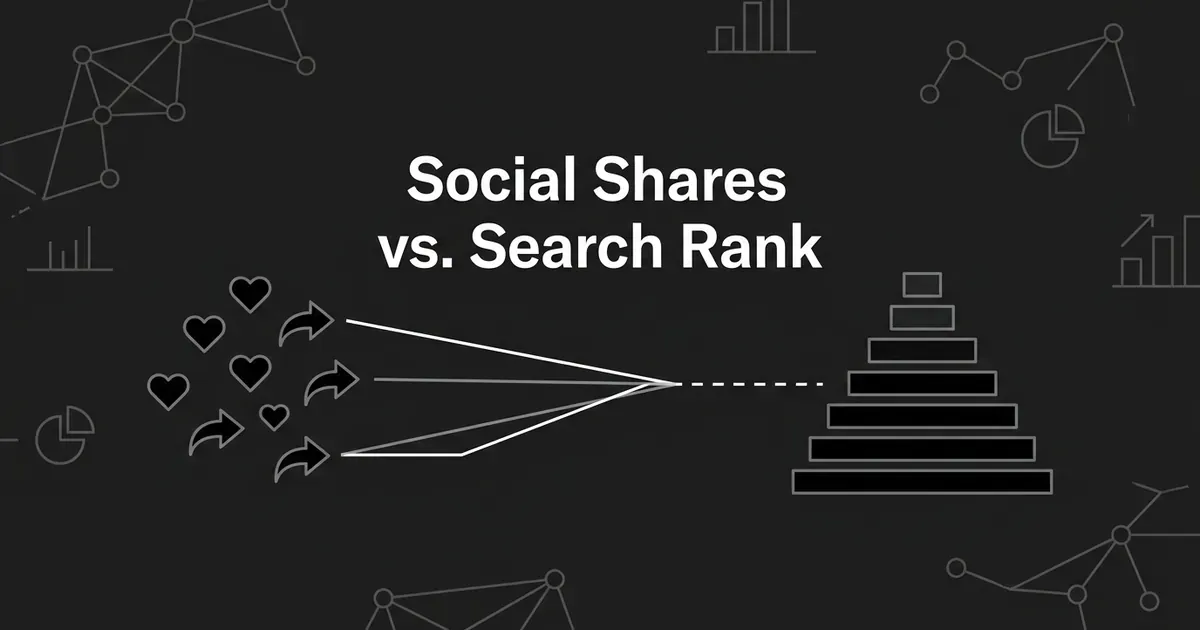
If you have ever justified a social media budget with "it helps our SEO," you have probably run into someone who pushes back on that, usually by asking whether a social media ranking factor Google actually uses even exists. Here is the honest answer. Google's own public statements and the research the industry has produced over the last decade do not support treating likes, shares, or tweets as a social signals ranking factor in the direct, algorithmic sense. The grade on that specific claim is strongly supported, meaning the evidence against a direct engagement-count mechanism is solid. What social distribution can still do is get your content in front of more people, some of whom visit it, and some of whom link to it the ordinary way. That is a different thing from Google counting your shares and nudging your rank for it.
This matters because the two claims get collapsed into one all the time. "Social helps SEO" sounds like a single fact. It is actually a bundle of four separate outcomes: social engagement, referral traffic, search discovery, and search ranking. Moving one does not automatically move the others, and most of the debate's confusion comes from treating them as interchangeable.
Why social signals became an SEO ranking debate
The debate has a real starting point, and it is not the denial most people remember. In December 2010, Barry Schwartz reported on Search Engine Land that Google was using social signals, mostly inside its real-time search index, while studying whether to expand that into broader web search. That statement is a genuine historical fact and it should not get erased just because it makes the later story less clean.
Then, in April 2011, Rand Fishkin published an analysis on Moz looking at the top 30 Google results for over 10,000 searches run shortly after the Panda update. Facebook shares showed a notable positive association with better rankings, and that association held up even after controlling for one measured link metric. Twitter's association weakened considerably under the same control. This study gave the industry its first real data point, and it is the reason "social signals affect rankings" became a standing assumption rather than a hunch.
From there, the debate ran for most of a decade across different companies, different platforms, and different methods. Moz repeated the correlation study in 2013 and again in 2015. cognitiveSEO ran a large study in 2016. Hootsuite ran an actual experiment in 2018. Each one found some association between social activity and search performance. None of them, including the ones with the biggest samples, isolated the engagement count itself as the cause. This same correlation-versus-causation trap shows up elsewhere in SEO folklore, including the long-running keyword density myth and the question of whether dwell time actually affects rankings.
What the studies actually found
Here is the shape of the evidence, in the order it appeared.
| Study | Scope | What it found |
|---|---|---|
| Moz, 2011 (Fishkin) | Top 30 results for 10,217 searches, late March 2011 | Facebook shares positively associated with rank, even controlling for one link metric. Twitter's link was weaker and dropped under that control. |
| Moz, 2013 (Peters) | Over 14,000 keywords, top 50 results, plus a 120-person survey | Google +1s and Facebook shares were among the most correlated attributes. The author named links as a possible alternate explanation for the correlation. |
| Moz, August 2013 (Shepard) | Google+ correlation follow-up | +1 counts correlated strongly with rank, trailing only Page Authority. The article itself later clarified Google did not use raw +1 counts directly. |
| Moz, 2015 (Shepard, Peters) | 16,521 queries, over 700,000 URLs, top 50 results | Pages with more social shares tended to rank better. Moz explicitly said the study did not show whether Google used these attributes in its core algorithm. |
| cognitiveSEO, 2016 | Roughly 300,000 pieces of content across 34,000 keywords, positions 1 to 10 | Greater social activity associated with better rankings overall, but Pinterest broke the pattern and the Facebook relationship did not hold for longer content. |
| Moz, 2016 (Kim) | 1,000 pages, engagement rate vs. normalized click-through rate | Content with strong social engagement often performed well in search too, but engagement rate is not a share count, and click-through rate is not rank. |
| Hootsuite, 2018 ("Project Elephant") | 90 articles split into control, organic, and organic-plus-paid groups over about a month | The promoted groups showed a positive relationship between engagement and rank changes, even after accounting for new referring domains. |
Notice what each study is and is not. The Moz and cognitiveSEO studies are correlation studies: they take a large snapshot of search results and check whether social numbers and rank move together. A correlation study can show that two things tend to happen at the same time. It cannot, by itself, tell you which one caused the other, or whether something else caused both. Moz's 2015 ranking factors study ran at an even larger scale and found the same pattern.
The Hootsuite study is different. It assigned articles to groups and measured a change over time, which is a stronger design than a snapshot. But even here, promoting an article changes exposure, visits, and the chance of earning a new link, all at once. Removing cases where referring domains changed helps rule out one explanation, but it does not isolate the engagement count as the one factor that moved the needle. One publisher, one platform, and a month-long window is a useful data point, not a universal law.
Also worth separating cleanly: the widely cited 7 percent figure from the 2013 Moz study was a survey result, 120 SEOs rating how important they personally believed social signals to be. It was never a measurement of how much weight Google's algorithm actually assigns, and treating it as one is a common way this debate gets misquoted.
What Google actually said
Set the studies aside for a moment and look only at what Google itself has said about whether a social media ranking factor Google uses even exists, in order, because the timeline matters here more than almost anywhere else in SEO.
December 2010. Google confirmed, through Matt Cutts, that it was using social signals, mainly within real-time search, with other uses under study. This is a real affirmative statement from Google, and "Google has always denied using social signals" is simply inaccurate as a summary of the full history.
January 2014. Barry Schwartz reported Cutts explaining that Google did not give Facebook or Twitter pages special treatment, and that the specific likes-and-tweets-counting approach people assumed was happening was not. He also pointed to a practical problem: access to those platforms could be blocked or restricted, and the people and relationships behind a like or follow could change between one crawl and the next, which makes that kind of signal unreliable to depend on even if an engine wanted to.
2015. John Mueller said directly that social signals do not help rankings. That statement has been consistently reported since, including in a later Search Engine Journal review.
Read together, those three data points tell a coherent story. Google used some social information in a narrow, specific product context in 2010, moved away from relying on engagement counts, and has said plainly and more than once since 2014 that it is not using likes, shares, or tweets as a ranking input. The 2010 statement is a real part of that history. It just does not generalize forward the way people sometimes assume.
One more thing worth separating out: a social media page showing up in Google results is not the same claim as a website getting a ranking boost from its engagement numbers. Cutts's 2014 explanation was about the second claim. Facebook and Twitter pages getting indexed and ranked like any other web page is the first, and unrelated, phenomenon.
Why correlation does not identify the ranking mechanism
If the studies keep finding an association and Google keeps saying there is no mechanism, both things can be true at once. A few explanations do the real work here.
Shared causes. Content that is genuinely useful, backed by an established audience, and promoted well tends to earn both social attention and strong search performance. The social number is a symptom of those advantages, not the cause of the ranking.
Reverse causality. A page that already ranks well gets found by more people, and some of those people share it. The arrow can run from search visibility to sharing just as easily as the other way around, and a snapshot comparison cannot tell you which direction it actually ran.
Mediated effects. Someone sees a post, likes what they read, and later links to it from their own site or blog post. If that page's ranking later improves, the real mechanism is the ordinary link, not the social count that got the content in front of that person in the first place. This is a plausible pathway, not a promise that any given share will turn into a link. That path also has a known failure mode: plenty of content earns links but no organic traffic, so a link earned through social reach is not automatically a ranking win either.
Measurement differences. "Social signals" has meant Facebook shares, broader Facebook activity, Google +1s, engagement rates, and referring-domain counts across these studies, depending on who ran it and when. Pooling all of that into a single number and calling it one phenomenon is part of why the debate never fully settles.
The verdict for your social and SEO strategy
Keep distributing content through social channels where your actual audience spends time. Just change the reason you are doing it. Justify the work by reach, readership, referral visits, and the chance of earning real editorial links, not by a promise that likes and shares move your Google rank directly.
Do not set an internal target like "get this many shares before it can rank." That idea has no support in any of the evidence reviewed here. High engagement is a real distribution win on its own terms. It is not, by itself, a search intervention.
Keep your reporting categories separate too. Track social engagement, referral traffic, earned links, and organic rank changes as distinct numbers rather than folding them into one blended visibility score. If a promoted article does move up in search a few weeks later, that is a good outcome worth noting, but the mechanism behind it still needs its own evidence before you repeat the tactic expecting the same result. Confirming a traffic change actually came from a Google update, rather than from a promotion you ran around the same time, is the same discipline in the other direction.
And do not buy engagement as a shortcut. Nothing in a decade of studies supports purchased likes or shares as a path to Google visibility, in either direction.
The same logic extends, with one more caution, to AI search. Google's own AI Features documentation says existing SEO practices remain relevant to AI Overviews and AI Mode, and that no special optimization is required for them. That is reassuring but limited: it does not create a separate social-engagement shortcut into an AI answer, and findings about Google do not automatically transfer to how ChatGPT or Perplexity select and cite sources, which is its own ranking versus AI citation question worth treating on its own terms. For a wider look at what's confirmed and what isn't, AI search visibility carries its own set of persistent myths that are worth checking against the same evidence standard used here.
A quick gut check before closing: if someone on your team still treats this as a settled social signals ranking factor, point them to the 2014 and 2015 statements above. That is the strongest and most direct evidence in this review, and it has held up for over a decade without a documented reversal.
What would change this answer
This verdict is not permanent, and it should not be treated as a closed case. It would change if Google published a current, specific statement naming an actual engagement metric and search surface it uses, or if independent researchers ran repeated experiments that isolated engagement counts while controlling for exposure, link acquisition, and the other explanations above. A single large correlation study, however big the sample, would not be enough on its own: that is exactly the kind of evidence this debate has already run through several times.
Until then, the more useful question for a marketing team is not "does this post need enough likes to rank," but "is this a channel worth the time for the readers it actually brings." That's a question you can answer with your own numbers, and it does not depend on anyone resolving Google's internal algorithm first. If you want a closer look at how distribution, promotion, and amplification differ in practice, that terminology is worth untangling on its own before you build a strategy around any of them, and if a piece you published is quietly going nowhere socially, the common distribution mistakes behind that are usually easier to fix than the ranking question ever was.
So, do likes and shares affect SEO at all? They affect the parts of SEO that run through people, reach, and links. They do not affect the part that runs through Google counting the numbers directly, and that distinction is the whole answer.