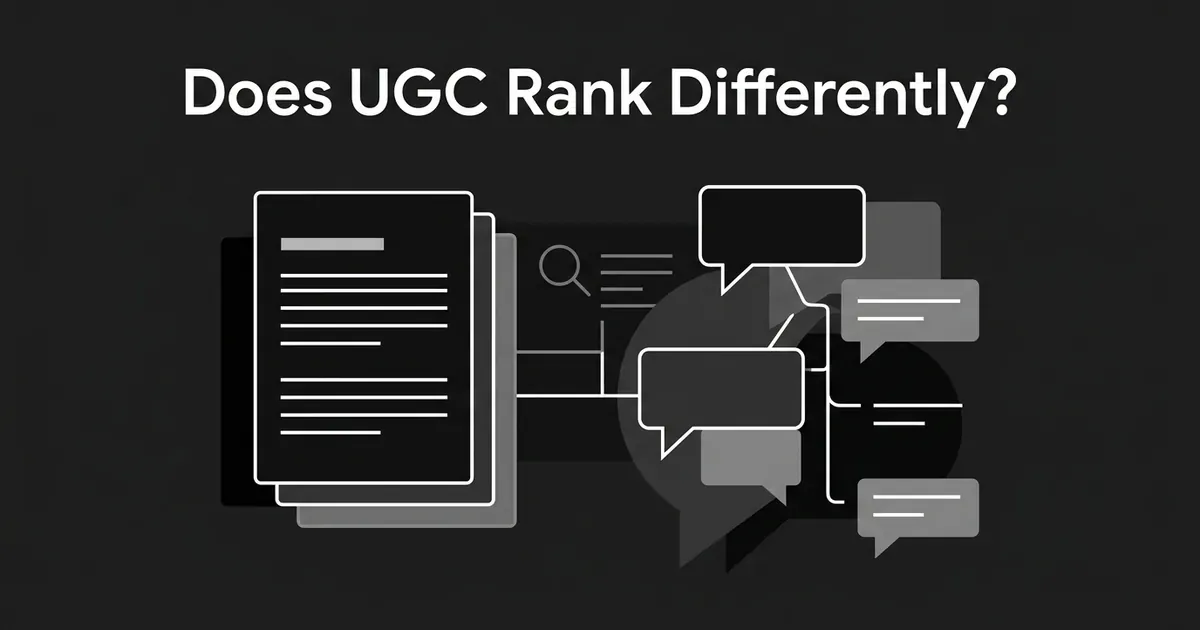
The claim shows up in planning meetings a lot: forums, customer reviews, and comment threads get some kind of ranking edge on Google just because users wrote them, so maybe the smart move is to build a community instead of paying writers. The evidence for that blanket claim is weak. Google does not document a general UGC ranking factor, a bonus or a penalty tied to the simple fact that a user, rather than a staff writer, typed the words. What Google has confirmed is narrower: real ranking improvements meant to surface more firsthand perspectives, a dedicated search feature for discussions, and a few places where it treats content types differently on purpose. Call the overall evidence grade mixed, leaning toward "no universal rule" with some real exceptions worth knowing.
The useful question underneath the myth is not which label wins. It's whether a piece of content gives a searcher what they actually came for.
What does the claim that UGC ranks differently actually mean?
User-generated content, or UGC, is anything a site's own users contributed: forum posts and replies, customer reviews, comments under an article, user-uploaded photos or videos. Editorial content is what the publisher wrote or commissioned under its own process. The claim being tested is whether Google's ranking systems give the first category different treatment than the second, purely because of who typed it.
That's a narrower question than it sounds. A page can be both things at once: an editorial article with a long, substantive comment thread underneath it is not cleanly "UGC" or "editorial," it's both, sitting on the same URL. And a site cannot assume that user contributions sit outside what Google actually evaluates. Google's own Creating Helpful, Reliable, People-First Content guidance, last updated October 5, 2026, says forum discussions, customer reviews, comments, and user-uploaded media can all count as a page's main content when they genuinely fulfill the page's purpose. The Search Quality Evaluator Guidelines, the document Google gives its human raters, defines main content the same way: by what it contributes to the page's goal, not by who wrote it.
That matters because "does user generated content rank differently" is really two questions wearing one sentence. One is about ranking: does the format itself move a result up or down. The other is about presentation: can a page show up in a discussion-specific search feature or a rich result. Evidence for one doesn't automatically answer the other, and most of the confusion around this topic comes from treating them as the same thing.
What evidence supports preferential treatment for UGC?
The strongest real evidence here is about firsthand experience, not UGC as a category.
In December 2022, Google added Experience as a fourth letter to what had been E-A-T, now E-E-A-T, in its quality rater guidelines. Its own example is worth sitting with: for correctly filling out a tax return, a reader probably wants content from an accounting expert. For choosing between tax-prep software, that same reader might get more value from a forum thread of people who have actually used the competing products. The lesson there isn't "forums beat articles." It's that the right kind of evidence depends on the task, and personal experience is one kind.
Google acted on that distinction with actual product changes. In September 2022, it announced "Bringing more voices to Search," a new Discussions and forums feature meant to surface diverse personal experiences for queries that could use them, starting in English on mobile in the US. In May 2023, it went further, saying it would focus more on content with unique expertise and experience, wherever that showed up: a forum comment, a small blog, an expert article. By November 15, 2023, Google confirmed the follow-through in plain language: "we've also rolled out a series of ranking improvements to show more first-person perspectives in results." That's a documented, dated ranking change, not just a new box on the results page.
What it doesn't establish is a universal bonus for the UGC label itself. First-person perspective is an informational quality. A customer forum post can have it. So can a professionally written article from someone who actually used the product being reviewed. The ranking improvement rewards the perspective, not the fact that a user rather than a staff writer supplied it.
What evidence argues against a blanket UGC ranking factor?
The oldest and most-cited data point here is a 2020 statement from Google's John Mueller, reported by Search Engine Journal: "Overall, Google doesn't differentiate between content you wrote and content your users wrote. If you publish it on your site, we'll see it as content that you want to have published. And that's what we'll use for ranking." His advice at the time was practical: make sure the UGC on your site meets your own publishing standards, because Google is going to treat it as part of what you published.
That's an older statement, worth treating as a dated data point rather than a full description of the current system, but current documentation backs the same basic idea: user contributions are not automatically outside ordinary content evaluation just because a user supplied them. If you're searching for forum content SEO advice that promises a shortcut here, this is the part of the picture that advice usually skips.
The other reason a blanket UGC advantage doesn't hold up is that E-E-A-T, the framework people reach for to explain it, is not itself a ranking factor. Google's own people-first guidance says plainly that raters do not control rankings, and their assessments are not fed directly into the ranking algorithm. E-E-A-T describes a mix of factors that can help identify content worth trusting; it is not a score, and it is not a lever that favors one authorship format over another.
So the honest middle ground is this: Google does not say every forum post or review outranks every article, and it does not say the reverse either. What it has confirmed sits in between, narrower than the myth, but real.
Where does Google explicitly treat content types differently?
This is the part worth knowing in detail, because it's where the genuine exceptions live.
The reviews system excludes third-party user reviews. Google's documentation for its reviews-focused ranking system says it evaluates articles, blog posts, and similar first-party standalone content written to give a recommendation, opinion, or analysis, and explicitly states: "It does not evaluate third-party reviews, such as those posted by users in the reviews section of a product or services page." That's a real, documented difference in system scope between an editorial review and a customer review left on a product page. It does not mean customer reviews are ignored by Search altogether, favored, or disqualified from every other quality check. It means one specific evaluation system has a defined boundary, and a customer review section sits outside it.
Discussion markup recognizes a format, it doesn't reward it. Google supports DiscussionForumPosting structured data to help identify forum content and consider it for features like Discussions and Forums. The documentation is specific about scope: use it for genuinely user-generated posts, not for content primarily written by the site's own staff, and user reviews about a product are explicitly listed as an invalid use case for this particular markup. Google is just as clear that the markup doesn't guarantee a result will actually appear in that feature. Correct markup earns eligibility, not a ranking boost, and relabeling a staff-written article as a "forum post" to chase that eligibility is a bad trade: it misrepresents the page and risks running into Google's structured-data policies against misleading markup.
rel="ugc" qualifies a link, not a page. Introduced in 2019 alongside sponsored and nofollow, the ugc attribute is a hint Google can use for links sitting inside user contributions, like comments and forum posts. Current guidance lets a site stop using it for contributors who've built a track record of high-quality posts, and notes that a link bearing one of these attributes generally won't be followed for ranking purposes, though it can still be discovered another way. That's a link-level signal, not evidence of a page-wide UGC penalty or bonus.
Quality standards apply either way, and so does spam enforcement. Google's Search Quality Evaluator Guidelines distinguish satisfying discussions from superficial or low-effort ones, and from material that's actively misleading, with YMYL topics (anything touching health, money, or safety) held to a higher trust bar regardless of who wrote them. Its spam policies separately define user-generated spam, things like spammy forum posts and comment spam, as something a site can be penalized for. At the same time, those same policies name forums and comment sections as legitimate use cases that are not inherently abusive. The through-line: a comment section isn't exempt from spam rules because it's user-generated, and it isn't automatically suspect either.
A short way to hold all four together: ranking asks whether the content is useful and trustworthy for the query. Presentation asks whether it's eligible for a specific feature. System scope asks whether a particular evaluation even looks at this kind of page. Link treatment asks how a specific link gets weighed. None of the four collapses into "UGC wins" or "UGC loses."
What should content teams conclude?
If the question driving this piece for you is still simply does user generated content rank differently enough to change how you plan a quarter, the answer stays the same whether you're weighing a blog comment feature or a full community platform: don't restructure a content program around an alleged UGC bonus. The documented evidence doesn't support that shortcut, and chasing it (relabeling articles as forum posts, adding comments purely for a ranking lift, treating a review section as a traffic hack) tends to create spam and quality problems faster than it creates rankings.
Match the format to what the reader actually needs. A forum thread can genuinely be the best answer to a troubleshooting question, because the useful detail might be three replies down, from someone who hit the exact same error. A tax question probably needs an accountant, not a thread. The decision isn't editorial-versus-UGC, it's expertise-versus-experience, and the right call changes by topic.
Build firsthand evidence into editorial work on purpose. Original testing, specific numbers, and a documented process read as experience whether a staff writer or a contributor produced them. That's the part of the 2023 ranking changes that's actually actionable: the reward tracks the evidence, not the authorship label.
If you're going to publish discussion content, markup it honestly and only where it's genuinely a forum, and keep spam and quality standards on it the same way you would anywhere else on the site. And keep these as separate scorecards: organic ranking, feature eligibility in something like a Discussions box, and whether an AI engine cites the page are three different measurements. A win in one doesn't prove a win in the others.
What would actually change this verdict is a direct Google disclosure that UGC authorship by itself gets a ranking adjustment, or a well-designed independent study that isolates authorship from the things that usually travel with it: relevance, source reputation, firsthand evidence, and how a result gets presented. Neither exists in the public record right now.