Somewhere on your team, someone is probably enforcing a formatting rule they can't actually explain. One H1 per page. Never skip a heading level. Bold the keyword in the first paragraph. Every list gets at least three bullets. These rules get passed down from brief to brief until nobody remembers where they came from, and the honest answer to "does formatting affect rankings" is more complicated than yes or no.
Here's the short version. Google has said, plainly and more than once, that it uses headings and emphasized text to understand what a page is about. That's real. What isn't established is a tag-level ranking reward, where swapping H2 for H1, or wrapping a paragraph in bullets, pushes a page up the results on its own. The grade on this claim is mixed, and the two halves don't cancel each other out. They describe different things.
What "formatting affects rankings" actually means
The phrase hides at least three separate questions, and most arguments about heading tags SEO happen because people are answering different ones without saying so.
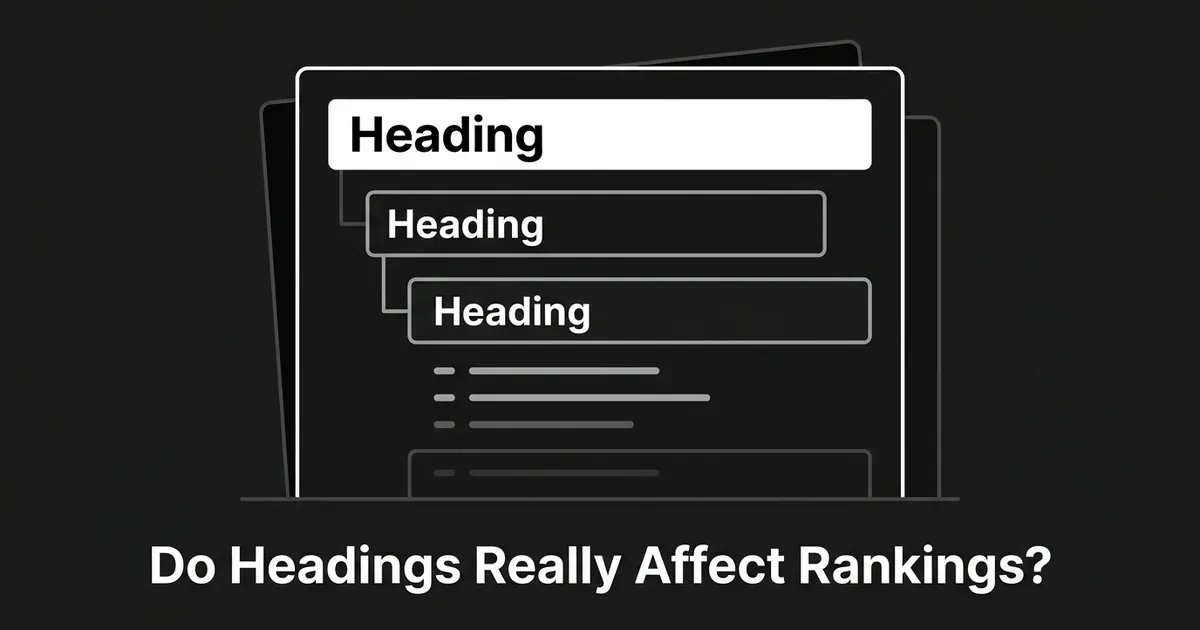
The first question is whether Google uses structure to understand content. It does. Google has explained more than once that headings help its systems figure out what a section of a page is about. That's a content-interpretation signal, and it's well documented.
The second question is whether a specific tag earns a ranking reward just for being used correctly, the kind of thing an H1 tag ranking factor checklist implies. This is the one that doesn't hold up. An otherwise identical page doesn't rank higher because it used H1 instead of H2, or because it used a bulleted list instead of a paragraph. Nobody has shown that reward, and Google's own statements point the other way.
The third question is about search-result presentation: how a title link gets built, whether a passage gets pulled into a featured snippet. These are real mechanics Google documents, but they're not proof of an underlying ranking boost. A page's title link changing doesn't mean the page moved up.
The fourth is usability. People can scan and navigate a well-structured page more easily, including with assistive technology. That's a real benefit, and it stands on its own without needing a ranking number attached to it.
Keeping these four apart is most of the work here. A signal that helps Google understand your content is not automatically a guaranteed reward for using a particular tag, and conflating the two is how a sensible practice turns into a superstition. It's also why a brief that frames heading tags SEO as a checklist item, rather than a reader-facing structure decision, tends to produce the wrong fix when a page underperforms.
What the evidence supports: headings as a signal, not a formula
Google has addressed this directly, more than once, over several years.
In October 2019, John Mueller told AskGoogleWebmasters that Google's systems weren't too picky about whether a page used one H1, multiple H1s, or styled text with no semantic heading markup at all, as Search Engine Land reported at the time. His follow-up line was blunt: it's not a secret ranking push.
In January 2020, Search Engine Journal quoted him going further: "We do use headings when it comes to search. But we use them to better understand the content on the pages." He explicitly pushed back on the idea that stuffing keywords into headings would make a page rank for those terms. Understanding content can help Google match it to the right query, which is a different claim than placing a tag earning points.
By August 2020, the framing had sharpened again. Mueller called a heading "a really strong signal telling us this part of the page is about this topic," but added that whether it's H1, H2, or H5 "doesn't matter so much," and that headings aren't Google's only ranking factor anyway. Read that whole statement together and it says something fairly narrow: headings carry topical information, not a hierarchy where H1 is worth more points than H2.
Google's SEO Starter Guide backs this up directly. It says semantic heading order is valuable for screen readers but doesn't matter from Search's perspective, and that there's no magical, ideal number of headings to use. The guide does recommend breaking content into sections with headings so people can navigate it, which is a usability instruction dressed up as a ranking tip less often than it should be.
None of this says headings do nothing. It says the thing they do is help Google figure out what your content covers, which is worth taking seriously on its own terms rather than as a workaround for a ranking formula nobody has confirmed. That's the part of heading tags SEO advice that's actually grounded in something Google has said, repeatedly, in its own words.
What challenges the H1 ranking-boost claim
If headings carried a tag-level reward, changing one tag while leaving everything else the same should move the needle. Someone actually ran that test.
Moz, working with Distilled's SearchPilot testing platform, split the Moz Blog's article headlines into two groups for eight weeks in a February 2020 experiment. Half kept the existing H2 markup the CMS had always used for article titles; half were changed to H1. The headline text itself stayed the same, prominent and recognizable, in both groups. Only the tag changed.
The result was a point estimate of a 6.2% uplift, roughly 6,200 extra monthly organic sessions for the H1 group, but the reported 95% interval ran from about 4,100 fewer sessions to 13,800 more. That range includes zero, so the test came back inconclusive. Moz didn't claim otherwise. The original write-up is explicit that the experiment doesn't prove H1 isn't a ranking factor either, which is the honest way to leave an inconclusive result.
That one test doesn't settle the whole question by itself, but it lines up with what Google has been saying since 2019: it can work with different heading implementations without a fixed reward attached to any one of them. A separate SearchPilot case study, published in May 2023, is sometimes cited as proof headings move rankings, and it's worth being precise about what it actually tested. SearchPilot rewrote an H2 from "Summary of Features" to "What are the Features of [Product Name]?" and measured roughly a 12% organic traffic lift over 20 days. The heading stayed an H2 the entire time. What moved was the wording and the added product name, not the tag. That's a real result, but it's evidence that changing what a heading says can matter, which is a different claim from changing which tag wraps the same words.
Those two tests aren't contradictory. They tested different things. One changed the tag and kept the words; the other changed the words and kept the tag. Treating them as the same experiment, or flattening both into "headings are a ranking factor," loses exactly the distinction that makes them useful.
What Google says about bold text and HTML lists SEO
Bold text gets an exception to the simple "no," and it's worth stating precisely because of how often it gets rounded up or down.
At a November 2021 Google SEO office-hours session, reported by Search Engine Roundtable, Mueller said Google looks at what's emphasized on a page, including headings and bolded or otherwise highlighted text, and that this can add "a little bit of extra value" because emphasis signals what a page or paragraph is about. Asked directly whether bolding important points helps SEO, his answer was yes, because it helps Google understand the paragraph. That's a real, acknowledged effect, and "formatting has zero SEO relevance" overstates the evidence just as much as "bold everything" does.
The qualifier matters as much as the claim. The value is relative within the page. If every sentence is bold, nothing stands out, and the signal collapses. Mueller also said these changes won't send a site rocketing up the rankings, which rules out treating "a little bit of extra value" as a measurable, predictable boost you can plan a quarter around.
Lists sit in a different spot. The accessibility case for real list markup is solid: W3C's guidance recommends using actual ul, ol, and dl elements for genuine lists, because some assistive technology lets users navigate from item to item or list to list. A visually bulleted row of text that isn't marked up as a list doesn't give a screen reader that same structure. That's a concrete reason to use list markup correctly, separate from any ranking claim.
What doesn't show up anywhere in Google's public documentation is a standalone ranking bonus for using ul or ol over a paragraph. No controlled test isolating list markup from everything else surfaced in this research, and the absence of that bonus isn't the same as proof Google ignores list structure when it reads a page. It just means "add bullets, rank higher" isn't something you can back with a citation, and treating HTML lists SEO as a solved, quantified lever gets ahead of what's actually been shown.
Featured snippets are a related but separate question. Google's documentation says its systems decide whether a page makes a good snippet and may elevate it, and publishers can't mark a page as snippet-eligible themselves. A well-formatted list can make a passage easier to lift into a snippet, but adding bullets doesn't guarantee one, and a snippet appearing is a presentation outcome, not confirmation that the page's ranking moved.
Does AI search change any of this?
Not in the way a lot of AEO advice implies. Google's own guidance on AI Features and AI Overviews says existing SEO best practices remain relevant, and that no additional special optimization or technical requirement is necessary to be eligible. A page still has to be indexed and eligible to appear with a snippet in regular search before it can support an AI answer; eligibility there isn't a guarantee of being served or cited.
Google's generative AI optimization guide adds specifics that are worth holding onto if your team is chasing a formula: organize content for human readers, use paragraphs, sections, and headings to make it easy to follow, and there's no requirement to split content into tiny chunks or hit an ideal page length. Clear headings and direct answers are sensible editorial choices for this reason, but they aren't a confirmed citation formula, and turning every H2 into a question or enforcing a fixed paragraph count on that basis isn't something the documentation supports.
One more scope note, since it comes up often in the same breath as headings: the article HTML element specifically doesn't have a particular effect on Google Search, per Google's own office-hours transcript, though markup can still carry accessibility value beyond ranking. That answer is about that one semantic element. It doesn't generalize into "all semantic HTML is irrelevant," and it isn't the main story here either way.
The verdict: keep the structure, drop the ranking myths
Here's where the evidence actually lands, claim by claim.
| Claim | What the evidence shows |
|---|---|
| Google uses headings to understand topics | Confirmed, repeatedly, in Google's own statements |
| H1 always outranks H2 as a ranking factor | Not established; Google emphasizes meaning over tag level |
| Every page needs exactly one H1 to rank | Not a documented ranking requirement |
| Skipping a heading level hurts rankings | Not supported for Search; still worth avoiding for accessibility |
| Bulleted lists get an independent ranking bonus | Unconfirmed by any public evidence found |
| Bold text has zero SEO relevance | Contradicted; Google describes some added value from selective emphasis |
So does formatting affect rankings in any way worth planning around? The honest answer is that it affects how well Google and your readers understand a page, which is worth planning around on its own terms. The practical move for a marketing lead isn't to abandon formatting standards. It's to keep the ones that serve a real purpose and drop the approval gates built on an invented one. Keep a recognizable main heading and a logical subsection order underneath it. Write headings that actually describe what's below them rather than generic labels like "Overview." Use real list markup for things that are genuinely lists. Use bold selectively, on the point that actually matters in a paragraph, not as a keyword-coverage exercise.
Stop blocking publication over a heading sequence that fails an SEO formula nobody can cite, a page with "too few" H2s, or a draft where every target phrase isn't bolded. Those are the gates built on the unconfirmed half of this claim, and they cost editorial time without a documented payoff. If a draft's structure genuinely confuses a reader or buries the main point, that's a real problem worth fixing. It's just a different problem than "the tag is wrong."
What would change this verdict is new, current evidence that isolates a tag or markup choice from everything else, wording, prominence, surrounding content, and shows a repeatable effect with the sample size and uncertainty reported. That hasn't shown up yet. Until it does, the honest instruction to give a writer or a freelancer is to format for the reader and for accessibility, and let the ranking chips fall where Google's own statements say they fall. Whether an H1 tag ranking factor exists in some undisclosed form isn't something anyone outside Google can confirm, so plan your editorial standards around what's documented, not around what the gap in the public evidence might be hiding.