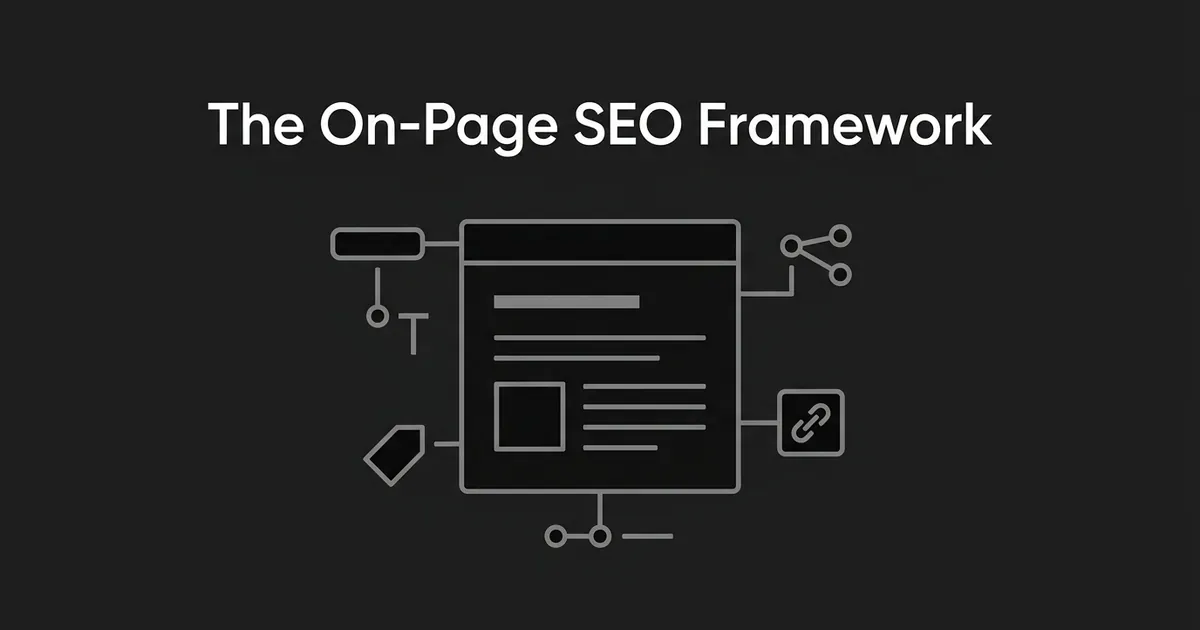
On-page SEO is the work of improving a page's content and the elements that sit directly on that page, so search engines can understand what it's about and people can recognize it, use it, and trust it. That's the whole definition. Everything else in on-page SEO is just a list of the pieces that belong to it: the writing itself, the title and headings, the description that might show up in search results, the images, the links on the page, and a few other page-level signals.
If you're a marketing lead trying to figure out where your editorial review time actually belongs, this is the map. Not a checklist to run through line by line, and not a ranking of which element beats which. Just a clear picture of what on-page SEO contains, so you can tell the difference between work that matters and work that's really just tidying up.
People use "on-page optimization" and "on-page SEO" to mean the same thing, and this piece does too. Either way, the idea is the same: the set of changes you can make directly on a page, as opposed to changes to the site around it or to how other sites link to it.
What on-page SEO actually includes
On-page SEO covers anything that lives on the page itself. That's the content and how well it fits what the reader is searching for, the visible headline and the headings underneath it, the HTML title element, the meta description, the images and their alt text, the URL, and any links you've placed on the page, whether they point to another page on your site or somewhere else entirely.
It helps to draw the line between on-page work and the two things people mix it up with. Off-page SEO is about signals that happen away from the page, mainly links coming in from other sites. A link you place on your own page pointing out is on-page. A backlink someone else points at your page is not, because you don't control it and it isn't part of the page.
Technical SEO is a different category again: whether a page can be found, loaded, and processed at all. Things like URL structure, structured data, mobile usability, and load time touch individual pages, but they're not something you fix by rewriting a paragraph. If a page can't be crawled or indexed in the first place, no amount of on-page polish will save it. Recognize where that boundary sits and hand technical problems to the people who own them.
Then there's search intent, which isn't a category of elements so much as the thing on-page SEO is supposed to serve. A page can use the exact right words and still fail if it answers a different question than the one the reader actually asked. Someone searching "what is on-page SEO" wants a definition and a map, not a product pitch and not a step-by-step tutorial on writing title tags. Every element on this list only does its job if it's pointed at the right intent to begin with.
This is also where content optimization for search stops being a mechanical exercise and starts being an editorial one. You're not optimizing words on a page in isolation, you're optimizing the match between what a page says and what a real person came looking for. Get that match wrong and every other element on the page is working against a lost cause.
Why content and structure come first
Google's own guidance for site owners says that offering compelling, useful content is likely to influence a site's presence in search results more than anything else in its starter guide. That's not a published percentage or a formula you can plug numbers into, but it's a clear signal about where to start: the actual substance of the page outranks the cosmetic fields around it.
Content depth doesn't mean length for its own sake. Google says there's no magic word count that helps rankings, and a short page that fully answers a narrow question can do the job just as well as a long one covering a genuinely complex topic. What depth really means is covering the parts of the question that matter, with enough clarity and distinct value that reading the page actually gets someone somewhere. A page that says "on-page SEO" fifteen times but never explains how it differs from technical or off-page work hasn't earned length just because it's long.
Structure is how content becomes usable rather than just present. A clear main heading, logical sections, and headings that describe what's actually in them let a reader scan for the part they need instead of reading the whole thing top to bottom. Good headings also give Google material to work with when it generates the title link shown in results, though the exact order of your headings isn't itself something Google flags as a problem. Order them for the reader first, and the rest tends to follow.
Originality and reliability sit next to structure because they answer a different question: not "can the reader find this," but "should they trust it once they do." Rewriting what five other pages already say isn't the same as adding something to the conversation. What counts as evidence of that varies by topic. A piece on payroll software for nonprofits might need a clear explanation of the actual constraints nonprofits face; a piece defining on-page SEO needs to draw real distinctions instead of restating the same idea in different words. Where it fits, accurate information about who wrote the page and what they know adds to that trust, without needing to become a credential requirement stapled onto every article regardless of topic.
Put those three together, search fit, real substance, and reliability, and you've covered the part of on-page optimization that does the most work. Everything past this point in the framework is important, but none of it rescues a page that gets these three wrong.
Which familiar checklist rules mislead
A lot of what passes for on-page SEO advice is left over from an earlier, more mechanical version of search, and some of it actively wastes editorial time today.
A required word count is one of them. Google has said directly that content length by itself doesn't determine ranking, and there's no supported minimum to hit. A specific keyword-density percentage is another: Google's language systems can connect a page to a search even when the exact phrase never appears verbatim, and stacking a term into every sentence reads as stuffing rather than optimization. Chasing a precise H1-H2-H3 sequence for some assumed ranking bonus is a similar dead end. Order your headings for a reader working through the page, and Google's starter guide is explicit that headings out of strict semantic order aren't, on their own, treated as a problem.
Cramming an exact-match keyword into the domain or URL doesn't move the needle much either. Google says those words alone have little effect on ranking beyond how they might show up as breadcrumbs in a result. A readable URL is worth having because people can understand it, not because of any keyword trick. Bumping a publish date without making real changes to the content is another old habit worth dropping: Google distinguishes a genuine content update from a cosmetic date change meant to look fresh, and treats the second one as the trick it is.
The meta-keywords tag deserves a mention only because it still comes up: Google said back in 2009 that it doesn't use that tag for web ranking. That's a long-settled fact, not new guidance, so there's no reason to spend time filling it in. And it's worth remembering that a title or description you write is a suggestion, not a guarantee. Google generates the title link shown in results from several possible sources and usually builds the visible snippet from the page's own content, sometimes pulling the meta description instead. Write both well because they represent your page honestly, not because you're certain they'll appear exactly as typed.
None of this means titles, headings, URLs, or descriptions don't matter. It means their job is to represent the page accurately and help someone decide whether to click, not to satisfy an invented length, placement, or repetition rule that never had much evidence behind it.
How to prioritize a page's work
Not every on-page issue deserves the same attention, and the order matters more than most checklists suggest.
Start with whether the page answers the right need at all. A page pointed at the wrong question won't be rescued by better formatting. From there, the content itself: is there enough substance, explained clearly, with the right qualifications and examples, for a reader to actually get their answer? That's foundational work, ahead of anything cosmetic.
Once the substance is right, structure and accuracy come next. Are the headings organized the way a reader would actually move through the page? Is the visible title honest about what's inside? Are the claims accurate and sourced where sourcing matters? These affect whether someone can use and trust what they're reading, which puts them well ahead of smaller fields like the exact wording of a URL.
A useful gut check when you're triaging a backlog of pages: pull up each one and ask whether the problem sits above or below that line. A page that doesn't answer its question, or buries the answer under vague headings, goes to the top of the list regardless of how old it is or how many words it already has. A page that answers the question fine but has a clumsy URL or a thin meta description can wait. Content optimization for search works best when it follows that order instead of working through pages alphabetically or by whichever field is easiest to fix that afternoon.
Images earn attention when they genuinely help explain something or when people are likely to search for them directly, not as a box to check on every page. The same goes for links placed on the page: they matter because they help both readers and search engines understand what a page connects to, and descriptive link text does real work here, but that's a separate skill from the content itself. Structured data and a readable URL sit further down the list, useful when they're in place but rarely the reason a page underperforms.
And underneath all of it sits the technical layer: whether the page can be crawled and indexed in the first place, whether it loads and displays properly on a phone. That's a prerequisite, not a competing priority. No amount of on-page work fixes a page a search engine can't reach.
There's no universal formula that ranks these against each other with numbers attached, and no cross-site study proves that fixing a title tag produces a specific traffic increase. What you can measure is whether visibility, clicks, and the searches that surface your page change over time, alongside whether readers who land on it can actually do what they came to do. Treat those as ways to check your work, not proof that any single edit caused any single result: demand shifts, competitors publish, and other things move at the same time.
On-page work also isn't the end of the story once AI-driven search entered the picture. Which of these fundamentals still hold and which ones have shifted for AI search specifically is a separate question worth its own read, once you've got this map in hand. For now, the priority stays the same regardless of which engine is reading the page: make it genuinely useful and easy to follow before you spend time polishing the smaller fields around it.