Here is the honest verdict up front: featured snippets are still worth pursuing when the placement sends you qualified visits that the answer on the results page does not already replace, but there is no solid evidence of a universal traffic lift just for holding one. Call the evidence grade mixed. Some of it says a snippet is worth defending. Some of it says the click you expected never shows up. Both are true, and which one matters more depends on the query, not on the feature.
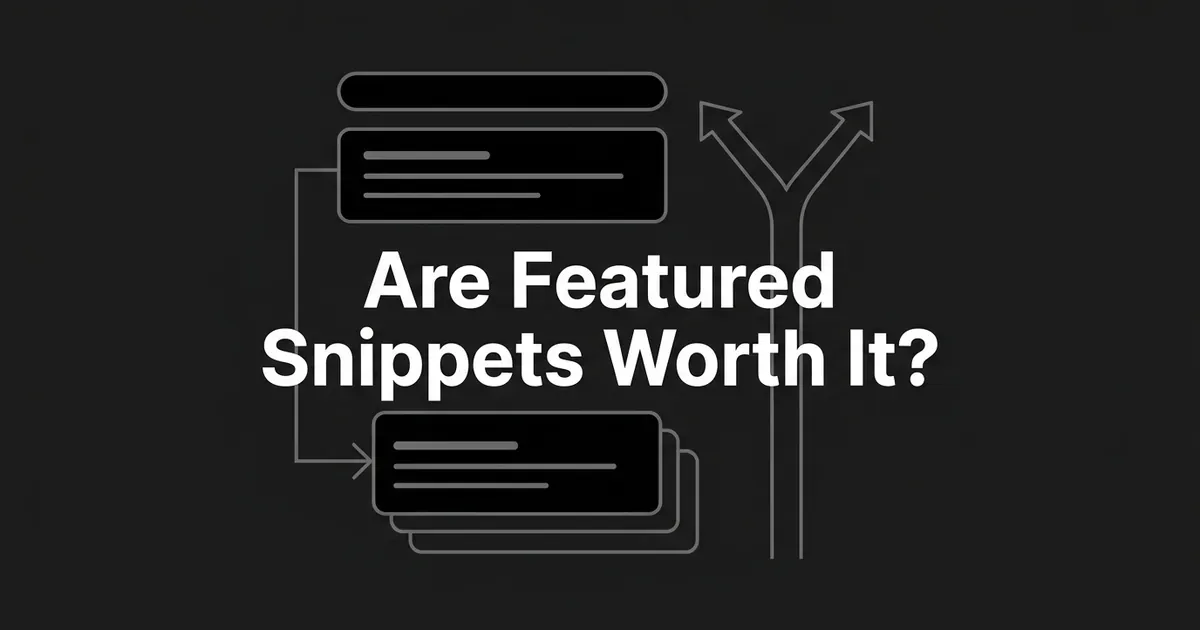
A Google featured snippet is a search result that pulls an excerpt from a page you already have live and displays it above the usual list of results, with a link back to your page. Google's own documentation describes it as flipping the normal order: the descriptive excerpt comes first, then the link, instead of the other way around. You cannot request one or mark a page to become one. Google's systems choose the source page automatically, and it can pull from a page ranking well outside the top spot to do it. Google also notes that featured snippets can show up next to Knowledge Graph panels and inside People Also Ask boxes, so it is not always the single result sitting at the very top of the page. Marketers often shorthand this top slot as position zero, since it sits above the first ordinary result, but that label describes where the excerpt sits, not any guarantee about what happens once someone reads it.
The four formats, and why the format is not the decision
You will run into four kinds of google featured snippets, and it helps to know them before you weigh whether chasing one is worth the effort.
A paragraph snippet pulls a short block of prose that directly answers the query. A list snippet displays steps or items right on the results page. A table snippet shows a compact set of values, usually for a comparison-type question. A video-associated result surfaces a clip or a relevant segment when the query calls for a demonstration rather than text.
None of these differences comes with a measured click-rate benchmark by format, so do not treat this list as a ranking of which snippet type performs best. What actually matters is how much of the searcher's task the visible answer completes. A paragraph snippet that fully answers a simple factual question gives the reader little reason to click through. A list snippet that names the steps but skips the explanation someone actually needs is a different story, because the reader still has a reason to visit. The same logic applies to a table: if the numbers on the results page finish the job, the click was never coming anyway. That crowding is part of a broader shift in how the modern SERP crowds out organic clicks across nearly every query, not just the ones with a snippet attached.
The case for defending a snippet you already hold
The strongest piece of evidence here comes from an actual traffic experiment, not a survey. In April 2020, Moz ran a split test with SearchPilot across Moz Blog pages that already held featured snippets. They marked the main content on a set of test pages with a data-nosnippet tag, which pulled those pages out of snippet consideration, and measured what happened next. The pages that lost their snippets saw roughly 12% less organic traffic, a result Moz reported at a 95% confidence level. Some of those snippets came back once the test ended, but not all of them did.
That result supports a narrow but useful conclusion: giving up a snippet you already hold can cost you real traffic, at least on the pages Moz tested. It does not mean every page that wins a fresh snippet will see a 12% lift, and it was never designed to measure that. It measured the cost of losing something you already had, which is a different question from the value of chasing something you do not.
Older case reports point in the same direction but carry less weight as general benchmarks. A STAT whitepaper dated March 2016 cites a 2015 case where a site's click-through rate reportedly moved from 2% to 8% after winning a snippet, along with a separate report of 20 to 30% more traffic while a site held one. Those numbers come from cases the whitepaper cites secondhand rather than measurements from its own analysis, and they predate a change to how Google displays snippet-holding pages on the results list, which the cannibalization section below explains. Treat them as historical color, not a return you should expect today.
The same STAT analysis did establish one durable pattern worth knowing: of the snippets in its sample, 70% cited a page that was not already the number one organic result. That sample covered one million high-cost keywords in US desktop results collected over two days in January 2016, with snippets appearing on 9.28% of the queries checked. This is a decision hint, not a quantified promise for today's results: winning a snippet from a lower starting position is generally a bigger swing than winning one when you already hold the top organic spot, because in the second case you are mostly replacing a result you already had.
The case against expecting an automatic click boost
Set against that is Ahrefs' snippet study, published May 29, 2017, which is the most cited counterweight to the "snippets are free traffic" assumption. In Ahrefs' click comparison, a featured snippet captured roughly 8.6% of clicks. The ordinary result sitting directly below it captured about 19.6%. For comparison, the first ordinary result on a results page that had no featured snippet at all captured about 26%. That click comparison drew on 100,000 keywords with at least 100 monthly searches, with paid ads and heavily branded searches excluded. The study's title references two million snippets total, but that larger number describes the scope of the snippets Ahrefs examined, not the size of the click sample, so the 100,000-keyword figure is the one that matters for the click numbers above.
Read those percentages narrowly. The 8.6% is the snippet's own average share of clicks, not a combined figure for the snippet plus a second listing from the same source. The 19.6% belongs to a different page entirely, the one sitting right below the snippet. The 26% describes a different group of results pages, the ones with no snippet at all. Ahrefs itself cautioned that snippets were not the only variable separating these query groups and that the numbers moved a lot keyword to keyword. Read together, this data says results pages with a snippet tend to keep more searches from ending in a click on any listing at all, which is consistent with more answers getting resolved without a visit. It is not a controlled estimate of how many clicks a specific site loses by winning a specific snippet. If your own traffic drops while rankings hold steady, the first move is to diagnose a CTR-driven traffic drop before blaming any one results-page feature.
It is worth being precise about what these sources do not establish. Neither Ahrefs nor any source in the current record supplies a defensible, present-day percentage of snippet impressions that end without a click. A visible answer can satisfy someone without them ever landing on your page, but the actual size of that effect for a given query is not something these studies measured, and treating an unrelated zero-click statistic as a snippet-specific number would misstate the evidence. Featured snippets predate the newer generation of AI answers, and a separate body of evidence looks specifically at whether AI Overviews are cutting organic clicks the same way.
Cannibalization: two different trade-offs, not one
"Cannibalization" gets used loosely here, and it actually covers two separate effects worth pulling apart.
The first is a snippet drawing clicks away from a competitor's ordinary listing. Ahrefs' cross-query averages illustrate the shape of this: about 19.6% for the first ordinary result sitting below a snippet, versus about 26% for a first ordinary result on a page with no snippet at all. That gap is observational, drawn from comparing two different groups of search results, not a controlled test proving the snippet alone caused the difference.
The second effect concerns your own listing, and this is the one that changed under you. Google began deduplicating the featured-snippet source from the regular first-page results in January 2020, which means a page that wins the snippet no longer automatically also keeps a separate ordinary listing on page one the way it sometimes could before. Moz's April 2020 test was built directly around that change: would giving up the snippet let the page's ordinary result climb back and recover the lost traffic, now that a second listing was no longer guaranteed? In their test, it did not. Treat cannibalization as competition between placements a page might hold, not as an assumption that a single source reliably gets both positions today the way it might have several years ago.
Google's current Search Central documentation adds one more qualification here: clicking a featured snippet can take the visitor directly to the quoted section of your page when the technology supports it, or to the top of the page when it does not. That confirms a route to your content exists. It confirms nothing about whether the person clicks, or what they do once they land.
What the primary sources actually settle
Google's own documentation is precise about a narrow set of things: what the feature is, that its systems choose which page to pull from, that it links back to the source, and what controls a publisher has over appearing in one. It makes no promise about click-through rate, conversion, or guaranteed eligibility for any page. Google's help pages also note that snippets can appear inside People Also Ask boxes, not only as a standalone top result.
Ahrefs supplies a 2017 observational comparison across different query groups, useful for understanding competition for clicks but not a causal test. STAT's 2016 figures come from a results-page prevalence analysis, not a click study, so it tells you how often snippets showed up in that sample, not how many clicks they earned. Moz and SearchPilot supply a real 2020 intervention, the most decision-relevant of the group, but it describes the cost of losing a snippet on one publisher's pages, not a universal formula for what winning one is worth.
What nobody has settled is the number that actually matters to you: the incremental qualified visits and outcomes a specific page would get from a specific snippet today, compared with whatever placement it would hold otherwise. Search layouts change, query mixes differ by industry, and a page's starting rank shifts the math. An old percentage from 2016 or 2017 is not a 2026 benchmark, and a correlation between snippet presence and click share is not proof of a fixed mechanism. This sits inside a broader pattern of impressions rising while clicks fall across many query types, not just snippet-holding ones, so a single snippet gained or lost rarely explains the whole picture on its own.
A decision rule you can actually apply
Chasing position zero is usually worth the effort when the query matters to your audience, the answer likely to appear on the results page would not fully satisfy someone's need, your page has real additional detail beyond what a short excerpt could show, and qualified visits matter more to you than the appearance of a prominent placement. The 2020 Moz result is a strong reason not to assume that walking away from a snippet will automatically recover the traffic you think it is costing you.
It is a lower priority, or arguably not worth the effort, when the query is asking for a fact your page could fully answer in one sentence anyway, your existing top-ranked result is already earning solid traffic with no evidence a different presentation would improve it, the query brings a lot of impressions but little real buying intent, or the time would clearly do more for a page tied to actual revenue. Losing potential clicks to a snippet format is a reason to check that particular query's numbers, not a blanket argument to avoid the format.
If you want a measurement frame rather than a guess, compare the same query and page's impressions, clicks, click-through rate, and any downstream action across a period when it holds the snippet and a period when it does not, while watching for other changes on the results page, ranking shifts, and seasonality that could explain the difference on their own. Search Console can show a similar pattern around AI Overviews, and knowing how to read that signature in Search Console data helps you separate the two effects instead of blaming the wrong one. Treat an uncontrolled before-and-after look as suggestive, not conclusive. What you are optimizing for is net qualified traffic and outcomes, not a snippet label sitting at the top of the page.
If you are weighing whether to actively withhold content from snippet consideration, Google gives you a few controls. A nosnippet tag blocks both the featured snippet and the ordinary search snippet for that page, which is a bigger move than it sounds. A data-nosnippet tag on specific text keeps just that text out of either kind of snippet. A shorter max-snippet limit can make a featured snippet less likely while keeping the ordinary snippet intact, but it does not guarantee exclusion, and Google has not published a universal length that reliably rules it out. Knowing these exist matters mostly because it shows opting out carries its own risk, not because withholding content is the default move. If you decide the effort is worth it, the mechanics of how to structure a page to win it are a separate, more tactical topic. A handful of answer and snippet optimization tools exist specifically to help with that structural side.
The honest summary is that a featured snippet is neither the guaranteed win the early case studies implied nor the traffic trap that low click-share numbers might suggest on their own. It is a placement worth defending once you hold it and worth chasing selectively, on the queries where the answer genuinely needs more than the results page can show.